Aisle50 was a Chicago-based digital grocery promotions platform that let CPG manufacturers fund deep discounts — often 50% or more — on their products, which consumers purchased online and redeemed in-store via their grocery loyalty card. Founded in 2010 and backed by Y Combinator, August Capital, Ron Conway, and Yuri Milner, the company raised approximately $6 million across two rounds and built a genuinely differentiated product with strong per-transaction metrics. Its core thesis — that CPG promotional spending would migrate from print newspaper inserts to digital channels — was directionally correct. But Aisle50 was ultimately constrained by the grocery industry's structural resistance to adopting new technology at scale. The company never landed a national retail partner, leaving it dependent on a patchwork of regional chains that could not generate the consumer density needed to attract major CPG budgets. Eighteen months after its Series A, Aisle50 was acqui-hired by Groupon in February 2015 — the very company it had spent years differentiating itself from — and the product did not survive the transition.
Christopher Steiner came to Aisle50 with an unusual background for a startup founder: seven years as a senior staff writer at Forbes covering technology.[1] That journalism career gave him a sharp analytical lens on market transitions, but it also meant he was entering the grocery and CPG industry without operational experience in either. His co-founder Riley Scott brought complementary skills, and a third co-founder, George Korsnick, joined as CTO — though Korsnick received almost no press coverage and his tenure at the company is not well documented.[2]
The company was originally named GrocerGoose before rebranding to Aisle50,[3] a change that suggests an early rethinking of how the product should be positioned. The founding date is itself disputed: Steiner's personal website cites 2010, while the YC database and some press sources suggest 2011.[1] The company was headquartered at 648 West Randolph Street in Chicago's West Loop.[4]
The founding insight was straightforward: the grocery industry had spent decades driving consumer demand through Free Standing Inserts (FSIs) — the coupon booklets stuffed inside Sunday newspapers. That channel was expensive, wasteful, and increasingly ineffective as newspaper readership declined. As Steiner put it at the time: "the grocery industry has been built around using major promotions to build consumer demand for ages," and Aisle50 positioned itself as the digital evolution of that system — one where a manufacturer could spotlight a single product without competing ads on the adjacent page.[5]
The team entered Y Combinator's Summer 2011 batch and debuted at Demo Day in August 2011 with a pitch that the press immediately shorthandled as "Groupon for groceries."[6] The framing was useful for investor comprehension but slightly misleading — the structural differences from Groupon were precisely what made Aisle50's model interesting.
The early days at YC were characterized by the kind of scrappy hustle the accelerator is known for. In a 2017 essay for FundersClub, Steiner described making a popsicle-stick explainer video to pitch CPG brands, road-tripping across the Midwest to get meetings with Kellogg's, and eventually landing Chobani as their first client — a breakthrough that validated the manufacturer-funded deal structure.[7]
Aisle50's core product was a digital deal platform that sat at the intersection of three parties: CPG manufacturers who wanted to promote their products, grocery retailers who wanted to drive foot traffic, and consumers who wanted to save money on groceries.
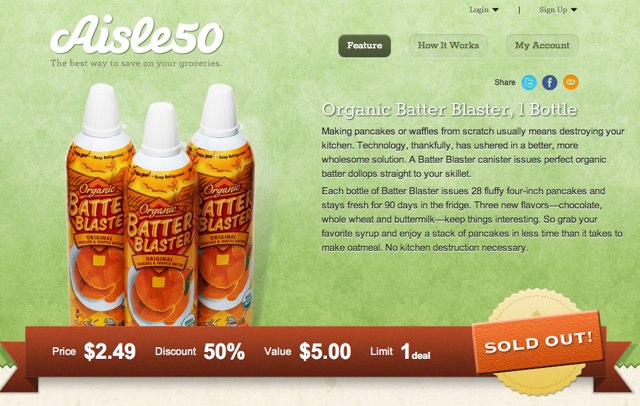
The consumer experience worked like this: a shopper signed up for Aisle50's email list and received periodic notifications about discounted grocery items — say, a box of Kellogg's cereal at 50% off, or Clorox cleaning products at a steep markdown. The consumer visited Aisle50's website, paid the discounted price upfront, and the deal was loaded directly onto their existing grocery store loyalty card or registered phone number. When they arrived at the store and scanned their card at checkout, the discount applied automatically. No printout. No coupon code. No explaining anything to a cashier.[13]
The structural elegance of the model was in who paid for what. Unlike Groupon, where the merchant funded the discount out of their own margin, Aisle50's discounts were funded entirely by the product's manufacturer.[13] The retailer received the full undiscounted price from the manufacturer, plus a standard 8-cent coupon handling fee — the same economics as a traditional paper coupon, but with none of the handling friction.[14] Aisle50 took a small cut of the discounted price — far less than Groupon's roughly 50% take rate.
This alignment of incentives was the product's most important design feature. Retailers had no reason to resist: they got full margin and incremental foot traffic. Manufacturers got targeted trial and brand exposure without a competitor's ad on the adjacent page — a direct shot at the FSI model. And consumers got genuine discounts with zero redemption friction.
The product evolved over time. In April 2013, Aisle50 launched a subscription feature that allowed consumers to automatically load recurring discounts to their loyalty cards at regular intervals,[10] an attempt to increase consumer lifetime value and reduce the churn inherent in a deal-of-the-day email model. The subscription product also addressed a key behavioral challenge: rather than requiring consumers to actively check for deals and prepay each time, it moved toward a passive, automatic savings model more consistent with how consumers had always interacted with loyalty card discounts.
By August 2013, over 140 brands were distributing offers through the platform, including Kellogg's, General Mills, Clorox, and Del Monte.[15] The product was live in five regional grocery chains across four states. The Wayback Machine preserves multiple captures of the live Aisle50 website from 2011 through 2015, showing the deal-of-the-day interface, loyalty card registration flow, and retailer partner listings.
What made Aisle50 different from Coupons.com — its primary incumbent competitor — was the loyalty card integration and the prepay mechanic. Coupons.com required consumers to browse a catalog, clip digital coupons, and load them to a card before shopping. Aisle50 collapsed that process into a single transaction: pay now, redeem automatically. The tradeoff was that consumers had to commit to a purchase before entering the store, a behavioral change that proved to be a meaningful source of friction.
Aisle50 served three distinct customer groups simultaneously, which was both its structural advantage and its primary operational challenge.
CPG manufacturers were the revenue source. Companies like Kellogg's, General Mills, Clorox, and Del Monte paid to run promotions on the platform, funding the consumer discounts in exchange for targeted trial, brand exposure, and data on redemption behavior.[15] These were large, slow-moving organizations with established promotional budgets and entrenched agency relationships — making them difficult to sell to quickly, as Steiner's road-trip-to-Kellogg's anecdote illustrates.[7]
Grocery retailers were the distribution channel. Without retail partners, Aisle50 had no stores in which consumers could redeem deals. Retailers received full manufacturer-funded pricing plus the standard coupon handling fee, so the financial case was straightforward. The operational case — integrating a new technology platform with existing loyalty card infrastructure — was less so.
Consumers were the end users whose engagement validated the platform to both manufacturers and retailers. Aisle50 reached consumers primarily through email, a channel that required building and maintaining a subscriber list store-by-store and market-by-market.
The addressable market was substantial on paper. The U.S. grocery industry generates roughly $700 billion in annual sales, and CPG companies historically spent billions of dollars annually on trade promotions and consumer couponing. The FSI market alone — the newspaper coupon inserts Aisle50 was positioning against — represented a multi-billion-dollar annual spend that was visibly declining as newspaper circulation fell.[16]
The digital coupon market was growing rapidly in the early 2010s, driven by smartphone adoption and the expansion of loyalty card programs at major chains. Aisle50's pitch was that it could capture a meaningful share of the promotional budget migrating from print to digital — a shift that was real and measurable.
The practical constraint was that Aisle50's addressable market was not the entire grocery industry, but only the subset of that industry served by its retail partners. With five regional chains at its peak, the company's actual reach was a small fraction of total U.S. grocery transactions.
Aisle50 competed in a crowded and rapidly evolving digital coupon space.
Coupons.com was the primary incumbent. It operated a large digital coupon catalog that consumers could browse and load to loyalty cards, and it had established relationships with both major CPG brands and national grocery chains. Its scale gave it a distribution advantage Aisle50 could not match.
Groupon was the obvious comparison in press coverage, though Aisle50's founders consistently pushed back on the analogy. Groupon's model required merchants to fund discounts out of their own margin and took a roughly 50% cut — economics that were unsustainable for grocery retailers operating on thin margins. Aisle50's manufacturer-funded model was structurally different, but the "Groupon for groceries" label stuck and may have created perception problems with retailers who had already grown skeptical of daily deal platforms by 2012–2013.
Ibotta launched in 2012 with a rebate-based model: consumers purchased items at full price, then submitted a receipt through the app to receive cash back funded by manufacturers. This approach required no retailer integration — a significant structural advantage that allowed Ibotta to scale nationally without negotiating loyalty card partnerships chain by chain.
SavingStar offered a similar load-to-card model and had secured partnerships with major national chains including Kroger and Safeway, giving it the national distribution that Aisle50 lacked.
The competitive landscape was moving quickly, and Aisle50's loyalty-card-integration approach — while elegant — required retailer cooperation at every step, creating a structural speed disadvantage relative to receipt-based competitors.
Aisle50 operated a three-sided marketplace with a transaction-based revenue model. CPG manufacturers paid to run promotions on the platform, funding the consumer discounts. Consumers paid the discounted price upfront on Aisle50's website. Aisle50 took a small percentage of each transaction — described in press coverage as "much less" than Groupon's roughly 50% take rate.[14] Retailers received the full undiscounted manufacturer price plus a standard 8-cent coupon handling fee, leaving their economics unchanged from traditional paper coupons.[14]
The April 2013 subscription product introduced a recurring revenue component, allowing consumers to pay a fee for automatic deal loading — an attempt to build more predictable revenue on top of the transaction model.[10] No revenue figures were ever publicly disclosed, and the small per-transaction take rate on grocery items — which typically retail for $2–$10 — meant the company needed very high transaction volume to build a meaningful revenue base. Total disclosed funding of approximately $5.2 million (with Steiner citing $6 million)[1] suggests the company never achieved the scale needed to demonstrate a path to profitability.
Aisle50's per-transaction metrics were genuinely strong. By August 2013, the company reported redemption rates consistently above 90% — a figure that compares favorably to traditional coupon redemption rates, which typically run in the low single digits for paper FSIs.[17] Customers who redeemed an Aisle50 offer spent 31% more on their total basket than average shoppers at the same stores.[17] Early data showed that 26% of redeeming customers had not shopped at the store in over a month before the deal brought them back — a meaningful lapsed-shopper reactivation rate that was directly relevant to retailers' core business problem.[9]
On the supply side, the company had signed 140+ brands by August 2013, including major CPG names like Kellogg's, General Mills, Clorox, and Del Monte.[15] Five regional grocery chains had integrated the platform: Lowe's Foods (North Carolina), Homeland Stores (Oklahoma), Shop 'n Save (Western Pennsylvania), D'Agostino (New York), and Raley's/Bel Air/Nob Hill Foods (120 locations in Northern California).[17]
The critical caveat is that all of these metrics were self-reported in a funding press release and were never independently verified. More importantly, no total consumer user count, email subscriber figure, or revenue number was ever disclosed publicly — making it impossible to assess whether the strong per-transaction metrics were translating into a business of meaningful scale. The absence of any national grocery chain partner — no Kroger, no Safeway, no Albertsons — was the most telling gap in the traction story.
Aisle50 closed with strong product metrics, credible investors, and a thesis that the market eventually validated. The failure was not conceptual. It was structural and sequential: a three-sided marketplace that required simultaneous scale on all three sides, in an industry that moved too slowly to provide it before the company's runway expired.
Aisle50's marketplace required three parties to participate simultaneously, and each party's willingness to engage depended on the others. Manufacturers would not pay for promotions without consumer reach. Consumers would not sign up without deals at their specific grocery store. Retailers would not integrate without proven consumer demand.
The company solved this problem locally — launching in Lowe's Foods stores in North Carolina in August 2011 and building outward from there.[8] But the solution required repeating the same retailer integration process for every new chain, in every new geography, one at a time. By August 2013 — two years after launch — the company had five regional partners.[17] That pace of retailer acquisition was insufficient to build the national consumer base needed to attract the largest CPG promotional budgets.
The attempted remedy was the April 2013 subscription product, which tried to increase consumer LTV and reduce churn within existing markets rather than expanding to new ones.[10] That was a reasonable optimization, but it did not address the underlying distribution constraint. The company needed more retail partners, not more engagement from existing consumers.
Grocery retail is one of the most operationally conservative industries in the American economy. Chains run on thin margins — typically 1–3% net — and are deeply resistant to technology changes that touch the point-of-sale system or loyalty card infrastructure. Every retailer integration required IT coordination, staff training, and a contractual relationship that took months to negotiate.
Steiner's road-trip-to-Kellogg's story illustrates the sales cycle on the manufacturer side.[7] Large CPG companies have established promotional agencies, annual budget cycles, and procurement processes that make them slow to adopt new platforms. Landing Chobani as a first client was a meaningful win, but converting that into a roster of 140+ brands took two years — and even then, the brands were running individual promotions rather than committing annual promotional budgets to the platform.
Riley Scott acknowledged the timing challenge directly at the Series A: "Physical retail stores are just beginning to leverage the web in ways that drive consumer engagement and, most importantly, extra store visits and sales increases. Aisle 50 is at the front of that trend."[18] The statement was accurate — but being at the front of a slow-moving trend is a precarious position for a venture-backed company with a finite runway.
The attempted remedy was to demonstrate compelling unit economics to accelerate retailer adoption. The 31% larger basket size and 26% lapsed-shopper reactivation metrics were designed precisely for this purpose — to give retailers a financial case for integration that was hard to ignore.[17] The metrics were strong, but they were not strong enough to accelerate the grocery industry's technology adoption cycle to venture speed.
Aisle50's redemption model required consumers to pay for a deal before entering the store. This was elegant from a technology standpoint — it eliminated the need for printouts or cashier interactions — but it represented a meaningful behavioral change from how consumers had always interacted with coupons.
Traditional coupons, digital load-to-card offers, and rebate apps like Ibotta all shared a common feature: consumers did not have to commit to a purchase before shopping. They could clip a coupon and decide at the shelf whether to buy. Aisle50 required the purchase decision to happen at home, in advance, on a website.
Industry observers identified this friction almost immediately. A September 2013 RetailWire discussion found most commenters skeptical of the model, with one retail consultant questioning directly why shoppers would prepay for deals they were accustomed to receiving passively.[11] The 90%+ redemption rate suggests that consumers who did prepay followed through — but it says nothing about how many consumers declined to engage with the prepay model in the first place.
The attempted remedy was the subscription product, which shifted the model toward automatic deal loading — removing the active prepay decision from the consumer experience.[10] No data on subscription adoption was ever disclosed, and the product launched only 16 months before the Groupon acquisition, leaving insufficient time to assess whether it resolved the friction problem.
Every one of Aisle50's five retail partners was a regional chain. Lowe's Foods operated in the Carolinas. Homeland Stores served Oklahoma. Shop 'n Save covered Western Pennsylvania. D'Agostino was a small New York City chain. Raley's operated in Northern California.[17]
The absence of a national partner — Kroger (2,700+ stores), Safeway, or Albertsons — was the most significant structural gap in Aisle50's distribution. National CPG brands allocate promotional budgets based on reach. A platform that could only deliver deals to consumers in five regional markets, with no overlap between them, was structurally limited in how much of a major brand's promotional budget it could justify capturing.
This was not simply a sales execution failure. National grocery chains had more sophisticated IT infrastructure, more complex loyalty card systems, and more leverage in partnership negotiations. They were also being courted by Coupons.com, SavingStar, and other well-funded competitors simultaneously. The integration cost-benefit calculation for a national chain considering Aisle50 — a startup with five regional partners and $5–6 million in total funding — was unfavorable.
The two equal-sized funding rounds of $2.6 million each, with no disclosed Series B, are the clearest financial signal of this constraint.[1] The company could not demonstrate the growth trajectory needed to raise a larger round, and without a larger round, it could not build the sales and integration team needed to land national partners.
Aisle50 was acquired by Groupon in February 2015 — the company it had spent years explicitly differentiating itself from.[1] Tracxn classifies the deal as an acqui-hire,[12] and the subsequent employee data supports that characterization: headcount dropped 90% from December 2014 to December 2015, with only one employee remaining by year-end 2015.[12] Crunchbase lists the company as "permanently closed."[19] The product did not survive inside Groupon.
The acquisition terms were never disclosed. No founder post-mortem explaining the decision to sell to Groupon — rather than raise additional capital or pursue a different acquirer — has been published. The timing, approximately 18 months after the Series A closed, suggests the company exhausted its runway without achieving the growth metrics needed for a Series B.
Three-sided marketplaces in slow-moving industries require a distribution shortcut, not just a better product. Aisle50's unit economics were strong, but the company had to negotiate every retailer integration individually in an industry with 12–18 month sales cycles. Ibotta solved the same consumer problem without retailer integration by using receipt scanning — a structural choice that allowed it to scale nationally without a single retailer partnership. When the core bottleneck is industry adoption speed, the product architecture needs to route around that bottleneck, not depend on it.
Impressive per-transaction metrics can mask a distribution problem. Aisle50's 90%+ redemption rates and 31% larger basket sizes were genuinely strong numbers — and they were used effectively to raise two funding rounds. But they measured the quality of transactions that occurred, not the volume of transactions that could occur. A company can have excellent unit economics and still fail if the total addressable market it can actually reach is too small to support the business. The absence of any disclosed total user count or revenue figure in four years of operation is itself a signal.
The "Groupon for X" framing is a double-edged sword. The comparison helped Aisle50 communicate its model quickly to investors and press in 2011. But by 2012–2013, Groupon's reputation had deteriorated significantly as merchants reported poor economics and consumer fatigue set in. Being associated with the Groupon model — even while explicitly differentiating from it — may have created headwinds with the grocery retailers Aisle50 needed as partners. Framing that accelerates early fundraising can constrain later business development.
Behavioral change is a hidden cost that compounds over time. Aisle50's prepay mechanic was technically superior to clipping coupons, but it required consumers to make a purchase commitment before entering the store — a departure from decades of coupon behavior. The subscription product was a direct attempt to remove that friction, but it launched too late and at too small a scale to change the company's trajectory. When a product requires consumers to change a deeply ingrained behavior, the adoption timeline is almost always longer than the founding team projects.
Accelerator validation is not market validation. In a 2017 FundersClub essay, Steiner reflected on the danger of treating YC admission as a milestone rather than a starting point.[20] Aisle50 attracted an impressive investor roster — Ron Conway, Yuri Milner, August Capital — on the strength of a compelling thesis. That thesis was correct in direction. But investor conviction about a market transition does not accelerate the transition itself, particularly in an industry as structurally conservative as grocery retail.