Included with Pro$20/mo
Technical Specs are included with Pro
Upgrade to Pro to get implementation-ready specs for every company, the full report library, and 5 on-demand report requests per month.
- Implementation-ready specs for every company
- Full report and rebuild playbook library
- 5 on-demand report requests per month
Overview
Booth AI was a San Francisco-based B2B SaaS company founded in August 2022 by Nick Locascio, Ian Baldwin, and Mitra Morgan. [1] The company built a "virtual photoshoot as a service" platform for e-commerce brands: sellers submitted basic product photos, and Booth AI's generative AI pipeline returned hundreds of high-quality lifestyle images — eliminating the cost and logistics of physical photo shoots. [2] The company joined Y Combinator's Winter 2023 cohort with a team of three, raising $500K in seed funding from Foundation Capital, Amino Capital, and three other investors. [3]
Booth AI failed because it entered a market that was commoditizing faster than its $500K runway could sustain, then compounded the problem by pivoting away from its core product within roughly 60 days of launch — before accumulating the customer evidence needed to justify abandoning it or the capital needed to build something new.
The company went operationally dormant after August 2023 and officially ceased service on August 5, 2024. [4] YC lists the outcome as "Acquired," while Crunchbase lists it as "Closed" — a contradiction that likely reflects an acqui-hire with no public announcement. [5] [6] Co-founder Ian Baldwin joined DoorDash as a GenAI engineer after the shutdown. [7]


Founding Story
Nick Locascio brought a deep computer vision and machine learning pedigree to Booth AI. He holds a Master of Engineering in Computer Science from MIT and had spent years at the intersection of AI and commerce: he built recommendation algorithms at Pinterest, developed computer vision systems at Perch Fitness, consulted on deep learning at Symantec, and served as Director of Engineering at Standard AI (Standard Cognition), an autonomous checkout startup. [8] The through-line across those roles was applying visual AI to physical retail problems — a background that made e-commerce photography a natural target.
Ian Baldwin arrived from a different but complementary direction. His PhD in Engineering Science from Oxford was followed by research engineering roles at NASA's Jet Propulsion Laboratory and NASA Ames Research Center, then technical leadership positions at Zoox (autonomous vehicles) and Xwing (autonomous aviation). [9] Baldwin's career had been defined by building perception systems that had to work reliably in the physical world — a discipline that maps directly onto the challenge of generating photorealistic product imagery. The third co-founder, Mitra Morgan, was part of the founding team, though her specific background and role have not been publicly documented. [10]
The company was founded in August 2022, at the precise inflection point when diffusion models were becoming capable enough to generate commercially viable imagery. The public launch of Stable Diffusion in August 2022 and DALL-E 2's broader rollout that same year made the underlying technology accessible; ChatGPT's November 2022 release then brought generative AI into mainstream business consciousness. Booth AI's founding timing was not accidental — the team was riding a visible wave.
Locascio's own framing of the moment was candid. In January 2023, he told a reporter: "This is a technology that a lot of traditional thinking about programming just doesn't work for. Nobody knows the best way to do anything right now. It's a complete gold rush." [11] The quote captures both the opportunity and the risk: in a gold rush, the absence of established best practices means the absence of defensible moats. The team's technical credentials were genuine, but the market they were entering rewarded distribution and capital as much as engineering depth.
Booth AI joined Y Combinator's Winter 2023 batch — a cohort that entered the program in January 2023 and presented at Demo Day in March. [12] The YC period coincided with the company's most active public phase: a seed raise, a product launch, and a press cycle that generated meaningful early attention.
No public record exists of a major pivot in the founding thesis before the SXSW workflow pivot in May 2023. The original product concept — AI-generated lifestyle photography for e-commerce brands — appears to have been the founding idea, not a post-YC refinement.
Timeline
- August 2022 — Booth AI founded by Nick Locascio, Ian Baldwin, and Mitra Morgan in San Francisco. [13]
- 2022 — Raises $500K seed round from Foundation Capital, Amino Capital, and three other investors. [14]
- January 2023 — Joins Y Combinator Winter 2023 batch with a team of three. [15]
- January 31, 2023 — Locascio quoted in press describing generative AI as a "complete gold rush." [16]
- February 22, 2023 — CB Insights publishes research brief featuring Booth AI: "How generative AI can help brands create virtual photoshoots." [17]
- March 4, 2023 — Booth AI launches AI Scene Generator targeting home furnishings, fashion, and packaged goods brands. [18]
- May 2023 — Booth AI demos "AI Workflow automation" tools at SXSW — first public signal of pivot away from product photography. [19]
- June 28, 2023 — Nick Locascio receives WTF Innovators Award for productizing AI image generation for e-commerce brands. [20]
- August 9, 2023 — Negative Trustpilot reviews posted; users report credit failures, inability to achieve results, and refund denials. These are the last recorded customer reviews. [21]
- August 14, 2023 — Locascio speaks at Amino Capital "Generative AI and AI Alignment" event in Los Angeles. [22]
- August 2023 — Booth AI goes effectively dormant; all public communications cease. [23]
- October 2023 — Booth AI featured at World Summit AI in Amsterdam — last confirmed public appearance. [24]
- August 5, 2024 — Booth AI officially ceases operations and service. [25]
- August 2024 — Ian Baldwin joins DoorDash as a GenAI engineer, confirming team dispersal. [26]
What They Built
Booth AI's core product addressed a genuine pain point in e-commerce: lifestyle photography is expensive, slow, and logistically complex. A mid-sized brand selling home goods or apparel might spend thousands of dollars per SKU on physical shoots — renting studios, hiring photographers, sourcing props, and coordinating models. Booth AI proposed to collapse that process into a software workflow.
The user experience, as described at launch, worked in three steps. First, a seller connected their Shopify store or uploaded product images directly. Second, they described the desired photoshoot in natural language — specifying scene type, mood, or setting. Third, Booth AI's pipeline returned a batch of 4K high-resolution lifestyle images, generated by fine-tuned diffusion models and GANs trained to preserve the specific product's appearance across varied backgrounds. [27] [28]
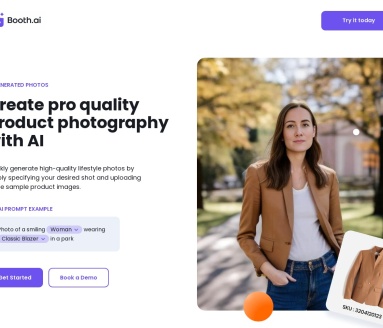
The March 2023 AI Scene Generator launch refined the product's vertical focus. Rather than targeting all e-commerce categories, the team concentrated on home furnishings, fashion, and packaged goods — categories where lifestyle context (a sofa in a living room, a jacket on a model, a beverage on a kitchen counter) meaningfully drives purchase conversion. [29] Jewelry was explicitly not supported, likely because the reflective surfaces and fine detail of jewelry posed harder generation challenges for 2023-era diffusion models. [30]
The pricing model charged credits per downloaded image: the entry plan cost $24.99, with each downloadable image consuming 10–20 credits, yielding approximately 5–10 final images per plan. [31] The platform also included basic editing tools and generated images at 4K resolution. [32]
By May 2023 — roughly 60 days after the Scene Generator launch — the company unveiled a fundamentally different product at SXSW: "Booth AI Workflows," a no-code editor for building generative AI applications. [33] The workflow builder offered a library of 165 nodes that users could connect to construct custom AI pipelines — a horizontal tooling play that bore little resemblance to the focused e-commerce photography product. [34] This pivot represented a complete repositioning: from a vertical SaaS product with a defined customer (e-commerce brand managers) to a developer/operator tool competing with platforms like Zapier, Make, and emerging AI workflow builders.
No public record confirms whether the Workflow product ever shipped to paying customers or achieved any meaningful adoption.
Market Position
Target Customers
Booth AI's original target was e-commerce brands selling physical goods — specifically small to mid-sized merchants in home furnishings, fashion, and packaged goods who lacked the budget for frequent professional photo shoots. [35] The Shopify integration signaled a focus on the long tail of independent sellers rather than enterprise retail, where in-house creative teams and agency relationships already existed. This was a sensible initial wedge: Shopify had over 1.7 million merchants in 2023, many of whom were underserved by traditional photography infrastructure.
The workflow pivot, if it had materialized, would have targeted a completely different buyer: developers, operations teams, or AI-curious business users looking to automate processes with generative AI. This is a broader market but one with no natural overlap with the original customer base — meaning Booth AI would have been starting customer acquisition from zero in a new segment.
Market Size
The global product photography market was estimated at several billion dollars annually in 2023, with e-commerce driving the majority of demand. The AI-generated imagery subset was nascent but growing rapidly: CB Insights flagged it as an emerging category in February 2023, the same month Booth AI received its first major press mention. [36] The total addressable market was large in principle, but the relevant question was not market size — it was how quickly the market would commoditize, and whether a $500K-funded startup could establish a defensible position before that happened.
Competition
Booth AI's competitive position was structurally weak along the two axes that mattered most: distribution reach and capital depth.
On distribution, Booth AI had no proprietary channel. Its Shopify integration was a sensible starting point, but Shopify itself — and the app ecosystem around it — could replicate or partner with any competitor offering the same functionality. There was no exclusive data moat: the training data for product photography models was broadly available, and fine-tuning diffusion models on product images was a technique any well-funded competitor could replicate.
On capital, the gap was severe. By mid-2023, Booth AI faced more than 200 direct competitors. [37] Well-funded players like Runway had raised tens of millions of dollars and were investing heavily in model quality and infrastructure. Free and open-source alternatives — particularly Stable Diffusion-based tools — set a price floor of zero for the underlying capability. Specialized competitors like Dresma, Pebblely, and Flair.ai were targeting the same e-commerce photography use case with comparable or superior funding.
The structural dynamic that made Booth AI's position particularly difficult was platform absorption risk. Adobe, Canva, and Shopify itself were all integrating generative AI image capabilities into their existing products during 2023. For a Shopify merchant, an AI photography feature built natively into the platform they already used would always be preferable to a standalone subscription — regardless of quality differences. This is the classic pattern where a startup's product becomes a feature inside a larger platform, and the startup's distribution disadvantage becomes insurmountable.
The workflow pivot did not improve the competitive position. The no-code AI workflow builder market was, if anything, more crowded: Zapier, Make (formerly Integromat), n8n, and a wave of AI-native workflow tools were all competing for the same users with substantially more resources.
Business Model
Booth AI operated a credit-based SaaS model. The entry-level plan was priced at $24.99, with credits consumed at 10–20 per downloaded image — yielding approximately 5–10 final images per plan purchase. [38] Higher-tier plans presumably offered more credits at a lower per-image cost, though the full pricing structure was not publicly documented.
The company never disclosed revenue figures. The absence of any ARR or MRR data in press coverage, investor communications, or founder interviews is itself a signal: companies with strong revenue metrics typically share them, particularly during the fundraising cycle that would have followed a YC Demo Day.
Inferring from available data: with $500K in total funding and a team of three in San Francisco, annual burn was likely in the range of $300K–$500K, assuming standard YC-era compensation and GPU infrastructure costs. [39] These are inferences, not disclosed figures. At that burn rate, the $500K seed provided roughly 12–18 months of runway — consistent with the August 2022 founding and the August 2023 operational dormancy, suggesting the company may have exhausted its capital by mid-to-late 2023 without securing a follow-on round.
The credit model created a structural problem: it required users to pay before experiencing the product's value, with no meaningful free tier to build trust or drive word-of-mouth. In a market where Stable Diffusion was free and open-source, this friction was a significant adoption barrier. [40]
Traction
Booth AI received meaningful early press attention. CB Insights featured the company in a February 2023 research brief on AI-powered virtual photoshoots. [41] The March 2023 AI Scene Generator launch generated coverage across AI tool directories and startup media. Nick Locascio received the WTF Innovators Award in June 2023 for productizing AI image generation for e-commerce. [42] The company appeared at World Summit AI in Amsterdam in October 2023 — its last confirmed public appearance. [43]
This recognition pattern — industry awards, analyst mentions, conference appearances — signals that the concept was validated as interesting by observers. It does not indicate paying customer traction. No user counts, customer counts, or revenue figures were ever disclosed.
The most direct evidence of user experience comes from Trustpilot reviews posted in August 2023. One user wrote: "There was no free version so I paid $24.99 to try and make things better — after about 15 minutes I gave up as there didn't appear to be a path to success." The same user reported being denied a refund. [44] A second reviewer complained: "pay then it claps out half way through credits." [45] These are the last recorded customer reviews — a small sample, but the only direct user feedback on record, and it is uniformly negative.
Post-Mortem
Primary Cause: Insufficient Capital Against a Rapidly Commoditizing Market
The most important structural fact about Booth AI's failure is the funding gap. The company raised $500K to compete in a market where model training, GPU inference infrastructure, and continuous iteration against improving open-source baselines were the primary cost drivers. [46] By mid-2023, direct competitors numbered over 200, including well-capitalized players who could absorb infrastructure costs that would be existential for a $500K-funded startup. [47]
This was not simply a matter of Booth AI making poor financial decisions. The AI image generation category in 2023 had a structural characteristic that made undercapitalization fatal: model quality was the primary differentiator, model quality required GPU compute, and GPU compute costs scaled with usage. A startup that could not afford to run inference at scale could not acquire the users needed to generate revenue, and could not generate the revenue needed to fund inference. The $500K seed created a ceiling that the business model could not break through.
The team does not appear to have raised a follow-on round. No Series A or bridge round appears in any public database. Whether they attempted to raise and failed, or chose not to attempt, is unknown — but the outcome is the same: the company ran out of capital without achieving the scale needed to become self-sustaining.
Secondary Cause: Premature Pivot Before Product-Market Fit
Within approximately 60 days of launching the AI Scene Generator, Booth AI was publicly demoing a completely different product — an AI workflow automation builder — at SXSW. [48] The pivot from a focused vertical SaaS product (AI photography for e-commerce) to a horizontal platform (no-code AI workflow builder with 165 nodes) [49] reset the company's go-to-market clock in a new, equally competitive market.
The timing of this pivot is significant. The AI Scene Generator launched on March 4, 2023. [50] SXSW 2023 ran in mid-March through mid-May. The pivot announcement came before the photography product had any meaningful opportunity to accumulate customer evidence. This pattern — abandoning a product before the market has had time to respond — typically reflects founder uncertainty about the original thesis rather than a data-driven decision to change direction.
Locascio's own March 2023 launch statement — "we look forward to maintaining our fast pace of innovation and expanding the customers and industries that we can serve" [51] — reads, in retrospect, as a signal that the team was already looking beyond the photography product rather than committing to it. The "fast pace of innovation" framing is characteristic of founders who are uncertain whether their current product is the right one.
The workflow pivot did not solve the underlying problem. The no-code AI workflow builder market was, if anything, more crowded than AI photography, with Zapier, Make, n8n, and a wave of AI-native competitors all better funded and further along. There is no public evidence that the Workflow product ever shipped to paying customers or generated any revenue.
Tertiary Cause: Pricing Model That Prevented Adoption
Booth AI's credit-based pricing — $24.99 entry with no meaningful free tier — created friction at the exact moment users needed to experience the product's value. [52] In a market where Stable Diffusion was free and open-source, and where competitors were offering free trials to drive adoption, requiring upfront payment before demonstrating value was a structural disadvantage.
The Trustpilot reviews from August 2023 illustrate the consequence: users who paid $24.99 and failed to achieve results within minutes felt deceived, not just disappointed. [53] The refusal to issue refunds compounded the reputational damage. A freemium model — even a limited one offering 5–10 free images — would have lowered the barrier to first value and created the word-of-mouth loop that a $500K marketing budget could not otherwise fund.
The team attempted no documented remedy to the pricing problem. No free tier was introduced, and no pricing restructuring was announced before the company went dormant.
Structural Factor: Platform Absorption Risk
The deepest structural threat to Booth AI's model was not a direct competitor — it was the platforms that e-commerce sellers already used. Adobe Firefly launched in March 2023, the same month as Booth AI's Scene Generator. Canva integrated AI image generation in 2023. Shopify itself began integrating AI tools into its merchant dashboard. For a Shopify merchant, an AI photography feature built natively into their existing platform would always be preferable to a standalone subscription, regardless of quality differences.
This is the pattern that makes vertical AI SaaS particularly fragile in the early stages of a new capability: the feature that a startup is selling is exactly the feature that incumbent platforms will add to retain their users. Booth AI had no proprietary data, no exclusive distribution, and no switching costs that would have protected it from this dynamic. The company's product was, structurally, a feature waiting to be absorbed — and the absorption happened faster than almost any prior software category.
The Zombie Period: 15 Months of Silence
After August 2023, Booth AI produced no blog posts, no tweets, no product updates, and no press coverage. [54] The company nominally operated for another 12 months before officially ceasing service on August 5, 2024. [55] This 15-month gap between operational dormancy and official shutdown is consistent with a company that had exhausted its capital and conviction simultaneously — continuing to exist on paper while the founders explored other options.
Ian Baldwin's departure to DoorDash as a GenAI engineer in August 2024 [56] provides the clearest post-mortem signal: the team dispersed into larger companies rather than attempting another startup. No founder has published a post-mortem, given an interview about the failure, or made any public statement about what went wrong. The silence itself is data — companies that find valuable lessons in failure typically share them.
Key Lessons
-
Pivoting from a vertical product to a horizontal platform within 60 days of launch is a signal of founder uncertainty, not strategic agility. Booth AI launched its AI Scene Generator on March 4, 2023, and was demoing a no-code AI workflow builder at SXSW roughly 60 days later — before the photography product had accumulated enough customer data to justify abandonment. The pivot reset the go-to-market clock in a new, equally competitive market, and there is no evidence the workflow product ever reached paying customers. The lesson is not "don't pivot" but rather: a pivot made before the original product has been genuinely tested by the market is more likely to reflect founder anxiety than market signal.
-
In AI infrastructure markets, $500K is a feature budget, not a company budget. Booth AI's seed was structurally insufficient for a GPU-heavy product requiring continuous model fine-tuning against improving open-source baselines. The company faced over 200 competitors by mid-2023, including players with tens of millions in funding. The $500K ceiling meant Booth AI could not run inference at the scale needed to acquire users, could not acquire users at the scale needed to generate revenue, and could not generate revenue at the scale needed to fund the next model iteration. Founders entering AI infrastructure categories in 2023 needed either a dramatically lower-cost architecture or a dramatically higher seed round.
-
Charging upfront without a free tier in a market with free open-source alternatives creates an adoption ceiling that word-of-mouth cannot overcome. Booth AI's $24.99 entry plan with no meaningful free tier required users to pay before experiencing value, in a market where Stable Diffusion was free. The August 2023 Trustpilot reviews — the only direct user feedback on record — show users who paid, failed within minutes, and were denied refunds. A freemium model offering 5–10 free images would have lowered the barrier to first value and created the organic growth loop that a $500K marketing budget could not otherwise fund. Booth AI never adjusted its pricing model before going dormant.
-
Technical depth in ML and computer vision is necessary but not sufficient for a consumer-facing SaaS product in a fast-moving market. Locascio (MIT MEng, Pinterest, Standard AI) and Baldwin (Oxford PhD, NASA JPL, Zoox) brought genuine technical credentials to Booth AI. But the skills that make a great perception engineer — rigor, long-horizon research, system reliability — are different from the skills that drive rapid GTM iteration in a crowded SaaS market. The team's public communications after the product launch were sparse, the pricing model was not iterated, and the pivot to a workflow builder suggests the team may have been more comfortable building a new technical system than selling and refining the existing one.
-
When a startup's core product is a feature that incumbent platforms will absorb, the window to establish switching costs is measured in months, not years. Booth AI launched its AI photography product in March 2023. Adobe Firefly launched the same month. Canva and Shopify integrated AI image tools within the same year. For a Shopify merchant, a native AI photography feature inside their existing platform was always going to win over a standalone subscription — regardless of quality. Booth AI had no proprietary data, no exclusive distribution, and no switching costs that would have protected it from platform absorption. The company needed to either establish deep enterprise relationships with switching costs before the platforms caught up, or accept that the window was closing and raise aggressively to accelerate. It did neither.
Sources
- The Founders Pack — Five YC W23 Cohort Companies
- Y Combinator — Booth AI Company Profile
- Crunchbase — Booth AI Organization
- Dresma — Best Alternative to Booth AI
- The Org — Ian Baldwin at Booth AI
- The Org — Ian Baldwin at DoorDash
- PR Newswire — Nick Locascio WTF Innovators Award
- Daily San Francisco Bay News — Cerebral Valley Generative AI
- PRWeb — Booth AI AI Scene Generator Launch
- Dang.ai — Booth AI Tool Profile
- Samantha Brandon — Booth AI Review
- Best of AI — Booth AI Tool
- Trustpilot — Booth AI Reviews
- Tracxn — Booth AI Funding and Investors
- CB Insights — Booth AI Company Profile
- Crunchbase — Booth AI Financials
- Nick Locascio LinkedIn
- LinkedIn — Booth AI Company Page
Included with Pro$20/mo
Ready to rebuild Booth AI?
Implementation-ready specs, every report, and 5 on-demand requests each month.
- Implementation-ready specs for every company
- Full report and rebuild playbook library
- 5 on-demand report requests per month