Included with Pro$20/mo
Technical Specs are included with Pro
Upgrade to Pro to get implementation-ready specs for every company, the full report library, and 5 on-demand report requests per month.
- Implementation-ready specs for every company
- Full report and rebuild playbook library
- 5 on-demand report requests per month
Overview
Codecademy was founded in August 2011 by Zach Sims and Ryan Bubinski, two Columbia University students who built an interactive, browser-based coding education platform from a single JavaScript lesson posted to Hacker News. Over the next decade, it grew into the dominant consumer brand in technical skills education — 50 million learners across 190 countries, $50M ARR, and a rare cash-flow-positive profile in a sector notorious for burning capital. Skillsoft acquired it for $525M in April 2022.
This is not a traditional failure story. Codecademy achieved genuine product-market fit, capital efficiency, and a strong exit. The cautionary arc comes after the deal closed: Skillsoft, an enterprise learning incumbent navigating its own AI-driven restructuring, absorbed Codecademy's brand and user base while systematically dismantling the human curriculum infrastructure that made the product worth buying.
By early 2026, Skillsoft had laid off the entire Codecademy curriculum team — confirmed publicly by Senior Curriculum Director Zoe Bachman after nearly nine years at the company. The outcome illustrates a recurring pattern in edtech M&A: a beloved consumer brand acquired at peak valuation by an enterprise incumbent whose strategic priorities diverge sharply from the product culture that created the value in the first place.


Founding Story
Codecademy's origin is a study in accidental clarity. Zach Sims was a political science major at Columbia University who had no formal programming background. Ryan Bubinski had graduated from Columbia in 2011 with a degree in Biophysics and Computer Science and had already started a campus club to teach programming to non-technical students.[1] The two met while working together on the Columbia Daily Spectator, the university's student newspaper.[2]
The founding insight was personal and direct. As Sims later described it: "I was learning to program and found it super challenging, while my cofounder Ryan had started a club on campus at Columbia to teach people to program."[3] The gap between Sims's experience as a struggling learner and Bubinski's experience as a working teacher became the product's core design principle: make coding education feel like doing, not watching.
The path to that insight was not linear. Sims and Bubinski entered Y Combinator's Summer 2011 batch without a firm idea.[4] They cycled through failed concepts — including a CRM system for club promoters — before landing on an earlier iteration: a skill-discovery and job-matching website designed to connect recent graduates with employers based on how they completed programming challenges.[5] That job-matching layer was eventually abandoned in favor of pure learning, a strategic choice that simplified the product but also removed a natural monetization lever that competitors would later exploit.
The market validation was immediate and overwhelming. In August 2011, Sims and Bubinski posted a single JavaScript lesson to Hacker News. Within days, 200,000 users had signed up.[6] The signal was unambiguous: there was enormous latent demand for coding education that was interactive, free, and required no setup.
Sims made one early strategic choice that would define the company's character for a decade: he chose New York City over Silicon Valley. The reasoning was deliberate. He wanted to build for people who didn't know about programming — not for software developers who already did.[7] That geographic and cultural orientation toward the mass consumer market shaped everything from the product's zero-friction design to the eventual B2B pivot toward banks and consulting firms rather than engineering teams.
The company raised $150,000 from Y Combinator and closed a $2.5M Series A from Union Square Ventures just two months after launch, in October 2011 — a pace that earned it the informal label of "the fastest-growing YC company ever."[8]
Timeline
-
August 2011 — Codecademy founded by Zach Sims and Ryan Bubinski; single JavaScript lesson posted to Hacker News attracts 200,000 users within days; accepted into YC S2011 with $150K backing.[6][9]
-
October 2011 — Raises $2.5M Series A led by Union Square Ventures, with participation from Yuri Milner and Ron Conway.[10]
-
December 2011 — Reaches 1 million users by end of year.[11]
-
January 1, 2012 — "Code Year" campaign launches; 200,000 signups in 7 days, 408,000 in 9 weeks. Mayor Bloomberg publicly joins, generating major viral momentum.[12][13]
-
June 2012 — Raises $10M Series B led by Index Ventures at a $62M valuation.[14][15]
-
January 2014 — Surpasses 24 million users who have completed over 100 million exercises.[16]
-
2015 — Introduces its first paywall — four years after launch — ending the fully free model.[17]
-
July 2016 — Raises $30M Series C led by Naspers Ventures; Naspers CEO Larry Illg joins the board. Headcount is 45 employees.[18][19]
-
August 3, 2017 — Codecademy Pro officially launches at $39.99/month or $19.99/month annually.[20]
-
~2018 — 45 million learners worldwide; 85 employees; ARR begins doubling year-over-year.[21][22]
-
~2019 — Becomes cash-flow positive; retains $20M of its $30M Series C unspent.[23]
-
2020 — Largest-ever growth year: 5M+ new users, 150,000 paid Pro subscribers, 600 Codecademy for Business customers; B2B bookings grow 350%.[24]
-
November 2020 — Hires first-ever CFO, Adam Goldman (formerly Chegg), signaling preparation for a liquidity event.[24]
-
January/February 2021 — Raises $40M Series D led by Owl Ventures; $50M ARR; 50M+ learners from 190+ countries.[25]
-
December 22, 2021 — Skillsoft announces acquisition for approximately $525M (~40% cash, ~60% Skillsoft equity).[26]
-
April 5, 2022 — Skillsoft acquisition closes; Zach Sims joins Skillsoft executive leadership team.[27]
-
2024 — Skillsoft installs a new CEO; investor calls emphasize AI-enabled learning objects and cost discipline.[28]
-
Early 2026 — Skillsoft lays off the entire Codecademy curriculum team, confirmed by Senior Curriculum Director Zoe Bachman after nearly nine years at the company.[29]
What They Built
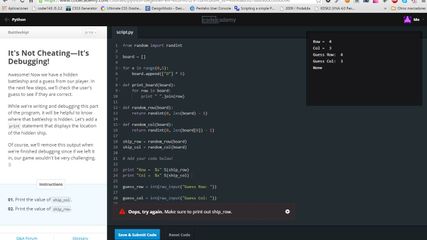
Codecademy's core product was an interactive, browser-based coding education platform. The defining design choice was eliminating setup friction entirely. A learner could open a browser, navigate to Codecademy.com, and write real, executable code within seconds — no downloads, no configuration, no prior knowledge required. The interface split the screen between an instruction panel on the left and a live code editor on the right, with immediate feedback on whether the code ran correctly. This "learn by doing" loop, rather than watching video lectures, was the product's primary differentiator from the beginning.
At launch, the platform offered a single JavaScript course. Over the following decade, the curriculum expanded to cover 14 programming languages — including Python, SQL, HTML/CSS, Java, Ruby, and Go — across four broad domains: application development, data science, cloud computing, and cybersecurity.[30] By the time of the Skillsoft acquisition, the curriculum spanned 150+ courses, 700+ projects and quizzes, and 1,000+ lessons — a content library built almost entirely by an in-house curriculum team.[31]
The original product concept included a job-matching layer: connecting students to employers based on how they completed programming challenges.[32] That feature was abandoned early in favor of pure learning, which simplified the product and accelerated growth but also removed a natural monetization mechanism — the ability to charge employers for access to a pre-screened talent pipeline.
The product remained entirely free from 2011 through 2015 — a four-year window during which the company built brand recognition but no revenue infrastructure. The first paywall arrived in 2015, though the specific features gated behind it are not documented in public sources.[17] Codecademy Pro, the formal subscription tier, launched officially on August 3, 2017, priced at $39.99/month or $19.99/month on an annual plan.[20] Pro offered additional projects, quizzes, and a structured "path" format that guided learners through a sequence of skills toward a defined career outcome — a meaningful upgrade over the free tier's more fragmented course structure.
The more consequential product evolution was the B2B pivot. Codecademy for Teams — later rebranded Codecademy for Business — targeted companies seeking to upskill their workforces in technical skills. The product allowed managers to assign courses, track completion, and report on team-wide skill development. In its first year in beta, B2B bookings grew 350%.[33] By 2020, the platform had 600 paying business clients, with half coming from non-technology sectors — banks, consulting firms, and small businesses — validating Sims's original thesis that the real market was people who didn't already work in tech.[34]
What distinguished Codecademy from video-based competitors like Lynda.com or Coursera was not curriculum breadth — those platforms had more courses — but interaction depth. Writing code and receiving immediate feedback is a fundamentally different cognitive experience from watching someone else write code. That interaction model was technically non-trivial to build in 2011 and remained a meaningful barrier to replication for several years.
Market Position
Target Customers
Codecademy's primary customer was the non-technical adult learner seeking to acquire coding skills for career advancement or personal interest. Sims's deliberate choice to build in New York rather than Silicon Valley reflected a conviction that the addressable market was not developers — who already had Stack Overflow, GitHub, and documentation — but the much larger population of people who had never written a line of code and found existing resources intimidating or inaccessible.
The B2B product expanded the target to include HR and L&D (learning and development) departments at mid-to-large enterprises seeking to upskill workforces in data science, cloud infrastructure, and software development. The 600 business clients acquired in the first year of the B2B launch — half from non-tech sectors — confirmed that the demand for technical upskilling extended well beyond the technology industry itself.[34]
Market Size
The global e-learning market was estimated at approximately $250 billion by the early 2020s, with the technical skills segment representing a disproportionate share of enterprise L&D spending. The "learn to code" consumer segment alone attracted hundreds of millions of dollars in venture capital across the 2010s, with Coursera, Udacity, and Pluralsight each raising nine-figure rounds. Codecademy's $50M ARR at the time of its Series D represented a meaningful but modest slice of a large and fragmented market — suggesting either significant room for growth or a ceiling imposed by the freemium model's conversion dynamics.
Competition
Codecademy competed on two distinct axes that rarely overlapped cleanly: consumer accessibility and enterprise depth.
On the consumer side, its primary competitors were Khan Academy (free, broad curriculum, strong brand), Treehouse (paid, video-based, developer-focused), and Code.org (free, K-12 oriented, nonprofit). Codecademy's interactive browser-based environment gave it a friction advantage over all of them — lower barrier to first lesson, higher immediate engagement. But Khan Academy's nonprofit positioning and Code.org's institutional partnerships gave those platforms distribution channels (schools, governments) that Codecademy never pursued.
On the professional and enterprise side, the competitive set was more formidable. LinkedIn's 2015 acquisition of Lynda.com for $1.5 billion gave that platform an unmatched distribution advantage: 700 million professional profiles, each representing a potential learner with a documented skill gap. Pluralsight targeted software developers specifically, with deeper technical content and stronger enterprise sales infrastructure. Coursera and Udacity offered university-credentialed content — a signal of quality that Codecademy's self-produced curriculum could not replicate.
The structural competitive dynamic that mattered most was distribution versus product depth. Codecademy had the superior beginner product — lower friction, more interactive, better designed for the non-technical learner. But LinkedIn/Lynda had the social graph. Every professional who completed a Lynda course could display it on their LinkedIn profile, creating a credential loop that Codecademy could not easily replicate. Codecademy's certificates existed but lacked the same professional visibility.
The more existential competitive threat arrived after the acquisition: AI-assisted coding tools. GitHub Copilot (launched 2021), ChatGPT (2022), and a wave of AI coding assistants fundamentally changed the question a learner might ask. Instead of "how do I learn Python?", the question became "can I just ask an AI to write this for me?" That shift did not eliminate demand for coding education, but it compressed the value of introductory curriculum — precisely the content that Codecademy's human team had spent a decade producing. Skillsoft's 2024 pivot toward "AI-enabled learning objects" was a direct response to this structural shift, and the curriculum team layoffs were its operational consequence.[28]
Business Model
Codecademy operated a freemium model with three revenue layers, introduced sequentially over its first decade.
Free tier (2011–present): The core product remained free throughout the company's life, providing access to a substantial portion of the curriculum. This was both a growth engine and a structural constraint — it built the 50M-user base but also trained users to expect free content, likely suppressing conversion rates when paid tiers launched.
Codecademy Pro (2017–present): Priced at $39.99/month or $19.99/month annually.[20] By 2020, the platform had 150,000 paid Pro subscribers.[24] At the annual price point, 150,000 subscribers would generate approximately $36M in annualized consumer revenue — a rough inference, not a disclosed figure. This would represent roughly 72% of the $50M ARR reported at Series D, though the actual split between consumer and enterprise is not publicly disclosed.
Codecademy for Business (2019–present): Enterprise contracts with companies seeking workforce upskilling. With 600 clients in year one and $50M total ARR, the implied average contract value across the business — if the B2B segment represented even 30% of revenue — would be approximately $25,000 per client annually. This is an inference based on publicly available data points, not a disclosed figure. The 350% first-year bookings growth suggests the B2B product was the primary driver of ARR acceleration from 2018 onward.[33]
The company never disclosed revenue publicly during its independent life. The absence of revenue data through 2016 — five years of operation — is itself a signal: there was no revenue to report until the paywall arrived in 2015, and the Pro tier did not formally launch until 2017. The $50M ARR figure at Series D was the first public revenue disclosure, and it came from a position of strength rather than necessity.
Total funding raised was approximately $82.5–$87.5M.[35] With 85 employees in 2018 and a New York City cost base, annual burn during the growth phase was likely in the $15–20M range — an inference based on headcount and market compensation norms, not disclosed financials. The fact that $20M of the $30M Series C remained unspent at Series D time suggests the company ran at significantly below that rate for extended periods, consistent with the cash-flow-positive claim.
Traction
Codecademy's user growth was among the most rapid in consumer edtech history.
- 200,000 users within days of the August 2011 Hacker News launch.[6]
- 1 million users by end of 2011.[11]
- 408,000 Code Year signups within 9 weeks of the January 2012 campaign launch.[12]
- 24 million users and 100 million completed exercises by January 2014.[16]
- 45 million learners worldwide by approximately October 2018.[21]
- 50 million learners from 190+ countries by February 2021.[36]
The 2020 cohort was the strongest single year: 5 million new users, 150,000 paid Pro subscribers, and 600 Codecademy for Business customers — the last figure representing the first year of formal B2B operations.[24] ARR had been doubling since 2018, reaching $50M by early 2021.[37]
The conversion rate from free to paid users — a critical metric for any freemium business — was never disclosed. At 150,000 paid subscribers against 50 million total users, the implied conversion rate was approximately 0.3%. This is low even by freemium standards (Spotify, for comparison, converted roughly 26% of free users to paid at a similar stage), though the comparison is imperfect given the different engagement models. The low conversion rate is consistent with Sims's own acknowledgment that four years of free-only operation trained users to expect free content.
Post-Mortem
Codecademy's story does not fit the standard post-mortem template. The company did not run out of money, lose to a better-funded competitor, or fail to find product-market fit. It achieved a $525M exit on approximately $82.5M raised — a strong outcome by any measure. The post-mortem is instead about what happened after the deal closed, and what the acquisition terms and post-close behavior reveal about the strategic logic (or lack thereof) behind the deal.
The Four-Year Monetization Delay Created a Structural Conversion Problem
Codecademy launched as a free product in August 2011 and did not introduce any paywall until 2015 — four years later.[17] Codecademy Pro, the formal subscription tier, did not launch until August 2017 — six years after founding.[20] Sims acknowledged this directly: "We could've and should've monetized sooner as we experienced diminishing returns providing a free product. We saw a continuously escalating set of metrics on the free side. Looking at those metrics and thinking you were doing well was intoxicating."[38]
The attempted remedy was the Pro tier launch in 2017, followed by the B2B product. The B2B pivot worked — 350% first-year bookings growth and $50M ARR by 2021 confirm that.[33] But the consumer Pro conversion rate — approximately 0.3% of total users — suggests the free-to-paid funnel never fully recovered from the expectation set during the free-only years. The company compensated by building a B2B business on top of the consumer brand, which was the right strategic move but also meant the consumer product was never the primary revenue engine it could have been.
The Acquisition Consideration Structure Transferred Risk to Sellers at Peak Valuation
The $525M acquisition price was announced on December 22, 2021 — near the peak of the edtech valuation cycle, roughly 10.5x the $50M ARR reported at Series D.[26] The consideration structure was approximately 40% cash and 60% Skillsoft equity.[26] This meant Codecademy's founders and investors received roughly $210M in cash and $315M in Skillsoft stock — at a moment when Skillsoft itself was a recently re-listed company navigating its own post-SPAC restructuring.
Skillsoft's stock has declined significantly since the acquisition closed in April 2022, meaning the realized value of the equity consideration was substantially below the announced headline figure. The exact magnitude of that decline is not calculable without knowing the precise lockup terms and sale timing, but the directional signal is clear: sellers who held Skillsoft equity through the post-close period received less than the $525M headline implied.
The Prosus conflict of interest compounds this concern. Prosus held approximately 23.8% of Codecademy and approximately 37.5% of Skillsoft simultaneously at the time of the deal.[39] A shareholder with a large stake in both the buyer and the seller has incentives that may not align with maximizing the acquisition price for Codecademy's minority shareholders. This conflict was investigated, though the outcome of that investigation is not documented in available sources.
Skillsoft's Strategic Pivot Made the Curriculum Team Structurally Redundant
The most consequential post-acquisition development was the 2024 installation of a new Skillsoft CEO and the subsequent strategic pivot toward AI-enabled learning objects and cost discipline.[28] By early 2026, Skillsoft had laid off the entire Codecademy curriculum team — the human infrastructure that had produced the 150+ courses, 700+ projects, and 1,000+ lessons that constituted the product's content moat.[29]
Zoe Bachman, Senior Curriculum Director, confirmed the layoffs publicly: "Yesterday, Skillsoft laid off my entire Codecademy Curriculum team. It's not how I imagined leaving after nearly nine years."[40]
The attempted remedy — replacing human curriculum production with AI-generated content — is a rational response to the structural shift in the coding education market. GitHub Copilot, ChatGPT, and similar tools have compressed the value of introductory coding curriculum by making it possible to generate working code without understanding it. The market for "learn Python from scratch" content is smaller and less defensible than it was in 2017. Skillsoft's AI pivot is not irrational; it is simply incompatible with the product culture and human expertise that made Codecademy worth $525M.
The deeper structural issue is that Skillsoft — an enterprise learning incumbent with a legacy content library and a cost-discipline mandate — was never a natural steward for a consumer-oriented, curriculum-driven product. The acquisition rationale emphasized brand reach and learner scale (the combined entity would serve 85 million learners).[41] But brand reach without the product investment to sustain it is a depreciating asset, not a compounding one.
The Acqui-Asset Trap: Brand Value Without Strategic Alignment
The pattern Codecademy's post-acquisition trajectory illustrates is distinct from the acqui-hire (buying a company for its team) or the strategic acquisition (buying a company for its product or market position). It is closer to what might be called an "acqui-asset" — buying a brand and user base as a distribution channel, with the intention of replacing the underlying product infrastructure with the acquirer's own technology stack.
This pattern is structurally predictable in edtech M&A. Enterprise learning incumbents (Skillsoft, Cornerstone, SAP SuccessFactors) have strong distribution to HR buyers but weak consumer brands. Consumer edtech companies (Codecademy, Duolingo, Khan Academy) have strong consumer brands but weak enterprise sales infrastructure. The acquisition appears to solve both problems simultaneously. In practice, the cultural and operational gap between consumer product development and enterprise cost management is rarely bridged successfully. The consumer product team — which moves fast, iterates on user experience, and measures success in engagement metrics — finds itself inside an organization that measures success in contract renewals and gross margin.
Sims's own management challenges as a first-time founder — his acknowledged difficulty delegating and tendency to prove himself to his team[42] — may have made it harder to build the organizational resilience needed to navigate a post-acquisition integration. Whether he remained at Skillsoft long enough to advocate for the curriculum team is not confirmed in available sources.
Key Lessons
-
Codecademy's four-year free period built a brand but poisoned the conversion funnel. By operating as a fully free product from 2011 to 2015, Codecademy trained 24 million users to expect free coding education. When Pro launched in 2017, the implied conversion rate was approximately 0.3% of total users — low even by freemium standards. Sims acknowledged this explicitly. The lesson is not "charge earlier" in the abstract; it is that Codecademy specifically had a monetizable product by 2012 (the Code Year campaign demonstrated massive willingness to engage) and chose not to test willingness to pay until the brand expectation of free was already deeply embedded.
-
The B2B pivot was the real business model discovery, but it arrived six years late. Codecademy's 350% first-year B2B bookings growth and 600 enterprise clients in year one suggest the enterprise upskilling market was large and accessible from the beginning. The original YC concept — connecting learners to employers based on challenge completion — was a version of this idea. Abandoning the employer-side of the marketplace in 2011 in favor of pure consumer growth was a reasonable simplification, but it meant the company spent six years building a consumer brand before discovering that enterprise contracts were the durable revenue model.
-
The Prosus dual-stake structure at acquisition created a conflict that minority shareholders could not easily resolve. Prosus held ~23.8% of Codecademy and ~37.5% of Skillsoft simultaneously when the deal was announced.[39] A shareholder with large positions on both sides of a transaction has incentives to optimize for deal completion rather than price maximization. Founders and early investors in companies with large institutional shareholders should model this scenario explicitly before entering a sale process — the investor who helped you grow may not be the investor who maximizes your exit.
-
A 60% equity consideration in a declining acquirer is not equivalent to cash. The $525M headline price was approximately 40% cash and 60% Skillsoft equity, announced at the peak of the 2021 edtech valuation cycle. Skillsoft's subsequent stock decline meant the realized value of the equity tranche was materially below the announced figure. Codecademy's founders and investors accepted significant acquirer-specific risk at a moment when the broader market was signaling peak valuations. The lesson specific to Codecademy is that a strong ARR trajectory and cash-flow-positive profile — the profile Codecademy had in 2021 — typically supports a higher cash consideration than 40%. The equity-heavy structure may reflect the Prosus conflict, Skillsoft's own balance sheet constraints, or both.
-
Human curriculum production is a cost center that AI will restructure, but the timing of that restructuring matters enormously for acquisition value. Codecademy's content moat — 150+ courses, 700+ projects, 1,000+ lessons built by an in-house team — was the primary justification for the $525M price. By 2024, Skillsoft's new leadership had concluded that AI-generated content could replace that team. Whether that conclusion is correct is debatable; what is not debatable is that Codecademy's sellers in 2021 received a price that included a premium for a content infrastructure that the buyer subsequently eliminated. The gap between the acquisition rationale and the post-close behavior is the clearest evidence that the strategic fit was weaker than the deal announcement implied.
Sources
- Codecademy — Wikipedia
- Zach Sims — Wikipedia
- YC Q&A with Zach Sims, Founder of Codecademy — Y Combinator Blog
- Codecademy Company Profile — Cleverism
- Codecademy Freemium Case Study — ProductLed
- Viral Codecademy Snagged 200,000 Users in Days — ABC News
- Zach Sims and Ryan Bubinski, Founders of Codecademy — Inc. Magazine
- Naspers Ventures Leads Codecademy's $30M Series C — PitchBook
- Codecademy Raises $30M Led by Naspers — BusinessWire
- Codecademy, the Free Online Coding School, Raises Another $30M Led by Naspers — TechCrunch
- Codecademy Raises $40M in Series D Funding — PR Newswire
- Codecademy Series D — TechCrunch
- Codecademy Sends It with Skillsoft in a $525M Deal — TechCrunch
- Skillsoft to Acquire Codecademy — Skillsoft Press Release
- Skillsoft Completes Acquisition of Codecademy — Skillsoft Press Release
- Skillsoft and Codecademy: Equipping Today's Workforce — Skillsoft Blog
- Skillsoft Acquisition of Codecademy — SEC Filing
- Prosus Conflict of Interest in Skillsoft/Codecademy Deal — Wohlfruchter Law
- Skillsoft Lays Off Entire Codecademy Curriculum Team — EdTech Innovation Hub
- Skillsoft Cuts Spark AI Job Displacement Debate — AICerts
- Zach Sims of Codecademy on Lessons in Raising $12.5 Million — First Round Review
- Codecademy with Zach Sims — Business of Business
- Founders Who Fundraise: Zach Sims — Bowery Capital
- Building with Purpose Ep. 1: Codecademy with Zach Sims — Medium
- Codecademy — Y Combinator Company Page
Included with Pro$20/mo
Ready to rebuild Codecademy?
Implementation-ready specs, every report, and 5 on-demand requests each month.
- Implementation-ready specs for every company
- Full report and rebuild playbook library
- 5 on-demand report requests per month