Overview
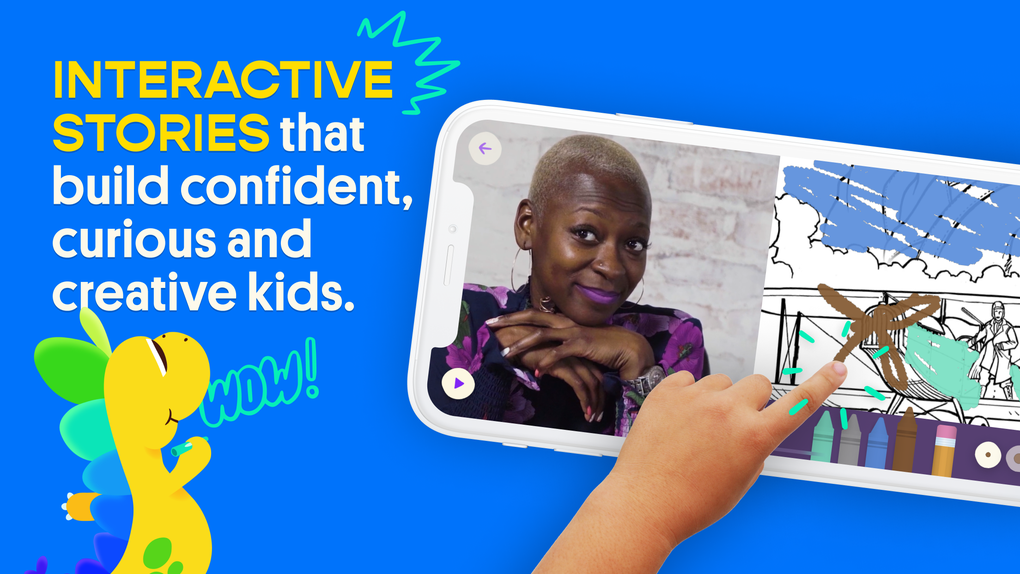
Hellosaurus was a New York City-based interactive video platform for children ages 2–8, founded in late 2019 by James Ruben under the legal entity All Together Labs, Inc. [1] The company built a subscription iOS app where children participated in "playable video" — content that used the device camera, microphone, and touchscreen to make kids active participants rather than passive viewers. It also built a no-code Creator Studio that allowed kids media producers to create interactive content without engineering resources. [2] Hellosaurus was part of Y Combinator's Summer 2020 batch and raised $3.65M–$5M across three rounds. [3]
Hellosaurus built a genuinely innovative product and earned real recognition — App Store features, Kidscreen Awards, and a creator network with 200M+ combined YouTube subscribers — but could not convert that qualitative momentum into a subscription business with the unit economics required to raise a Series A and scale independently.
In December 2022, roughly two years after its public launch, Brilliant.org acquired Hellosaurus for an undisclosed price. The acquisition framing emphasized the Creator Studio technology and team rather than the consumer subscriber base — the hallmarks of an acqui-hire rather than a business acquisition. James Ruben subsequently returned to Stanford University, leaving the consumer app to continue in app stores under Brilliant's ownership. [4]

Founding Story
James Ruben's path to Hellosaurus was unusually direct. He graduated from Harvard University with a degree in Economics and Computer Science, joined Google as a product manager, and then moved to HQ Trivia as Head of Product — a role that placed him at the center of one of the most culturally significant interactive media experiments of the late 2010s. [5] Forbes named him to its 30 Under 30 list for Consumer Technology. [6]
The founding insight came directly from HQ Trivia. As Ruben later described it, the best interactive content has no fourth wall — it makes the audience a participant, not a spectator. [7] At HQ Trivia, millions of adults would stop what they were doing twice a day to answer trivia questions in real time with a live host. Ruben saw that the engagement mechanism — the feeling of being in the content rather than watching it — was the product, not the trivia itself. The question he brought to Hellosaurus was whether that same mechanism could be applied to the 2–8 age bracket, where passive screen time had become both ubiquitous and a source of parental anxiety.
Two structural market dislocations sharpened the timing. COVID-19 lockdowns in early 2020 drove kids' mobile screen time up by over 150% — in some studies as high as 500% — creating both demand for kids content and parental guilt about its quality. [8] Simultaneously, YouTube's January 2020 FTC settlement caused a roughly 75% revenue collapse for kids content creators by restricting targeted advertising on children's content. [9] Creators who had built large audiences on YouTube suddenly had both the motivation and the urgency to find alternative platforms.
Ruben founded Hellosaurus in late 2019 as a solo founder — a structural choice that would later carry operational implications — and incorporated it as All Together Labs, Inc. in New York City. [10] Rather than recruit a co-founder, he assembled a team of industry veterans: people from Toca Boca, Nickelodeon, Sesame Street, Apple, and EA Games. [11] The first creative collaborator was Jens Peter de Pedro, a former Toca Boca executive, who co-created the company's debut product alongside producer Sara Berliner. The hiring signal was deliberate: Hellosaurus was positioning itself as a media-plus-technology hybrid from the start, not a pure tech startup that happened to make kids content.
For Pro Subscribers
Unlock the full Hellosaurus teardown
Read the complete post-mortem, the rebuild playbook, and the exact reasons Hellosaurus is still worth studying now.