Overview
Mindmesh was a Boston-based productivity startup, part of Y Combinator's Summer 2021 batch, that set out to build a "virtual desk" — a unified workspace for product managers and knowledge workers drowning in tool fragmentation. The company conducted extensive pre-launch research, achieved SOC 2 Type II certification, earned a #1 Product of the Day ranking on Product Hunt, and secured two rounds of seed funding. Despite these early signals, the product failed to convert launch momentum into sustained user growth. The team pivoted to an NLP-powered customer insights product, then pivoted again toward AI for customer support — neither iteration gaining documented traction. By 2023, YC listed both founders as "Former Founders," CEO Raffaele Colella had moved on to co-found Climate House, and no formal shutdown announcement was ever published. Mindmesh's arc illustrates how strong founder credentials, rigorous pre-launch research, and a celebrated debut can still fail to produce product-market fit when the core value proposition is too abstract to drive habitual use.
Founding Story
Raffaele Colella came to Mindmesh with an unusually strong pedigree for a first-time YC founder. His earlier startup, Cannonball Corporation, built an email app called "My Blend" that received multiple Apple App Store features before being acqui-hired by Google. At Google, Colella served as lead product manager on the Google News Android app — a role that gave him direct exposure to the challenge of surfacing relevant information from a fragmented content landscape. He also holds an MBA from MIT Sloan School of Management. [1] [2]
His stated motivation for starting Mindmesh, however, was notably founder-centric rather than problem-centric. In a podcast interview, Colella explained: "I wanted to do another startup because I did one a few years ago, which actually brought me to Google because we are acquired there and so [I needed] to go back to the founder spot." [3] This framing — returning to founding as an identity rather than solving a specific pain point — is a subtle but meaningful signal about the company's eventual struggles with product focus.
Co-founder and CTO Ulysse Mizrahi brought complementary technical depth. He holds a Masters in Mathematics and Theoretical Physics from the University of Cambridge and École Polytechnique. His career spanned R&D engineering at Dataiku, Head of Data Science at Nextperf, CTO at Fitle, and Senior Engineer and Product at Upflow — itself a YC S2020 company. [4] Mizrahi's data science and NLP background would later prove directly relevant when the company pivoted away from its original product.
The company was incorporated under the legal entity name "Just Spot inc." — a detail that surfaces on Crunchbase and is confirmed by the GitHub organization name "justSpot." [5] [6] This suggests that "Spot" or "justspot.io" may have been the founders' longer-term brand vision, with "Mindmesh" serving as an early iteration. The relationship between the two identities was never publicly explained.
Mindmesh was accepted into Y Combinator's Summer 2021 batch, providing early validation, network access, and the standard YC seed investment. [7] The company was headquartered in Boston, MA, and grew to approximately seven employees at its peak. [8] No public record exists of how Colella and Mizrahi met or why they chose the productivity space specifically.
Timeline
- 2021 — Mindmesh founded by Raffaele Colella and Ulysse Mizrahi in Boston, MA, under legal entity "Just Spot inc." [5]
- 2021 — Accepted into Y Combinator Summer 2021 (S21) batch [7]
- 2021 — Team conducts 300+ interviews with product people and 400+ interviews with knowledge workers in SaaS companies across the US and Europe [9] [10]
- 2021 — Raises first funding round (amount undisclosed); described as seed-funded [11]
- January 2022 (approx.) — Three-month closed beta begins [9]
- April 19, 2022 — Mindmesh launches publicly on Product Hunt; achieves #1 Product of the Day, hunted by YC's Michael Seibel [12]
- 2022 — Raises second funding round (amount undisclosed) [11]
- 2022–2023 — Pivots from virtual desk product to "Mindmesh Customer Insights," an NLP-based customer support ticket analysis product (exact date unknown) [13]
- 2022–2023 — LinkedIn description updated to "AI for Customer Support — Next-generation AI to supercharge your Customer Support," indicating further product evolution [14]
- 2023 — Mindmesh winds down; YC lists both founders as "Former Founders" and no jobs are posted [15]
- 2023–2024 — CEO Raffaele Colella moves on to co-found Climate House [16]
What They Built
The Virtual Desk (Original Product)
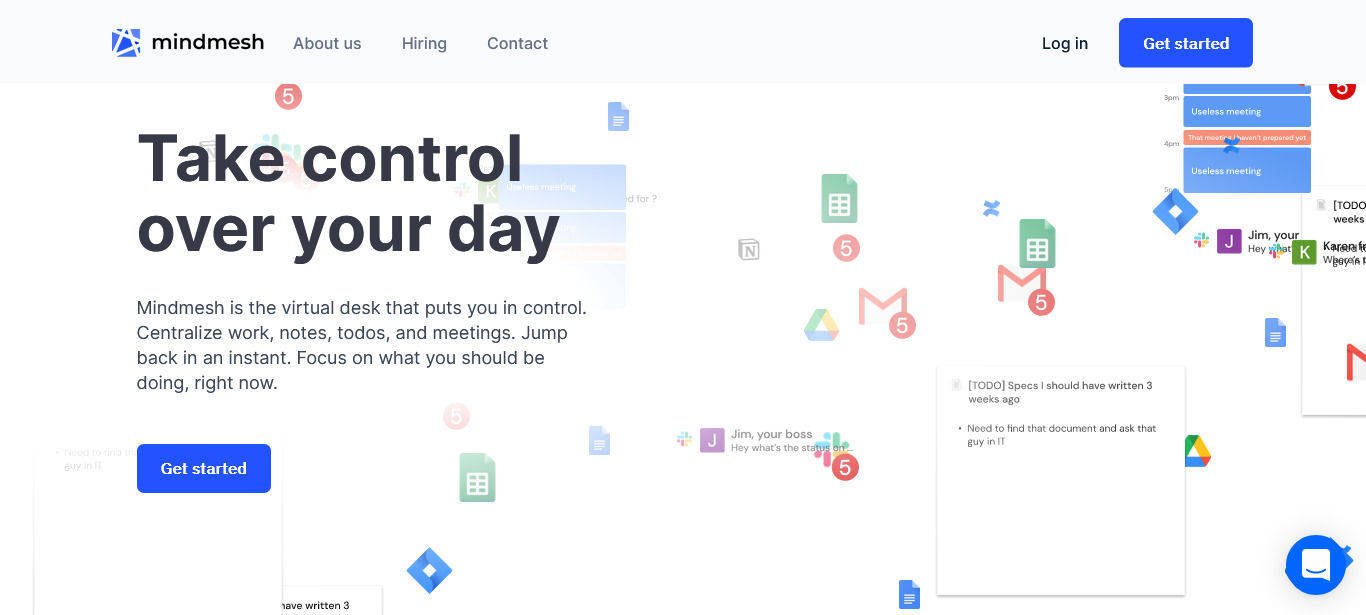
Mindmesh's first product was a unified workspace designed to eliminate the context-switching that plagues product managers and knowledge workers. The core premise: a typical PM in a SaaS company starts their day with email in Gmail, checks Slack for messages, reviews tickets in Jira, scans their Google Calendar, and stores notes in a separate tool — often losing track of what needs attention and when. Mindmesh aimed to pull all of these streams into a single "virtual desk." [17]
The product integrated with Gmail, Slack, Google Calendar, Jira, and Google Drive. Users could view and manage tasks, meeting notes, and work items from these tools in one interface without switching between applications. The intended workflow was a daily planning session inside Mindmesh — the user would see everything that mattered, prioritize it, and work from that single view throughout the day. [18]
Colella described the product vision in a podcast interview: "The product wants to be, wants to give you the big picture. The big picture of like everything that it matters to you and then you need to focus on." [19] The abstraction in that description — "everything that matters" — reflects a challenge the product never fully resolved: it was difficult to articulate a crisp, specific use case that would make a user switch their daily workflow to a new tool.
Before launching publicly, the team invested heavily in validation. They conducted over 300 interviews with product people and more than 400 interviews with knowledge workers at SaaS companies across the US and Europe. [9] [10] They ran a three-month closed beta before the public launch. [9] They also achieved SOC 2 Type II certification and Google verification for sensitive OAuth scopes — a significant investment for an early-stage company that signals genuine enterprise ambition. [20]
What differentiated Mindmesh from alternatives like Notion, Asana, or Linear was its read-write integration model: rather than asking users to migrate their data into a new system, Mindmesh pulled live data from existing tools and let users act on it in place. This avoided the "blank page" problem of productivity tools that require users to rebuild their workflows from scratch. The tradeoff was that Mindmesh's value was entirely dependent on the quality and depth of its integrations — a technically demanding and commercially fragile foundation.
The Pivot: Mindmesh Customer Insights
After the public launch failed to generate documented sustained traction, the team pivoted to a fundamentally different product. "Mindmesh Customer Insights" used natural language processing to analyze customer support tickets from platforms like Zendesk, Salesforce Service Cloud, and Intercom. The product promised to surface patterns, themes, and actionable insights from support data that product and customer success teams could use to improve their products. [13]
The delivery model was also different: rather than a daily-use SaaS tool, Customer Insights was positioned as a near-turnkey service. A customer provided their customer support platform API key, and Mindmesh delivered a first insights report within ten days. [21] This shift — from a self-serve productivity app to a managed insights service — represented a complete change in buyer, sales motion, and product architecture.
A subsequent iteration, reflected in the company's final LinkedIn description, reframed the product again as "AI for Customer Support — Next-generation AI to supercharge your Customer Support." [14] Whether this represented a third distinct product or a repositioning of Customer Insights is not documented.

Market Position
Target Customers
Mindmesh's original product targeted product managers and knowledge workers at SaaS companies — a well-defined but demanding buyer persona. PMs are sophisticated tool users who already have strong opinions about their workflows. They are also not typically budget owners, which complicates the sales motion for a tool that requires them to advocate internally for adoption. The company's 700+ pre-launch interviews suggest genuine effort to understand this persona, but the product's abstract value proposition ("the big picture of everything that matters") made it difficult to displace entrenched tools with specific, measurable value. [9] [10]
After the pivot, the target buyer shifted to customer support teams and product organizations at SaaS companies — a different persona with different procurement processes, different success metrics, and a different relationship to data. The pivot required the team to rebuild their go-to-market understanding from scratch.
Market Size
The productivity software market is large and well-documented. The global market for project management and collaboration tools was estimated at over $5 billion annually in the early 2020s, with strong growth driven by remote work adoption. The customer insights and voice-of-customer analytics market — the space Mindmesh entered with its pivot — was a smaller but fast-growing segment, with vendors like Qualtrics, Medallia, and emerging AI-native tools competing for enterprise budgets. Neither market suffered from a lack of demand; both suffered from intense competition and high switching costs.
Competition
In the virtual desk space, Mindmesh competed against a crowded field of well-funded incumbents and fast-moving startups. Notion had already established itself as the default "second brain" for knowledge workers. Linear was gaining ground with engineers and PMs who wanted fast, opinionated task management. Asana and Monday.com held enterprise relationships. Newer entrants like Coda and Roam Research were experimenting with similar "unified workspace" concepts. Each of these competitors had larger teams, more integrations, and established user bases.
The integration-aggregation approach — pulling data from Gmail, Slack, Jira, and Calendar into one view — was also being pursued by tools like Superhuman (for email), Reclaim.ai (for calendar), and later by AI-native tools like Notion AI and Microsoft Copilot. The market was moving fast, and Mindmesh's differentiation narrowed with each new feature shipped by incumbents.
In the customer insights space, the competitive landscape was equally challenging. Established players like Qualtrics, Medallia, and Gainsight had deep enterprise relationships. Emerging AI-native competitors like Dovetail, Grain, and Insight7 were building similar NLP-based analysis products for qualitative data. Mindmesh entered this market without a documented customer base, without brand recognition in the space, and without the sales infrastructure to compete for enterprise contracts.
Business Model
Mindmesh's business model was never publicly detailed, but available signals point to a B2B SaaS structure. The company described itself as "seed funded" in job postings and company descriptions, [22] and Crunchbase lists two funding rounds with undisclosed amounts. [11] The original virtual desk product targeted individual knowledge workers and small teams, suggesting a freemium or low-cost subscription entry point with potential for team-level upsells. The SOC 2 Type II certification and Google OAuth verification indicate the team was building toward enterprise sales, where security compliance is a procurement requirement. [20]
The Customer Insights pivot implied a shift toward a higher-ACV, lower-volume sales model — delivering reports to customer support and product teams rather than acquiring individual users. No pricing, revenue figures, or customer counts were ever disclosed publicly for either product iteration.
Traction
The clearest traction signal in Mindmesh's public record is its Product Hunt launch on April 19, 2022. The product earned #1 Product of the Day, 501 upvotes, 145 comments, and a 4.89/5 star rating from nine reviews. It was hunted by Michael Seibel, YC's managing director — a credibility signal that drove significant launch-day attention within the startup community. [12]
Beyond the launch day, no public metrics exist. No user counts, daily active user figures, retention rates, revenue numbers, or customer testimonials were published. No TechCrunch coverage, Hacker News product discussions, or Reddit community threads surfaced in the public record — a meaningful absence for a product targeting technically sophisticated knowledge workers who are active on those platforms. The gap between the April 2022 launch and the eventual pivot is undated, making it impossible to determine how long the team persisted with the original product before concluding it was not working.
Post-Mortem
Mindmesh left no public post-mortem. Neither founder published a reflection on what went wrong, no investor commentary surfaced, and no shutdown announcement was made. What follows is an analysis built from the available evidence — the product record, the pivot sequence, the competitive landscape, and the founder's own words.
1. The Value Proposition Was Too Abstract to Drive Habit Formation
The most fundamental problem with Mindmesh's original product was the difficulty of articulating what it did in terms that would motivate a behavior change. Colella's own description — "give you the big picture of everything that it matters to you" — is aspirational but not actionable. [19]
Productivity tools succeed when they solve a specific, recurring pain with a specific, repeatable workflow. Notion succeeded by giving teams a flexible document system. Linear succeeded by making issue tracking fast. Superhuman succeeded by making email faster to process. Each of these products had a concrete, demonstrable "aha moment" — a specific action that proved the value within minutes of first use.
Mindmesh's value was cumulative and contextual: it required a user to route their entire daily workflow through a new tool before the "big picture" benefit materialized. This is a high switching cost for an unproven product. The 700+ pre-launch interviews validated that context-switching was a real pain, but they did not validate that Mindmesh's specific solution was the one users would adopt and retain. The Product Hunt launch attracted 501 upvotes from an audience predisposed to try new productivity tools — but that audience is not representative of the mainstream PM or knowledge worker who is deeply embedded in existing workflows.
The team attempted to address this by investing in a three-month closed beta before launch, [9] presumably to refine the onboarding and value delivery. But the absence of any post-launch retention data or user growth metrics in the public record suggests the beta did not resolve the core adoption challenge.
2. Founder Motivation Was Misaligned With Problem Urgency
Colella's stated motivation for starting Mindmesh was to return to founding — not to solve a specific problem he had personally experienced and found intolerable. [3] This is a meaningful distinction. The most durable startups are typically built by founders who cannot stop thinking about a specific problem because they have lived it. The 700+ interviews Mindmesh conducted before launch were a genuine attempt to compensate for this gap — to find the problem through research rather than personal experience.
Research-driven problem discovery is a legitimate approach, but it carries a risk: it can produce a product that addresses a validated problem category without identifying the specific, acute version of that problem that users will pay to solve immediately. The interviews confirmed that knowledge workers struggled with context-switching. They did not confirm that Mindmesh's specific solution was the one those workers would adopt over the alternatives they were already using.
This misalignment likely contributed to the product's abstract positioning. A founder who has personally experienced the pain of managing Gmail, Slack, Jira, and Calendar simultaneously — and who has a specific, visceral memory of the moment that fragmentation cost them something important — would likely have built a more opinionated, specific product. Mindmesh's "big picture" framing suggests a product designed to appeal broadly rather than to solve one specific problem acutely.
3. The Pivot Was Technically Credible But Commercially Unvalidated
When the virtual desk product failed to generate documented traction, the team pivoted to "Mindmesh Customer Insights" — an NLP-based product that analyzed customer support tickets. [13] The pivot made sense from a technical standpoint: Mizrahi's background in data science and NLP at Dataiku and Nextperf gave the team genuine capability in this domain. [4]
But the pivot represented a complete change in every commercial dimension simultaneously: the target buyer (individual PMs to customer support/product teams), the sales motion (self-serve to managed service), the delivery model (daily-use SaaS to 10-day report delivery), and the competitive landscape (productivity tools to enterprise analytics). [21] Executing a pivot of this scope requires rebuilding go-to-market understanding, customer relationships, and sales infrastructure from scratch — a significant undertaking for a team of seven with limited runway.
The subsequent reframing to "AI for Customer Support" [14] suggests the Customer Insights product also failed to find its footing, prompting a further repositioning. Two pivots in rapid succession — each requiring a new buyer, a new sales motion, and a new competitive analysis — is a pattern consistent with a team that was searching for product-market fit rather than executing against a validated hypothesis.
No paying customers, revenue figures, or user counts were ever disclosed for either the Customer Insights product or the AI for Customer Support iteration. The absence of any public customer reference or case study is a meaningful signal that commercial traction did not materialize.
4. The Launch Spike Did Not Convert to Sustained Distribution
The #1 Product of the Day ranking on Product Hunt, hunted by Michael Seibel, was a genuine achievement. [12] But Product Hunt success is a notoriously poor predictor of sustained user growth, particularly for productivity tools targeting professional workflows. The Product Hunt audience skews toward early adopters, founders, and startup enthusiasts — not the mainstream PM or knowledge worker embedded in a corporate SaaS stack.
The absence of any follow-on press coverage, Hacker News discussion, or community engagement after the launch suggests the spike did not convert to organic growth or word-of-mouth. No evidence exists that the team ran paid acquisition, content marketing, or community-building programs to sustain momentum after the launch day. The company's public profile went quiet after April 2022, with the next documented event being the pivot to Customer Insights — an undated transition that likely occurred sometime in late 2022 or early 2023.
Key Lessons
-
Research validates problems, not solutions. Mindmesh conducted 700+ pre-launch interviews — an unusually rigorous effort — and confirmed that context-switching was a real pain for knowledge workers. But the interviews validated the problem category, not the specific solution. A product that addresses a broad, diffuse pain without a specific, demonstrable "aha moment" will struggle to drive the behavior change required for adoption and retention. The lesson is not to do less research, but to use research to identify the most acute, specific version of a problem — the one where users say "I need this fixed today," not "yes, that's annoying."
-
Founder-market fit matters as much as product-market fit. Colella's motivation for starting Mindmesh was to return to founding, not to solve a problem he had personally experienced as intolerable. This is a structural disadvantage: founders who have lived the problem they are solving tend to build more opinionated, specific products and persist through early setbacks with more conviction. Investors and founders alike should scrutinize whether the founding motivation is "I need to solve this" or "I want to build a company" — the former produces better products.
-
Multiple rapid pivots signal a search, not a strategy. Mindmesh executed at least two significant pivots — from virtual desk to customer insights to AI for customer support — in a compressed timeframe with a small team. Each pivot required rebuilding buyer understanding, sales motion, and competitive positioning. Pivots are sometimes necessary, but each one consumes runway and organizational focus. A single well-validated pivot is a strategic correction; multiple rapid pivots without documented traction between them suggest the team was searching for product-market fit rather than executing against a validated hypothesis.
-
Launch day success is not a distribution strategy. A #1 Product of the Day ranking, hunted by a prominent YC partner, is a meaningful credibility signal — but it is a one-day event, not a repeatable acquisition channel. Productivity tools targeting professional workflows require sustained distribution strategies: content marketing, community building, enterprise sales, or viral loops embedded in the product itself. The absence of any documented post-launch distribution effort likely contributed to the gap between launch-day excitement and sustained growth.
Sources
- Hireotter: Raffaele Colella, CEO of Mindmesh — Behind Company Lines interview
- Crunchbase: Raffaele Colella profile
- Y Combinator: Mindmesh company profile
- Crunchbase: Mindmesh organization profile
- GitHub: justSpot organization
- Product Hunt: Mindmesh launch page (April 19, 2022)
- Product Hunt: Mindmesh product profile
- Mindmesh: Full-stack job posting / company description
- Mindmesh: Author page — Raffaele Colella
- LinkedIn: Mindmesh company page
- RocketReach: Mindmesh YC S21 management profile
- RocketReach: Raffaele Colella email/profile
- Y Combinator: Mindmesh jobs page
- Hacker News: Launch YC S21: Meet the Batch, Thread #9