Overview
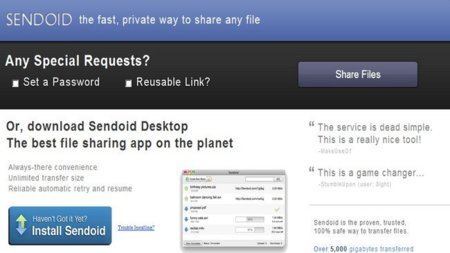
Sendoid was a browser-based, peer-to-peer file transfer service built by Caffeinated Mind Inc., a San Francisco startup that emerged from Y Combinator's Winter 2011 batch. Founded by engineers John Egan and Zac Morris, the product routed encrypted data directly between sender and receiver machines — no central server — achieving transfer speeds roughly 50x faster than contemporary alternatives. By January 2012, the company had abandoned the consumer product and pivoted to Expresso, an enterprise-grade UDP-accelerated data transfer server targeting CAD firms, genome research labs, and big data analytics teams.
The company never validated a sustainable business model. The consumer product attracted only thousands of users after a year of operation, and Expresso never left private beta before the team was acqui-hired.
On February 29, 2012 — approximately one year after YC Demo Day — Facebook acquired the three-person team for an undisclosed sum, explicitly not acquiring the technology. Both Sendoid and Expresso were shut down within two weeks. The outcome was a talent exit: the founders went on to meaningful careers at Facebook and Uber, but investors received no disclosed return, and users lost access to a product they had come to rely on.

Founding Story
John Egan and Zac Morris started building Sendoid in 2010, roughly a year before their YC Demo Day appearance in March 2011.[1] Both were engineers. Morris had previously worked at Apple, giving the team credibility in systems-level software development.[2]
The founding motivation was direct and personal. Egan and Morris were working on projects together while living on opposite coasts, and they needed to regularly move large, sensitive files — often exceeding 500MB — between each other.[3] The existing options were slow, required uploading to a third-party server (introducing privacy risk), or imposed file size caps that made them impractical for the team's actual workloads. The founders built the tool they needed, then asked whether others needed it too.
The company was incorporated as Caffeinated Mind Inc. and accepted into Y Combinator's Winter 2011 cohort — one of 43 companies in the batch.[4] YC provided early validation, network access, and the standard seed terms of the era. The team was small and engineering-heavy: three people total, with no identified business or sales co-founder.[5] The identity of the third team member has not been publicly disclosed.
At launch, the founding vision was explicitly consumer-first: a fast, private, browser-based file transfer tool that anyone could use without creating an account. The enterprise angle — film studios, pharmaceutical companies — was framed as a monetization layer on top of the free consumer product, not a separate product line.[6]
That framing would not survive the year. By January 2012, the team had concluded that the consumer product was not generating a viable path to revenue and pivoted entirely to Expresso, an enterprise big data transfer server. The pivot was a significant strategic reorientation — from a consumer tool with no login requirement to a B2B infrastructure product requiring enterprise sales cycles. Caffeinated Mind's own shutdown statement framed the journey as a coherent evolution: "When CMI first started, we wanted to change the way files moved online. That vision has evolved over the last year through our experience at YCombinator, where since launching Sendoid we've moved countless files for our users and then later went on to tackle big data transfer problems for enterprises with Expresso."[7]
For Pro Subscribers
Unlock the full Sendoid teardown
Read the complete post-mortem, the rebuild playbook, and the exact reasons Sendoid is still worth studying now.