Overview
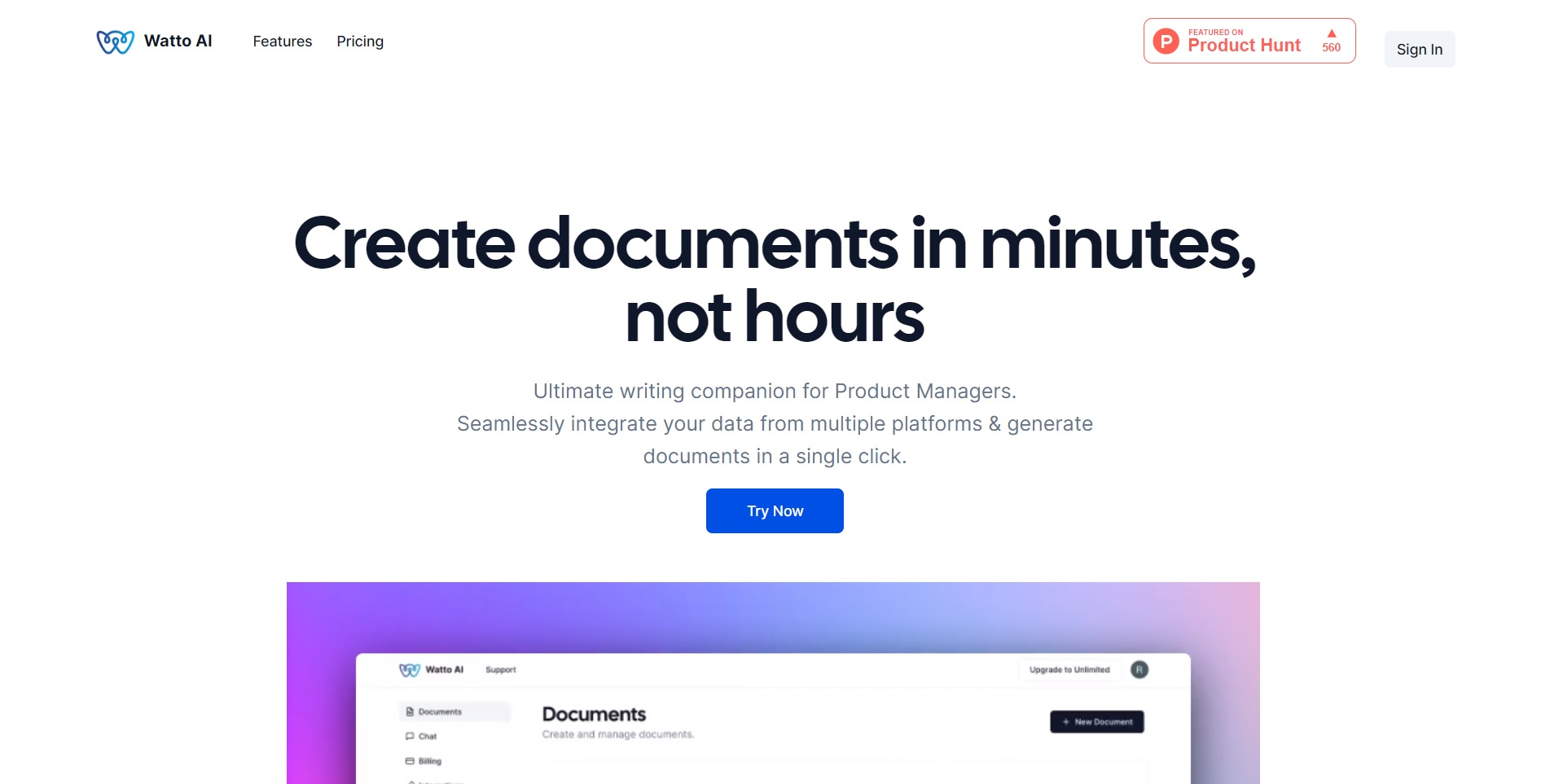
Watto AI was a Seattle-based AI startup founded in July 2023 by Rishabh Panwar, Ishita Bhandari, and Suryansh Soni under the legal entity Tensai Technologies, Inc.[1][2] The company graduated from Y Combinator's Summer 2023 batch with a product that used large language models to generate structured business documents — PRDs, GTM strategies, white papers — targeting Product Managers who, the founders argued, spent 40% of their working hours on content creation.[3]
The company's core product was commoditized before it could scale. Watto launched in mid-2023 precisely as Notion, Atlassian, Microsoft, and Google were embedding AI writing assistants natively into the tools PMs already used — eroding the willingness-to-pay for a standalone point solution. The team pivoted to AI voice assistants for restaurants and healthcare clinics, but could not raise a follow-on round and was ultimately acquired.
Both Rishabh Panwar and Ishita Bhandari now work at Salesforce on AI voice agent products, including the Agentforce Voice platform.[4][5] The outcome is consistent with an acqui-hire: Salesforce absorbed the team's voice AI expertise, and no public acquisition announcement was made. Y Combinator's company page lists Watto AI's status as "Acquired."[6]

Founding Story
Watto AI was not a company born from a cold insight. The three founders — Rishabh Panwar, Ishita Bhandari, and Suryansh Soni — had known each other for roughly a decade before incorporating in July 2023, having previously worked on multiple projects and at least one startup together in India.[7] That shared history reduced a risk that kills many early-stage companies before product-market fit is ever tested: co-founder conflict.
The team's technical credentials were solid. Panwar holds a Master of Science in Information Technology with a software engineering focus from Carnegie Mellon University and previously worked as a full-stack Android engineer at Wish.[8][9] Bhandari is a University of Washington iSchool alumna with over seven years of software development experience at StubHub and DoorDash — and notably, she had already founded a company before Watto: Wordly, an award-winning vocabulary app for non-native English speakers built during her undergraduate years.[10][11] Soni, the CTO, is also a UW alumnus with a parallel background at StubHub and DoorDash.[12]
The founding insight came from direct professional experience. The team had watched Product Managers — one of the most document-intensive roles in any tech organization — spend enormous portions of their week writing artifacts that followed predictable structures: product requirements documents, go-to-market strategies, launch communications, competitive analyses. The founders quantified this as 40% of PM work hours consumed by content creation.[3] The hypothesis was that LLMs, properly scaffolded with PM-specific templates and connected to the tools PMs already used, could compress that time dramatically.
The initial vision was horizontal within the PM persona: a single platform that could generate any PM document type, learn from a team's prior work, and integrate deeply enough into existing workflows that it became indispensable. The founders described their proprietary LLMs as capable of "fine-tuning and learning over time" to become a team's "star performer."[13]
For Pro Subscribers
Unlock the full Watto AI teardown
Read the complete post-mortem, the rebuild playbook, and the exact reasons Watto AI is still worth studying now.