Included with Pro$20/mo
Technical Specs are included with Pro
Upgrade to Pro to get implementation-ready specs for every company, the full report library, and 5 on-demand report requests per month.
- Implementation-ready specs for every company
- Full report and rebuild playbook library
- 5 on-demand report requests per month
Overview
Wufoo was an online form builder founded in 2006 by Kevin Hale, Chris Campbell, and Ryan Campbell in Tampa, Florida, operating under the legal entity Infinity Box Inc. [1] The company emerged from Y Combinator's Winter 2006 batch — one of the accelerator's earliest cohorts — with a deceptively simple product: a web application that let anyone build a form, collect data, and process payments without writing a single line of code. [2]
Wufoo did not fail. It is one of the clearest examples in YC's history of a bootstrapped SaaS company that achieved profitability on its own terms, refused venture capital on principle, and exited cleanly at a price that rewarded its founders and early angels. The more instructive narrative is not about collapse but about deliberate constraint: a team of three that stayed at ten people through acquisition, raised only $118,000 in outside capital, and built a product that a major acquirer called "the market leader in online form creation." [3]
On April 25, 2011, SurveyMonkey acquired Infinity Box Inc. for $35 million in cash and stock. [4] The entire team relocated from Tampa to Palo Alto. Kevin Hale subsequently joined Y Combinator as a partner, institutionalizing Wufoo's operational lessons into the accelerator's curriculum. The company's story is less a cautionary tale than a template — one that the startup ecosystem has been slowly rediscovering ever since.

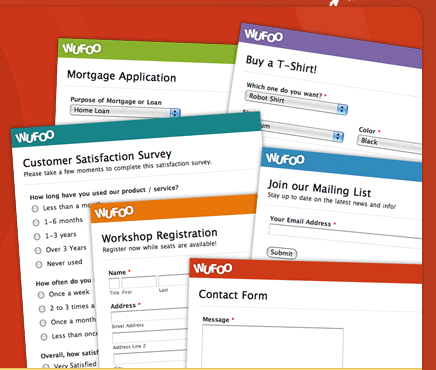
Founding Story
Kevin Hale, Chris Campbell, and Ryan Campbell were not first-time hackers stumbling into their first startup. Before Wufoo, the three had already built and operated Particletree Inc., a web development blog and monthly PDF magazine called Treehouse that gave them a real audience, operational credibility, and a revenue-first mindset before they ever walked into a Y Combinator interview. [5]
The plan before YC was straightforward: use Treehouse magazine revenues to fund the web application they actually wanted to build. Kevin Hale, who had served as editor-in-chief of his college newspaper, was already thinking about publishing as a funding mechanism for software. [6] That plan never had to be tested. Y Combinator changed the trajectory.
The product idea itself did not come from the founders. During the YC interview, Paul Graham suggested building a web application for online forms. The founders' initial reaction was resistance. As Kevin Hale later recounted: "We looked at other form builders, and we were like, 'All these people are crappy. And we don't want to be in that space.'" [7]
The pivot from resistance to conviction happened quickly. The founders recognized that a universally mediocre competitive landscape was not a deterrent — it was an invitation. If every existing form builder was bad, a team that could execute on user experience had a clear path to differentiation. The insight was contrarian but grounded: they were not betting on a new market, they were betting on their ability to out-execute incumbents in an established one.
The legal structure required some untangling. Because Particletree Inc. could not accommodate YC's seed funding for legal reasons, the founders created a new entity — Infinity Box Inc. — specifically to house Wufoo. [8] The two companies ran in parallel for a period before Wufoo became the clear focus.
Even the name was contested. Kevin Hale coined "Wufoo" from the first syllables of Wu Tang Clan and Foo Fighters. The other two founders were initially not fans. [9] The fact that the name survived internal dissent and became a recognizable brand is a small but telling signal about how the team navigated disagreement — productively, without paralysis.
Kevin Hale later described YC's value in terms that went beyond the $18,000 check: "It is no exaggeration for me to say that it transformed the lives of the founders pretty completely. They gave us introductions and opportunities that we would have been hard pressed to recreate solely on our own." [10]

Timeline
-
2006 — Kevin Hale, Chris Campbell, and Ryan Campbell found Infinity Box Inc. in Tampa, FL; accepted into Y Combinator Winter 2006 batch with $18K seed funding. Paul Graham suggests online forms as the product idea during the YC interview. [11]
-
2006 — Founders raise $100K in angel funding from Paul Buchheit, Paul Graham, and others, bringing total outside capital to $118K. New legal entity created to accommodate YC funding. [12]
-
2006 — After six months of development during the YC program, Wufoo launches publicly. Servers crash on TechCrunch launch day; Particletree community members defend the product in comments, turning a technical failure into a PR positive. [13]
-
2007 — Wufoo reaches profitability within 9 months of launch, validating the freemium conversion model. The company never raises outside capital again. [14]
-
2008 — Jakob Nielsen ranks Wufoo as one of the best application UIs of 2008, cementing its UX reputation in the developer and design community. [15]
-
January 2010 — Wufoo has grown to seven employees, operates remote-first with no central office, and is growing revenues more than 10% month-over-month. [16]
-
2010 — Wufoo adds payment processing to its forms; the company has approximately 350,000 total users. [17]
-
Late 2010 — SurveyMonkey raises $100M in debt, beginning an acquisition spree. [18]
-
April 25, 2011 — SurveyMonkey acquires Infinity Box Inc. (Wufoo) for $35M in cash and stock. Entire ~10-person team relocates from Tampa to Palo Alto. More than $100M in transactions have been processed through Wufoo forms. [4]
-
March 2012 — Post-acquisition, Wufoo has over 500,000 users and more than 3 million forms created. [19]
-
2015 — Kevin Hale, now a Y Combinator partner, reflects publicly on the acquisition as a rare "by the book" outcome and draws on Wufoo's lessons in Startup School lectures. [20]
What They Built
Wufoo solved a problem that every organization had but most accepted as unavoidable: building a form to collect data required a developer, a database, a backend, and days of work. Wufoo collapsed that entire stack into a drag-and-drop interface that any non-technical user could operate in minutes. [21]
The core mechanic was automatic infrastructure generation. When a user designed a form in Wufoo's interface — adding fields, setting validation rules, choosing a layout — the application simultaneously built the database schema, the backend logic, and the submission scripts required to make that form functional. The user never saw any of this. They saw a form. Wufoo handled everything else. [22]
The user experience followed a straightforward path: create an account, open the form builder, drag in fields (text inputs, dropdowns, checkboxes, file uploads, date pickers), configure rules, customize the visual theme, and publish via a shareable link or an embed code. Responses appeared in a structured data view inside the Wufoo dashboard, with basic reporting and export options. The entire workflow required no technical knowledge.
What made this technically meaningful in 2006 was the use of AJAX — a then-novel approach to building web interfaces that behaved like desktop software, updating dynamically without full page reloads. [23] Most web applications of the era felt clunky and slow by comparison. Wufoo's form builder felt immediate. That responsiveness was not incidental — it was a deliberate design choice that Jakob Nielsen recognized when he ranked Wufoo among the best application UIs of 2008. [15]
The product evolved in one significant direction after launch: payment processing. A few years in, Wufoo added the ability to collect payments directly through forms, integrating with payment gateways so that event registrations, product orders, and donations could be completed without leaving the form. By the time of acquisition, more than $100 million in transactions had been processed through Wufoo forms — a figure that reframes the product from a data-collection tool into a lightweight transactional platform. [24]
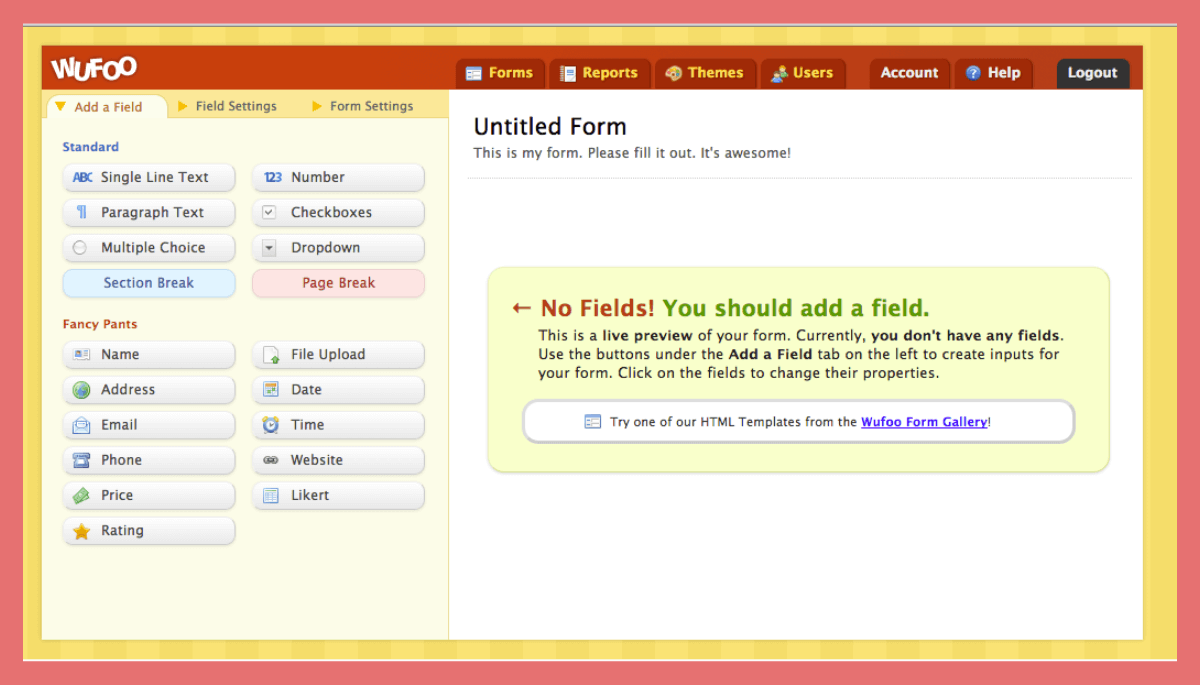
The freemium model structured access in tiers. The free plan offered three forms and up to 100 entries per month — enough to demonstrate value, not enough to run a real operation. Paid tiers unlocked payment integration, SSL encryption, higher entry limits, more forms, and removal of Wufoo branding. [25] The free tier was designed to convert users who hit limits, not to maximize free usage indefinitely.
What separated Wufoo from alternatives was not any single feature but the cumulative quality of the experience. Competitors existed — FormSite, JotForm, and others — but none had invested in UX at the same level. The founders' original contrarian insight held: the market was not short on form builders, it was short on good ones.
Market Position
Target Customers
Wufoo's customer base was deliberately broad. The product served anyone who needed to collect structured data without technical resources: small businesses building contact forms, nonprofits processing event registrations, educators gathering student feedback, HR departments running internal surveys, and developers who wanted a faster path to data collection than building from scratch. High-profile institutional users including Harvard University and Amazon provided social proof that accelerated adoption across both enterprise and SMB segments. [23]
The bottom-up adoption pattern was characteristic of the product's design. Individual users discovered Wufoo, embedded it in their workflows, and brought it into their organizations — a motion that predated the formal "product-led growth" playbook by several years. The freemium tier served as the top of this funnel, converting users who outgrew its limits into paying subscribers.
Market Size
The total addressable market for online form builders is difficult to bound precisely because the use case is so horizontal — virtually every organization that collects data is a potential customer. In 2006, the market was nascent as a software category; most organizations either built forms manually or used survey tools that were not designed for general data collection. By 2011, the category was growing rapidly, and SurveyMonkey's willingness to pay $35M for the market leader signals that it viewed the space as strategically significant. [4] The subsequent emergence of Typeform (founded 2012), Google Forms (expanded significantly post-2012), and Airtable (founded 2012) confirms that the market Wufoo helped define became large and contested.
Competition
Wufoo competed in a market that was structurally fragmented at launch and became structurally consolidated over time. In 2006, the competitive landscape consisted of legacy form tools (FormSite, founded 1998) and early web-native alternatives, none of which had invested meaningfully in user experience. This fragmentation was the founders' entry point: they were not trying to displace a dominant incumbent, they were trying to be the first good product in a category full of mediocre ones.
The competitive dynamics shifted along two axes after Wufoo's launch. First, the product quality bar rose as competitors observed Wufoo's success and invested in their own UX. JotForm, founded in 2006 (the same year as Wufoo), grew aggressively and eventually surpassed Wufoo in user count. Second, and more consequentially, platform players began absorbing the use case. Google Forms, initially launched in 2007 as part of Google Docs, was free, deeply integrated with Google's ecosystem, and sufficient for a large portion of Wufoo's potential user base. This is the structural dynamic that most threatened Wufoo's long-term independence: the core use case was simple enough that a platform with distribution advantages could offer a "good enough" version at zero marginal cost.
Wufoo's response to this dynamic was not to compete on distribution — it could not — but to compete on depth and quality. The AJAX-driven builder, the payment processing integration, the UX polish, and the customer support experience created a product that was meaningfully better than Google Forms for users who needed more than basic data collection. That positioning held through 2011. Whether it would have held through 2015 — when Typeform introduced conversational forms and Google continued expanding Forms — is an open question the acquisition rendered moot.
The acquisition by SurveyMonkey was itself a competitive move. SurveyMonkey's core product was survey creation; Wufoo's was general-purpose form building. The two products were adjacent but distinct. By acquiring Wufoo, SurveyMonkey extended its data collection surface area and blocked a potential competitor from growing into its core market.
Business Model
Wufoo operated on a freemium SaaS model with monthly subscription tiers. The free plan served as the acquisition layer; paid plans converted users who needed more capacity, payment processing, SSL, or white-label options. [25] The company never disclosed specific revenue figures, and the absence of public financial data is consistent with its deliberate low-profile posture.
The only revenue estimate available is a low-confidence community calculation from a Hacker News commenter who, using 1.5 million monthly unique visitors and revenue-per-visitor comps from SurveyMonkey, estimated approximately $3.5M in annual recurring revenue at the time of acquisition. [26] This figure should be treated as directional, not factual. If accurate, the $35M acquisition price implies a roughly 10x revenue multiple — reasonable for a high-growth, profitable SaaS business in 2011.
Total outside capital raised was $118,000: $18,000 from Y Combinator and $100,000 from angels including Paul Buchheit and Paul Graham. [12] The company never raised again. With a team that peaked at approximately 10 people, a remote-first structure based in Tampa (not San Francisco), and no sales or marketing spend, burn rate was structurally low. A team of 10 in Tampa in 2010, even at generous compensation, would imply annual operating costs well under $2M — meaning the company was generating meaningful free cash flow by the time of acquisition.
Kevin Hale was explicit about why the company declined VC interest: "There wasn't a venture capitalist that I met that I felt like I needed his money so badly or that he was going to give me intellect that I felt would be helpful for the company." [27] This was a values decision, not a fundraising failure. Profitability within nine months of launch meant the founders never needed to make a different choice. [14]
Traction
Wufoo's growth was almost entirely organic. The company ran no paid acquisition campaigns and had no sales team. Growth compounded through word-of-mouth, driven by a deliberate strategy of creating "super fans" rather than maximizing user counts. Kevin Hale described the approach: "All we had to do was get a few super fans. We tried to be as human as possible and we wanted to make the people who are our champions look awesome to their peers." [28]
The launch itself was turbulent. Servers crashed on TechCrunch launch day — a common failure mode for early-stage products hit with sudden traffic. What was unusual was the response: members of the Particletree blog community, who had followed the founders before Wufoo existed, defended the product in the TechCrunch comments and vouched for the team's credibility. [29] The founders' pre-existing audience functioned as a launch buffer that most cold-start products don't have.
By early 2010, revenues were growing more than 10% month-over-month, and the team had reached seven employees. [16] At approximately the same time, total users stood at roughly 350,000. [17] By March 2012 — roughly a year post-acquisition — the user base had grown to over 500,000, with more than 3 million forms created. [19]
The support volume at scale is a useful proxy for engagement: Wufoo was handling approximately 800 support emails per week against a user base of 500,000. [30] That ratio — roughly 1.6 support contacts per 1,000 users per week — suggests a product that was largely self-service and well-documented, consistent with the founders' investment in documentation and support-driven development.
Post-Mortem
Wufoo did not fail. A post-mortem in the traditional sense — cataloguing the decisions that led to collapse — does not apply here. What the company's story demands instead is a structural analysis of how it succeeded against the odds, and what the constraints it chose reveal about the assumptions most startups make.
The Contrarian Market Entry Thesis Held
The founding insight — that a universally bad competitive landscape was an opportunity for a team that could execute on experience — proved correct over five years of operation. Wufoo entered a market where incumbents had distribution but not quality. The founders bet that quality would compound through word-of-mouth faster than incumbents could improve their products. That bet paid off.
The structural risk in this thesis was always platform encroachment. Google Forms launched in 2007, one year after Wufoo, and was free, deeply integrated with Google Docs, and sufficient for basic use cases. A product that competes on quality against a free, good-enough alternative from a platform with billions of users is structurally disadvantaged in the long run. Wufoo's response — competing on depth, payment processing, and UX polish — was correct but time-limited. The acquisition in 2011 came before this dynamic fully played out. Whether Wufoo could have sustained its position through 2015 against Google Forms, Typeform, and JotForm is unknowable, but the structural pressure was real and growing.
Capital Efficiency as a Strategic Choice, Not a Constraint
Most startups treat capital efficiency as a constraint imposed by investors or market conditions. Wufoo treated it as a deliberate strategic choice. The founders raised $118,000 and never raised again. [12] They declined VC interest explicitly, on the grounds that no investor offered intellectual value commensurate with the cost of dilution and control. [27]
The consequences of this choice were structural. A small team in Tampa with no sales function and no marketing spend had a burn rate that allowed profitability within nine months. [14] Profitability meant the founders could make decisions on their own terms — including the decision to sell, and the decision of when and to whom. The $35M exit on $118K of outside capital represents an extraordinary return for founders and angels alike, precisely because dilution was minimal.
The tradeoff was growth rate. A well-capitalized competitor with a sales team could have grown faster. JotForm, which raised external capital, eventually surpassed Wufoo in user count. Whether faster growth would have produced a better outcome for the founders is not obvious — a larger, VC-backed Wufoo might have commanded a higher acquisition price, or it might have been forced into a growth trajectory that destroyed the culture and operational model that made it valuable.
Support-Driven Development as a Compounding Feedback Loop
Wufoo's most distinctive operational practice was requiring engineers and designers to do customer support. Kevin Hale framed this as a structural forcing function: "The people who do the creating are the people who do the supporting." [31] The logic was that builders who feel the pain of their product's failures directly cannot rationalize away user problems. Every support ticket was a product signal that went immediately to the person who could fix it.
This practice also served as a marketing channel. Kevin Hale described every support email as "an opportunity to make a fan out of someone." [32] At 800 support emails per week against 500,000 users, the volume was manageable for a team of 10 — but only because the product was well-documented. Every team member wrote documentation, distributing the knowledge work that most companies centralize in a support function. [33]
The compounding effect of this approach was a product that improved faster than competitors who relied on user research or product managers to mediate between customers and builders. It also produced a user base that was unusually loyal — users who had received a human, helpful response to a support request were more likely to become the "super fans" that drove word-of-mouth growth.
The Audience-First Launch Advantage
Most products launch cold. Wufoo launched into an existing community. The Particletree blog had built an audience of web developers and designers before Wufoo existed. When the TechCrunch launch crashed the servers — a moment that could have been a reputational disaster — Particletree community members stepped in to defend the product in the comments. [29]
This was not luck. The founders had spent years building credibility with their target audience before they had a product to sell them. The Particletree blog was, in retrospect, a years-long customer development exercise that also happened to produce a launch community. This advantage is structural and difficult to replicate: it requires founders who have already built something valuable before they start the company they intend to scale.
What the Acquisition Reveals About the Market
SurveyMonkey's decision to acquire Wufoo for $35M in April 2011 — as the third acquisition in a short window following a $100M debt raise — reveals something about how the market was consolidating. [18] SurveyMonkey was not buying a distressed asset; it was buying the market leader in an adjacent category before that category became a direct competitive threat. Dave Goldberg's characterization of Wufoo as "the market leader in online form creation" was both a compliment and a strategic rationale. [3]
The entire team's relocation from Tampa to Palo Alto suggests SurveyMonkey valued the people as much as the product. Whether the integration preserved what made Wufoo distinctive — the support-driven development culture, the small-team discipline, the UX focus — is not publicly documented. Acquisitions of culture-driven companies by larger organizations frequently fail to preserve the practices that made the acquired company valuable. The absence of public information about Wufoo's post-acquisition trajectory is itself a signal worth noting.
Kevin Hale's own reflection on the outcome was measured: "I feel like I had one of those really rare acquisition circumstances that actually went by the book. We were super lucky that we found Wufoo a good home, and we as the co-founders got to go on to do other things." [34] The framing of luck is notable from a founder who made a series of deliberate, non-consensus decisions that produced the outcome. The luck, if any, was in the timing — selling before the platform encroachment dynamic fully played out.
Key Lessons
-
A bad competitive landscape is an entry signal, not a deterrent — if you can out-execute on the dimension incumbents have ignored. Wufoo entered a market where every existing form builder was, in the founders' own words, "crappy." Rather than treating this as evidence that the market was unwinnable, they treated it as evidence that the market was underserved on user experience. The bet paid off: Jakob Nielsen ranked Wufoo's UI among the best of 2008, and SurveyMonkey called it the market leader five years later. The lesson is not generic ("find a bad market") but specific: Wufoo's founders had the design and development skills to execute on the dimension incumbents had neglected, and they correctly identified that dimension before entering.
-
Profitability within nine months created a decision-making freedom that no amount of VC funding could replicate. Wufoo's ability to decline investor interest, choose its own acquirer, and exit on its own timeline was a direct consequence of being cash-flow positive from month nine. [14] A VC-backed Wufoo with a board and a growth mandate would have faced different pressures at every decision point — on hiring, on pricing, on when and whether to sell. The $118K in outside capital was not a constraint that limited the company; it was a constraint that preserved the founders' optionality.
-
Requiring builders to do support is a product development strategy, not a cost-cutting measure. Wufoo's support-driven development practice — engineers and designers handling customer support directly — created a feedback loop that most product organizations pay consultants and researchers to approximate. [31] The practice worked at Wufoo's scale (10 people, 800 emails/week) and would face structural challenges at larger team sizes. The lesson is not that every company should do this indefinitely, but that the early-stage period when builders can still do support is a window that most companies close too quickly.
-
An existing audience is the most undervalued asset a founding team can bring to a new company. Wufoo's launch survived a server crash on TechCrunch because the Particletree community showed up to defend it. [29] That community was built over years of publishing credible, useful content before Wufoo existed. Founders who have already built an audience in their target market have a structural advantage at launch that cannot be manufactured in the weeks before a product ships.
-
YC's value in 2006 was almost entirely network, not capital — and the founders knew it. The $18,000 YC check was operationally irrelevant to a company that reached profitability within nine months. What YC provided was introductions to Paul Buchheit and Paul Graham as angel investors, credibility with early users, and a network that Kevin Hale later re-entered as a partner. [10] Wufoo's story is an early data point in the ongoing debate about what accelerators actually provide — and a case where the answer was clearly not the money.
Sources
- Y Combinator — Wufoo Company Profile
- Grokipedia — Wufoo
- SurveyMonkey Newsroom — Wufoo Acquisition Announcement
- TechCrunch — Wufoo Sells to SurveyMonkey for $35 Million
- Crunchbase — Infinity Box Inc.
- Team Treehouse Blog — Kevin Hale of Wufoo Talks UX, Funding, Startups and API Integration
- Mixergy — Wufoo Sold for $35M, Here's the Story Behind Its Success
- Techleash — Interview with Chris Campbell, Co-founder, Wufoo.com
- Mixergy — Kevin Hale Interview
- ZURB Soapbox — Kevin Hale's Soapbox: Wufoo's Buildup to SurveyMonkey's $35M Acquisition
- Yahoo Finance / Startup School — Y Combinator: Kevin Hale Shares Lessons
- Hacker News — SurveyMonkey Acquires Wufoo (acquisition announcement thread)
- Hacker News — Revenue estimate discussion thread
- Andrew Spittle — Kevin Hale: Engineer Docs
- Unmatched Style Podcast — Kevin Hale of Wufoo, Episode 44
- CBInsights — Wufoo
Included with Pro$20/mo
Ready to rebuild Wufoo?
Implementation-ready specs, every report, and 5 on-demand requests each month.
- Implementation-ready specs for every company
- Full report and rebuild playbook library
- 5 on-demand report requests per month