Overview
Zipio — publicly known as Dealupa during its operational life — was a Y Combinator Winter 2012 company that built a search and ranking layer for the daily deals market.Founded by two former Google engineers in Seattle, the company aggregated deals from across the web, ranked them using a proprietary algorithm modeled on Google's PageRank, and personalized results using collaborative filtering and Facebook's social graph.The core thesis was elegant: the daily deals space was fragmented and noisy, and what it needed was not another deals publisher but a discovery infrastructure layer.
The company cycled through four names in roughly 18 months, reported strong early traction at Demo Day, and then went silent.It never raised a documented follow-on round.
The most likely cause of failure was not a product flaw but a category collapse: Dealupa entered the daily deals market at its precise peak and built its entire business model on an ecosystem — deal publishers, affiliate programs, crawlable inventory — that began contracting almost immediately after the company launched.When the supply side disappeared, so did Dealupa.

Founding Story
Sanjay Mavinkurve and Vijay Boyapati met at Google, where both had built careers working on large-scale search and information systems. Mavinkurve held a B.A. and M.S. in computer science from Harvard and had worked on Google Maps for mobile devices before rotating through the Google X and Google+ teams. [1] His connection to the Harvard ecosystem ran deep: he had been one of the early engineers on HarvardConnection — the social network founded by the Winklevoss twins and Divya Narendra that predated Facebook — before graduating in 2003 and joining Google. [2] Boyapati, who attended The Australian National University, had been part of the engineering team that built Google News. [3] [4]
The two left Google in 2011 to found the company in Seattle — an unusual base for a YC-backed startup, suggesting neither founder was deeply embedded in the San Francisco startup ecosystem prior to the program. Their founding premise was explicit: the daily deals market was generating enormous consumer interest but was structurally broken as a discovery experience. Consumers had to visit Groupon, LivingSocial, and dozens of smaller publishers separately, with no way to compare or rank deals across the ecosystem. Mavinkurve framed the opportunity in terms of their shared professional identity: "search is in our blood." [5]
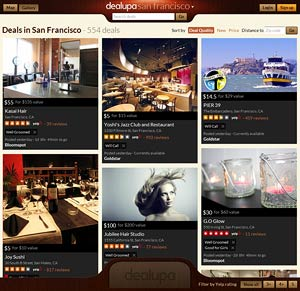
The company launched publicly in November 2011 under the name Deelio, positioning itself as a search and discovery platform for deals. [6] Within weeks it had rebranded to The Dealmix — only to encounter domain squatters, forcing yet another name change. [7] The company entered Y Combinator's Winter 2012 batch as Dealupa and used the three-month program to rebuild the product's visual design around a Pinterest-style cascading card interface. It would later rebrand one final time to Zipio — the name under which it is listed on YC's company directory — though no press coverage of that final rebrand exists.
For Pro Subscribers
Unlock the full Zipio teardown
Read the complete post-mortem, the rebuild playbook, and the exact reasons Zipio is still worth studying now.