
AI.Fashion
Summer 2020InactiveAI.Fashion is the AI creative suite for the fashion industry.
Pressure-test this opportunity
Explore the risks and possibilities with a prompt for ChatGPT, Claude, or your agent.
AI.Fashion is the AI creative suite for the fashion industry.
Explore the risks and possibilities with a prompt for ChatGPT, Claude, or your agent.
AI.Fashion developed tools for creating fashion imagery before production and extending photography with digital versions of real models. Daniel Citron and John Chirikjian’s Los Angeles company joined YC’s Summer 2020 batch. Neo led a $3.6 million seed round announced in February 2024.[1][3]
Its most useful distinction was Persona: real models could license their likenesses for virtual shoots. Anne Klein, owned by WHP Global, tested the product. That work supplies concrete evidence of a buyer and a production workflow. YC now lists the company as inactive. The public record establishes those endpoints, but leaves the financial outcome and reason for ending operations unresolved.[5][6][1]
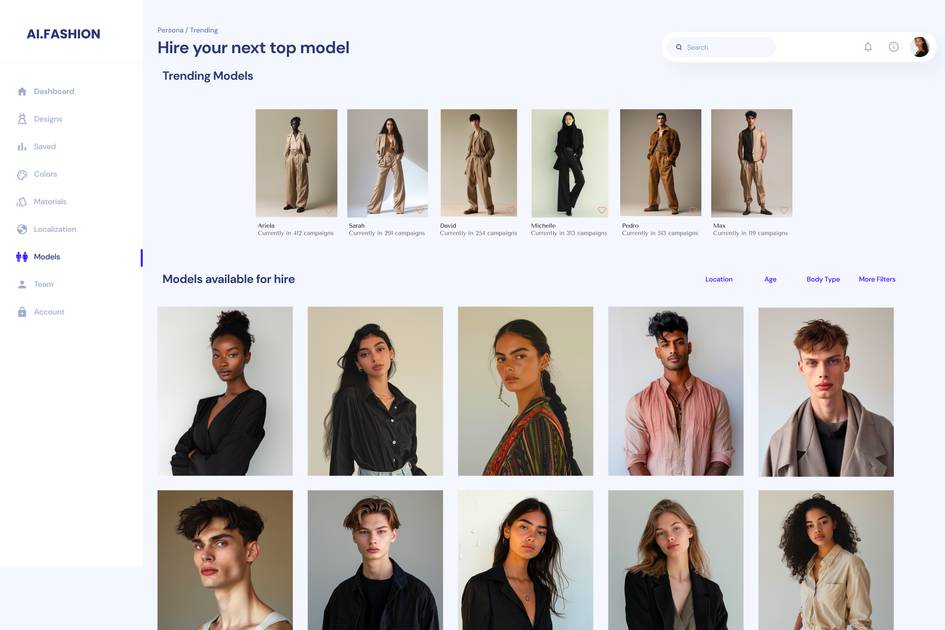
Image 1 / 2
Citron came from filmmaking and creative technology. He described Backlot, the company’s earlier film tool, as a way to simulate productions before shooting. Advertising uses brought fashion brands into view, but the original output fell short of their quality needs. Work on costume design led to a technical improvement; repeated brand demos then persuaded the founders to focus on fashion. His June 2024 interview documents the sequence, without dating the pivot.[2]
Both founders attended Gilman School: Citron graduated in 2012 and Chirikjian in 2013. YC records the company’s founding year as 2020.[4][1]

The early design workflow accepted computer-aided design files, then let users choose model types, settings, poses, and expressions. Gilman’s account describes photorealistic images returned within hours. This was a product claim about imagery; the retrieved evidence does not demonstrate accurate garment fit, lower returns, or measured waste reduction.[4]
Persona added a human talent market. Models supplied photos and measurements, set rates, and were paid when their images were used. Brands and models both opted into a collaboration. Approved brands could create studio or editorial images and adapt their aesthetics. Pricing varied with the model, image count, and type of photography.[5]
The Anne Klein test shows what adoption required. Sourcing Journal reported that Tisha Jacobson accepted a collaboration and that approximately 30 images used her digital likeness. She reviewed test images. AI.Fashion also worked with the creative team to soften lighting that initially looked too generic. Only a small share of Anne Klein’s product listings used Persona then; planned expansion was still a plan.[7]
The practical buyer was a fashion brand’s creative or e-commerce team seeking more assets from an existing season’s photography. WHP’s account describes that exact job. The company’s earlier CAD workflow also addressed pre-production visualization, but Persona’s named deployment depended on model relationships and brand review.[6][4]
No verified addressable-market estimate or paid-customer count is available. Apparel sales are a poor substitute for imagery-software spending. A useful market estimate would count brands with recurring image production, a budget owner, and enough revisions or licensing work to justify another tool.
As checked in October 2026, Botika sells fashion imagery with styling and retouching. Photoroom offers fashion models, product-image editing, batch production, and enterprise controls. Veesual’s current website promotes VidCapAI for turning product visuals into short videos. These are active alternatives for different parts of the creative job.[12][13][14]
Persona combined software production with compensation for talent. That creates costs beyond image generation: model payments, onboarding, creative revisions, and customer support. Its announcement specifies variable brand pricing, but does not disclose AI.Fashion’s take rate or margins.[5]
The documented $3.6 million figure is a seed round, not a complete capital history. Public evidence does not establish revenue, cash burn, retention, profitability, or investor returns. The economics cannot be reconstructed from a directory’s team size.[3]
WHP’s executive confirmed Anne Klein’s early use. The available case study documents a deployment, without quantified savings or recurring revenue.[6]
Citron also promoted the WHP relationship through the WWD/Sourcing Journal 2024 Tech Report and Lead Summit. Industry coverage offered access to the intended audience. The available record does not show how many buyers converted from that exposure.[8]
Anne Klein’s test exposed the work needed after generation: model review and lighting revisions. WHP also valued keeping human talent involved. These observations support a production-workflow lesson, while the cause of closure remains unknown.[7]
For a new entrant, the practical test is whether customers repeatedly pay for the finished workflow. A producer must deliver usable assets, preserve agreed scope, and track revisions. Current competitors already address parts of that work. A narrower product needs evidence that its handoff saves effort beyond the tools a brand already uses.
The current sequel check found Chirikjian’s YC biography pointing to Starpilot, whose site describes an applied robotics lab. Citron’s public profile lists Gap Inc. Neither record establishes an acquisition or transfer of Persona. The missing evidence is an operating announcement, transaction record, or founder account explaining the company’s end.[1][10][11]