
Mindmesh
Summer 2021InactiveMindmesh is the virtual desk that puts you in control.
Pressure-test this opportunity
Turn this teardown into a decision-ready prompt for ChatGPT, Claude, or your agent.
Mindmesh is the virtual desk that puts you in control.
Turn this teardown into a decision-ready prompt for ChatGPT, Claude, or your agent.
Mindmesh was a Boston-based productivity startup, part of Y Combinator's Summer 2021 batch, that set out to build a "virtual desk" — a unified workspace for product managers and knowledge workers drowning in tool fragmentation.The company conducted extensive pre-launch research, achieved SOC 2 Type II certification, earned a #1 Product of the Day ranking on Product Hunt, and secured two rounds of seed funding.
Despite these early signals, the product failed to convert launch momentum into sustained user growth.The team pivoted to an NLP-powered customer insights product, then pivoted again toward AI for customer support — neither iteration gaining documented traction.
By 2023, YC listed both founders as "Former Founders," CEO Raffaele Colella had moved on to co-found Climate House, and no formal shutdown announcement was ever published.Mindmesh's arc illustrates how strong founder credentials, rigorous pre-launch research, and a celebrated debut can still fail to produce product-market fit when the core value proposition is too abstract to drive habitual use.
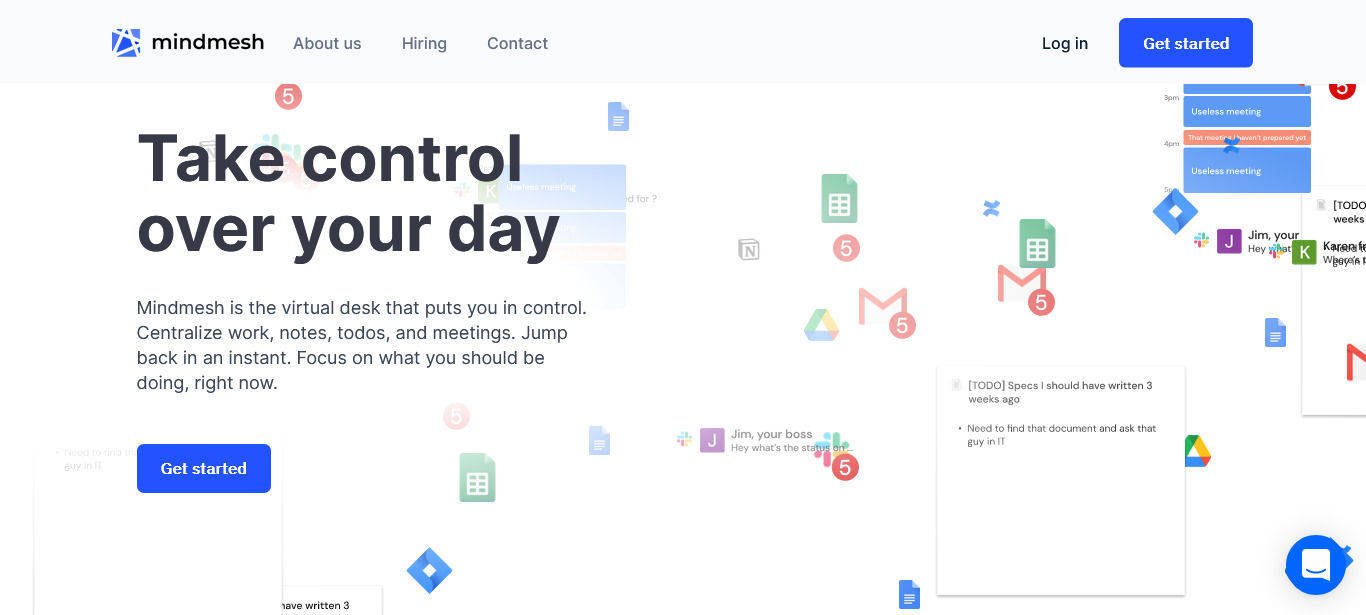

Image 1 / 2
Raffaele Colella came to Mindmesh with an unusually strong pedigree for a first-time YC founder. His earlier startup, Cannonball Corporation, built an email app called "My Blend" that received multiple Apple App Store features before being acqui-hired by Google. At Google, Colella served as lead product manager on the Google News Android app — a role that gave him direct exposure to the challenge of surfacing relevant information from a fragmented content landscape. He also holds an MBA from MIT Sloan School of Management. [1] [2]
His stated motivation for starting Mindmesh, however, was notably founder-centric rather than problem-centric. In a podcast interview, Colella explained: "I wanted to do another startup because I did one a few years ago, which actually brought me to Google because we are acquired there and so [I needed] to go back to the founder spot." [3] This framing — returning to founding as an identity rather than solving a specific pain point — is a subtle but meaningful signal about the company's eventual struggles with product focus.
Co-founder and CTO Ulysse Mizrahi brought complementary technical depth. He holds a Masters in Mathematics and Theoretical Physics from the University of Cambridge and École Polytechnique. His career spanned R&D engineering at Dataiku, Head of Data Science at Nextperf, CTO at Fitle, and Senior Engineer and Product at Upflow — itself a YC S2020 company. [4] Mizrahi's data science and NLP background would later prove directly relevant when the company pivoted away from its original product.
The company was incorporated under the legal entity name "Just Spot inc." — a detail that surfaces on Crunchbase and is confirmed by the GitHub organization name "justSpot." [5] [6] This suggests that "Spot" or "justspot.io" may have been the founders' longer-term brand vision, with "Mindmesh" serving as an early iteration. The relationship between the two identities was never publicly explained.
Read the complete post-mortem, the rebuild playbook, and the exact reasons Mindmesh is still worth studying now.