
Overview
Pixelapse was a Y Combinator-backed startup (W12) that built version control and collaboration software for designers — internally described as "GitHub for designers." Founded in 2011 by Shravan Reddy and Min Ming Lo in Palo Alto, the company solved a genuine, observed workflow problem: designers had no reliable way to track changes to their files, share feedback visually, or collaborate without resorting to chaotic shared folders.Pixelapse addressed this with an automatic desktop sync tool that captured visual revision history in the cloud, requiring no technical knowledge from its users.
The company grew to tens of thousands of daily active users and reached profitability before being acquired by Dropbox in January 2015.Financial terms were never disclosed.
Rather than a traditional failure, Pixelapse represents an acqui-hire outcome: the technology was validated, the team was absorbed, and the product was integrated into Dropbox before being shut down as a standalone service approximately one year later.The central unanswered question is whether the business could have scaled to venture-scale returns independently — a question the acquisition made permanently moot.
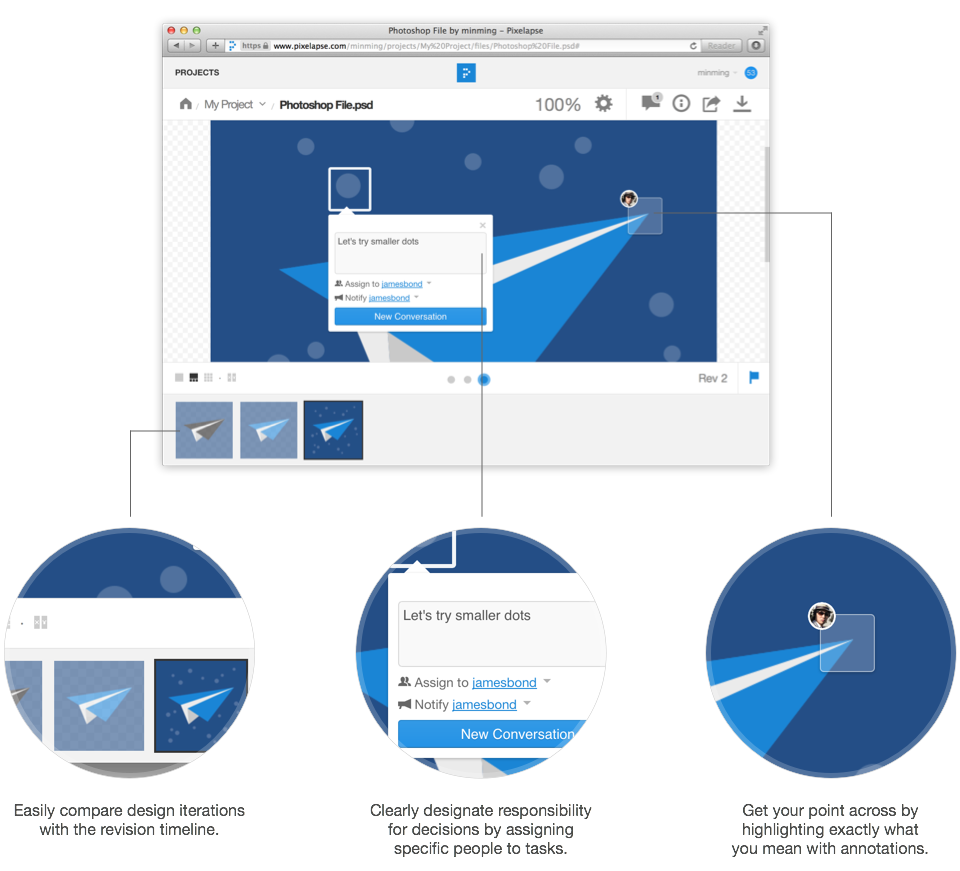
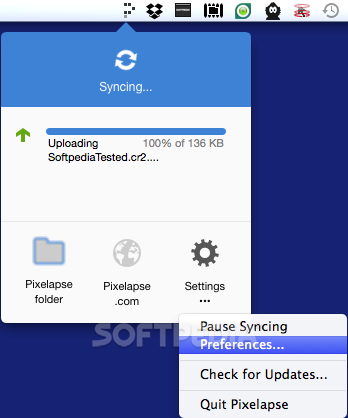
Image 1 / 2
Founding Story
The idea for Pixelapse did not emerge from market research or competitive analysis. It came from direct observation of a broken workflow.
Co-founder Min Ming Lo worked as a UX design intern at Google and watched designers struggle with a problem so mundane it had become invisible: there was no process for version-controlling design files.[1] Files accumulated in shared folders with no clear ownership, no history, and no way to give structured feedback. Co-founder and CEO Shravan Reddy described what Lo observed in blunt terms: "They didn't really have a process to version-control their work. Everyone dumped their files in a single giant folder. It was hard to tell whose assets were whose. Giving feedback was a pain — it was kind of a mess."[2]
Software engineers had solved this problem decades earlier with version control systems like Git. Designers had nothing equivalent — and the tools engineers used required command-line interfaces that most designers would never adopt. The founding insight was that the solution needed to be invisible: automatic, visual, and requiring zero technical overhead.

Reddy and Lo co-founded the company in Palo Alto in 2011.[3] A third co-founder, Michael Wu, is listed in at least one source, though his specific role and contribution to the founding are not documented in the public record.[4] How the founders met and how they divided responsibilities has not been publicly disclosed.
The product was originally codenamed "Folio" before being renamed Pixelapse — a portmanteau of "Pixel" and "Timelapse" — to encode the core value proposition directly in the brand name: the visual evolution of a design over time.[5] The name was a deliberate signal to designers that this was a tool built for their medium, not adapted from an engineering workflow.
The founding team secured institutional validation quickly. Pixelapse joined Y Combinator's Winter 2012 batch[6] and then participated in Stanford's StartX accelerator in the summer of the same year[7] — a dual-accelerator path that signaled strong founder credibility. The seed round that followed drew from a broad and high-profile syndicate, including Spark Capital, Andreessen Horowitz, SVAngel, YC, and notable angels including Matt Cutts of Google and Josh Reeves of Gusto.[8] The total amount raised was not disclosed.[9]
The company's initial vision — a definitive version control and collaboration platform for creative professionals — did not materially change between founding and acquisition. There were no documented major pivots. The product evolved in features and polish, but the core thesis remained intact from the Google internship observation through to the Dropbox acquisition announcement.
Timeline
-
2011 — Pixelapse co-founded by Shravan Reddy and Min Ming Lo in Palo Alto, inspired by Lo's observation of design workflow chaos during a Google UX internship.[1]
-
January 2012 — Pixelapse joins Y Combinator's Winter 2012 batch.[6]
-
2012 — Seed round closed from Spark Capital, a16z, SVAngel, YC, and notable angels. Amount undisclosed.[8]
-
Summer 2012 — Pixelapse participates in Stanford's StartX accelerator program.[7]
-
2012 — Team previews the product on Hacker News, receiving significant community feedback and early sign-ups — first public validation signal.[10]
-
January 16, 2013 — Pixelapse announces tiered pricing plans via Twitter, signaling the transition from beta to monetization.
- February 13, 2013 — Pixelapse officially launches publicly via TechCrunch. Over 500,000 image revisions already hosted; user base in the thousands. Tiered pricing (free through $69/month) rolls out simultaneously.[11]
-
January 2, 2015 — Appvita publishes a profile of Pixelapse's "Visual Workspaces" product, documenting pricing tiers and listing three co-founders including Michael Wu.[4]
-
January 26, 2015 — Dropbox acquires Pixelapse. Financial terms undisclosed. At time of acquisition, Pixelapse has tens of thousands of daily active users and has reached profitability.[12]

- ~2016 — Pixelapse shuts down as a standalone product approximately one year after acquisition. Paid users receive a free year of Dropbox. Dropbox integrates Adobe file support, version history, and image annotation into its core product.[13]
What They Built
Pixelapse built a visual version control and collaboration platform designed specifically for designers — people who work in binary file formats like Photoshop and Illustrator that traditional code-based version control systems cannot meaningfully process.
The Core Mechanic
The product worked through a desktop companion application. After installation, Pixelapse created a dedicated sync folder on the user's computer. Whenever a designer saved changes to a file inside that folder, the application automatically detected the change and synced the new version to the cloud.[14] No manual action was required — no "commit" command, no version naming, no deliberate save-to-cloud step. The system captured history passively, in the background, while designers worked normally.
In the cloud, each file's history was rendered as a visual timeline: a sequence of thumbnail images showing how the design had changed over time. A designer could scrub through this timeline to see exactly when a logo changed color, when a layout was restructured, or when an element was removed. This visual representation was the key differentiator from code-based tools, which show text diffs that are meaningless for image files.

File Format Support
Pixelapse supported more than 50 file formats, including Adobe Illustrator (.ai), Photoshop (.psd), and Fireworks files, as well as front-end code files in CSS, HTML, and JavaScript.[15] This breadth made the product applicable across the full spectrum of digital design work — from brand identity to web design to UI/UX — without requiring designers to change their toolchain.
Collaboration Features
Beyond version history, Pixelapse included a collaboration layer. Invited team members could leave comments and visually annotate specific areas of an image — pointing to a particular element and attaching feedback directly to it, rather than describing it in a separate email or chat message.[16] The platform also offered a public gallery feature, allowing designers to share their work and its revision history publicly — a portfolio and community function layered on top of the core versioning utility.
Technical Challenge
The sync mechanism was not trivial to build. CEO Shravan Reddy acknowledged publicly that "syncing was a tremendous problem" to solve correctly.[17] Design files — particularly Photoshop and Illustrator files — are large, complex binary formats that change in ways that are difficult to detect and transmit efficiently. Unlike text files, where a diff can capture only the changed lines, binary files often require transmitting the entire file on each save. Building a sync system that was fast, reliable, and storage-efficient for these formats was a meaningful engineering challenge.
Pricing
At public launch in February 2013, Pixelapse introduced a freemium pricing structure: a free plan with 1GB of storage, a Small plan at $15/month, a Medium plan at $29/month, a Large plan at $69/month, and a Team plan with custom pricing.[18] The free tier was positioned as permanent for open-source design work, following the GitHub model of free public repositories.
What distinguished Pixelapse from alternatives was the combination of automatic capture (no manual commits), visual rendering (not text diffs), and broad file format support — all packaged in a tool that required no technical knowledge to use. GitHub required command-line proficiency. Dropbox provided storage but no visual history or annotation. Adobe's own tools offered no cross-application version control. Pixelapse occupied a specific gap between these options.
Market Position
Target Customers
Pixelapse targeted two overlapping segments: freelance designers working independently, and creative teams inside agencies or companies. By the time of the Dropbox acquisition in January 2015, the platform had "tens of thousands" of freelance designers and creative teams as daily active users.[19]
The product was designed for professional designers who used desktop tools — primarily the Adobe Creative Suite — as their primary workflow. This was a specific and well-defined user profile: technically capable enough to install a desktop application, but not expected to use command-line tools or understand version control concepts. The UX assumption was that the product had to be invisible in operation; any friction would cause abandonment.
The collaboration features also made the product relevant to design managers, creative directors, and clients who needed to review and annotate work — extending the potential user base beyond the designer herself to everyone involved in the design review process.
Market Size
The addressable market for design collaboration tools in 2012–2015 was real but difficult to size precisely. The global design software market was growing alongside the broader expansion of digital product development, mobile app design, and web design. Adobe's Creative Suite had millions of licensed users worldwide — the upper bound of Pixelapse's potential reach, assuming every Adobe user was a potential customer.
In practice, the immediately addressable market was narrower: professional designers who worked collaboratively, managed multiple file versions, and had enough workflow pain to adopt a new tool. This was a meaningful niche — likely in the hundreds of thousands to low millions of users globally — but not obviously a market capable of supporting a standalone venture-scale business without significant expansion into adjacent categories.
The design tooling category would later be validated at scale by Figma, which reached a $10 billion valuation by 2021 and was acquired by Adobe for $20 billion (a deal that was ultimately blocked by regulators). Abstract, a version control tool specifically for Sketch files, also raised $30 million in venture funding before pivoting in 2022. These later outcomes confirm that the category Pixelapse identified was real and large — but they also suggest that the market required a platform shift (from desktop to browser-based, collaborative-by-default tools) to fully unlock.
Competition
At the time of Pixelapse's acquisition, no single company had established a dominant standard for design version control.[20] The competitive landscape included:
LayerVault — The most direct competitor, also positioned as version control for designers. LayerVault launched around the same time as Pixelapse, raised venture funding, and built a similar feature set. It shut down as a standalone product in 2014 — before Pixelapse — after failing to achieve sustainable growth, and its team was absorbed into a pivot called Designer News.
Adobe — The incumbent with the largest installed base. Adobe had deep integration with its own file formats but offered no cross-application version history or collaborative annotation at the time. Its Creative Cloud subscription service, launched in 2012, provided cloud storage but not versioning.
GitHub — Technically capable of storing design files as binary blobs, but offered no visual rendering, no design-specific diff tools, and required command-line proficiency. Used by some technically sophisticated designers but not broadly applicable.
Dropbox — Provided file sync and a limited version history feature (recovering deleted or overwritten files), but offered no visual timeline, no annotation, and no design-file-specific rendering. Dropbox's acquisition of Pixelapse was, in part, an acknowledgment that its own version history feature was insufficient for design workflows.
The fragmented competitive landscape in 2015 — with no clear winner among these options — suggests the market had not yet consolidated around a solution. Figma's eventual dominance came not from better versioning of desktop files, but from eliminating the desktop file entirely: a browser-based, real-time collaborative tool that made the version control problem largely moot by design.
Business Model
Pixelapse operated a freemium SaaS model with tiered monthly subscriptions. The free plan offered 1GB of storage and was positioned as permanent for open-source design work. Paid plans ranged from $15/month (Small) to $29/month (Medium) to $69/month (Large), with a custom-priced Team tier for larger organizations.[18]
Revenue came from converting free users to paid plans as their storage needs grew or as they required collaboration features beyond the free tier's limits. This model mirrored Dropbox's own freemium structure and GitHub's free public / paid private repository model.
At public launch in February 2013, the vast majority of users were on the free plan, and conversion to paid was an open question.[21] By the time of the January 2015 acquisition, CEO Shravan Reddy had grown the business to profitability[22] — indicating that the unit economics were workable at the scale the company had reached. Revenue figures were never disclosed, and the path to venture-scale revenue from a niche design tool audience remained untested at the time of acquisition.
Traction
Early validation was strong and came from the developer community before the product was publicly available. The team previewed Pixelapse on Hacker News and received significant feedback and sign-ups, confirming that the problem resonated with technically aware designers.[10]
By the February 2013 public launch, over 500,000 image revisions had already been hosted on the platform, and the user base had grown into the thousands since the private beta.[23] At that point, the vast majority of users were on the free plan — tiered pricing had only just been introduced, and conversion rates were not disclosed.[21]
Between the February 2013 launch and the January 2015 acquisition — a period of approximately 23 months — the user base grew from "thousands" to "tens of thousands" of daily active users.[19] This represents steady but not explosive growth: roughly an order-of-magnitude increase over two years in a niche professional tool category. Whether growth was accelerating or plateauing in the months before the acquisition is not documented.
The most significant traction signal was profitability. CEO Shravan Reddy grew the business to profitability before the acquisition[22] — a meaningful indicator that the unit economics were sound and that the company was not burning through its seed capital unsustainably. For a niche B2B SaaS tool with a freemium model, reaching profitability at tens of thousands of DAUs suggests a meaningful proportion of users had converted to paid plans, though exact conversion rates and revenue figures remain undisclosed.
Post-Mortem
Pixelapse is not a conventional startup failure. The company reached profitability, was acquired by a major technology company, and had its core technology integrated into a product used by hundreds of millions of people. By most measures, this is a successful outcome. The more precise question is why Pixelapse did not continue as an independent company — and what that reveals about the structural constraints it faced.
The Market Was Real But Narrow — and the Timing Was Wrong
The most fundamental constraint Pixelapse faced was not product quality or execution. It was the structure of the design tool market in 2012–2015.
Pixelapse was built for a world where designers worked in desktop applications — Photoshop, Illustrator, Fireworks — and saved files locally. Version control for these files was genuinely painful, and Pixelapse solved that pain well. But the solution was architecturally dependent on the problem: a sync-based version control tool only matters if designers are working with local files that need to be synced.
By 2012, Figma was already in development (it launched publicly in 2016), and the broader trajectory of design tools was toward browser-based, real-time collaborative applications. In these tools, version history is a native feature of the platform, not a third-party add-on. The problem Pixelapse solved was real in 2013 — but the platform shift that would make it less relevant was already underway.
No single company — Pixelapse, Adobe, LayerVault, or GitHub — had become an industry standard for design version control by the time of the acquisition.[20] This fragmentation suggests the market had not yet decided what the right solution looked like — and the eventual answer (Figma's browser-native collaboration) made the entire category of desktop-file version control largely obsolete.
Pixelapse did not fail to execute in this environment. But the market it was building for was contracting, not expanding, as design tools migrated to the browser.
The Technical Core Was a Meaningful Constraint on Growth Speed
CEO Shravan Reddy acknowledged publicly that "syncing was a tremendous problem" to solve.[17] This was not a throwaway comment. Building reliable, fast, storage-efficient sync for large binary design files — files that can easily exceed 100MB and that change in ways that are difficult to diff incrementally — is a genuinely hard engineering problem.
The consequence of this technical difficulty was that a significant portion of the company's engineering resources were likely consumed by the core sync infrastructure rather than by product features that would drive growth. Every new file format supported, every edge case in the sync logic, every reliability improvement required engineering investment that could not simultaneously go toward collaboration features, mobile support, or integrations that might have expanded the addressable market.
This is a structural tension common to infrastructure-heavy products: the thing that makes the product valuable (reliable sync of complex files) is also the thing that consumes the most resources to build and maintain, leaving less capacity for the growth-driving features that sit on top of it.
The Freemium Model Created a Conversion Challenge at Scale
At public launch in February 2013, the vast majority of Pixelapse users were on the free plan.[21] The company reached profitability by January 2015[22] — but profitability at tens of thousands of DAUs in a niche market is a different proposition than the growth trajectory required to justify a Series A and independent scaling.
The freemium model that worked for GitHub and Dropbox — where network effects and viral sharing drove organic growth, and storage consumption naturally pushed users toward paid plans — was harder to replicate in a niche professional tool. Designers who used Pixelapse for personal projects might never exceed the 1GB free tier. Teams that needed the collaboration features were the natural paid customers, but selling to teams requires a different sales motion than converting individual users.
The path from "profitable niche tool" to "venture-scale business" required either expanding the addressable market (adding features that attracted non-designer users), raising prices significantly, or growing the user base by an order of magnitude beyond what organic growth had achieved. None of these paths was clearly underway at the time of acquisition.
The Acquisition Was a Rational Choice, Not a Distress Sale
The founders' own language in the acquisition announcement is instructive. They wrote: "We started Pixelapse with the mission of building the definitive version control and collaboration platform for creatives. Since then, we've been fortunate to become a part of the daily workflow of tens of thousands of freelance designers and creative teams. The prospect of developing products at Dropbox that expand this vision to millions of users is tremendously exciting."[24]
The framing — "expand this vision to millions of users" — suggests the founders recognized that reaching millions of users independently was not a near-term prospect. Dropbox, with its existing user base and distribution, offered a path to scale that Pixelapse could not achieve organically in a reasonable timeframe.
The acquisition was Dropbox's second in 2015[25] and was clearly strategic: Dropbox immediately integrated Pixelapse's core features — Adobe Creative Suite file previews (.psd, .ai, .eps), rich version history, and image annotation — into its own product.[26] Post-acquisition, Shravan Reddy led teams at Dropbox building collaboration tools including comments and file previews.[27] The technology and the team were both assets Dropbox wanted.
Paid Pixelapse users received a free year of Dropbox when the standalone product shut down[28] — a managed, responsible wind-down that reflected Dropbox's interest in retaining the user relationships, not just the technology.
The shutdown page captured the outcome precisely: "Today, we are shutting down Pixelapse as a standalone product but its story does not end here. The original vision we had for the company will continue to be served by Dropbox with a far reaching impact on millions of users."[29]
The Direct Competitor's Failure Provides a Counterfactual
LayerVault, Pixelapse's most direct competitor, shut down as a standalone product in 2014 — before Pixelapse was acquired. LayerVault had raised venture funding and built a comparable feature set, but failed to achieve sustainable growth and pivoted its team to a new product (Designer News). This outcome provides a useful counterfactual: the company that tried to scale independently in the same category, at the same time, did not succeed. Pixelapse's acquisition may have been the better outcome available in the market conditions of 2014–2015.
Key Lessons
-
Solving a real problem is necessary but not sufficient for venture-scale outcomes. Pixelapse validated genuine user pain — tens of thousands of designers adopted the product, and Dropbox valued the solution enough to acquire it. But validation at the niche level does not automatically translate to the growth trajectory required for an independent venture-scale business. The gap between "profitable niche tool" and "Series A-worthy growth" required either a larger addressable market or faster user acquisition than Pixelapse achieved organically in two years post-launch.
-
Platform shifts can make a category obsolete faster than a startup can scale within it. Pixelapse built an excellent solution for version-controlling desktop design files — but the design tool market was moving toward browser-native, real-time collaborative applications (Figma, Zeplin) that made local file versioning less relevant. Startups building in categories adjacent to major platform transitions face the risk that the problem they solve disappears before they can reach scale. Figma's eventual dominance validated the category's importance while simultaneously eliminating the specific problem Pixelapse addressed.
-
Infrastructure-heavy products face a structural tension between reliability and growth. The core technical challenge of syncing large binary design files reliably consumed significant engineering resources — resources that could not simultaneously go toward growth-driving features. Products where the hard engineering problem is also the core value proposition face a persistent tradeoff: solving the hard problem well is what makes users stay, but it leaves less capacity for the features that make new users come. This tension is manageable at small scale but becomes a constraint on growth speed.
-
Acqui-hire outcomes are underanalyzed as a startup exit category. Pixelapse's acquisition by Dropbox is often categorized as a "failure" because the standalone product shut down. But the founders achieved their mission — their technology reached millions of users through Dropbox's platform — and the team went on to build meaningful products at a major company. For founders in niche markets with strong technology but limited independent scaling paths, acquisition by a platform with existing distribution may be the highest-value outcome available, not a consolation prize.
-
The "GitHub for X" framing is a powerful positioning tool but sets a high bar. Describing Pixelapse as "GitHub for designers" immediately communicated the value proposition to a technical audience and generated early Hacker News traction. But GitHub's success was built on network effects, open-source community dynamics, and viral sharing that are difficult to replicate in a professional tool for a smaller audience. The framing attracted the right early adopters but may have set expectations — for investors and founders alike — about growth trajectories that the niche market could not support.
Sources
- TechCrunch — YC-Backed Pixelapse Brings GitHub-Style Sharing And Version Control To Your Design Projects (February 13, 2013)
- VentureBeat — Dropbox acquires Pixelapse, a version control and collaboration tool for designers (January 26, 2015)
- Appvita — Pixelapse Visual Workspaces (January 2, 2015)
- Pixelapse Official Site / Retrospective Page
- Pixelapse Blog — Pixelapse + Dropbox Announcement (January 26, 2015)
- Pear VC — Shravan Reddy Team Page
- Pixelapse Blog — Shutdown / Migration Page
- Hacker News — Pixelapse (YC W12): GitHub-Style Sharing and Version Control For Design Projects