
Queenly
Winter 2021InactiveLeading marketplace for formalwear
Pressure-test this opportunity
Turn this teardown into a decision-ready prompt for ChatGPT, Claude, or your agent.
Leading marketplace for formalwear
Turn this teardown into a decision-ready prompt for ChatGPT, Claude, or your agent.
Queenly was a San Francisco-based vertical marketplace for formalwear, founded in 2019 by Trisha Bantigue and Kathy Zhou-Patel and active through approximately late 2024. The company built a peer-to-peer resale platform for prom, pageant, quinceañera, and wedding dresses, layering in machine learning search, computer vision, augmented reality try-on, and generative AI listing tools — technology depth unusual for a seed-stage consumer marketplace. It participated in Y Combinator's Winter 2021 batch and raised $7.1 million in total institutional funding, including a $6.3 million seed extension led by Andreessen Horowitz.[1]
Queenly failed because it could not reconcile genuine user love with unsustainable unit economics. By late 2023, the company was burning approximately $273,000 per month against $200,799 in annual revenue — a ratio that made Series A fundraising structurally impossible and left the seed capital raised in 2021 on a terminal countdown.[2]
CTO Kathy Zhou-Patel published a post-mortem on February 3, 2025, confirming the shutdown.[3] No acquisition or acqui-hire has been publicly confirmed. The company's YC profile is listed as "Inactive," and CBInsights records it as having ceased operations. For investors, the outcome was a near-total loss on $7.1 million deployed. For the founders — both named to Forbes 30 Under 30 in 2022 — the shutdown closed a six-year chapter that produced genuine technical innovation and a cautionary lesson about the gap between product-market fit and business model viability.

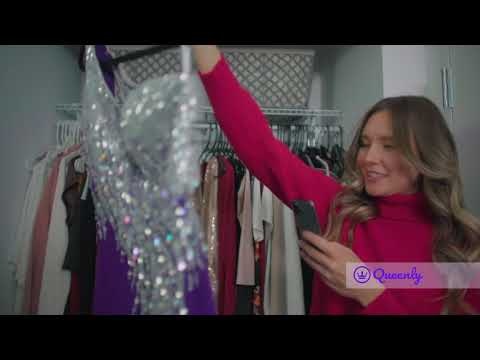
Image 1 / 2
Trisha Bantigue and Kathy Zhou-Patel came to Queenly through parallel but distinct paths that converged on the same market gap.
Bantigue grew up competing in pageants starting in 2013, using prize money and modeling fees to fund her education at UC Berkeley.[4] That experience gave her direct, repeated exposure to the formalwear resale problem: contestants needed unique dresses for each competition, spent hundreds to thousands of dollars per gown, and had no reliable channel to recover value afterward. She later worked in operations and business roles at Google, Facebook, and Uber — giving her a framework for thinking about marketplace dynamics and scale.[4] She was also a former fashion model for formalwear designers, meaning she understood the supply side of the market as well as the demand side.[5]
Zhou-Patel graduated from the University of Pennsylvania in 2015 with degrees in Computer Science and Environmental Science, then joined Pinterest and Venmo as a full-stack engineer.[4] She brought the technical depth to build what Bantigue envisioned — and, critically, she built most of it herself: the iOS app, the Android app, the web platform, the ML search engine, and the computer vision layer.[5]
The two founders had both competed in pageants, which gave them shared cultural fluency with the community they were building for — a rare form of founder-market fit that would later prove critical to early distribution.[5]
The idea began as a side project in late 2018, born from personal frustration with the existing formalwear resale experience — a fragmented landscape of Facebook groups, eBay listings, and Poshmark posts with no vertical-specific search, sizing tools, or trust infrastructure.[6] By the summer of 2019, the project had gained enough traction that both founders quit their day jobs to pursue it full-time.[6]
Read the complete post-mortem, the rebuild playbook, and the exact reasons Queenly is still worth studying now.