This report was generated by our Deep Research agent and may contain mistakes.
Did we get something wrong? DM @oscrhong and we'll fix it ASAP!
Upgrade to Pro to get implementation-ready specs for every company, the full report library, and 5 on-demand report requests per month.
Squire.ai was a developer tooling startup founded in 2021 by Karl Clement, Saumil Patel, and Brandon Waselnuk. The company entered Y Combinator's Summer 2021 batch as "Codex," a VS Code extension for contextual code annotation, and raised $4.52M in total funding before undergoing two complete product pivots — first to EchoLayer (codebase knowledge mapping) and finally to Squire.ai (agentic code review). [1] [8] At its peak, the company had 8 employees and was shipping features as recently as November 2024. [3] [29]
The company was killed by a combination of platform aggregation and feature-versus-product risk. The same LLM wave that invalidated its original documentation product also empowered GitHub — the platform Squire.ai depended on for distribution — to absorb its final product as a native, near-free feature. Each pivot moved the company closer to GitHub's core surface area rather than away from it.
Squire.ai wound down quietly sometime after its November 2024 Product Hunt launch, with no formal shutdown announcement. [4] The founders dispersed: Brandon Waselnuk joined Mintlify and then Unblocked; Saumil Patel co-founded Envoy AI as CTO. [20] [22] No acquisition was announced, and no investor statements were made public.


Karl Clement, Saumil Patel, and Brandon Waselnuk had worked together for eight years before founding Squire.ai, shipping more than 50 products across a VC fund, a software agency, and personal projects. [2] That shared history — at Dignified, a software agency, and CoVenture, a VC fund — gave the team both technical execution depth and investor-relations fluency that most early-stage teams lack. [28]
The founding insight was a documentation problem the team had observed repeatedly across software organizations: institutional knowledge about why code was written a certain way lived in engineers' heads, not in the codebase. Comments in code were static and disconnected from the lines they described; as codebases evolved, context decayed. The original product, Codex, attempted to solve this by letting engineers attach living annotations — comments, questions, notes — to specific lines of code, with that context traveling alongside the code as the team continued to build. [5]
The team entered Y Combinator's Summer 2021 batch under the name "Codex" with the domain usecodex.com. The YC application positioned the product as a VS Code extension, though the GitHub repository history — including repos named codex-jetbrains and codex-desktop — confirms the team had multi-platform ambitions from early on. [26]
The original thesis did not survive contact with the LLM revolution. As large language models became capable of generating documentation, summarizing code, and answering questions about codebases, the specific problem Codex was solving — contextual annotation — became something developers could approximate with general-purpose AI tools. Saumil Patel later described the disruption candidly on the Stack Overflow podcast: "We were doing just in time documentation and LLM kind of knocked us out of that. And we went through a couple of iterations, so we moved towards code ownership... And the most recent iteration is Squire AI." [9]
What is notable about this founding story is that the team's demonstrated shipping velocity — a genuine strength — may have also normalized pivoting as a response to structural market shifts. A team that had shipped 50+ products in eight years was well-equipped to rebuild quickly. Whether that capability served them or masked deeper product-market fit problems is a question the available data cannot fully answer.
August 2021 — Company enters Y Combinator Summer 2021 batch as "Codex" (usecodex.com), a VS Code extension for contextual code annotation. Receives $125K YC investment. [0]
September 2021 — One month after YC funding, Codex launches private beta with 25 companies. [15]
December 14, 2021 — NFX leads a $4.4M seed round with participation from Ludlow Ventures, Emergence Capital, and operator angels. Waitlist has grown to 200+ companies. Total funding reaches approximately $4.52M. Round announced via VentureBeat; company described as planning to grow team and onboard beta users. [13] [14]
2022 — Company pivots from Codex to "EchoLayer," shifting focus from code annotation to codebase knowledge mapping and AI-powered security vulnerability attribution. Founder later attributes this pivot to LLMs disrupting the documentation use case. [6]
August 2023 — Operating as EchoLayer, Saumil Patel announces relocation from Canada to San Francisco, citing a "quickly growing customer base" in the Bay Area and the value of proximity to infrastructure engineers. [17]
2023 — Company pivots again from EchoLayer to Squire.ai, an agentic code review and PR description platform that integrates with GitHub and learns team preferences. [7]
June 7, 2024 — Saumil Patel appears on the Stack Overflow podcast to discuss Squire.ai's agentic code review product, publicly describing the full pivot sequence and acknowledging the competitive landscape between GitHub Copilot and full AI agents like Devin. [9]
November 5, 2024 — Squire.ai launches an "AI Linter" feature on Product Hunt, indicating the product is still actively shipping. [29]
Late 2024 — Brandon Waselnuk posts on LinkedIn announcing his departure from Squire AI. He subsequently joins Mintlify and then Unblocked. [20]
April 4, 2025 — GitHub Copilot code review reaches general availability, having already grown 10x since initial launch and accounting for more than 1 in 5 code reviews on GitHub. Over 1 million developers used it within a month of public preview. [23]
2025 — Squire.ai listed as "Inactive" on Y Combinator directory with no open job postings. Saumil Patel is now Co-Founder/CTO at Envoy AI. [4] [22]
Phase 1 — Codex (2021–2022)
Codex was a VS Code extension that let engineers attach living annotations to specific lines of code. Unlike standard inline comments, which are static strings embedded in source files, Codex annotations were designed to travel with the code as it evolved — preserving the why behind implementation decisions, flagging open questions, and enabling asynchronous collaboration within the IDE itself. [5]
The user experience was straightforward: a developer highlights a line or block of code, opens the Codex panel, and attaches a note — a question for a colleague, a warning about a known edge case, a link to the relevant design doc. Teammates see those annotations in context when they open the same file. The product's value proposition was that this context would persist through code reviews, refactors, and onboarding — reducing the "why did we do it this way?" conversations that slow engineering teams.
The GitHub repository history confirms the team built beyond VS Code: repos named codex-jetbrains and codex-desktop suggest JetBrains IDE support and a standalone desktop client were in development or shipped. [26]
Phase 2 — EchoLayer (2022–2023)
After LLMs made general-purpose documentation assistance widely available, the team pivoted to EchoLayer — a platform that mapped codebase knowledge across an engineering organization. Rather than annotating individual lines, EchoLayer analyzed the codebase to identify which engineers had the deepest expertise in which modules, using AI-powered attribution to surface the right people when security vulnerabilities needed resolution. [6]
This pivot moved the product from individual developer productivity toward engineering intelligence and security operations — a different buyer (security teams and engineering managers rather than individual developers) and a different value proposition (organizational knowledge routing rather than personal annotation).
Phase 3 — Squire.ai (2023–2024)
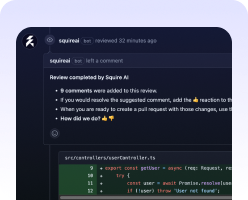
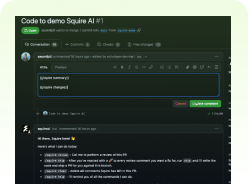
The final product was an agentic code review platform that integrated directly with GitHub. When a developer opened a pull request, Squire.ai would automatically generate a PR description, review the code across multiple dimensions — security, code quality, error handling, performance, and scalability — and post structured feedback as review comments. [11]
The technical architecture used a mixture-of-experts approach: multiple specialized AI systems evaluated the code in parallel, each focused on a different quality dimension, with a chain-of-thought reasoning layer synthesizing their outputs into coherent recommendations. The product's stated differentiation was that it learned team-specific preferences over time — adapting its review style to match a team's conventions rather than applying generic rules. [11]
Pricing started at $20/month, suggesting a product-led growth motion targeting individual developers or small teams rather than enterprise procurement. [12] A November 2024 Product Hunt launch of an "AI Linter" feature indicated the team was still shipping new capabilities in the product's final months. [29]
The Squire.ai product sat in a deliberate middle position: more integrated and workflow-aware than GitHub Copilot's autocomplete, but less autonomous than full AI coding agents like Devin. Saumil Patel articulated this positioning explicitly in June 2024 — though as events would show, that middle ground was precisely where GitHub was expanding. [25]
Codex targeted individual software engineers and engineering teams who experienced knowledge decay as codebases grew — a near-universal problem in software organizations of any size. EchoLayer shifted the buyer to security teams and engineering managers who needed to route vulnerability remediation to the right engineers quickly. Squire.ai returned to a developer-facing motion, targeting engineering teams that wanted automated code review without the overhead of configuring and maintaining custom linting rules.
The $20/month price point for Squire.ai's final product is the clearest signal of the intended customer profile: individual developers or small teams making a self-serve purchasing decision, not enterprise procurement cycles. [12] The relocation to San Francisco in August 2023 — specifically to be closer to "infrastructure engineers" — suggests the EchoLayer phase was targeting platform and infrastructure teams at Bay Area technology companies, a more concentrated and potentially higher-value segment. [17]
The developer tools market is large and well-documented. GitHub alone had over 100 million developers on its platform as of 2023, and the AI coding tools segment was growing rapidly through the period of Squire.ai's operation. The code review sub-segment — where Squire.ai ultimately competed — was validated by GitHub's own investment: the company built and scaled a native code review product that reached 1 million users within a month of public preview. [23]
The market size was not the constraint. The constraint was that the largest platform in the market — GitHub, with 100 million developers and a distribution moat no standalone startup could replicate — had both the incentive and the capability to serve the same need.
Squire.ai's competitive position evolved with each pivot, but its final product faced a structurally unfavorable competitive map along two axes that mattered most: distribution reach and platform integration depth.
On distribution reach, GitHub Copilot had an insurmountable advantage. GitHub's 100 million registered developers represented a captive audience that any standalone tool had to acquire one customer at a time. When GitHub added code review to Copilot, it could surface the feature to every developer who already had a Copilot subscription — no separate purchase decision required.
On platform integration depth, Squire.ai was entirely dependent on GitHub's APIs and webhook infrastructure. This created a structural asymmetry: Squire.ai could only integrate as deeply as GitHub's public APIs allowed, while GitHub's native feature could integrate at the infrastructure level — accessing code context, reviewer history, and repository metadata that third-party tools could not.
Other standalone AI code review tools — including CodeRabbit and Sourcegraph Cody — occupied similar positions in this competitive map, suggesting the category itself was structurally challenged rather than Squire.ai specifically being outcompeted. The category was winner-take-all along the distribution axis, and the winner was the platform itself.
The competitive dynamic Squire.ai faced was not a faster competitor or a better-funded rival. It was platform aggregation: GitHub adding the feature natively, at a price point (included in existing Copilot subscriptions) that made standalone tools difficult to justify. [24]
Squire.ai's final product was priced starting at $20/month, indicating a subscription SaaS model targeting individual developers or small teams. [12] The company never disclosed revenue figures at any stage of its operation — the absence of any public revenue data across three product phases and four years of operation is itself a signal that the company did not achieve the kind of growth that founders or investors typically publicize.
Inferred unit economics (labeled as estimates): With $4.52M in total funding and a peak headcount of 8 employees, a rough burn rate estimate is possible. Assuming average fully-loaded compensation of $150,000–$200,000 per employee plus infrastructure and overhead, annual burn was likely in the range of $1.5M–$2.0M. At that rate, the $4.52M raised would have provided approximately 27–36 months of runway from the December 2021 seed close — consistent with an operational window through late 2024. These are inferences from public headcount and funding data, not confirmed figures. [3] [13]
At $20/month per customer, the company would have needed approximately 6,250–8,333 paying customers to cover estimated annual burn — a threshold that appears unlikely given the quiet wind-down and absence of any growth announcements. No additional funding rounds beyond the December 2021 seed were identified in public records, suggesting the company operated on its original $4.52M through shutdown.
The EchoLayer phase — targeting security teams and engineering managers — may have carried higher per-seat pricing, but no pricing data for that phase is available.
The clearest traction data comes from the Codex phase. Within one month of receiving YC funding in August 2021, the company launched a private beta with 25 companies. [15] By December 2021, the waitlist had grown to more than 200 companies — a signal of genuine demand for the problem space, though no conversion data from waitlist to active paying users was ever disclosed. [16]
During the EchoLayer phase, Saumil Patel described a "quickly growing customer base" concentrated in the Bay Area in August 2023, which was the stated rationale for relocating from Canada to San Francisco. [18] The language suggests active customers rather than a waitlist, but no specific counts or revenue figures were provided.
No traction data — user counts, revenue, retention, or growth rates — was publicly disclosed for the Squire.ai phase. The November 2024 Product Hunt launch of the AI Linter feature generated some community engagement, but no metrics were attached. [29] The GitHub organization's 17 public repositories confirm sustained engineering activity across all three product phases, but repository count is not a proxy for user adoption. [26]
The most important structural fact about Squire.ai's final product is that it was built entirely on top of GitHub — and GitHub was its primary competitor.
Squire.ai integrated with GitHub via its API and webhook infrastructure to intercept pull request events, run AI analysis, and post review comments. This architecture made GitHub the distribution channel, the data source, and the competitive threat simultaneously. When GitHub added native AI code review to Copilot, it did not need to match Squire.ai feature-for-feature. It needed only to be good enough — and it had distribution advantages that made "good enough" decisive.
GitHub Copilot code review reached general availability in April 2025. By that point, it had already grown 10x from its initial launch and accounted for more than 1 in 5 code reviews on GitHub. Over 1 million developers used it within a month of its public preview launch. [23] [24]
No standalone startup could acquire 1 million users in a month. GitHub surfaced the feature to developers who were already using Copilot — a zero-friction distribution path that required no separate purchase decision, no onboarding, and no integration work from the developer. Squire.ai, at $20/month, required all three.
Saumil Patel acknowledged the competitive squeeze in June 2024, framing Squire.ai as occupying a middle ground between GitHub Copilot's autocomplete and full AI agents like Devin. [25] The framing was accurate — but that middle ground was precisely where GitHub was expanding. The company's competitive positioning was a description of the gap that was closing, not a defensible moat.
The same technological force that destroyed Squire.ai's final product also destroyed its original product — and the company's response to the first disruption created the conditions for the second.
When LLMs became capable of generating documentation and answering questions about code in 2022, the specific value of Codex's contextual annotation product collapsed. Saumil Patel described this directly: "We were doing just in time documentation and LLM kind of knocked us out of that." [10] The team's response — pivoting to EchoLayer and then to Squire.ai — was to use LLMs as the foundation of the new product rather than compete against them. This was a rational adaptation.
But the pivot toward LLM-powered code review placed the company directly in the path of GitHub's own LLM-powered roadmap. The same infrastructure (OpenAI models, GitHub's code context, pull request data) that Squire.ai was using to build its product was also available to GitHub — and GitHub had the integration depth, the distribution, and the existing customer relationships to deploy it faster and at lower marginal cost.
The LLM wave was not a one-time disruption. It was a continuous force that kept raising the capability floor for what platforms could offer natively, compressing the window in which standalone tools could justify their existence.
Squire.ai underwent at least two complete product pivots in four years. [8] Each pivot was a rational response to a real market signal, but the cumulative effect was a company that never had time to build the compounding advantages — customer relationships, proprietary data, brand recognition — that create defensibility.
The $20/month price point for the final product is a specific signal worth examining. At that price, the company was competing on the same dimension as GitHub's Copilot subscription tier — a price-sensitive, self-serve motion where platform distribution dominates. An enterprise sales motion — with higher contract values, longer sales cycles, and deeper integration requirements — might have created switching costs that GitHub's native feature could not easily displace. There is no evidence the company attempted this motion. The relocation to San Francisco in August 2023 to be closer to "infrastructure engineers" suggests customer proximity was valued, but the $20/month price point suggests the sales motion remained self-serve. [17] [12]
The team's demonstrated ability to ship — 50+ products in eight years — likely enabled the pivot cascade. [2] But shipping velocity is not the same as market fit velocity. The company could rebuild quickly; it could not rebuild into a position that was structurally defensible against platform aggregation.
Squire.ai's failure is not primarily a story about execution mistakes. It is a story about a category — AI-assisted code review — that was structurally prone to platform absorption.
Code review is a workflow that lives inside GitHub for the vast majority of software teams. Any tool that improves code review must integrate with GitHub, which means it must use GitHub's APIs, live within GitHub's permission model, and compete for developer attention inside GitHub's interface. This creates a structural dependency that is difficult to escape: the better the integration, the more the product looks like a GitHub feature — and the easier it is for GitHub to replicate.
This dynamic is not unique to Squire.ai. It applies to any developer tool that improves a workflow that a major platform owns. The platform has distribution, data, and integration depth that standalone tools cannot match. The question for any startup in this position is whether it can build enough proprietary advantage — in data, in customer relationships, in workflow depth — before the platform moves. Squire.ai did not.
Building on a platform that owns your workflow is a distribution strategy and an existential risk simultaneously. Squire.ai's GitHub integration was its primary go-to-market channel — developers discovered and installed the product through GitHub's marketplace. But that same dependency meant GitHub could replicate the product's core function natively, at zero marginal distribution cost, the moment it chose to. Squire.ai had no distribution channel that GitHub did not control, which meant it had no path to survival once GitHub entered the category directly in 2024–2025.
Pivoting toward LLM-powered products in 2022–2023 was rational, but it moved Squire.ai into GitHub's roadmap rather than away from it. When LLMs invalidated Codex's documentation thesis, the team correctly identified code review as a high-value, LLM-addressable workflow. But GitHub had the same insight, the same models, and far superior distribution. The pivot from Codex to Squire.ai was a move from a niche that LLMs had commoditized into a niche that GitHub was about to commoditize — a lateral move rather than an escape.
A $20/month price point in a category where the incumbent offers the feature as part of an existing subscription is not a viable long-term position. Squire.ai's self-serve pricing made customer acquisition dependent on developers choosing to pay separately for a capability that GitHub Copilot subscribers would eventually receive as part of their existing plan. The company never publicly disclosed a move toward enterprise contracts or higher-value customer segments — a path that might have created switching costs GitHub's native feature could not easily displace.
The absence of any public revenue milestone across four years and three products is a meaningful signal. Startups that achieve meaningful revenue typically announce it — in fundraising announcements, in press coverage, in founder interviews. Squire.ai's 200-company waitlist in December 2021 was the last publicly disclosed traction metric. [16] The silence across the EchoLayer and Squire.ai phases suggests the company never converted early interest into durable, growing revenue — a pattern consistent with a team that could build products but could not find a position the market would defend against platform competition.
Relocating to San Francisco mid-pivot signals optimism, not momentum. The August 2023 move from Canada to San Francisco — during the EchoLayer phase, before the final Squire.ai pivot — was framed as a response to a "quickly growing customer base." [18] In retrospect, it was a significant operational investment made at a moment when the company was still searching for its final product form. The move increased burn rate and signaled confidence in a product thesis that would be abandoned within months. It illustrates how optimism about trajectory can lead to infrastructure investments that reduce runway precisely when flexibility is most needed.
Ready to rebuild Squire.ai?
Implementation-ready specs, every report, and 5 on-demand requests each month.