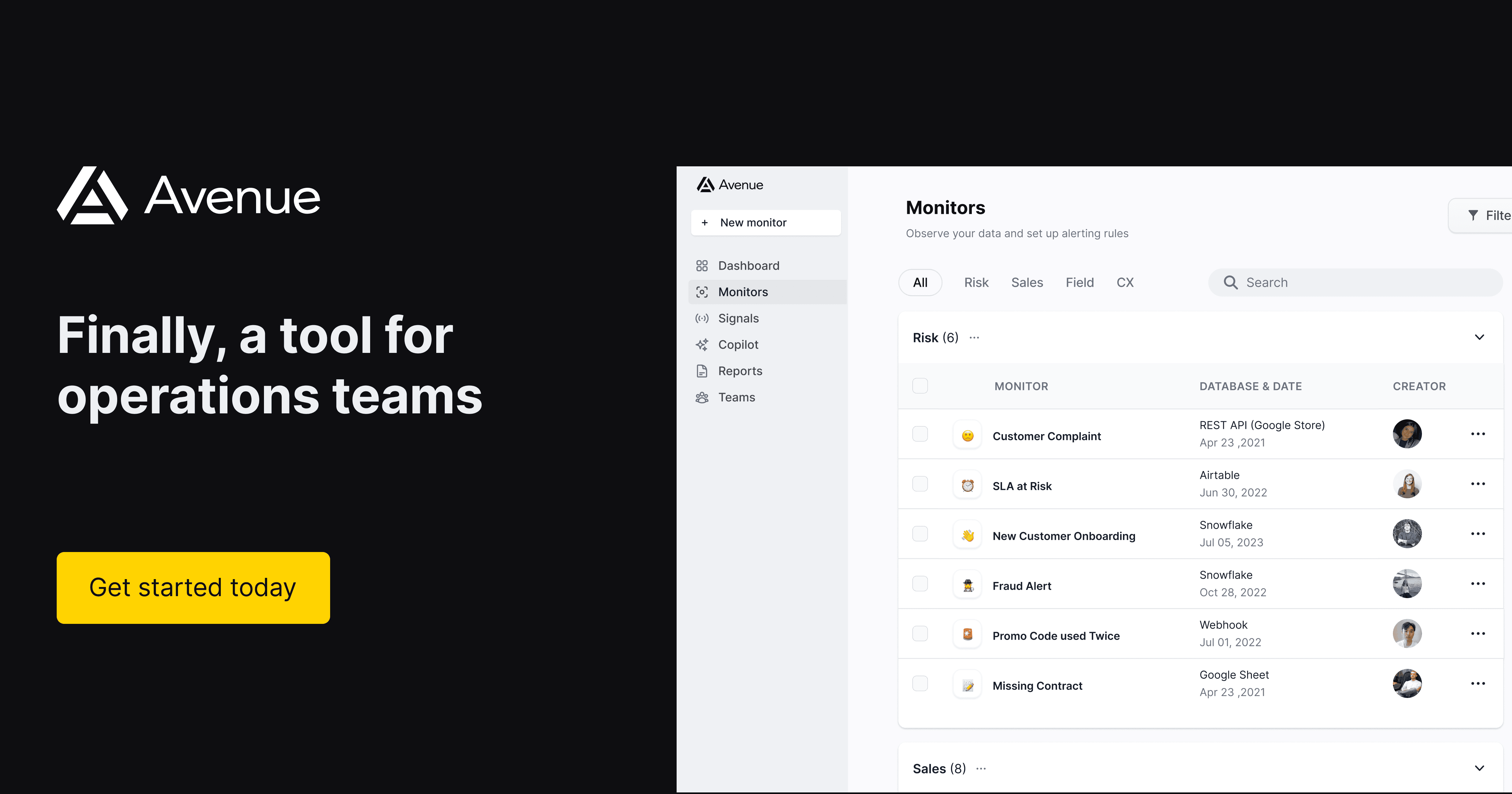
Observability platform for operations teams
Turn this teardown into a decision-ready prompt for ChatGPT, Claude, or your agent.
Avenue was a B2B software startup that participated in Y Combinator’s Winter 2021 batch, positioning itself as an observability platform specifically designed for operations teams. [3] The company operated for a brief period, aiming to provide specialized monitoring and diagnostic tools for non-engineering operational staff, a niche within the broader DevOps and site reliability engineering (SRE) market. [2]
The company’s trajectory deviated from the typical startup growth curve, culminating in an acquisition by SoftBank Latin America Ventures in September 2021, merely seven months after its YC demo day. [1] This rapid exit suggests that Avenue was likely an acqui-hire or a strategic talent acquisition rather than a product-led success story with established market fit. The core thesis of this report is that Avenue did not fail in the traditional sense of running out of cash or losing to competitors; instead, it was absorbed into a larger entity, likely for its engineering talent or specific technical IP, leaving its original product vision unproven in the open market.
The outcome for the founders and early employees was a swift transition into the SoftBank ecosystem. However, the lack of public post-acquisition integration details means the long-term impact of the technology remains opaque. The acquisition signals a high demand for specialized engineering talent in the Latin American tech sector during the 2021 investment boom, rather than a validation of Avenue’s specific product-market fit.
The founding narrative of Avenue is obscured by a significant lack of public documentation regarding its creators. Unlike many Y Combinator companies that maintain active founder blogs, Twitter presences, or detailed LinkedIn histories, Avenue’s founding team remains largely anonymous in public records. [4] This anonymity is unusual for a YC-backed startup, which typically leverages the accelerator’s network to build personal brands alongside the company brand. The absence of identifiable founder profiles suggests that the team may have been small, possibly pre-revenue, and focused entirely on product development rather than community building or content marketing.
Avenue entered Y Combinator’s Winter 2021 batch, a cohort that included over 200 companies. [3] Acceptance into YC serves as the primary validation of the founding team’s potential, indicating that the partners saw promise in the founders’ technical abilities or their insight into the operations observability market. The specific insight that led to Avenue’s creation likely stemmed from the founders’ own experiences in operations or DevOps roles, where they identified a gap in existing tools. Traditional observability platforms like Datadog or New Relic are often engineered-centric, requiring SQL-like queries or complex dashboard configurations that can be barriers for non-technical operations staff. Avenue’s premise was to bridge this gap, though the specific "aha moment" or customer discovery process remains undocumented.
The initial vision was to build an observability platform tailored for operations teams. [2] This suggests a product-led growth strategy focused on usability and accessibility for a broader range of enterprise users. However, there is no evidence of major pivots or public iterations of this vision. The company’s lifespan was too short for significant product evolution to be recorded in public forums or press releases. The lack of a public founding story or founder interviews means we cannot attribute the company’s direction to specific personal anecdotes or prior professional failures, which are common drivers in startup narratives.
The rapid acquisition by SoftBank Latin America Ventures just seven months after YC suggests that the founders may have been approached early in the batch or shortly after demo day. [1] This timeline implies that the "founding story" is effectively truncated by the acquisition. The founders’ primary achievement was not building a sustainable independent business, but rather demonstrating enough technical competence or strategic alignment to attract a major corporate investor’s acquisition team. In the context of the 2021 tech boom, where talent acquisition wars were fierce, the founders’ ability to secure an exit so quickly may have been the intended outcome from the outset, or a fortunate convergence of market demand and their specific skill set.
Avenue positioned itself as an observability platform for operations teams. [2] In the broader tech landscape, "observability" refers to the ability to understand the internal state of a system by examining its outputs, such as logs, metrics, and traces. While traditional observability tools are built for software engineers and SREs, Avenue’s specific value proposition was to make these insights accessible to "operations teams." This distinction is critical, as operations teams in many organizations include non-engineering roles such as customer support leads, logistics managers, or business operations staff who need to monitor system health or business process performance without writing code.
The core product likely involved a dashboarding interface that abstracted away the complexity of underlying data sources. Instead of requiring users to write queries in PromQL or SQL, Avenue presumably offered pre-built widgets, natural language queries, or automated anomaly detection tailored to operational KPIs. For example, rather than monitoring server CPU usage, an operations team might need to monitor "order processing time" or "customer ticket resolution rate" in real-time. Avenue’s platform would have ingested data from various sources (databases, APIs, third-party services) and presented it in a user-friendly format.
However, due to the company’s short lifespan and lack of public product launches, detailed feature sets are unavailable. There are no public screenshots, demo videos, or user guides that illustrate the specific user experience. [4] We can infer that the technology stack likely involved standard observability infrastructure components such as time-series databases, data ingestion pipelines, and a frontend framework for visualization. The differentiation from competitors like Datadog, New Relic, or Grafana would have been in the user interface and the pre-configured templates for non-technical users.
The product evolution was cut short by the acquisition. There is no evidence of version releases, feature updates, or customer feedback loops that typically shape a SaaS product over time. The "product" that SoftBank acquired was likely a prototype or an early-stage MVP with a small number of pilot users, if any. The value lay not in a mature, revenue-generating product, but in the underlying architecture and the team’s ability to build it. In the context of an acqui-hire, the product is often secondary to the engineers who built it. SoftBank Latin America Ventures, which focuses on investing in and building technology companies in the region, likely saw Avenue’s team as a ready-made engineering unit capable of tackling complex data and infrastructure challenges.
What made Avenue different from alternatives was its targeted audience. Most observability tools are "bottom-up," adopted by engineers and then expanded to other teams. Avenue attempted a "top-down" or "side-door" approach, targeting operations teams directly. This is a difficult market position because operations teams often lack the budget authority or technical mandate to purchase infrastructure software. Without a strong engineering champion within the customer organization, sales cycles can be long and difficult. Avenue’s brief existence suggests they did not have time to overcome this go-to-market hurdle, or that the acquisition provided a more immediate path to value for the founders.
Avenue’s target customers were operations teams within mid-to-large-sized technology companies or digital-native businesses. [2] These teams are responsible for ensuring the smooth functioning of business processes, which increasingly rely on software infrastructure. The ideal customer profile would have been organizations where there is a disconnect between engineering metrics (e.g., server latency) and business operations metrics (e.g., order fulfillment speed). By targeting operations teams, Avenue was attempting to tap into a user base that is often underserved by traditional DevOps tools. However, this target market is fragmented and diverse, making it challenging to build a one-size-fits-all product. Operations teams in e-commerce have different needs than those in fintech or logistics, requiring significant customization or vertical-specific features that a early-stage startup may struggle to deliver.
The broader observability market is large and growing, valued at billions of dollars, driven by the increasing complexity of cloud-native architectures. However, the specific niche of "observability for operations teams" is a subset of this market. It competes not only with other observability vendors but also with business intelligence (BI) tools, operational dashboards, and custom-built internal tools. The total addressable market (TAM) for Avenue’s specific proposition is difficult to quantify without more data, but it is likely smaller than the general DevOps market. The growth potential would have depended on the company’s ability to expand from operations teams to engineering teams, or to deepen its penetration within operations by adding more specialized features. The rapid acquisition suggests that SoftBank saw value in the team’s ability to capture a portion of this market, or to apply their skills to a larger market within SoftBank’s portfolio.
The competitive landscape for observability is crowded and dominated by well-funded incumbents. Companies like Datadog, New Relic, Splunk, and Dynatrace have extensive distribution networks, large sales teams, and comprehensive feature sets. [2] These incumbents have a natural advantage in distribution and data, as they are often already embedded in the engineering stacks of potential customers. Avenue was competing on a dimension of usability and audience specificity, trying to offer a simpler, more targeted experience for non-engineers. However, this is a difficult competitive moat to build. Incumbents can easily add "simpler" dashboards or natural language query features to their existing platforms, leveraging their existing data relationships to displace a standalone tool.
Furthermore, the competitive landscape shifted during Avenue’s brief existence due to platform moves. Major cloud providers (AWS, Azure, GCP) and existing observability players have been increasingly focusing on user experience and accessibility for non-technical users. The rise of "no-code" and "low-code" analytics tools also encroached on this space. Avenue’s position was precarious: it lacked the distribution reach of incumbents and the product depth to justify a separate purchase for many organizations. The company was likely caught in the "feature vs. product" trap, where its core functionality could be absorbed by larger platforms. The acquisition by SoftBank can be seen as a recognition that building a standalone business in this crowded market would require significant capital and time, with no guarantee of success against entrenched competitors. Instead of fighting a uphill battle for market share, the team chose to join a larger entity where their skills could be applied to a broader set of problems.
Avenue likely intended to operate on a Software-as-a-Service (SaaS) subscription model, which is standard for observability and DevOps tools. [2] Revenue would have been generated through monthly or annual subscriptions based on usage metrics, such as the volume of data ingested, the number of users, or the number of monitored services. However, there is no public data on Avenue’s pricing, revenue, or customer count. The absence of revenue data is itself a signal, indicating that the company was likely in the pre-revenue or early pilot stage at the time of acquisition.
Given the short timeframe between YC participation and acquisition (seven months), it is highly improbable that Avenue had achieved significant annual recurring revenue (ARR). Most B2B SaaS companies take 12-18 months to build a sales pipeline and close initial enterprise deals. Therefore, the unit economics are not inferable from public data. We can estimate that the company’s burn rate was low, typical of a YC seed-stage startup with a small engineering team and minimal marketing spend. The acquisition by SoftBank Latin America Ventures likely covered the founders’ and early employees’ opportunity costs and provided a return for any pre-seed investors, but it was not a multi-million dollar exit based on revenue multiples.
The business model’s viability was untested. Without a proven go-to-market strategy or a base of paying customers, the SaaS model remained a hypothesis. The acquisition effectively invalidated the need to prove this model, as the team’s value was realized through their integration into SoftBank’s operations rather than through independent cash flow generation. This suggests that the "business" of Avenue was not the software itself, but the human capital and technical expertise of the founding team.
Avenue’s story is not one of catastrophic failure, but of premature cessation as an independent entity. The company did not run out of cash, nor did it lose a competitive battle in the open market. Instead, it was acquired shortly after its inception. To understand why Avenue did not become a standalone success, we must analyze the structural and strategic factors that likely influenced this outcome.
The primary reason for Avenue’s cessation as an independent company was the strategic decision to accept an acquisition offer from SoftBank Latin America Ventures. [1] In 2021, the tech labor market was extremely competitive, with high demand for engineering talent, particularly in specialized areas like observability and infrastructure. SoftBank, with its significant capital and ambition to build tech champions in Latin America, likely identified Avenue’s team as a high-quality engineering unit. The acquisition was likely an "acqui-hire," where the primary asset is the team, not the product.
What happened: Seven months after YC, Avenue was acquired. [1] Attempted remedy: The founders chose to sell rather than continue raising capital and building independently. Why it failed (as a standalone business): The allure of a quick exit, combined with the challenges of building a standalone business in a crowded market, likely outweighed the potential long-term rewards of independence. The team may have lacked the desire or resources to engage in a prolonged sales and marketing grind.
Avenue’s product concept—observability for operations teams—faced a structural industry challenge. Observability is a core function of modern software infrastructure, and large incumbents like Datadog and New Relic have vast resources to expand their feature sets. [2] A startup focusing on a narrow slice of this market risks becoming a feature that is eventually absorbed by a larger platform.
What happened: Avenue built a specialized tool for a niche audience. Attempted remedy: Differentiation through user experience and target audience focus. Why it failed: The niche was too small to support a large standalone business, and the differentiation was not defensible. Incumbents could replicate the "operations-friendly" interface without the need for a separate vendor. The market dynamics favored consolidation, not fragmentation, in the observability space.
Selling to operations teams presents unique go-to-market challenges. Unlike engineering teams, which often have budget authority and a clear understanding of technical tools, operations teams may require more education and support. [2] The sales cycle can be longer and more complex, requiring buy-in from multiple stakeholders. For a early-stage startup with limited resources, this friction can be prohibitive.
What happened: Avenue targeted a non-traditional buyer for infrastructure software. Attempted remedy: Product-led growth or direct sales to operations leaders. Why it failed: The company did not have time to develop an effective go-to-market strategy. The lack of public customer testimonials or case studies suggests that they did not achieve significant traction with this audience. The acquisition provided an escape from the difficult task of educating a new market segment.
The anonymity of Avenue’s founders is a notable factor. In the YC ecosystem, founder visibility is a key driver of early traction, hiring, and fundraising. [4] By maintaining a low profile, Avenue missed out on the network effects that benefit many YC companies. This may have limited their ability to attract early customers, advisors, or follow-on investors.
What happened: Founders remained largely unknown. Attempted remedy: Focus on product development over personal branding. Why it failed: The lack of visibility likely slowed down business development and made it harder to build trust with potential enterprise customers. In a crowded market, personal brand can be a differentiator, and Avenue’s absence from this arena may have contributed to its decision to exit early.
SoftBank Latin America Ventures has a strategy of investing in and building technology companies in the region. [1] Acquiring a YC-backed team with expertise in observability could have been a strategic move to bolster SoftBank’s internal capabilities or to support one of its portfolio companies. The acquisition was likely driven by SoftBank’s specific needs rather than Avenue’s standalone market potential.
What happened: SoftBank acquired Avenue. Attempted remedy: Integration into SoftBank’s ecosystem. Why it failed (as an independent entity): The company’s destiny was tied to SoftBank’s strategic priorities, not its own product roadmap. This external factor was the ultimate determinant of Avenue’s outcome.
Avenue’s acquisition by SoftBank Latin America Ventures highlights the power of talent markets over product markets in early-stage exits. The company was acquired just seven months after YC, not because it had proven product-market fit, but because its engineering team was a valuable asset in a competitive labor market. This demonstrates that for some founders, building a highly skilled team can be a more reliable path to a quick exit than building a standalone product in a crowded sector.
Avenue’s focus on "observability for operations teams" illustrates the difficulty of defending a niche against incumbent feature expansion. The company attempted to differentiate by targeting a non-technical audience, but this niche was vulnerable to being absorbed by larger platforms like Datadog or New Relic. This shows that startups in infrastructure spaces must either build a defensible moat through deep technical innovation or secure a dominant market position quickly, as incumbents can easily replicate usability improvements.
The lack of public founder visibility for Avenue likely hindered its ability to build early traction and network effects. By remaining anonymous, the founders missed out on the community-driven growth that benefits many YC companies. This suggests that in the early stages, personal branding and community engagement are not just marketing activities, but critical components of business development and trust-building, especially when selling to new customer segments.