Overview
Balsa made collaboration tools for people building software. Founder Paul Rosania initially described a companion to tools such as Jira, GitHub and Figma. By 2023, the company presented Balsa as a place to write product requirements, design documents and technical specifications.[1] [2]
In January 2024, Airtable announced that the teams behind Balsa and Airplane were joining it. The announcement does not disclose Balsa's price or establish which assets and liabilities transferred. Airtable continues to sell its own collaboration platform; the reviewed sources do not establish the separate fate of every Balsa feature.[3]
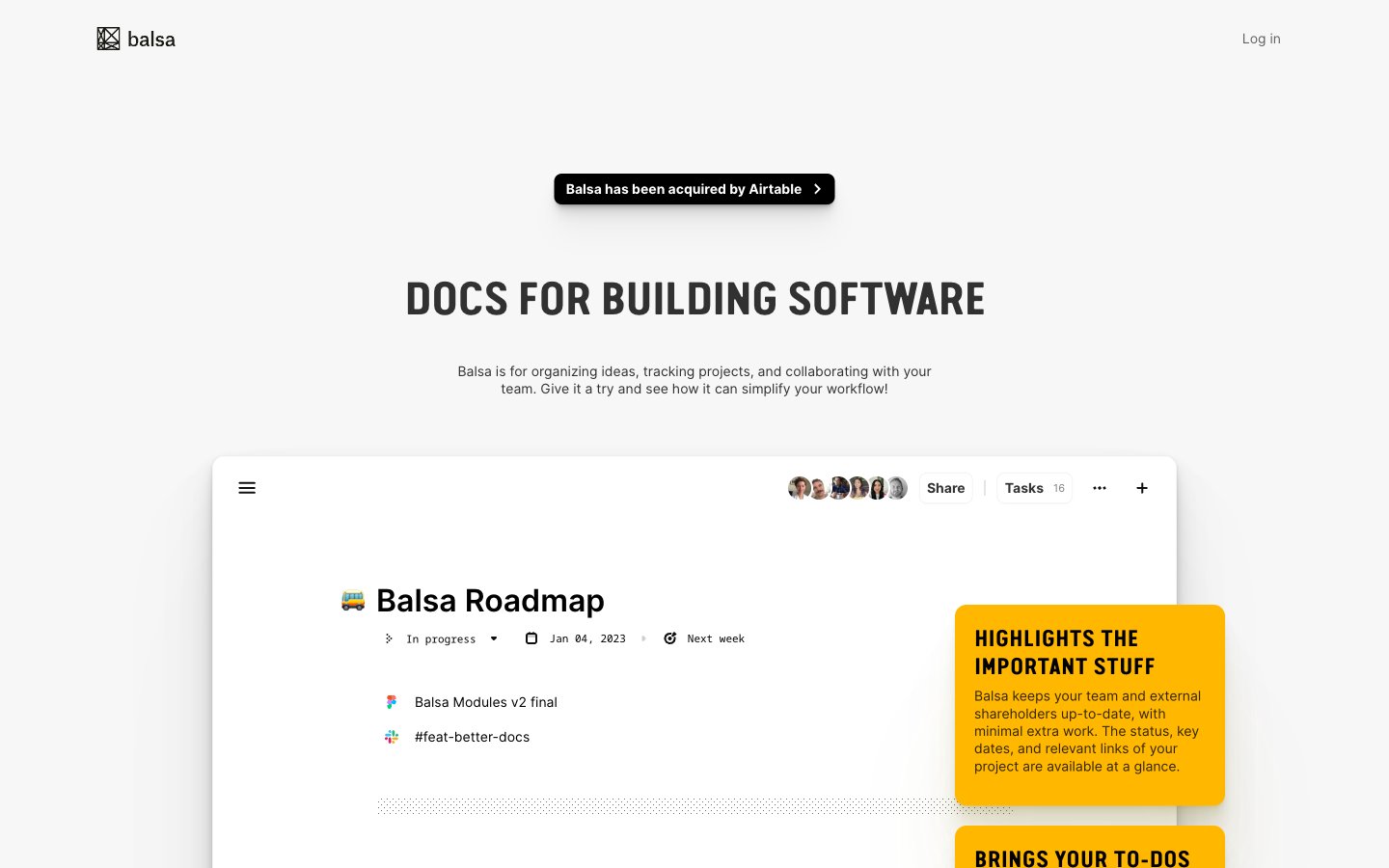
Image 1 / 1
Founding Story
Rosania founded Balsa in early 2020, after leading product teams at Twitter and Slack. At Twitter he worked on the home timeline; at Slack he led the core product team. He told SaaStr that as companies grew, some tools used to build software became less enjoyable or harder to use. He wanted to improve the experience for the people making products.[1]
The company came out of stealth in October 2020 with a seed round led by Andreessen Horowitz. Rosania said the company was founded at the beginning of that year. The seed amount was not disclosed in the interview.[1]
Timeline
- 2020: Balsa was founded and announced an Andreessen Horowitz-led seed round.[1]
- 2023: Balsa presented a document tool for product briefs, requirements, design documents and technical specifications.[2]
- 2024: Airtable announced the acquisition of the teams behind Balsa and Airplane.[3]
What They Built
Balsa's initial pitch was a second screen for builders that brought together work from existing tools. In 2023, its own launch text described a more specific document product for writing the briefs and specifications used to make software. A requirements document could give a team a shared place to explain a problem and a proposed solution; integrations aimed to connect that context with work tracked elsewhere.[1] [2]
The public sources establish the product's stated purpose, but do not document every feature, the reliability of its integrations or how many teams used it. The shift in public descriptions shows a narrower document emphasis; it does not by itself establish why the team made that choice.
Market Position
Target Customers
Balsa targeted people who create software, including product and engineering teams that write requirements and use issue trackers and design tools.[1] [2]
Market Size
The reviewed sources do not establish a reliable market size for this narrow document workflow.
Competition
Teams could already write specifications in shared documents and track work in established software. Notion, Atlassian Confluence and Airtable continue to offer collaboration tools. These products have established distribution and existing team data. A newcomer must make the connection between documents and delivery useful enough to justify another tool.[4] [5] [6]
Business Model
Balsa was a venture-backed software company. Its 2020 seed round included Andreessen Horowitz and other investors. The public sources reviewed do not establish the round amount, pricing, revenue or margins.[1]
Traction
The 2023 launch described the intended document workflow, but the sources do not provide verified customer, usage or revenue figures. The absence of public metrics prevents a reliable assessment of the product's adoption.[2]
Outcome and evolution
The team joined Airtable
Airtable announced the teams behind Balsa and Airplane were joining it in January 2024. Investor Script Capital also listed Balsa as acquired by Airtable. The announcement emphasizes the teams; it does not provide a transaction price or enough detail to describe the legal scope of the deal.[3] [7]
What followed
Airtable remains a competitor for teams building shared workflows. In 2026 its product leadership described plans following Airtable's acquisition by Bending Spoons. The available sources do not show whether Balsa's standalone product or particular components continued inside Airtable.[8]
Key Lessons
- Balsa moved from a broad companion for builders to a concrete document workflow. The sources do not establish the cause or effectiveness of that change.
- Existing documents, issue trackers and design tools gave teams alternatives and made integration a core part of Balsa's pitch.
- A team acquisition announcement does not disclose the purchase price or prove the fate of every product feature.