Overview
Canoo designed an electric vehicle around a flat platform that could support different bodies. The company paired that engineering idea with an ambitious business model: first subscriptions, then a stronger focus on commercial and government customers. It reached public markets before it reached production at scale.[1]
The company filed for Chapter 7 liquidation on January 17, 2025, and announced that operations would cease immediately. A later asset sale did not restore the original public company. The central problem was the distance between a working vehicle, a large customer announcement, and a funded manufacturing business.[2][3]
Founding Story
The venture began in 2017 under the name EVelozcity. Early leaders included Stefan Krause, Ulrich Kranz, and Richard Kim, whose experience covered finance, vehicle engineering, and design at BMW and other manufacturers. In a March 2018 interview, Krause described approximately $1 billion in investment or commitments. That wording does not establish that $1 billion had already arrived in cash.[4]
Krause initially favored contract manufacturing. He told Forbes, “they are designers and engineers, they don't necessarily manufacture themselves,” when describing Apple as an analogy. It was an argument for concentrating on design while buying production capacity.[4]
The founding group was wider than those three executives. Canoo’s own 2021 announcement identifies Sohel Merchant and Kim as founders. Contemporary engineering interviews identify Phil Weicker, while later reporting identifies Christoph Kuttner. Tony Aquila joined later as an investor and leader; he was not an original founder.[5][6][7]

Timeline
- 2017: The original vehicle venture began. Its later public-company structure came from a separate merger.[5]
- 2019: Canoo presented its vehicle and subscription concept. Kranz told an interviewer, “You need lots of money to launch a car company.”[8]
- 2020: Canoo announced a merger at approximately $2.4 billion pro forma equity value. The transaction closed on December 21.[1][9]
- 2022: Walmart announced an agreement for 4,500 delivery vehicles, with an option up to 10,000. These were prospective purchases, not completed deliveries.[10]
- 2023: NASA received three vehicles. Canoo reported completing 22 vehicles during the year, including 17 in the fourth quarter.[11][12]
- 2025–2026: Liquidation was followed by a completed asset sale and a district-court decision affirming the sale order.[13]
What They Built
The platform placed batteries and propulsion beneath a flat cabin floor. Different bodies could sit above it. Weicker described integrating the battery into the platform instead of adding a separate enclosure. The purpose was to reduce packaging layers and leave more usable cabin space. These were engineering choices with physical prototypes, rather than a business consisting only of vehicle illustrations.[6]
Canoo also developed steering controlled electronically, giving it more freedom to place the steering interface and arrange the cabin. Its early consumer proposal bundled a vehicle with maintenance, registration, and other ownership needs in a monthly subscription. The 2020 announcement expected a consumer launch in 2022 and a delivery vehicle in 2023; those dates were plans.[1]
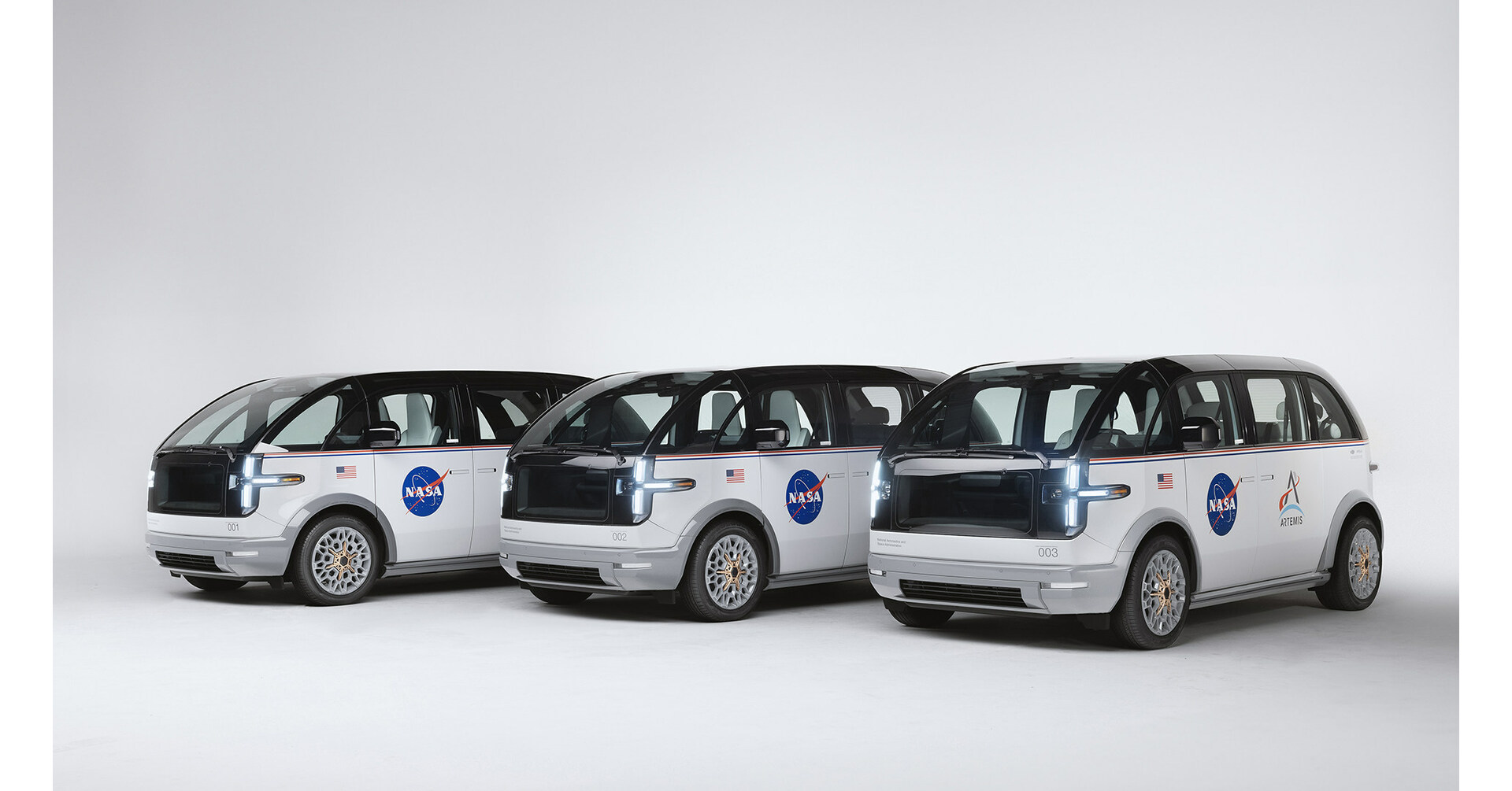
NASA independently confirmed delivery of three customized crew transport vehicles on July 11, 2023. They were designed for suited astronauts, support personnel, and equipment. That is concrete delivery evidence, although a small specialized fleet cannot establish a mass-production rate.[11]
Market Position
Target Customers
The early subscription plan targeted urban consumers. Later customers included delivery fleets and government programs. Those groups bought different things: household flexibility, delivery capacity, or a vehicle tailored to a mission. A common platform did not make their sales cycles or support requirements identical.
Market Size
Canoo’s merger materials promoted a large last-mile delivery opportunity. For a new manufacturer, the immediate constraint was narrower: which orders could it build, deliver, service, and finance? No broad market estimate establishes that those specific orders would become profitable sales.[1]
Competition
Fleet buyers could choose other vehicles and suppliers. Walmart’s 2023 climate disclosure described Ford E-Transit deployment alongside its Canoo purchase option. The buyer’s interest in Canoo therefore did not mean it depended exclusively on Canoo to electrify deliveries.[14]
Business Model
The gap between orders and cash was substantial. Canoo’s audited 2023 statements reported $886,000 revenue, a $302.0 million net loss, and $251.1 million used in operating activities. Those are different financial measures for the same year. None should be divided by completed vehicles and called a recurring manufacturing cost per vehicle.[15]
At September 30, 2024, Canoo reported $1.533 million cash and equivalents. The broader $16.069 million figure included restricted cash. Revenue for the first nine months was $1.497 million. Combining restricted balances with available cash would overstate funds available for ordinary operations.[16]
Forecast credibility also became a regulatory issue. In August 2023, the SEC announced settled charges involving Canoo, former CEO Kranz, and former CFO Paul Balciunas. It alleged inaccurate engineering-services revenue projections. The settlements did not require admitting or denying the allegations. This was a disclosure matter, not proof that every technical claim was false.[17]
Outcome and evolution
Canoo’s January 2025 announcement said it could not obtain hoped-for Department of Energy support or foreign capital. That was management’s account of its final funding effort. The bankruptcy filing transferred control to a trustee and ended management’s authority to act for the debtors.[3][2]
A March 17, 2026 district-court opinion confirms that WHS Energy Solutions, an Aquila affiliate, completed its asset purchase on April 11, 2025. The court affirmed the sale order after Harbinger challenged provisions concerning litigation rights. This decision concerned the sale terms; it did not decide the underlying trade-secret allegations or prove renewed vehicle production.[13]
Vehicle support had consequences after closure. By December 2025, reporting described NASA switching to a leased Astrovan and USPS ending use after an evaluation. Later that month, collectSPACE reported that NASA retained the Canoo vehicles as backups. Delivery, active use, and backup retention are separate states.[18][19]
Key Lessons
- Track the conversion from order to cash. An agreement, completed vehicle, accepted delivery, and recognized revenue each answer a different question.
- Fund support alongside production. Customers need parts, qualified service, and a fallback when the supplier changes.
- Separate available cash from restricted balances. The distinction matters when estimating how long operations can continue.
- Keep forecasts current. Changes to a material revenue plan need clear disclosure before investors rely on the old version.
Sources
- Canoo / SEC — August 2020 merger announcement
- Canoo / SEC — January 2025 bankruptcy filing
- Canoo — Immediate closure announcement
- Forbes — Early founder interview, March 2018
- Canoo / SEC — Founder roles, December 2021
- Electrek — Phil Weicker engineering interview, December 2019
- TechCrunch — Kuttner departure, September 2024
- Xinhua — Launch interviews, September 2019
- Canoo / SEC — Completed merger, December 2020
- Walmart — July 2022 agreement
- NASA — Three vehicles received, July 2023
- Canoo — Fiscal 2023 results
- District of Delaware — Asset-sale appeal opinion, March 2026
- Walmart — 2023 climate disclosure
- Canoo / SEC — Audited 2023 financial statements
- Canoo — Third-quarter 2024 results
- SEC — Settled projection and disclosure charges, August 2023
- electrive — Government vehicle use, December 2025
- collectSPACE — NASA’s replacement and backup vehicles, December 2025