Overview
Cardpool turned unwanted gift cards into cash and gave shoppers discounts on cards they could use. The Winter 2010 YC company secured an early acquisition by Blackhawk Network, then operated for almost another decade. Its 2021 shutdown belongs to that later operating history; the original acquisition was an exit, not evidence that the startup had failed. [1][2]
The clearest explanation is a weakening exchange business followed by unresolved customer-service problems and a severe reported revenue shock. Blackhawk put Cardpool up for sale in 2017. Customer complaints increased before COVID-19. By December 2020, a company official was telling AARP that it was winding down. Public evidence does not establish how much each problem contributed or provide final audited accounts. [3][4][5]
A later security investigation adds a separate concern. Researchers publicly attributed stolen payment-card data to Cardpool in April 2021, after the shutdown. They expressed less certainty about the associated gift-card dataset. That investigation cannot establish that public disclosure caused the earlier closure. [6][7]
Founding Story
Anson Tsai and Timothy Wong founded Cardpool around a simple mismatch: one person wanted cash for a gift card another person wanted to spend. Tsai’s founder profile dates his Cardpool work to 2009 and describes earlier work on Anywhere.FM, which imeem acquired. YC identifies Cardpool as Winter 2010 and lists Tim Wong. The founder’s account supports 2009 as its launch-era starting point; the directory’s 2008 metadata does not establish an exact incorporation date. [1][8]
September 2010 brought instant online redemption and undisclosed funding led by Jeff Fluhr, with Ron Conway and Max Levchin participating. [9]
Tsai later described retaining separate offices and culture after acquisition in a Yale School of Management publication. He also said the cash sale left him financially independent and that he quit shortly afterward. His account distinguishes a successful founder exit from the later exchange’s difficulties; it does not disclose his proceeds. [10]
Timeline
| Period | What changed |
|---|
| 2009–2010 | Founders launched the exchange; Cardpool joined YC Winter 2010. [1][8] |
| September 15, 2011 | Blackhawk acquired Cardpool, according to Safeway’s annual filing. The public announcement followed in October. [2][11] |
| 2013–2014 | Blackhawk reduced estimated contingent acquisition payments after delays launching Cardpool inventory-acquisition channels. The final earnout period ended in 2014. [12] |
| January 2017 | A redesigned site added shopping-history recommendations, better sorting and Swift Buy for combining cards toward a target spend. [13] |
| July 2017 | Cardpool added seller-priced Marketplace listings alongside cards it purchased directly. [14] |
| October 2017 | Blackhawk classified Cardpool as held for sale and recorded a $9 million non-cash goodwill impairment. [3] |
| Early 2019 | Contemporary reporting described a sale to a private buyer. Reporting identified CPL Acquisition LLC and David Jones, a former Blackhawk executive. The precise closing date, capitalization and terms remain unverified. [15][16] |
| December 2020–January 2021 | BBB warned about complaints; David S. Jones told AARP the company was shutting down. [4][5] |
| February 2021 | Permanent closure was reported. Cardpool’s buyer guarantee stopped applying. [17][18] |
| April 6, 2021 | Gemini Advisory published its security assessment concerning data offered for sale in February. [6][7] |
What They Built
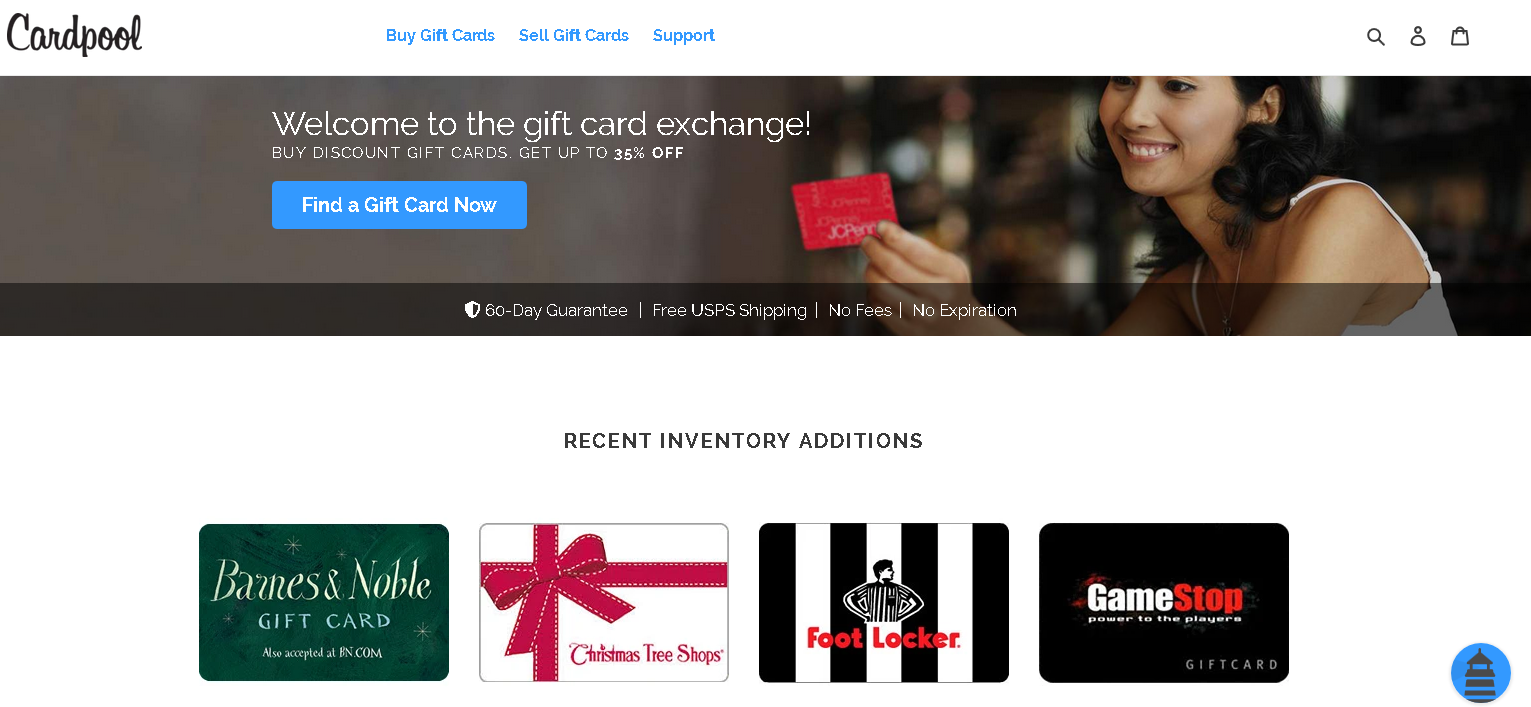
Cardpool initially bought cards below their remaining value and resold them at a higher price that still gave buyers a discount. Free shipping, balance checks and purchase guarantees helped make a used card easier to trust. YC’s description advertised sellers receiving up to 90% of face value and buyers saving up to 30%. Those maximum offers applied to different cards; they do not describe the spread on one transaction. [1][11]
Under Blackhawk, the exchange also reached customers through retail locations and partner interfaces. Blackhawk’s 2014 filing describes a proprietary platform handling pricing, spreads, orders and inventory, with both customer-facing and partner API access. The business already required more than matching two users. [12]
The January 2017 release documents useful shopping features. Swift Buy assembled several cards toward a requested spending amount. Recommendations used shopping history. Customers could find nearby exchange locations, use a mobile application, and browse across device sizes. Its guarantee then lasted up to 180 days, with a $1,000 lifetime customer limit. These were dated contractual limits, not permanent protection. [13]
The July 2017 Marketplace launch changed how inventory entered the site. Sellers could accept Cardpool’s direct offer or set their own asking price. In the latter flow, they delivered the card after a sale and received payment after delivery. The release advertised a one-year guarantee, showing that protection terms changed over time. Moving inventory to sellers did not remove the need to handle invalid balances and disputes. [14]
Market Position
Blackhawk could bring a large prepaid-card distribution network to the exchange. Its acquisition announcement said Cardpool would remain headquartered in San Francisco and continue serving customers under its own name. This was a strategic addition to an existing payments business, not a rescue disclosed as such. [11]
The later divestiture reflected a different judgment. Digital Transactions reported Blackhawk’s October 2017 expectation of $65 million in adjusted Cardpool revenue, down from $85 million in 2016, and an adjusted net loss of $4 million. The forecast was not a final annual result. It also reported shrinking kiosk distribution and software problems at some older kiosks. [19]
The secondary market continues. CardCash still buys unwanted cards and resells them, with a 45-day protection period subject to its terms. GCX says some cards come from member-to-member sales and some directly from brands. These are existing alternatives, not proof that every operator is profitable. [20][21]
GCX also documents automatic repricing with seller-controlled discount limits and activity logs. Its August 2026 tier schedule lists a 15% commission for new sellers, lower rates for qualifying higher-volume sellers, and additional listing/refund fees. A new entrant needs a specific improvement in sourcing, recourse or operational cost; merely adding pricing automation is already overlapping territory. [22][23]
Blackhawk itself still offers gift-card distribution and rewards products. Its continuing business should not be confused with continued operation of the divested Cardpool exchange. [24]
Business Model
The core economics depend on the difference between a buyer’s payment and the seller’s proceeds, after transaction costs and losses. For illustration, buying a $100 card for $80 and reselling it for $90 creates a $10 gross spread. That is a hypothetical example, not Cardpool’s reported margin. Processing, verification, shipping, support, acquisition costs and reimbursements consume that amount.
Acquisition value also needs careful units. Safeway reported $42.3 million of consideration at the September 2011 acquisition: $9.9 million paid at closing, $9.2 million due a year later, and $23.2 million of contingent consideration. Blackhawk’s later filing identifies that contingent amount as its acquisition-date fair-value estimate against an earnout ceiling of $25 million. Aggregate earnout payments ultimately totaled $5.6 million. The approximately $19 million fixed component and the $42.3 million initial accounting value describe different things. Neither is a disclosed founder payout. [2][12]
The 2017 warning signs likewise mix distinct measures. Blackhawk’s $9 million goodwill impairment was an accounting charge, not a cash reimbursement to customers. Digital Transactions’ $4 million adjusted loss was a forecast. Its kiosk-related revenue discussion indicates distribution weakness, but does not establish Cardpool’s entire customer base or a transaction-level fraud rate. [3][19]
By shutdown, Jones attributed a 90% revenue decline to COVID-19 and described losses from sellers reusing cards and cards originally bought with stolen payment credentials. AARP reported those statements; they are management’s account, not independently audited loss totals. [4]
Post-Mortem
The operating problems preceded the pandemic. Blackhawk’s 2014 filing already identified delays opening inventory-acquisition channels. Its 2017 release moved the exchange into the held-for-sale category. A business can find demand yet struggle to acquire safe inventory cheaply enough and distribute it economically. These disclosures support that mechanism without proving that all gift-card exchanges are unviable. [3][12]
A guarantee only works when customers can obtain the promised remedy. BBB’s 2021 study confirms a December 2020 Cardpool warning. AARP reported nearly 2,200 complaints across the preceding three years and interviewed customers about invalid cards, unsuccessful reimbursement requests and delayed seller payments. BBB told AARP that complaints had begun rising in 2018. These are attributed complaints and interviews, not adjudicated findings for every transaction. [4][5]
The closure left different obligations on each side. February reporting relayed Cardpool’s claim that sellers had been paid, with recent payments still expected shortly. That does not prove every liability was settled. Buyers lost the company guarantee. Frequent Miler also reported uncertainty about accessing cards purchased before September 1, 2020. The reviewed sources do not establish eventual recovery or reimbursement for all affected customers. [17][18]
The security findings require their own uncertainty. Gemini’s April report connected a 330,000-payment-card dataset to a likely February–August 2019 breach. It assessed with moderate confidence that an accompanying 895,000-gift-card dataset, with an estimated $38 million face value, came from the same breach. Face value is not a confirmed realized customer loss. BankInfoSecurity reported that the researchers did not know whether Cardpool had detected a breach or whether it contributed to closure. [6][7]
Public evidence therefore supports cumulative operational and customer-recourse problems, followed by a management-reported pandemic shock. It does not establish an undercapitalized purchaser, a deliberate refusal to disclose, or one exclusive cause. The 2011 exit and the 2021 wind-down can have different outcomes for founders, owners and customers.
Key Lessons
- Measure obligations after the sale. A balance check records one moment. Later reuse, merchant cancellation and disputed funding can create losses after delivery. CardCash’s current terms explicitly address later balance changes and seller recovery. [25]
- Separate software control from issuer control. Encrypting a code protects one stored copy. It cannot make a seller forget the code or force a merchant to preserve the balance.
- Design the wind-down before promising protection. Customers need usable records, clear claim deadlines and an identified source of reimbursement. A guarantee loses practical value when the operator closes.
- Test a narrow improvement against live alternatives. Current exchanges already offer resale, safeguards and pricing tools. AI may assist review; it does not establish retailer permission, prevent every loss or fund refunds.
Sources
- YC: Cardpool
- Safeway 2011 annual filing: acquisition date and consideration
- Blackhawk Q3 2017 results: held for sale and impairment
- AARP, January 6, 2021: customer interviews and Jones’s response
- BBB 2021 study: Cardpool warning
- Gemini’s April 2021 assessment (historical URL now redirects)
- BankInfoSecurity, April 6, 2021: attributed breach assessment
- Anson Tsai’s founder profile
- TechCrunch, September 2010
- Yale SOM: post-exit founder accounts
- Blackhawk acquisition announcement, reproduced by Finextra
- Blackhawk 2014 annual filing: platform, earnout and channel delays
- Cardpool January 2017 product release
- Cardpool July 2017 Marketplace release
- Doctor of Credit: contemporary ownership-change reporting
- Gift Cards Galore: ownership and closure updates
- Doctor of Credit, February 8, 2021: closure and payment claims
- Frequent Miler, February 9, 2021: lost guarantee and older-card access
- Digital Transactions, October 12, 2017: Cardpool forecasts and kiosks
- CardCash: current product FAQ
- GCX: member and brand inventory
- GCX: Smart Pricing
- GCX: seller tiers, updated August 2026
- Blackhawk: current gift-card and rewards business
- CardCash: protection and seller obligations
- Extrabux: historical Cardpool screenshot