
CareRev
Summer 2016AcquiredSeamlessly connecting healthcare facilities and professionals through…
Pressure-test this opportunity
Explore the risks and possibilities with a prompt for ChatGPT, Claude, or your agent.
Seamlessly connecting healthcare facilities and professionals through…
Explore the risks and possibilities with a prompt for ChatGPT, Claude, or your agent.
CareRev connects healthcare facilities with local clinicians who can claim shifts through an app. Founded in 2015 and part of YC's Summer 2016 batch, it grew from outpatient staffing into acute-care hospitals and internal workforce management. [1] [2]
IntelyCare announced its acquisition of CareRev on January 8, 2026, saying both brands and services would continue. The stated combination joined acute and post-acute staffing, recruiting and internal resource pools. A January 16 IntelyCare account described an agreement to acquire; neither source supplies a separate closing date or purchase price. [11] [12]
CareRev's trajectory includes rapid pandemic expansion, a 2023 staffing reduction and a broader surviving product. The practical lesson is that matching workers with openings requires local supply, facility-specific qualifications and control over labor costs. A funding round or acquisition announcement alone cannot show whether that operating model earned acceptable returns.
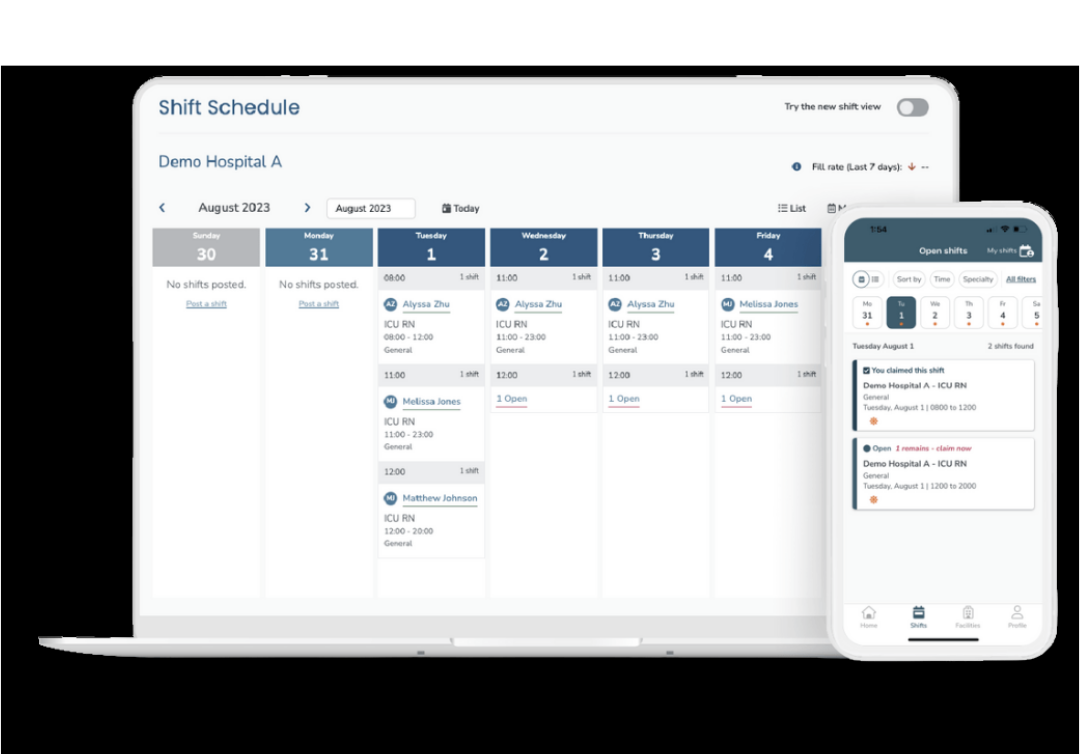
Image 1 / 1
William Patterson brought direct experience from ICU nursing. He graduated from Duke's nursing program in 2012 and struggled to find extra local shifts while carrying six-figure student debt. Hospitals also struggled to move their own professionals between facilities. His 2021 account describes Airbnb as an inspiration for making discovery and booking easier. [2]
Patterson met mentor and co-founder Sofia Pessanha in 2014. Derrek Long later joined as third co-founder and CTO. The team started with outpatient centers, moved toward larger health systems in 2018 and secured Froedtert Health after a two-year sales effort. That account shows how enterprise sales and onboarding shaped expansion; it does not date the Froedtert contract precisely. [2]
By May 2020, Patterson was using ABC7's Hiring SoCal initiative to reach local workers. He named Valley Presbyterian, Mission Community Hospital and College Hospital in Long Beach as customers with staffing needs. The interview captured a mixed pandemic market: some hospitals needed help while cancelled elective procedures left others quieter. [3]
The marketplace follows a short sequence. Facilities post shifts, eligible local clinicians receive app notifications, and professionals claim work, attend on site and receive payment from CareRev. Current materials advertise local W-2 clinicians, bundled shift blocks and an Available Now pool for professionals who indicate availability within 72 hours. [14]
The qualification work is more involved than the booking screen. In June 2023, CareRev described nurse interviews, KarmaCheck background checks, Nursys license verification, health screenings, specialty certifications and facility orientation. These are the company's stated processes. They do not establish that every historical placement met every applicable requirement. [7]
CareRev also sells internal staffing tools. IRP+ gives employed staff first access to openings, cascades shifts across workgroups and applies visibility, overtime and hours policies. Its current solutions page includes forecasting and cost planning. [21] This continues an approach Patterson described in 2020: use internal employees and float pools before supplemental external resources. [15] [8]
Smart Rates adds suggested shift pricing based on demand and past performance. CareRev reports an 18% labor-cost reduction in a cohort of 7,812 shifts from July 2022 through March 2023, with results varying by customer. That vendor case study is useful evidence of a specific deployment claim, not a general savings guarantee. [20]
CareRev sells into a persistent staffing problem. BLS currently projects about 180,800 registered-nurse openings annually during 2025–2035, including replacement openings. AHA's March 2026 report estimates labor, including purchased services, at 60% of hospital expenses in 2025. Neither measure is a software market estimate. [17] [18]
Its early distribution depended on hospital relationships and local clinician recruitment. The 2021 funding announcement named SSM Health and Froedtert; its January 2023 note also named Providence and Advocate Aurora. These dated relationships should not be treated as a list of current contracts. [4] [5]
| Offering | Documented job | Implication for a new entrant |
|---|---|---|
| CareRev Marketplace | Local clinical shift access and payment | Requires a qualified local workforce and facility adoption |
| CareRev IRP+ | Internal-first staffing, cascading policies and workforce planning | A generic internal scheduling app already has direct competition |
| ShiftMed Flex | Branded internal-pool app, routing and credential workflows | Tiered release alone provides limited differentiation |
The comparison comes from current vendor descriptions. CareRev's acquisition announcement adds acute and post-acute coverage to the combined organization's intended range. It does not prove that customers already use a fully unified workflow. [14] [15] [16] [11]
CareRev reported more than 11,000 professionals, over 30 hospitals and health systems, and more than 500 outpatient centers in April 2021. It also reported 20% monthly growth since April 2020 and revenue doubling over six months, without publishing the revenue base. [4]
The June 2023 CEO announcement reported over 22,000 professionals and a 133% increase in filled shifts from 2021 to 2022. The June 2026 Dallas release reported more than 35,000 clinicians, over 650 locations and coverage in over 32 metropolitan areas. [6] [13]
These company-reported counts show an expanding advertised footprint. They combine different measures and do not establish active clinicians, comparable fill rates, recurring revenue or independently measured patient outcomes.
CareRev connects a hospital buyer's paid staffing need with a clinician's earnings. Its current marketplace promotes control over hourly rates and payment through CareRev. Public product pages do not provide a universal fee schedule, contract margin or audited unit economics. [14]
The Information reported $55 million 2022 net revenue, one-third from SSM, and disputed vetting allegations. [19]
The two disclosed $50 million rounds financed expansion and product work. Transformation Capital led Series A; Series B participants included ShawSpring, Tribe Capital, Transformation Capital, HighSage and MBX. The $70 million financing was a debt commitment, not proof that CareRev drew or spent that amount. [4] [5]
For a local staffing marketplace, each additional facility must justify recruiting, screening, onboarding and support costs through repeat qualified shifts. Concentrated buyers can expose both revenue and worker opportunity to a renewal decision. Public disclosures do not provide enough detail to calculate CareRev's contribution margin or sale returns.
The clearest documented operating reversal came in January 2023. Patterson announced a staff reduction, accepted responsibility and prioritized self-service tools, facility adoption and better use of the workforce already registered. That change supports a diagnosis of expansion being reset around product adoption and operating focus. It does not measure how much the reset improved retention or profitability. [5]
The product subsequently broadened beyond nursing and added W-2 access, internal pools and pricing tools. The announced IntelyCare combination offered a route across more care settings, while the 2026 Dallas partnership documents continued selling under the CareRev brand. [9] [10] [13]
The acquisition thesis connects acute and post-acute staffing within health systems. Whether shared technology, recruiting or qualification operations lower costs remains a claim to test. The public record leaves purchase consideration, investor recovery and the exact economic contribution of earlier operating problems unresolved.