
Overview
Causal illustrates the gap between generating product interest, closing contracts, and giving a finance team a planning model it can run without the vendor or a lone champion. Founded in May 2019 by Oxford mathematics graduates Taimur Abdaal and Lukas Köbis, Causal raised roughly $25m from venture funds and angels, built a multidimensional financial modeling engine in the browser, and sold to German CFO-software vendor Lucanet in October 2024.[1][16] The founders applied to Y Combinator in 2019 and were rejected after their interview.[1]
The deal was a strategic acquisition with a continuing product. Lucanet kept Causal's 18-person team intact to launch Lucanet Extended Planning and Analysis (xP&A) in February 2025, where the software remains active as of November 2026.[17][19] Exact exit revenue, purchase price, and investor returns remain undisclosed, though the founders state that the team and early investors made money.[1] Over five standalone years, top-down contract values rose quickly while vendor-built implementations left renewals vulnerable, and a later self-serve pivot stabilized retention without unlocking breakout demand.
From probabilistic demo to spreadsheet grid
Abdaal and Köbis met at Oxford in 2013, shipped university side projects together, and entered the workforce in 2017.[1] In August 2018, frustrated by single-point spreadsheet forecasts in his data-science role, Abdaal began exploring a tool for modeling uncertain inputs as probability ranges.[1]

To gauge demand before building a full app, they posted an interactive demo on Hacker News on April 20, 2019: "Show HN: Should you buy a house and rent it out?"[2] It earned 353 points, 243 comments, and 600 waitlist signups.[1][2] Abdaal and Köbis quit their jobs and incorporated Causal, Inc. in Delaware on May 15, 2019.[1] Across August and September 2019, they raised a $1m pre-seed round in 40 days off a $300k target.[1]
Waitlist curiosity rarely converted into budgets. Weekly onboarding calls from June 2019 to March 2020 drew polite praise and little active use, while a verbally agreed six-month Cisco pilot stalled for nine months in procurement and never ran.[1] After one London marketing agency adopted Causal in spring 2020, the founders contacted over 1,000 agencies and took 50+ calls before concluding the firm was an outlier.[1] Opening self-serve signups uncovered small-business demand, reaching 40 SMB customers paying $50/month by September 2020.[1] Two positioning decisions followed: the founders moved into the established FP&A category and stopped leading with Monte Carlo simulation while keeping it inside the product.[1]
Small-business buyers proved too inconsistent for repeatable growth. In October 2020, 15 interviews with ~100-person companies revealed that prospects could not picture Causal's card interface holding corporate models; they expected a spreadsheet grid.[1] Over six weeks, the founders rebuilt the front end on AG Grid while preserving multidimensional variable formulas, letting users write expressions like Price * Units across months, products, and countries instead of copying cell references.[1][4][10] In January 2021, 36 demos converted into eight one-page pilot projects, and Smarkets became Causal's first paying mid-market customer.[1]
Price discovery, growth illusions, and renewal churn
Mid-market momentum brought rapid financing. Causal signed a term sheet with Accel in February 2021. Accel led the $4.2m seed at a $25m post-money valuation, and the founders say the April announcement continued to bring in leads six months later.[1][3] Targeting 30% month-on-month growth, Causal reached $500k in annual recurring revenue (ARR) by August 2021 and finished the year at $800k ARR with 11 employees.[1] Largest annual contracts climbed from $6k in January 2021 to $36k in September, putting year-end average contract value near $18k across a $12k–$40k range.[1]
Inbound investor demand produced a $20m Series A at a $100m post-money valuation co-led by Coatue and Accel, closing $17m initially and $3m over later months from investors including Alameda Research.[1] (SEC Form D filings from August 25, 2022 show $5,732,393 and $20,164,992 sold across two equity offerings; the founders summarize lifetime funding as about $25m.[1][5][6]) Causal announced the round in March 2022 and crossed $1m ARR on March 31, 2022 across 65 customers, aiming for $5m ARR by year-end and expanding toward 50 staff.[1] ARR reflects annualized subscription commitments rather than GAAP recognized revenue or profit.
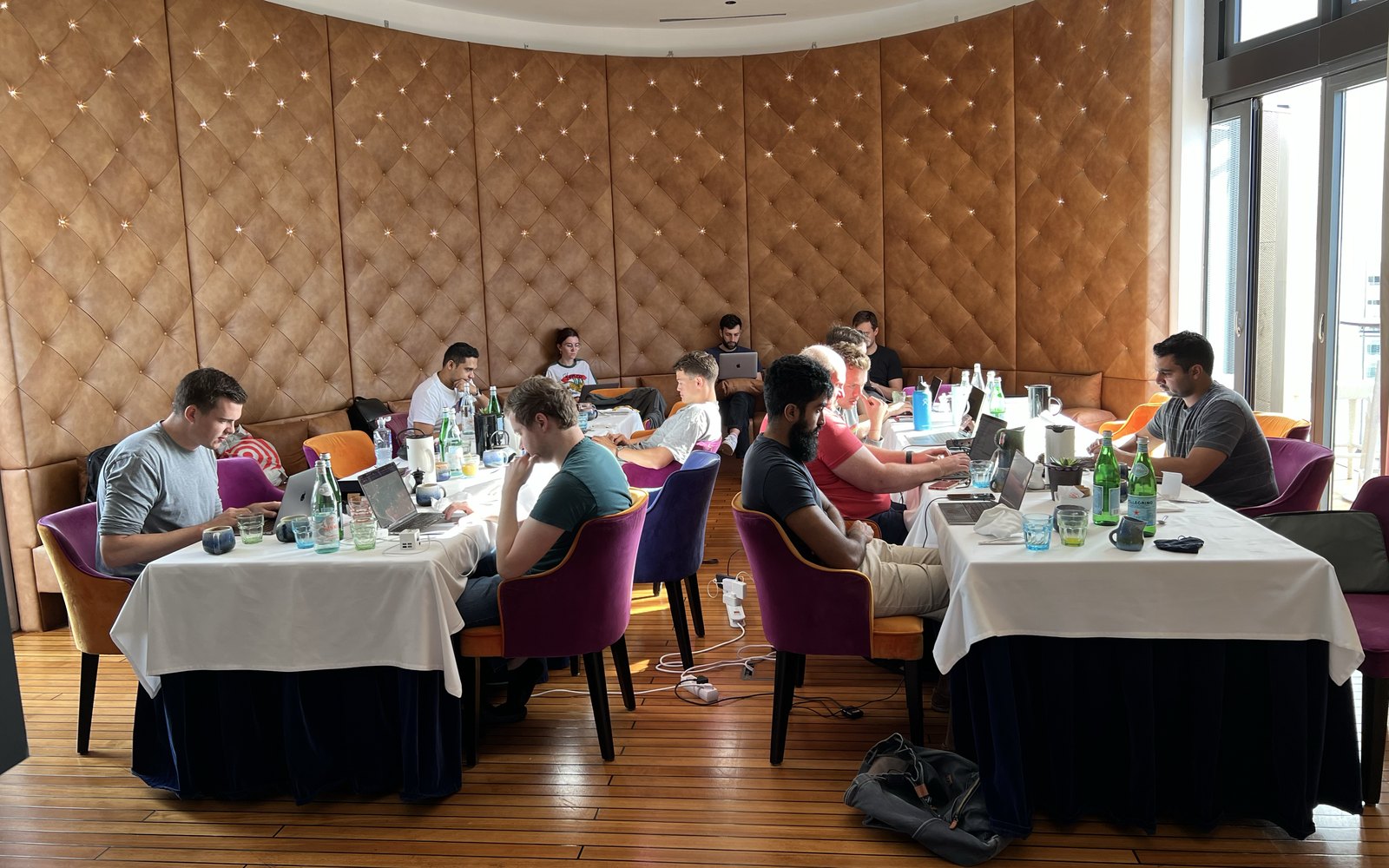
Growth stalled right after that milestone. The founders later realized their 30% monthly rate had been sustained by seed-round publicity and 25% price increases on each new cohort rather than compounding lead volume; Q1 2022 new ARR matched Q4 2021.[1] Meanwhile, closing deals "hand to mouth" piled up custom integrations and fragile features.[1] In January 2022, one customer's 52GB model took Causal down for every user, and one week in April brought 18 serious issues and three outages. At that point, fixing bugs took about half of engineering time. The team slowed product development for two quarters to improve reliability.[1] Köbis and his team rewrote the calculation engine from browser JavaScript to Node.js and then Go (reaching millions of cells) and worked with a consultant on array layouts toward a goal of billions of cells, noting in July 2022 that Causal had not yet reached billions.[1][4]
Some buyers found enough value to justify a hands-on setup. Marley Spoon co-built a weekly country-level cohort revenue model with Causal's customer success team pulling two years of warehouse actuals; Prefect spent six weeks moving its corporate model over with customer success; and ClassDojo's revenue team modeled its freemium subscription offering without an in-house finance team.[7][8][9]
The founders say hands-on implementation typically took 10 to 30 hours over two to eight weeks. The early wins gave them little warning about what would happen at renewal.[1] Renewals began in Q2 2022, and half the 2021 cohort eventually churned. In 2022, Causal was adding $200k–$250k in new annual recurring revenue per quarter. From Q2, it began losing $100k–$150k per quarter to churn.[1] According to the founders, building models for clients undermined self-sufficiency, lone "savvy" champions rarely had a backup operator if they left, and routine non-modeling finance workflows remained thin.[1] Tighter budgets in 2022 plausibly amplified these problems. By 2024, Abdaal also identified Runway as a direct competitor.[1][10] Scaling sales ahead of retention worsened the drag: after hiring a VP of Sales in Q4 2022, Causal reached 10 sales and marketing staff inside a 31-person team by April 2023 while closing less revenue than one salesperson in a 10-person team had closed in 2021.[1]
Self-serve pivot, reporting wizards, and distribution limits
By Q2 2023, self-serve out-earned the sales team.[1] Public pricing also undercut top-down pitches: listing a $250/month "Startup" tier beside a $2,000/month "Growth" plan (an eightfold jump) pushed prospects to test self-serve instead of signing $24k annual deals.[1] The founders cut headcount twice, from 31 to 24 in May 2023 and again in September 2023, when they eliminated six sales, marketing, and operations roles to focus on small businesses using self-serve. The founders reported 20 staff by December and about $1.5m in annual burn savings.[1]
Self-serve reached $750k ARR by the end of 2023 (roughly half of total ARR per a December investor update), and paid add-ons brought net dollar retention for the SMB business close to 100% in 2024, according to the founders.[1] Because power users were running Causal for recurring historical reporting, the team shipped one-click data wizards (starting with Stripe in March 2024) alongside a cheaper Reporting tier so startups could inspect live ARR, MRR, churn, and cash before building forecasts.[1][11] The wizards fell short of turnkey forecasts for most users, yet they persuaded far more signups to connect live data, and dogfooding Causal on Snowflake for daily company metrics exposed recurring usability papercuts the founders had missed.[1] On March 19, 2024, the team launched Causal 2.0 on Hacker News, drawing 261 points and 71 comments.[10]
Better onboarding did not widen the funnel. Causal ran joint webinars with Ramp and Merge, a B2B pricing webinar with Sam Blond, Startup Suite templates with Packy McCormick's Not Boring, public company dashboards, and LinkedIn video.[1][13][14] Its fractional CFO partner program referred up to 10 clients per week and reached 25% of new monthly revenue at peak, but demanded full-time effort to train advisors and help them sell clients on an extra $250–$500/month bill.[1][12] Separately, a programmatic GPT-3 SEO experiment grew to roughly 1 million monthly page views (over 99% of site traffic) before collapsing after a viral November 2023 Twitter thread; the founders say those pages never converted into signups, and daily signups stayed flat near 50 per day from 2022 through 2024.[1]
Outcome and evolution
By late 2023, Abdaal and Köbis still had runway and an improving funnel, but recognized Causal was not on a venture breakout curve.[1] Exploratory M&A talks with an unnamed late-stage BI company, arranged through Benn Stancil and advised by Jake Fuentes, ended without an offer.[1]
In March 2024, Berlin-based Lucanet, a CFO software company backed by Hg Capital, reached out via an FP&A contact. Lucanet reported serving more than 5,500 companies when it announced the deal.[1][16] Lucanet had spent a year evaluating planning vendors to add operational planning across its installed base.[16] After product diligence, the parties signed an LOI in early August 2024, chose a Delaware merger structure, incurred $750,000 in legal fees, and closed on October 29, 2024 ahead of expected UK capital gains tax changes in the October 30 Budget.[1] UK Companies House filings corroborate Hgcapital LLP gaining significant control of Causal's UK subsidiary on October 29, 2024.[15]
Both companies announced the sale on October 31, 2024, keeping Causal's 18-person team intact as Lucanet's xP&A Centre of Excellence serving 300+ finance leaders.[1][16][17] On Hacker News the next day, Köbis projected that standalone Causal would have reached profitability in under 12 months at its growth rate without extra hiring, countering a distress-sale assumption.[18]
Lucanet launched xP&A publicly on February 12, 2025.[19] As of November 2026, causal.app keeps a login link for existing customers and directs new visitors to Lucanet xP&A, which sells through demos and sales contacts with no public list price.[20][21] xP&A preserves multidimensional modeling, scenarios, model-level audit logs, and raw-value exports, and added an AI Modeler Agent in June 2026 that builds models from text prompts without reading external spreadsheets.[22][23][24][25] UK filings record Abdaal and Köbis ending UK subsidiary directorships on April 8, 2026.[15] On July 17, 2026, Lucanet announced that xP&A would end support for JavaScript formulas and Monte Carlo simulations after August 2026 as part of a new calculation engine rollout, retiring inside xP&A the probabilistic feature that first brought Causal to Hacker News in 2019.[24]
Timeline
- April 20, 2019: Interactive probabilistic demo hits the Hacker News front page, drawing 600 waitlist signups.[1][2]
- May 15, 2019: Causal, Inc. incorporates in Delaware.[1]
- August–September 2019: Raises $1m pre-seed round in 40 days.[1]
- September 2020: Reaches 40 SMB customers at $50/month after repositioning into FP&A.[1]
- January 2021: Ships AG Grid UI, converts 36 demos into eight pilots, and signs Smarkets as first paying mid-market customer.[1]
- February–April 2021: Raises $4.2m seed led by Accel ($25m post-money); TechCrunch launch fuels six months of inbound leads.[1][3]
- September–December 2021: Closes $20m Series A ($100m post-money) co-led by Coatue and Accel; ends 2021 at $800k ARR.[1]
- January–April 2022: A 52GB customer model triggers an outage; Causal hits $1m ARR across 65 customers on March 31 just before Q2 renewal churn hits.[1]
- May & September 2023: Two layoffs reduce headcount from 31 to 20 and cut ~$1.5m/year in burn during the self-serve pivot.[1]
- December 2023: Self-serve reaches $750k ARR as the company shifts resources to smaller buyers.[1]
- March 2024: Ships Stripe wizard, launches Causal 2.0 on Hacker News, and receives Lucanet's inbound approach.[1][10]
- October 29–31, 2024: Delaware merger closes October 29 (corroborated by UK Companies House PSC filing); Lucanet announces acquisition October 31.[1][15][16]
- February 12, 2025: Lucanet launches xP&A publicly on Causal's technology.[19]
- April–August 2026: Founders resign UK subsidiary directorships April 8; Lucanet releases Modeler Agent in June and ends xP&A support for JavaScript formulas and Monte Carlo simulations after August 2026.[15][24]
Sources
- Taimur Abdaal and Lukas Koebis, "Causal: From Idea to Acquisition — Reflections on our B2B SaaS Journey"
- Hacker News, "Show HN: Should you buy a house and rent it out?" (April 20, 2019)
- Accel portfolio profile: Causal
- Lukas Koebis, "Scaling our Spreadsheet Engine from Thousands to Billions of Cells" (July 5, 2022)
- SEC Form D, Causal, Inc. ($5,732,393 sold, filed August 25, 2022)
- SEC Form D, Causal, Inc. ($20,164,992 sold, filed August 25, 2022)
- Causal customer story: Marley Spoon
- Causal customer story: Prefect
- Causal customer story: ClassDojo
- Hacker News, "Show HN: Causal 2.0 – Modern Financial Planning for Startups" (March 19, 2024)
- Sacra interview with Taimur Abdaal (May 2024)
- Causal LinkedIn post: Causal for Fractional CFOs
- Causal LinkedIn post: joint webinar with Merge and Ramp
- Taimur Abdaal LinkedIn post: Startup Suite templates with Packy McCormick and Not Boring
- UK Companies House filing history for Causal UK subsidiary (Company 12406585)
- Lucanet press release, "Causal joins the Lucanet Group" (October 31, 2024)
- Causal announcement, "Causal joins the Lucanet Group" (October 31, 2024)
- Hacker News, "Tell HN: We (Causal) got acquired – thank you HN" (November 1, 2024)
- Lucanet press release, launch of Extended Planning and Analysis (xP&A) (February 12, 2025)
- Causal legacy transition page
- Lucanet Support documentation: xP&A overview and licensing
- Lucanet Support documentation: working with xP&A models and audit logs
- Lucanet Support documentation: exporting a model as raw values
- Lucanet Support release notes: xP&A updates (2025–2026)
- Lucanet Support documentation: Modeler Agent