
Chariot
Winter 2015AcquiredThe world's first private mass transit service providing a commuting…
Pressure-test this opportunity
Explore the risks and possibilities with a prompt for ChatGPT, Claude, or your agent.
The world's first private mass transit service providing a commuting…
Explore the risks and possibilities with a prompt for ChatGPT, Claude, or your agent.
Chariot connected commuters to fixed shuttle routes through a booking app. Founded in 2014 and part of YC's Winter 2015 batch, it offered shared vans between public transit and individual ridehail. Ford acquired the company in 2016, expanded it, and closed the service in early 2019.[1][2][3]
Its route-launch mechanism was stronger than a popularity poll. Chariot used crowdfunding to collect commitments to buy initial monthly passes. That reduced launch uncertainty, but could not establish continuing ridership, route profitability or the cost of expanding across cities. The useful distinction is between paid initial demand and a durable operating business.[4]
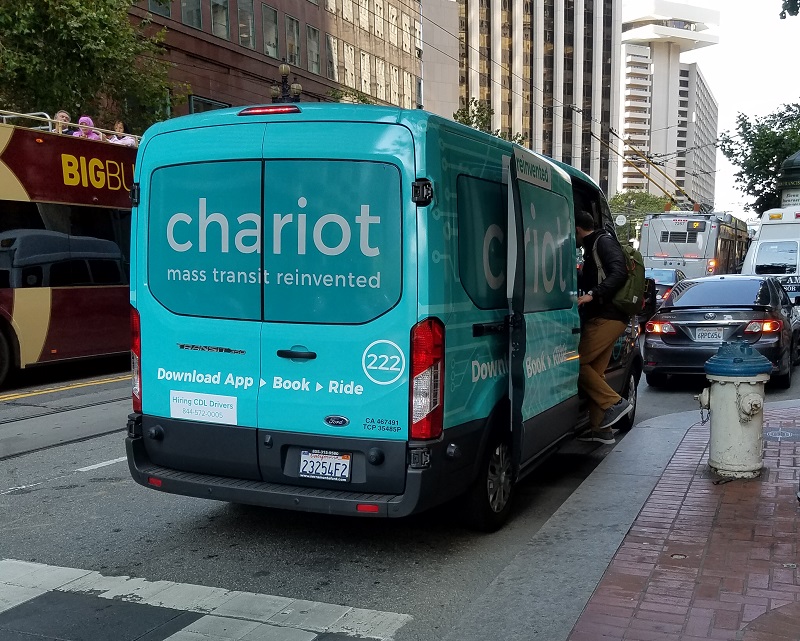
Image 1 / 1
Ali Vahabzadeh's account described crowded buses, costly peak-hour rides and neighborhoods with weak connections as the problems he wanted to solve. His current company, Safari AI, identifies him as Chariot's founder. YC separately lists Romain Di Vuolo. These records describe different members of the founding team; they do not support treating one listing as an exhaustive roster.[3][5][1]
Chariot combined passengers along fixed corridors.[8] Its hired-driver operation required vans, insurance, parking and fuel as well as an app.[4]
The crowdfunding interface made a route's launch conditional on initial customer commitments. Vahabzadeh explained that cards were charged for the first monthly pass only when the signup threshold was reached.[6] A route could therefore start with paying customers, while still facing renewal and service-cost risk.
Chariot's original service ran recurring commuter routes, with app or web signup and fare options including passes. MaRS's 2016 assessment describes routes launching after at least 60 people purchased initial passes. The Fisherman's Flyer, for example, addressed workers' connection from BART to jobs around Fisherman's Wharf. That was a specific last-mile problem, not a general promise to replace public transit.[4]
In London, passengers could book a seat and track the shuttle. Ford announced 14 minibuses on four routes connecting neighborhoods to transport hubs. Selected vehicles were wheelchair accessible at launch. The HELLOLDN promotion offered free rides until February 14, 2018; subsequent pay-as-you-go rides cost £2.40. Those were launch terms, not evidence of what customers ultimately paid over the service's lifetime.[11]
The enterprise service changed the buyer and access rules. Ford's August 2018 announcement described easitNETWORK's shuttle between Hayes & Harlington station and Stockley Park, plus a lunchtime shopping service. App booking and vehicle tracking remained. The announcement did not disclose contract revenue or profitability.[12]
Chariot sold a more directed commute than many public-transit trips and a shared fare rather than an individual ride. The buyer still had alternatives: public transit, carpooling, employer shuttles and ridehail. Comfort and a direct corridor could win a rider without making every departure economical.
SFMTA's 2018 report recorded 266,000 total San Francisco trips during Chariot's first six months of permitted operation, with 12 morning and nine evening routes. These figures demonstrate actual use. They do not reveal unique customers, seat occupancy, renewals or profit per route.[10]
Public streets also constrained the product. SFMTA required safe, legal stops; new routes that complemented Muni; ridership and GPS data; equivalent disability service; and labor and driver-training standards. Private route planning therefore involved permission, accessibility and network coordination alongside customer demand.[9]
Current institutional transport remains a competitive market. Via offers corporate shuttles with vehicles, drivers, booking and management. In May 2026 it announced planning software for vehicle and driver schedules across fixed-route and demand-response services. A new coordination workspace would need to demonstrate value against these existing capabilities.[14][15]
Chariot combined passenger fares with enterprise services. A pass commitment could help finance a launch; ongoing revenue still depended on renewals, customer travel patterns and contracts. Costs included paid driver hours, vehicle provision, insurance, maintenance and idle or repositioning time. Public evidence does not provide enough data to reconstruct route margins or an occupancy break-even point.
The acquisition supported Ford's move into mobility services. Ford's 2016/17 sustainability report described plans to develop dynamic shuttles and make Chariot accessible through FordPass. This was a strategic growth thesis, not a disclosed financial result.[2]
Later reports put seed funding at $3 million and the acquisition around $65 million. No observed primary transaction document confirms the complete purchase terms. Ford's audited $40 million goodwill impairment is a different accounting measure: a write-down of an acquisition-related asset following the decision to close, not the total purchase price or Chariot's accumulated operating losses.[3][13]
A company spokesperson told Crunchbase News that continuing the service was not sustainable. Ford's annual report establishes that the decision to cease operations preceded the fourth-quarter 2018 impairment. The acquisition itself was an expansion milestone; closure came more than two years later.[3][13]
The plausible economic mechanism is limited productive vehicle time combined with recurring physical costs. Commuter demand concentrates in narrow windows and directions. An initial pass threshold cannot establish retention or how much revenue each vehicle hour produces. Additional cities add local route design, stops, staffing and regulatory work. Public evidence supports examining those costs, but cannot isolate low occupancy, regulation, expansion pace or Ford's changing priorities as the sole cause.
Chariot had paying launch commitments, substantial reported use and enterprise services before closure. Contracted demand was already part of its business, so simply proposing an employer buyer does not explain how a rebuild would succeed. A viable route still needs a funded service floor, operational performance and renewal at a price covering its costs.
Chariot has no verified continuing shuttle product in this evidence set. Ford's 2018 annual report says lessons from its millions of rides informed other businesses, including non-emergency medical transport; that statement does not establish a currently available successor.[13] Stockley Park still advertises an easit peak-time station shuttle; its page does not identify Chariot as the operator.[16] Vahabzadeh now leads Safari AI, a separate computer-vision company.[5]