
Cocoon
Winter 2019AcquiredBring your most important groups closer together
Pressure-test this opportunity
Explore the risks and possibilities with a prompt for ChatGPT, Claude, or your agent.
Bring your most important groups closer together
Explore the risks and possibilities with a prompt for ChatGPT, Claude, or your agent.
Cocoon was a W19 private-sharing app built by former Facebook colleagues Sachin Monga and Alex Cornell. Launched in November 2019, it gave families and close friends a digital home for photos, conversation, calls, location, and everyday signals such as steps or battery level.[1]
Its product judgment was stronger than its business model. Cocoon correctly saw that intimacy needs a small graph and low-pressure sharing. But the moments that made the app valuable were also available through free group chats, photo albums, and operating-system services. Charging for group access, then for archive depth, never created a clear economic reason to move an entire family. Substack acquired the team in August 2021 while leaving the app independent.[2]
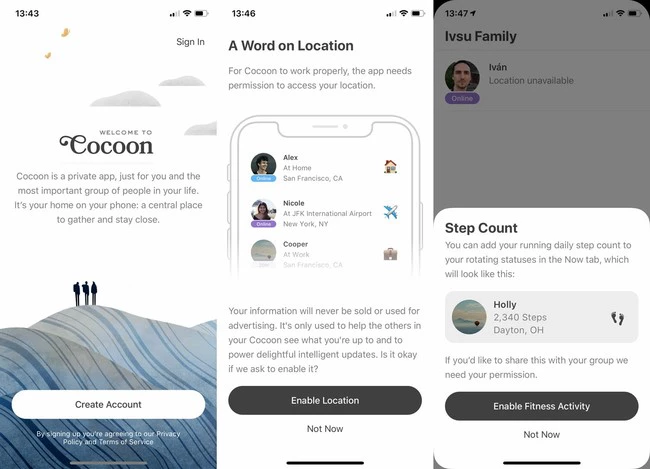
Image 1 / 1
Monga and Cornell met in product roles at Facebook. Monga joined Facebook in 2011 and worked across growth, platform, advertising, and the main app's sharing team. Cornell led design for Facebook Video and had already co-founded Moonbase and UberConference.[2] Their shared problem was partly institutional: they wanted software that deepened a few relationships, while Facebook's advertising model rewarded more attention across a broad network.
They left Facebook in 2018 and spent roughly a year building Cocoon before its public launch. Cornell's launch note framed the premise plainly: “The purpose of Cocoon is to keep a small group close over time and distance.” He connected that premise to his own family, which had aged and moved apart while relying on phones, email, text messages, and general-purpose social networks.[3]
Monga's family provided the more concrete prototype. He showed Quartz an app containing updates from his parents in Toronto, one sister in New York, and another in San Francisco. “We haven't shared a physical home in 17 years, but we're still a family, and we thought there should be sophisticated software to handle that,” he said.[1]
The initial design enforced the thesis. Each user chose one group of no more than twelve people. Cocoon called this a “chosen family,” allowing close friends as well as relatives but refusing the sprawling graph that had made Facebook noisy. Cornell told Euronews, “Networks are good for so many things, but over time they get a little bit worse at handling our most intimate relationships.”[4]
Cocoon tried to make a small group feel like a household rather than a channel. A new user created a private space, invited family or close friends, and chose which ambient signals to share. The home feed mixed intentional posts with passive updates: a photo, a short thought, someone's location, a step count, or a low battery. Conversations clustered around each update instead of collapsing into one chronological stream.[1]
That design lowered the cost of sharing mundane life. A family member did not need a story worth announcing, and others did not have to reply immediately. Voice and video calls sat inside the same private space. The Daily Album later organized photos and videos into a shared history, while private replies and reactions let people respond without turning every moment into a group discussion. Archived App Store material also shows Android support and multiple Cocoons in the mature product.[9]
The privacy promise was unusually strict for a social app. Monga said Cocoon would not sell or share user data with third parties.[4] Location and fitness permissions were optional, but they created a difficult trust test: the signals that best reproduced co-presence were also the ones users would be most cautious about granting.
The product evolved away from its hardest constraints. One group became multiple Cocoons. A paid product became free group creation with an optional archive subscription. These changes made adoption easier, but they also blurred the original claim that a single, deliberately bounded home was the product.
Cocoon targeted geographically separated families and chosen families who already used several weak substitutes: group text for conversation, shared albums for photos, phone calls for depth, and location apps for awareness. The best early users had both emotional urgency and a coordinator willing to persuade everyone else to install another app. That made the household, not the individual, the real unit of adoption.
The company disclosed no market estimate. The broad U.S. household base was large, but only a fraction had the combination of distance, privacy concern, cross-platform needs, and willingness to pay. For scale, the 2024 American Community Survey counted 129.2 million households, including 23.2 million married-couple households with children under 18.[10] Those figures describe an upper bound, not Cocoon's serviceable market.
Cocoon competed on intimacy and design against products with distribution already solved. WhatsApp and iMessage owned group conversation. Apple and Google owned photos, identity, notifications, and device-level signals. FamilyAlbum focused the photo-sharing use case on parents and grandparents while offering cross-device access and physical photo products.[11]
That gap has narrowed further. Apple Invites launched in February 2025 with cross-platform RSVPs and event-specific Shared Albums. Apple then announced full-resolution uploads, reactions, richer activity, temporary albums, and web participation for Shared Albums in its fall 2026 releases.[12][13] A general private-sharing rebuild would now fight the operating system on storage, invitations, and photo collaboration. Its defensible territory must be a recurring family job that Apple and Google do not want to own.
Cocoon refused ads and data sales, so subscription revenue had to support the service. The app launched free, later moved toward a $4 monthly subscription, then changed course in July 2021: group creation became free, while Membership offered infinite Daily Album history beyond the free seven-day window.[8][7]
No observed source disclosed revenue, paid conversion, retention, headcount, or acquisition price. A burn estimate would therefore be invented. The visible sequence still matters: Cocoon removed its adoption paywall one month before the team joined Substack. That does not prove subscription failure, but it shows the team was still searching for a chargeable unit late in the company's independent life.
The public record contains one traction marker. In April 2020, five months after launch, Monga told Axios that thousands of families had downloaded Cocoon.[6] The timing should have favored the product: pandemic restrictions turned distance from an occasional family problem into a daily one.
Downloads do not establish active groups, retained households, or paid demand. Substack later praised a “happy and healthy community,” but published no size or engagement data.[2] The available evidence supports real affection among a small user base, not venture-scale adoption.
Cocoon needed several people to install, grant intimate permissions, and form new habits before any one user received the full benefit. Yet a subscription required someone to pay for a group whose alternatives were already installed and free. Charging at the group boundary increased the cost of the exact action that created value.
The team tried to fix this by making unlimited Cocoons free. But the replacement paywall surrounded old photos, not the daily sense of presence that made Cocoon distinct. Archive depth was easier to meter than closeness, and weaker as a reason to subscribe. This mismatch is the central structural problem: Cocoon could monetize storage-like scarcity or preserve frictionless intimacy, but it did not find a paid feature that strengthened both.
Monga later explained the motive behind the company: advertising requires a service to “accumulate a lot of time spent and attention and convert that into basically sellable eyeballs.” Cocoon explored a better experience for “helping you feel close to a handful of people.”[14] The critique was right. A principled rejection of ads did not, by itself, create subscription demand.
Cocoon was compared with Facebook, but its practical competitors were a bundle: text, shared photos, calls, Find My, and fitness apps. Its integrated experience was better designed, yet every household member had to agree that integration was worth another app and new permissions. Incumbents could improve each component without asking users to rebuild their social graph.
The 2025–2026 Apple releases strengthen the counter-explanation. Cocoon was not merely early; it occupied territory that platform owners could absorb. A stronger design might have improved retention, but it could not remove the distribution advantage of software bundled with the phone.
Substack valued Cocoon's product and design talent and shared its preference for user-funded software. It explicitly left the app outside the acquisition.[2] Cornell called that “a perfect outcome” and said the app would remain online under paid subscriptions.[15]
That was a good talent outcome and an incomplete product outcome. Archived listings later carried user complaints about lost support and an unavailable app on a replacement phone.[9] No first-party shutdown notice was found, so the precise ending remains unresolved. What is clear is that Cocoon did not become part of Substack and its independent service did not remain a durable consumer platform.