
Coursedog
Winter 2019AcquiredHigher Ed's Best Friend - integrated academic operations software.
Pressure-test this opportunity
Explore the risks and possibilities with a prompt for ChatGPT, Claude, or your agent.
Higher Ed's Best Friend - integrated academic operations software.
Explore the risks and possibilities with a prompt for ChatGPT, Claude, or your agent.
Coursedog began with class scheduling and became a suite for academic administration. Justin Wenig and Nicholas Diao built tools for registrars after struggling to register for computer-science classes at Columbia. Their product connected to the student information system (SIS), the institution’s authoritative student database, while improving the work around it. [2] [3]
In March 2023, Coursedog announced a $90 million strategic growth investment from JMI Equity and Gregg Scoresby. Wenig later described a majority sale. The operating company continued: Andrew Rosen became CEO in 2024, and Coursedog acquired ClassRanked in April 2026. Its current site reports 500-plus campuses serving 3.5 million students. [1] [8] [10] [2]
Coursedog grew while its founders sought a different future. The company’s integration strategy supported expansion; its founders’ account of the sale adds financial and personal limits that customer counts alone cannot explain.
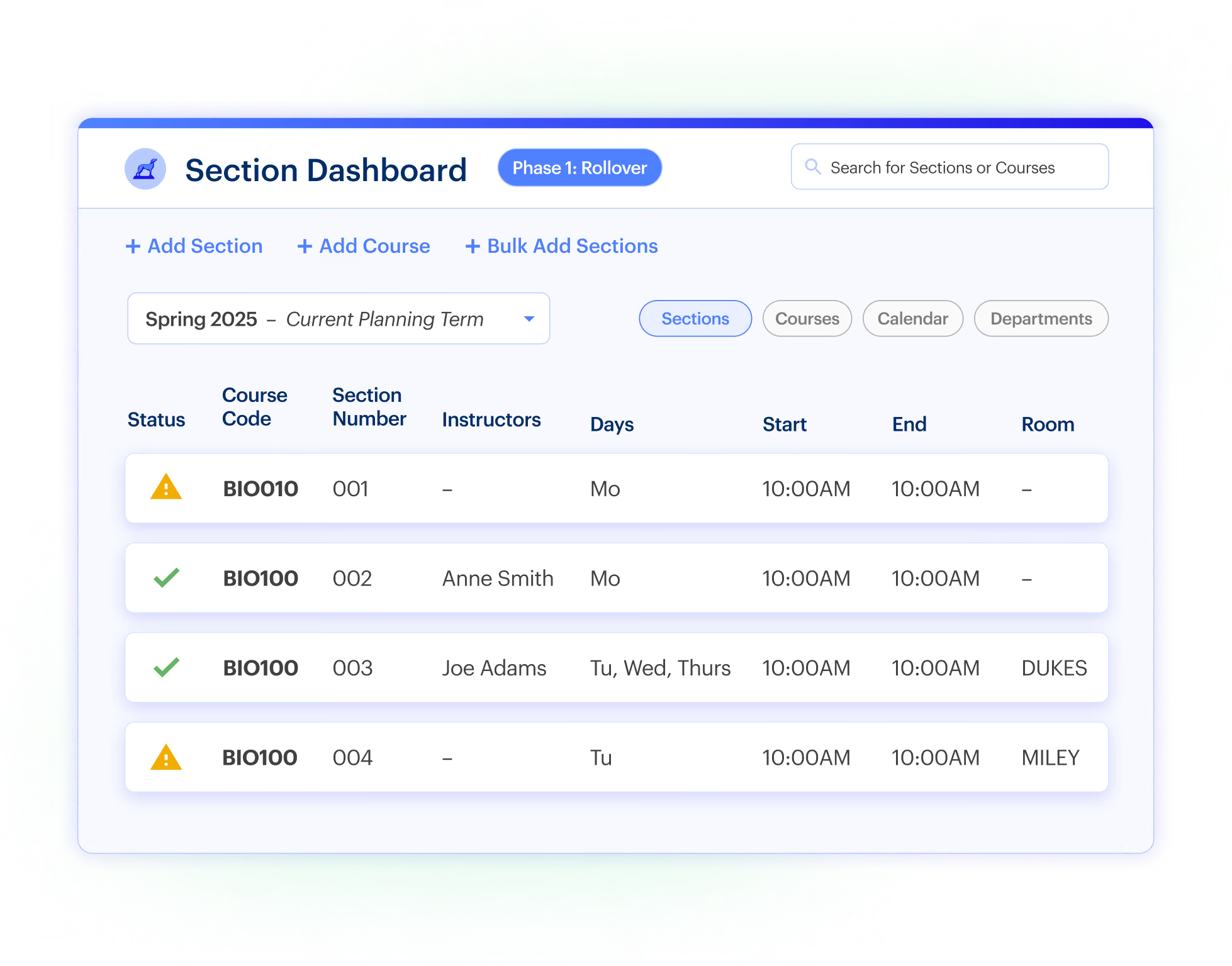
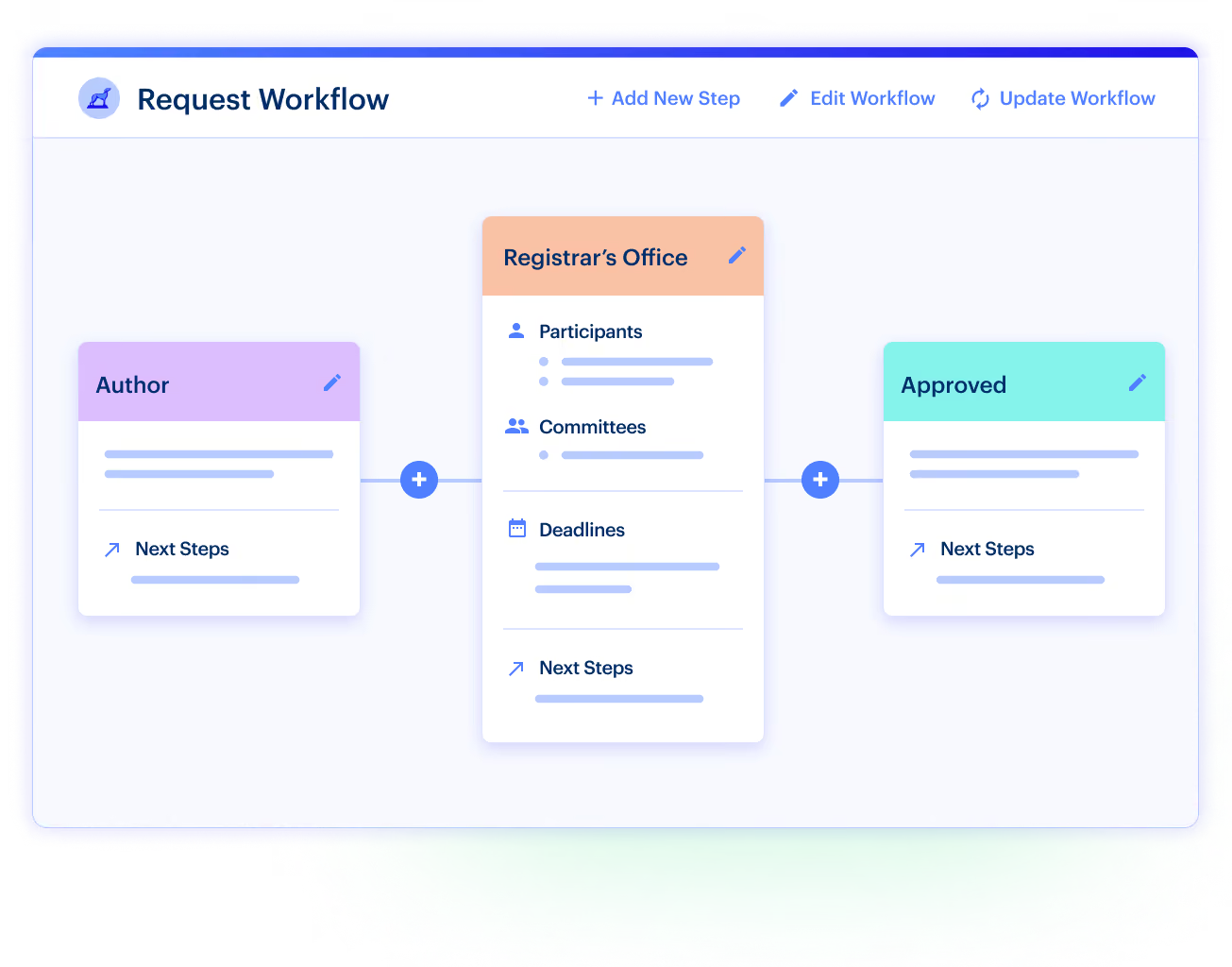
Image 1 / 2
Wenig and Diao were Columbia computer-science students. A 2021 alumni profile describes abandoning summer internships, working in Mudd Lounge, and making roughly 1,000 calls. Their initial interest in a better student course-selection tool became software that administrators used to build schedules. [4]
The founders’ August 2019 launch account describes universities using “excel spreadsheets, manual horse/brain/caffeine-power and SQL reports to clean up inevitable errors.” They built a Vue/Node application with mixed-integer optimization for times and rooms, then added manual editing because institutional politics complicated the ideal schedule. Columbia Law School and BYU were early users. [3]
That change in audience mattered. A student needed a class; a registrar needed to coordinate departments, rooms, instructor preferences, and campus rules. Automating the registrar’s task required a way to preserve decisions that an optimizer could not make alone. The company launched in 2018 and joined YC’s Winter 2019 batch. [2] [3] [5]
Early customers entered room availability and institutional rules, collected instructor preferences, and reviewed suggested schedules. Coursedog integrated with Ellucian, Jenzabar, and PeopleSoft. EdSurge reported three-to-five-week integrations for standard systems in 2019, with longer work for homegrown systems. That is a historical implementation measure, not a current service guarantee. [5]
The current scheduling product includes room optimization, faculty-preference forms, meeting patterns, section assignments, and request approvals. Operators can inspect conflicts and apply their institution’s rules. The suite also includes curriculum proposals, catalogs, syllabi, faculty workload, course-demand projections, and assessment. These products coordinate changes above the SIS rather than replace the full student record. [22] [11]
Coursedog joined Ellucian’s Ethos community in August 2021. The announced integration offered shared customers an API connection between systems. Access to incumbent data was therefore part of product delivery, not an optional feature. It also created dependence on supported interfaces and the terms of ecosystem partners. [13]
Coursedog’s three current product groups are Curriculum, Scheduling, and Assessment clouds. eLumen selected it as an exclusive curriculum-and-catalog partner, offering existing customers an upgrade path while preserving support from eLumen’s team. The companies announced the partnership at the California Community College Chief Instructional Officers’ Spring Conference. This gave Coursedog a distribution path beyond selling each new institution from scratch. [11] [17]
ClassRanked adds course evaluations to Assessment Cloud. Its mobile-friendly feedback tools and SIS/LMS integrations are intended to connect teaching feedback to curriculum, scheduling, and accreditation work. The April 2026 announcement names Hayden Hall as the incoming Assessment Cloud leader. It does not establish that every customer had completed a migration or that acquisition alone improved student outcomes. [10]
Registrars were the initial champions. Provosts, CIOs, curriculum committees, and assessment teams widened the buying group. JMI’s 2024 account named Columbia, Stanford, CUNY, and BYU among more than 200 institutions. Coursedog’s current about page separately reports 500-plus campuses and 400-plus institutions. Campuses, institutions, and contracts have different scopes; these figures cannot establish revenue growth by themselves. [12] [2]
CourseLeaf CLSS also preserves the SIS as the system of record. It supports scheduling rules, approvals, curriculum connections, and included course-demand analytics. Ad Astra offers scheduling, demand forecasting, faculty-capacity planning, and SIS integrations. Akari offers curriculum governance and mapping. Connecting specialist tools to an SIS is a category strategy, not an exclusive Coursedog capability. [18] [19] [20]
WICHE’s 2024 projections expect US high-school graduates to peak in 2025, then fall 13% by 2041. They also project declines in 38 states relative to 2023. That creates pressure to plan course capacity carefully, but does not prove a specific software budget or guaranteed enrollment gain. A new product must show a decision improvement beyond existing vendor modules and campus processes. [16]
EdSurge reported average implementation fees of $100,000 and annual licenses of $15,000–$100,000 in June 2019. At that point, Wenig claimed 55 customers, $5 million in booked contracts, and profitability with 16 employees. Bookings are not recognized revenue, and this reported profitability does not describe later periods. The article put total funding at $1.5 million, including the newly announced $1.25 million round. [5]
In 2021, the company reported nearly 100 institutional partners and a 60-person team alongside its $17 million Series A. By the 2023 growth investment, its announcement named 170-plus customers. Paid implementation and multi-year contracts fit campuses that needed data mapping, security review, local rules, and stable academic-cycle handoffs. Shared connections could then support additional modules. [7] [1]
In his later account of the 2023 sale, Wenig reports about $10 million in annual recurring revenue, about 85% growth, 105% net revenue retention, 98% gross revenue retention, and roughly $400,000 monthly burn. He omits growth/retention windows, burn basis, and audited reconciliation. He describes a low nine-figure valuation and a majority-cash, part-stock deal without an earn-out. These are retrospective sale-period claims. The $90 million announced investment is a separate transaction measure; neither figure determines an individual payout or investor return. [9] [1]
Current revenue, margin, retention, and profitability remain undisclosed in the cited company material. Continued operation and wider product coverage establish activity, while the founder figures describe an earlier financing decision.
Coursedog’s Weatherford case study reports 75% more efficient curriculum work, 20 added classes, and $84,000 in annual revenue from those classes. It separately associates connected curriculum and catalogs with 35% enrollment growth and $1.8 million in added revenue. These are vendor-published customer claims with different scopes. They illustrate a proposed mechanism, but do not isolate Coursedog’s causal contribution or predict another college’s result. [14]
The founders initially hoped to rebuild university administration broadly. The current business concentrates on academic operations connected to existing student records. That boundary reduces the data migration required for a first purchase and gives later products a reusable integration. The founder’s 2019 sales account describes outbound calls, references, and easier expansion after the first campus product. [3] [11]
Implementation also remains a source of risk. In an August 2024 CUNY University Faculty Senate post, John Verzani, the senate chair, criticized degree-map demonstrations for credit-count errors and difficulty representing local rules. This is a dated participant account, not proof that those errors persist in the current product. The post also notes a subsequent contract extension, including demand projections. A connected workflow still needs correct local data and academic review. [21]
Wenig says he and Diao wanted another mission. He ran a sale process, writing “We definitely sold our business.” He later felt detached even as the business exceeded his expectations. This explains founder intent, while customers’ decisions require separate evidence. [9]
JMI describes a growth investment in the platform and team. Rosen’s appointment brought experience from Blackboard and Interfolio, while eLumen and ClassRanked extended the suite. Together, these observations support a transition to sponsor-backed expansion. They leave open how much the transaction reflected growth financing, founder liquidity, or other shareholders’ preferences. [12] [8] [17] [10]
Wenig subsequently built Starbridge around another difficulty he knew: selling to government and educational buyers. Craft Ventures describes time spent reading meeting minutes and requesting records to identify prospects. The sequel retained domain knowledge while changing the user job from campus operations to public-sector sales. [15]
Coursedog already sells the scheduling-and-curriculum integration that made its first product useful. A fresh generic overlay would face native alternatives. The related Precept concept instead tests regional nursing-placement coordination, with de-identified cohort needs and confirmed capacity handed back to existing systems.
That adjacent job is also occupied. Exxat One connects schools and clinical sites, including non-Prism schools, and permits free school searches and requests. Florida’s Nursing Consortium administers an existing centralized placement system developed by the Foundation for California Community Colleges. A coalition-governed exchange therefore needs evidence that its shared allocation rules and handoffs improve a particular region’s unused capacity beyond those options. Software cannot create preceptors or clinical capacity by reorganizing the calendar. [23] [24]