Overview
DAQRI tried to put instructions where industrial work happened: directly in a worker’s field of view. Founded in 2010, the Los Angeles company moved from mobile augmented reality into a Smart Helmet, lighter Smart Glasses, and the Worksense software suite. Its integrated technology still needed to become deployable workplace equipment.[1][2]
In September 2019, DAQRI told customers that an asset transaction would end its industrial wearables business and begin a company wind-down. Contemporary reporting put accumulated investment at $275 million. Some assets and staff later moved to Snap, according to reporting. That transfer did not preserve DAQRI’s original products or customer service.[3][4]
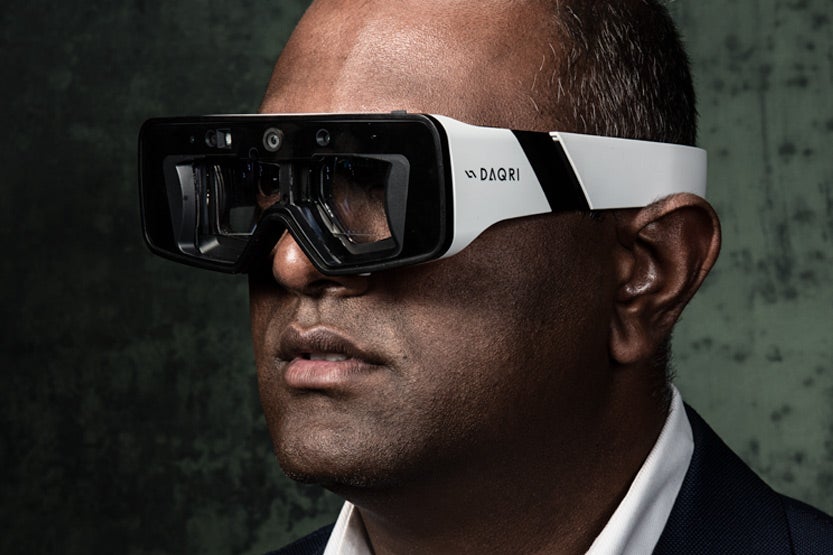
Image 1 / 1
Founding Story
Brian Mullins and Gaia Dempsey were DAQRI’s co-founders. Dempsey’s biography dates the company to 2010 and describes her work across marketing, international expansion, government relations, and operations. Mullins brought earlier experience with augmented reality at the Department of Transportation and the Space and Naval Warfare Systems Command.[1][5]
The original opportunity extended beyond industrial machinery. Crayola’s October 2014 Color Alive announcement named DAQRI as its technology partner. Children aimed a device at a colored page and saw the character appear on screen. Mullins described “the way it ignites their curiosity and imagination.” The partnership gave the technology an established consumer brand and physical distribution.[6]
Industrial work promised a different source of value. A worker might need instructions, a model, or an expert while keeping both hands available. Solving that problem required more than a convincing overlay. The product had to fit the wearer, work at the site, connect to existing information, and remain supportable after deployment.
Timeline
- 2010: DAQRI was founded.[1]
- 2014: Crayola announced its Color Alive partnership.[6]
- 2015: DAQRI acquired EEG headband company Melon and AR software company ARToolworks.[7][8]
- January 2016: Intel presented the Smart Helmet at CES.[9]
- 2016: DAQRI acquired display manufacturer 1066 Labs.[10]
- 2017: The company brought Seamus Blackley and a team from Heat Engine into its research operation.[11]
- March 2018: DAQRI announced Worksense.[2]
- September 2019: Customers received the wind-down notice.[3]
What They Built
The Smart Helmet combined a display, cameras, sensors, and computing inside industrial headgear. Intel’s CES material described an Intel Core M processor and RealSense technology. Its demonstration placed work instructions over equipment and supported inspection and remote assistance.[9]
At the keynote, Mullins said the team had worked with Intel to “redesign the helmet from the ground up.” The demonstration made the intended benefit easy to see. A later CEO reached a different conclusion about the form: Roy Ashok told Cornell that the helmet weighed almost two kilograms and could not become a practical commercial product.[12][13]
The replacement Smart Glasses separated the headset from a body-worn computer. DAQRI’s datasheet lists 335 grams for the glasses and 496 grams for the compute pack. It specifies a 44-degree diagonal field of view and several safety and eye-protection standards. Those component specifications and certifications do not establish suitability for every industrial site.[14]
Worksense tried to package recurring jobs into applications. Show supported remote experts and annotation. Tag attached information to places and equipment. Scan captured spaces, Model displayed designs, and Guide presented instructions. The standard suite came with the glasses; a Pro subscription offered additional capability. DAQRI was moving toward a repeatable software package around the device.[2]
Market Position
Target Customers
Manufacturers and field-service teams needed expert guidance, instructions, and designs near the equipment. Worksense packaged those tasks for industrial customers.[2]
Market Size
A large workforce does not establish a market for a specific wearable. The reachable market depends on tasks where wearing it improves the result, a buyer’s deployment budget, and the cost of making each site work. The reviewed evidence does not establish profitable repeat deployments or an audited market size.
Competition
The product competed with familiar manuals, phones, on-site experts, and other wearable systems. A demonstration could compare well with paper while still losing to the buyer’s existing operating process.
The category continues. As reviewed October 23, 2026, RealWear sells Navigator 520 devices starting at $3,150. TeamViewer Frontline offers remote assistance, instructions, and inspection workflows on phones or smart glasses. Its Assist product can operate independently or within its broader suite. A new company must compete with available products.[15][16]
Business Model
DAQRI pursued a hardware-and-software business, including subscription packages. The consumer partnership, component acquisitions, and broad research program show how many capabilities the company tried to develop before a repeatable industrial deployment emerged.[6][11]
The reported $275 million is accumulated financing, not revenue, an exit value, or a measured loss. DAQRI’s capital came substantially from Tarsadia. Public material does not provide the cap table or recoveries needed to calculate investor returns.[3][4]
Traction
The strongest industrial use case involved costly equipment and complex work. Cornell’s 2019 profile named early customers Siemens and Rolls-Royce, and reported more than 150 customers. Ashok described typical deployments of only three to five glasses. That distinction matters: a customer relationship and a fleet-wide rollout are different milestones.[13]
Outcome and evolution
Ashok’s 2019 account described a company that had grown through acquisitions without clear responsibilities. He reorganized offices and reduced scope. Those changes show that leadership recognized an operating problem. They do not establish that the revised strategy had enough time, capital, or customer demand to succeed.[13]
The September notice planned to retire Smart Glasses and Worksense at month-end. Contemporary reporting described closed offices and layoffs. A subsequent Protocol investigation, now republished by its author at Lowpass, attributed deployment and organizational problems to former employees. The anonymous accounts describe reported experiences; they do not establish findings against every product or manager.[3][4]
The same investigation reported Snap’s confirmation that it acquired certain assets and roughly two dozen employees. It did not disclose a price. The article’s comparison with an unnamed acquisition in Snap’s filings cannot establish DAQRI’s sale price. The observed sequel is a partial asset and team transfer, not a continuation of Worksense.[4]
Key Lessons
- DAQRI’s helmet made the concept visible but imposed a wearing burden. Validate the full shift and real task before treating a demonstration as a deployable product.
- DAQRI’s small customer deployments left a major commercial question unresolved. Measure repeat use, rollout size, support effort, and contribution separately from customer logos.
- DAQRI combined hardware, software, acquisitions, and research programs. Each added coordination work. A narrower workflow can test customer value before a company owns the whole device stack.
Sources
- Gaia Dempsey biography.
- Original Worksense announcement.
- Contemporary wind-down report.
- Protocol investigation, republished at Lowpass.
- Mullins’s Senate testimony.
- Crayola partnership announcement.
- Melon acquisition.
- ARToolworks acquisition.
- Intel CES backgrounder.
- 1066 Labs acquisition.
- Heat Engine team announcement.
- CES keynote transcript.
- Cornell’s Roy Ashok profile.
- Smart Glasses datasheet.
- RealWear current store.
- TeamViewer Frontline.