
Drivingforce
Winter 2022InactiveRippling for trucking
Pressure-test this opportunity
Explore the risks and possibilities with a prompt for ChatGPT, Claude, or your agent.
Rippling for trucking
Explore the risks and possibilities with a prompt for ChatGPT, Claude, or your agent.
Drivingforce was a Y Combinator-backed startup (W22) founded by Kevin Huang, an ex-Uber engineer, that aimed to build "Rippling for trucking" — an all-in-one workforce management platform consolidating compliance, HR, asset management, hiring, and payroll for trucking fleets. The company operated from 2022 until early 2024, when Huang announced its shutdown after nearly four years as a full-time founder.
Drivingforce failed because it targeted mid-size trucking carriers — a customer segment with razor-thin margins and abundant access to cheap overseas labor — who showed little willingness to pay for the very technology the startup was built to sell. The company didn't die from running out of money; it died because the solo founder ran out of energy after a long sequence of pivots, unable to find a wedge into a more profitable niche before burnout set in.
Huang announced the shutdown in a candid Substack post in March 2024, then joined AI video platform HeyGen full-time in October 2024. The company never raised institutional funding beyond YC's standard investment and a few early angels, and its failure was driven by a fundamental mismatch between the product's value proposition and the economic realities of its target market.
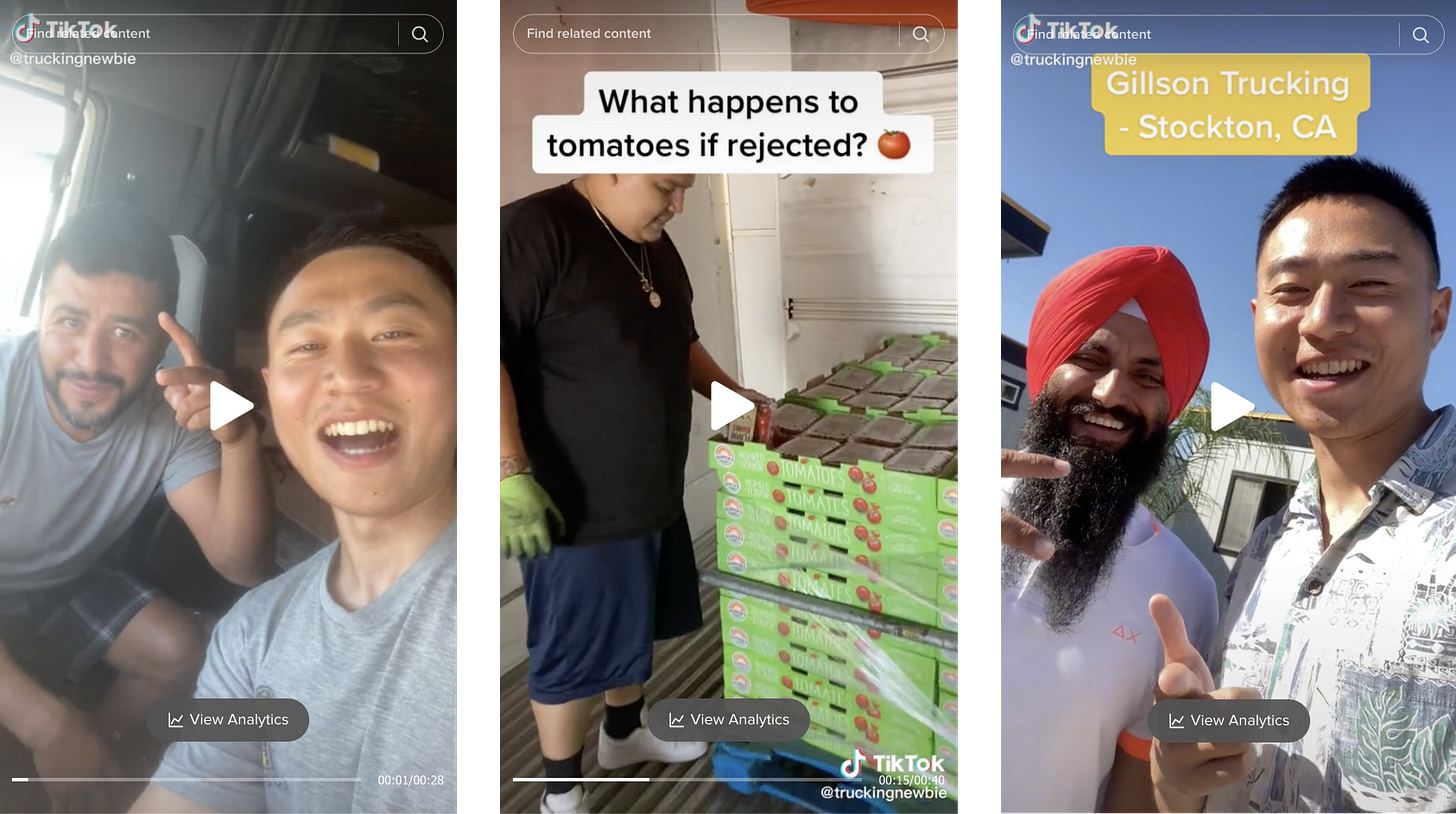
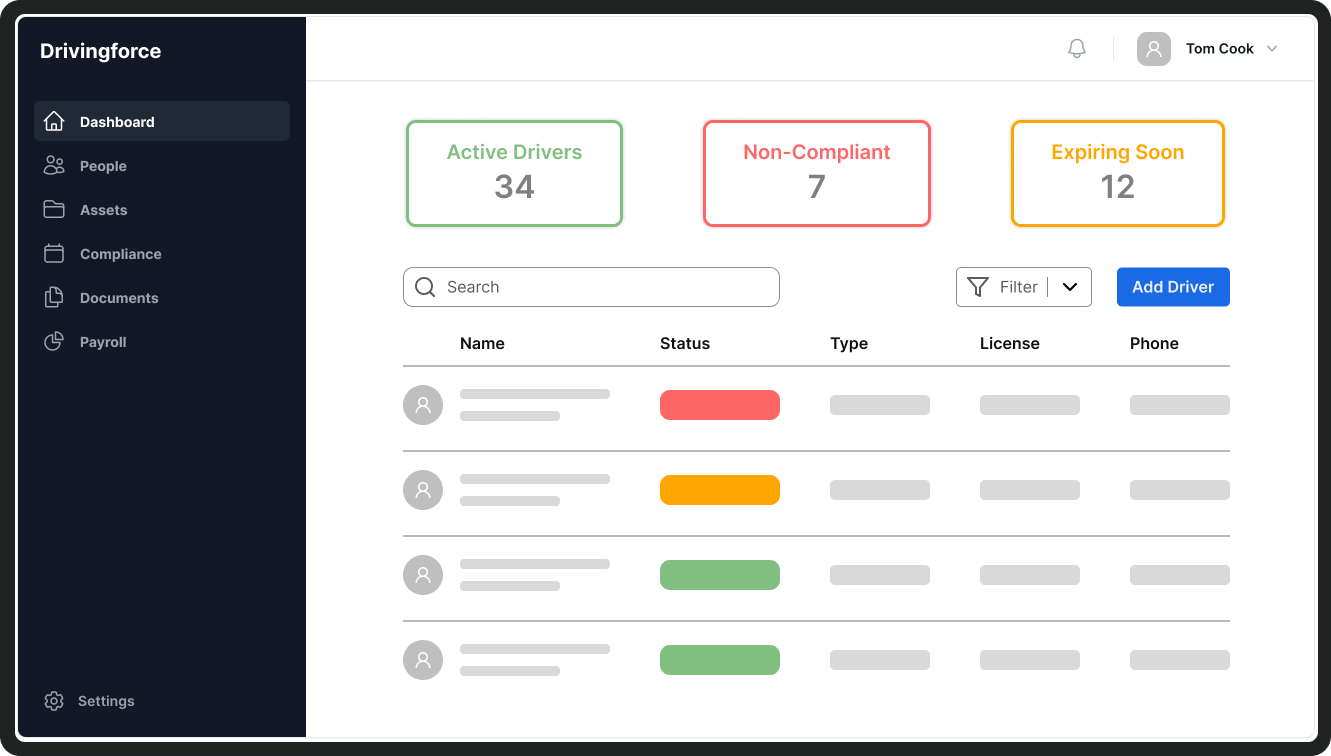
Image 1 / 2
Kevin Huang's path to Drivingforce was not a straight line. He studied Mechanical Engineering at UC Berkeley (BS, 2011–2015) and worked as a mechanical engineer before joining Uber, where he was an engineer until May 2020, when the pandemic-driven layoffs hit.[3][4] That layoff "catapulted" him into full-time founding, but the next two years were a graveyard of abandoned ideas: meal delivery, SaaS for online fitness creators, a cohort-based online Figma course, SaaS for ecommerce, and embedded fintech for B2B marketplaces.[5]
In April 2021, after "the last of many pivots," Huang and his cofounder "ran out of gas as a team and decided to split up."[6] He applied to YC with a manufacturing/supply chain idea — managing suppliers, purchase orders, and production timelines — and was accepted into W22. He received the acceptance call from YC partner Gustaf Alstromer in late October 2021, on the night of his 29th birthday.[7]
The YC experience was rocky. Huang went through the batch as a solo founder, and early on realized the manufacturing problem "wasn't a priority for many customers." He pivoted during the batch — describing solo founding plus pivoting during YC as "not a good combo" — and missed W22 Demo Day entirely.[8]
After Demo Day in April 2022, Huang stumbled into trucking. He took advice from other trucking founders in the YC community: "If you want to learn about trucking, go to truck stops and talk to truckers."[27] He hustled into the industry by visiting truck stops, talking to drivers, and building a TikTok account (@truckingnewbie) that gained traction during the California AB5 protests at the Port of Oakland in July 2022.[9][10]
Huang's on-the-ground reporting gave him unusual access to truckers' perspectives. He told Business Insider: "I think there's often a disconnect between the public and truckers. From a lot of truckers I've spoken with, they often feel like they are misunderstood and underappreciated by the general public."[11]
Drivingforce was positioned as an all-in-one workforce management platform for trucking companies. The core insight was that generic HR tools — Rippling, Gusto, ADP — are insufficient for trucking because of DOT-regulated drivers, high driver turnover, and the need to manage expensive assets like trucks and trailers.[25]
The product exited stealth in June 2023 with five modules:[24]
The product's design rationale was that trucking companies face a unique combination of regulatory burden (DOT compliance), operational complexity (managing expensive rolling assets), and workforce instability (turnover rates that dwarf most industries). A generic HR platform couldn't handle the DOT-specific compliance requirements, and a generic asset management tool couldn't track the maintenance cycles of a truck fleet. Drivingforce aimed to be the single system that tied it all together.
The company's YC profile described it as "Rippling for trucking," a clear signal of the ambition: just as Rippling consolidated HR, IT, and finance for knowledge-work companies, Drivingforce would consolidate the operational backbone of a trucking company.[1]
The product's actual feature depth is hard to assess from public sources — no detailed screenshots or demos beyond a single image from Huang's post-mortem exist. What's clear is that the product was built by a solo founder with a low burn rate, and that it reached a functional state capable of landing at least one mid-size customer for the compliance module by July 2023.[13]
Drivingforce targeted mid-size trucking carriers — companies large enough to have meaningful compliance and HR overhead but too small to justify enterprise-grade solutions or in-house software teams. These are the carriers that might run 50 to 500 trucks, with a small back office handling DOT compliance, driver onboarding, payroll, and asset tracking, often through a patchwork of spreadsheets and legacy tools.
Huang's customer discovery was unusually deep. His TikTok account and truck-stop hustling gave him direct access to drivers, and his October 2023 "internship" at a mid-size trucking company in Stockton, CA — about 1.5 hours from San Francisco — gave him an inside view of operations.[14] But there was a critical mismatch: the customer who pays for workforce management software is the carrier, not the driver. Huang's on-the-ground research gave him deep empathy for drivers, but the economic decision-maker was the carrier owner — a very different persona with very different priorities.
The trucking industry is enormous — millions of drivers, hundreds of thousands of carriers, and a massive addressable market for software. The US trucking industry moves the vast majority of domestic freight, and the fragmented carrier landscape (dominated by small and mid-size operators) would seem to create a natural market for tools that reduce administrative overhead.
But market size in revenue terms is not the same as market size in addressable customers. The mid-size carrier segment that Drivingforce targeted operates on razor-thin margins, and the willingness to pay for software is structurally constrained by the economics of the industry itself.
The competitive landscape for trucking software is crowded but fragmented. Incumbents like Omnitracs, Samsara, and KeepTruckin (now Motive) have established positions in fleet management and telematics. HR and payroll players like ADP and Paychex have trucking-specific offerings. And a long tail of point solutions address individual pain points — compliance, hiring, payroll, asset tracking.
Drivingforce's positioning — an all-in-one platform consolidating all of these functions — put it in direct competition with both the incumbents and the point solutions. The structural problem was that the company was competing on a dimension where incumbents had a natural advantage: distribution. Samsara and Motive had already built sales teams, established relationships with carriers, and had hardware installed in trucks. A solo founder with a TikTok account and a Substack post was not going to out-sell them.
The more fundamental issue was that the category itself was structurally difficult. Trucking software is a classic "feature, not a platform" problem: each individual function (compliance, payroll, hiring) can be solved by a point solution, and the integration value of an all-in-one platform is only compelling if the customer is already convinced they need to consolidate. Mid-size carriers, operating on thin margins, are the least likely segment to pay a premium for consolidation.
Drivingforce's business model was SaaS — a subscription platform for trucking carriers, with pricing presumably tiered by fleet size and modules used. The company never disclosed its pricing, revenue, or customer count publicly.
The company's financial trajectory is notable for what it reveals about the failure mode. Huang noted that despite not having raised institutional funding, the company still had sufficient financial runway thanks to investment from YC and a few early angels, given his low burn rate as a solo founder.[18]
The absence of revenue data is itself a signal. The company landed one mid-size customer for the compliance service in July 2023 — a proof point that the product worked and that at least one carrier saw value — but there is no evidence of a repeatable sales motion or a pipeline of additional customers. A solo founder with a low burn rate and YC's standard $500k investment (the standard YC deal at the time was $125k for 7%, plus the follow-on) could operate for years without external pressure, but that runway also removed the forcing function to find revenue quickly.
Public traction data for Drivingforce is thin. The company's most significant milestones were:
The single customer and the failed fundraise tell the story: the product worked, but the market didn't respond. One customer is a data point, not a market signal.
Drivingforce's core failure was not a product failure — it was a market failure. Huang's internship at the Stockton trucking company in October 2023 gave him the clearest view yet of the problem. He struggled to find strong willingness to pay for technology among trucking carriers, "likely due to the razor-thin margin in trucking as well as their abundant access to affordable overseas workforce."[15]
This is the crux of the failure. The mid-size carrier segment that Drivingforce targeted operates on margins so thin that software subscriptions are a meaningful cost, not an efficiency investment. And the "abundant access to affordable overseas workforce" — the ability to hire remote administrative staff at a fraction of US wages — meant that the manual processes Drivingforce was automating were already cheap to run. Why pay $500/month for software when you can pay $800/month for a remote assistant in the Philippines to do the same work?
The structural mechanism here is subtle and worth spelling out: Drivingforce was selling automation to a segment whose labor costs were already so low that automation didn't pay for itself. The value proposition of HR software is typically "replace expensive manual labor with cheaper software." When the manual labor is already cheap — because it's outsourced overseas — the ROI calculation collapses. This is not a problem that better marketing or a better product could have solved. It's a structural feature of the market.
Huang's own words capture the emotional reality: "Most startups don't die because they run out of money. They die because the founders run out of energy. I was in this out-of-energy camp."[20]
The market problem was compounded by the founder's isolation. Huang went through YC as a solo founder, pivoted during the batch, and missed Demo Day. He described the YC saying: "Growth fixes everything. When you are growing, all your problems seem to go away. When you are stagnant, all sorts of problems seem to come up. This often leads to pivots. Every pivot is a gut punch. It takes the air out of startups. A team can only withstand so many gut punches before completely losing steam."[21]
By the time Huang found trucking — a genuinely interesting market with real problems — he had already been through years of pivots, a cofounder split, and a YC batch that didn't go well. The energy reserves were depleted. He wrote: "when I paid my most recent visit back to the pivot hell, I struggled to feel energized toward exploring new ideas and found myself feeling burnt out. The lack of a support system from cofounder(s)..."[19]
The counterfactual is worth considering: if Huang had found trucking in 2020 instead of 2022, with a cofounder and fresh energy, would the outcome have been different? Possibly. But the market problem — thin margins, cheap overseas labor — would have remained. The energy depletion explains why the company shut down when it did; the market economics explain why it was failing regardless.
The broader structural issue is that trucking workforce management software is a category where incumbents have natural advantages and the "all-in-one" pitch is hard to execute. Samsara and Motive had already established distribution through hardware sales and telematics. ADP and Paychex had existing relationships with carriers through payroll. A startup trying to consolidate all of these functions faces the classic "feature, not a platform" problem: each individual function can be solved by a point solution, and the integration value is only compelling once the customer is already convinced they need to consolidate.
The market was also not growing in a way that favored new entrants. Trucking is a mature, cyclical industry with intense cost pressure. The technology adoption curve for mid-size carriers is slow, and the willingness to pay for software is structurally constrained by the industry's economics. This is not a market where a solo founder with a low burn rate can out-execute incumbents with established distribution.
A contrarian reading of Drivingforce's failure is that Huang found the right market but the wrong moment. The trucking industry has been under enormous pressure — the AB5 protests in California, the post-pandemic freight recession, and the ongoing driver shortage. In a downturn, carriers cut costs, not add software. A Drivingforce launched in 2025, when the freight cycle has turned and carriers are investing again, might have found a different reception.
But this counter-narrative is weak. The willingness-to-pay problem Huang identified is structural, not cyclical. The razor-thin margins and cheap overseas labor are permanent features of the mid-size carrier segment. A better-timed launch might have found a few more customers, but the fundamental economics of the segment would have remained hostile.
The customer who pays is not always the customer you research. Huang's TikTok account and truck-stop hustling gave him deep empathy for drivers, but the economic decision-maker was the carrier owner. His research told him what drivers cared about; it didn't tell him what carriers would pay for. The Stockton internship — where he finally saw the carrier's perspective — came 18 months after he started building.
Selling automation to a segment whose labor is already cheap is a structural trap. Drivingforce's value proposition was "replace manual processes with software." But mid-size carriers had already solved the labor cost problem by outsourcing to overseas workers. The ROI of software automation collapses when the alternative is $800/month for a remote assistant. This is not a positioning problem — it's a market structure problem.
Solo founders have a lower burn rate but a higher burnout rate. Huang's low burn rate gave him years of runway, but it also meant he carried the entire emotional burden alone. The cofounder split in April 2021 and the YC batch as a solo founder left him without a support system when the pivots kept coming. "Every pivot is a gut punch" — and a solo founder takes every punch alone.
YC's "growth fixes everything" framework can be a trap for market-structure problems. The YC orthodoxy is that growth solves all problems, and that lack of growth leads to pivots. But Drivingforce's problem wasn't growth — it was that the target segment had no structural reason to buy. Pivoting within the same hostile market doesn't fix the underlying economics.
The energy to keep going is a real resource, and it depletes. Huang's shutdown post is a rare candid account of founder burnout. "Most startups don't die because they run out of money. They die because the founders run out of energy." The lesson is not just "take care of yourself" — it's that the sequence of pivots, the isolation of solo founding, and the absence of a support system are compounding costs that eventually exceed the founder's capacity to absorb them.