
Escher Reality
Summer 2017AcquiredThe backend for Augmented Reality.
Pressure-test this opportunity
Explore the risks and possibilities with a prompt for ChatGPT, Claude, or your agent.
The backend for Augmented Reality.
Explore the risks and possibilities with a prompt for ChatGPT, Claude, or your agent.
Escher Reality built a backend for shared augmented reality. Its promise was simple: two people should see the same virtual object in the same physical place, then find it there again later. Niantic acquired the six-person company on February 1, 2018, before Escher established a long public record as an independent platform vendor. The acquisition price was not disclosed.[1][2]
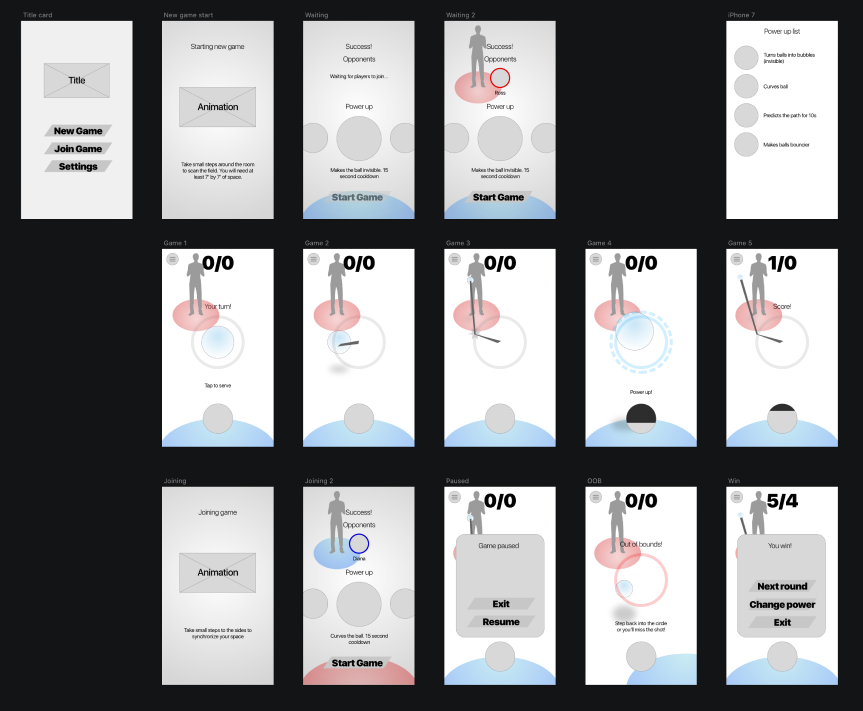
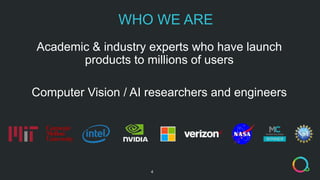
Image 1 / 2
Escher coordinated an experience across devices and visits, above the work of tracking one device. Apple and Google were making phone-based AR easier to build. Escher addressed work above that foundation. Joining Niantic connected that work to an operator already building location-based games. This explains the strategic fit; it does not establish the founders' financial return.
Ross Finman and Diana Hu met at Carnegie Mellon and founded the company in spring 2016. Finman worked on robotics and computer vision at MIT; Hu brought experience from Intel Labs. They chose AR while much of the surrounding attention went to virtual reality. Finman told MIT News, “We decided to be contrarian.”[3]
The first MIT Sandbox cohort supported their early work. Pokémon GO's arrival helped make AR understandable to customers. Through the NSF I-Corps program, the team interviewed 100 AR and game developers in about seven weeks. They investigated what developers needed before presenting their platform.[3]
The product also needed a clear demonstration. Its designer documented a two-player game in which players deflected a ball, alongside branding and AR interface guidelines. The company name referred to M. C. Escher. These helped developers understand unfamiliar spatial behavior.[4]
The archived product site describes three linked capabilities: multiplayer coordination, persistent content, and support for iOS and Android. It advertised custom computer vision and networking, markerless mapping, and a beta API. Content was meant to remain at precise locations in a room between visits.[10]
These capabilities solve different problems. Localization identifies a device's position relative to a shared reference. Synchronization distributes changes between participants. Persistence keeps the scene after a session ends. A product can support one without reliably supporting the others. Escher packaged them as a developer-facing system, so a game studio could work on its experience instead of assembling every layer itself.
The designer's surviving wireframes document the multiplayer demo. The original video was removed after the acquisition. Escher also published AR Human Interface Guidelines, showing that it treated interaction design as part of developer adoption.[4][11]
Escher targeted developers building shared mobile AR experiences. Its archived website listed Legendary, HappyGiant, and Fishermen Labs under “Working with.” That is evidence of named relationships, but the page does not disclose contracts, fees, deployed users, or the scope of each engagement.[10]
The discovery interviews, beta API, demo, and design guidance formed a coherent route to this audience. Each reduced a different adoption barrier: finding a need, trying the integration, understanding the experience, and designing a usable app.
The relevant market was the developer budget for shared AR infrastructure. It was smaller than the entire games or AR market. Public sources establish funding and relationships, but do not establish a count of paying projects or an addressable annual subscription market. A large potential audience for AR did not by itself establish repeatable platform revenue.
ARKit made local tracking accessible, while Escher emphasized shared and persistent experiences. That historical distinction should not become a permanent claim that operating-system tools cannot handle shared AR. Google's Cloud Anchors now supports persistent, shared experiences across Android and iOS. It supplies a common spatial reference; the application still needs to distribute anchor IDs and manage its own shared state.[12][13]
Niantic's surviving platform is also part of the current competitor map. Its 2026 migration retained existing ARDK 3 apps and keys, while directing new features toward NSDK 4. A rebuild must account for this continuation rather than treat the old Lightship portal's closure as disappearance of its capabilities.[8]
Contemporary reporting described a Unity plug-in with usage-based charges linked to developers’ commercial success; development use began free.[17]
Escher pursued a developer-platform business. Its beta and named relationships show how developers could encounter it; they do not establish paid conversions. Approximately $3 million in pre-acquisition funding provided capital to build the technology and team. The NSF's report states that the purchase price was not made public.[2]
The commercial question was whether studios would repeatedly pay for shared infrastructure, and at what stage of their own product development. Public evidence does not resolve Escher's revenue, burn, runway, or investor distributions. Those gaps prevent a financial verdict on the exit.
The strongest observable signals are the working demo, named website relationships, financing, and purchase by Niantic. They demonstrate technical and strategic interest. None supplies a retained-user count or proves a profitable standalone subscription business. Contemporary acquisition coverage also names support from MassChallenge, Autodesk BUILD, and MassDiGI, illustrating the ecosystem around the early company.[1][4]
The outcome was strategic integration, with standalone commercial performance unresolved. Niantic CEO John Hanke connected the purchase to persistent, shared AR. In a later YC interview, Hu explained the continuity of the original vision: “we are still building it.” The acquisition offered a concrete destination for the team's work.[1][14]
The plausible mechanism is distribution and integration. A small infrastructure vendor depended on other studios shipping experiences. A games operator could develop the shared platform alongside its own products. The evidence supports that strategic alignment; it cannot prove that Escher would otherwise have failed, that acquisition eliminated technical risk, or that every subsequent Niantic feature came from Escher.
The sequel also qualifies the rebuild opportunity. Shared spatial references are now available from established providers, while provider interfaces continue to change. Even 8th Wall's current form differs from its former hosted platform: its 2026 transition released an open-source framework, but SLAM remains in a separately licensed binary. “Open source” does not mean every spatial capability is freely replaceable.[15]
Finman’s subsequent company, Augmodo, applies spatial computing to inventory work through wearable Smartbadges and its SpatialView dashboard. That is a new customer workflow, not a revival of Escher’s standalone SDK.[16]
A useful new company therefore needs a narrower customer problem than recreating a universal AR backend. Shared-scene testing, session state, and restoration are plausible workflow gaps. Their value still needs customer evidence.
[1] GamesBeat: Niantic acquires Escher Reality [2] NSF I-Corps report [3] MIT News: MIT Sandbox's first acquired startup [4] Fifth Revision: Escher Reality design archive [5] Apple Developer: ARKit announcement [6] Apple: iOS 11 availability [7] The AR Show: Ross Finman, part 2 [8] Niantic Spatial: Lightship migration FAQ [9] YC: Diana Hu's Managing Partner announcement [10] Archived Escher Reality product site [11] Archived AR Human Interface Guidelines [12] Google: Cloud Anchors overview [13] Google: Cloud Anchors codelab [14] YC: Diana Hu founder interview [15] 8th Wall: open-source transition and licensing
[16] Augmodo: product and founder FAQ [17] 2017 profile