Overview
Eventjoy was a mobile-first event management platform founded in 2013 by Todd Goldberg and Karl White, both based in Tampa Bay before relocating to San Francisco for Y Combinator's Winter 2014 batch. The company built a bundled suite — ticketing, event websites, native iOS and Android apps, Twitter walls, analytics, and attendee communications — under a single platform aimed at independent event organizers. It launched publicly in February 2014 under the tagline "fee-free ticketing, optimized for mobile," having previously operated in private beta as EXMO.
Eventjoy was not a failure in the conventional sense. It was acquired by Ticketmaster just seven months after public launch, absorbed into a larger consolidation strategy, and ultimately merged into Universe — a Toronto-based DIY ticketing platform Ticketmaster had separately acquired — in September 2015. The company ceased to exist as a standalone product roughly 12 months after acquisition, not because it collapsed, but because a larger platform made it structurally redundant.
The outcome was a soft landing for the founders: Todd Goldberg became VP of Eventjoy at Ticketmaster, and by 2020 had co-founded a $7.3 million angel fund alongside Rahul Vohra of Superhuman. [1] The acquisition price was never disclosed, making it impossible to assess the financial return for YC and early investors. What Eventjoy's story reveals is a recurring dynamic in platform-adjacent startups: building a genuinely useful product that an incumbent needs as a feature is not the same as building a durable, independent business.


Image 1 / 2
Founding Story
Todd Goldberg and Karl White met in 2012 at StartUp Weekend Tampa Bay, a 54-hour hackathon format where participants pitch ideas, form teams, and build prototypes over a single weekend. [2] The founding insight was not derived from market research — it was personal and immediate. As Goldberg later described it: "I met Karl at Startup Weekend — a 54-hour hackathon to launch an idea — two years ago. We immediately bonded over how we live on our mobile devices, but at business conferences most of the time we're not sure what's going on." [3]
That observation — that event attendees were perpetually disoriented despite carrying smartphones — became the organizing thesis for everything Eventjoy built. The problem was not that events lacked technology; it was that the technology available was desktop-centric, fragmented across multiple vendors, and poorly adapted to the way people actually behaved at live events.
The company initially operated under the name EXMO, a brand that gave little indication of its eventual focus on event joy or attendee experience. [4] Whether the EXMO-to-Eventjoy rebrand reflected a substantive product pivot or simply a marketing refinement is not documented in available sources, but the timing — coinciding with the public launch and YC affiliation — suggests the founders used the YC period to sharpen both product and identity simultaneously.
The decision to apply to Y Combinator and relocate from Tampa Bay to San Francisco was a deliberate bet on network proximity. Tampa Bay had a nascent startup ecosystem in 2013, but access to enterprise clients, press, and potential acquirers was structurally limited outside the Bay Area. The move proved consequential: YC's Demo Day network almost certainly accelerated the Ticketmaster acquisition timeline in ways that organic enterprise sales from Tampa Bay would not have.
At the time of their YC listing, Eventjoy was a two-person team with no disclosed advisors or angel investors beyond the $120,000 YC seed. [5] [6] The leanness of the founding team — and the absence of any subsequent disclosed funding round — suggests the founders either moved quickly toward acquisition or were unable to raise a Series A on terms they found acceptable. The public record does not resolve which.
Timeline
-
2012 — Todd Goldberg and Karl White meet at StartUp Weekend Tampa Bay; founding insight about poor mobile event experience is established. [2]
-
2013 — Company founded; begins operating as EXMO in private beta, used by 14 Startup Weekend events and dozens of hackathons, barcamps, and conferences. [4]
-
October 2013 — EXMO exits private beta having run 100 events with thousands of total attendees. [4]
-
February 18, 2014 — Company rebrands from EXMO to Eventjoy and launches publicly. Platform has 700+ organizers including TEDx events. Pricing set at $1 + 2% per ticket for paid events, free for free events. [4]
-
March 25, 2014 — Eventjoy raises $120,000 seed round from Y Combinator as part of the W14 batch. [6]
-
May 2, 2014 — Eventjoy drops all ticketing fees entirely, pivoting to a free core model with future premium services (event promotion, commerce) as the monetization strategy. [7]
-
June 18, 2014 — Eventjoy launches dedicated Organizer app for iOS/Android with sales monitoring, attendee check-in, and push notifications. [8]
-
September 11, 2014 — Ticketmaster (Live Nation Entertainment) acquires Eventjoy for an undisclosed amount. Todd Goldberg becomes VP of Eventjoy at Ticketmaster. Acquisition framed as Ticketmaster's first entry into the DIY events market. [9]
-
January 2015 — Eventjoy operates as a four-person team within Ticketmaster. App has 30,000–50,000 downloads and seven-digit transaction volume. Updated attendee app launches with real-time chat and social media aggregation. [10]
-
June 8, 2015 — Ticketmaster separately acquires Universe, a Toronto-based DIY ticketing platform. [11]
-
September 21, 2015 — Ticketmaster merges Eventjoy into Universe. Eventjoy brand is retired, new event creation is disabled, and existing clients and features are rolled into Universe. [12]
-
February 2020 — Todd Goldberg co-founds a $7.3 million angel fund with Rahul Vohra (founder of Superhuman), signaling a successful post-Ticketmaster transition to investor. [1]
What They Built
Eventjoy's core product proposition was bundling. Where most event technology companies in 2014 specialized in a single layer — Eventbrite in ticketing, Guidebook in mobile apps, Cvent in enterprise registration — Eventjoy offered all of it in one platform. [13]
An organizer using Eventjoy could create an event page, set up ticketing (paid or free), generate a branded mobile app for attendees, embed a Twitter wall for social engagement, send communications to registered attendees, and monitor real-time analytics — without leaving the platform or integrating third-party tools. This was a meaningful reduction in operational complexity for small-to-mid-size event organizers who lacked dedicated technical staff.
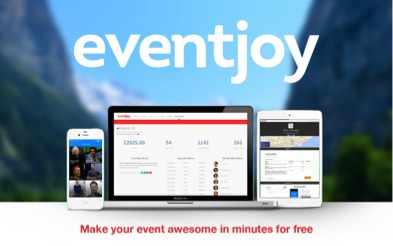
The mobile-first orientation was a genuine differentiator in early 2014. Most event management tools were built for desktop-first workflows, with mobile as an afterthought. Eventjoy inverted this: the attendee experience was designed around the smartphone, and the organizer tools followed. The June 2014 Organizer app — which allowed real-time sales monitoring, QR-code-based attendee check-in, and push notification delivery — was a direct expression of this philosophy. [8]
The January 2015 attendee app update added real-time chat between attendees and organizers, live push announcements, and a social media aggregator pulling from Twitter and Instagram. [10] Goldberg explained the rationale directly: "We realized that communication is a big pain point during events." [10] This feature traced directly back to the founding insight — the disoriented conference attendee — and suggests the product roadmap remained coherent with the original problem statement even after acquisition.
The product evolution from EXMO (a generic event tool used at hackathons) to Eventjoy (a branded, mobile-first platform with organizer and attendee apps) to a Ticketmaster-integrated product with premium promotion features represents three distinct phases of scope expansion, each adding surface area without a clear monetization anchor.
What distinguished Eventjoy from Eventbrite was not ticketing capability — Eventbrite's ticketing was more mature — but the mobile app layer and the bundled attendee experience. What distinguished it from Guidebook was the ticketing integration and lower price point. The bundling strategy created a product that was more complete than any single competitor in its tier, but it also meant Eventjoy was never the best-in-class option in any individual category. For enterprise buyers with existing vendor relationships, this made Eventjoy a harder sell. For independent organizers running beer festivals, hackathons, and community conferences, it was often the simplest option available.
Market Position
Target Customers
Eventjoy's primary customers were independent event organizers — individuals or small teams running conferences, hackathons, community events, beer festivals, bus tours, and movie screenings. [10] The platform's private beta roots in Startup Weekend events and barcamps established an early community of technically sophisticated but resource-constrained organizers who valued simplicity and cost.
The client list expanded upmarket over time. By the time of acquisition, Eventjoy had been used by TEDx events, Target, and The Home Depot — a range that suggests the platform could serve semi-professional and corporate use cases, not just grassroots organizers. [14] However, the absence of any disclosed enterprise sales motion or dedicated account management suggests these larger clients were likely self-serve adopters rather than the result of structured enterprise sales.
Market Size
The global event management software market was estimated at approximately $6 billion in 2014 and growing. The DIY segment — independent organizers who could not afford enterprise platforms like Cvent — represented a meaningful but price-sensitive slice of that market. Eventbrite, the most direct comparable, had processed over $1 billion in gross ticket sales by 2013 and was valued at approximately $1 billion. The market was real and growing; the question was whether a bundled, mobile-first entrant could carve out a defensible position before incumbents closed the gap.
Competition
Eventjoy competed simultaneously across multiple product categories, which created a structurally difficult competitive position. [13]
On ticketing, Eventbrite was the dominant incumbent with a massive distribution advantage: organizers discovered Eventbrite through its public event discovery marketplace, not just through direct sales. Eventjoy had no equivalent discovery layer — organizers had to find Eventjoy through word of mouth, press, or the YC network. Eventbrite also had a free tier for free events and a well-understood fee structure for paid events, making the switching cost for organizers low and the incentive to switch modest.
On mobile event apps, DoubleDutch, Guidebook, and Quickmobile were well-funded specialists with deeper feature sets and established enterprise relationships. DoubleDutch had raised over $50 million by 2014. Guidebook had a large library of pre-built templates and a self-serve model that made it accessible to smaller organizers. Eventjoy's mobile app was competitive at the low end of the market but lacked the customization depth that enterprise clients expected.
On event management broadly, Cvent and Bizzabo served the upper end of the market with registration, venue sourcing, and post-event analytics that Eventjoy did not attempt to match.
The competitive map reveals a structural problem: Eventjoy was positioned in the middle of a market where the top end was served by well-capitalized specialists and the bottom end was increasingly served by free tools (Facebook Events, Meetup, Google Forms). The DIY organizer segment Eventjoy targeted was real, but it was also the segment most sensitive to price — which is why dropping ticketing fees in May 2014 was both necessary for adoption and damaging for the business model.
The most important competitive dynamic, however, was platform risk. Ticketmaster's acquisition of Eventjoy was itself evidence that the major ticketing platforms recognized the DIY mobile gap and were willing to buy their way into it rather than build. Once Ticketmaster owned Eventjoy, the competitive landscape for any remaining independent player in this space became significantly more difficult — a well-resourced incumbent now had a mobile-first DIY product and the distribution to scale it.
Business Model
Eventjoy launched in February 2014 with a straightforward transactional model: $1 per ticket plus 2% of the ticket price for paid events, free for free events. [4] This was a lower fee than Eventbrite's standard rate (approximately 2.5% + $0.99 per ticket, plus a 3% payment processing fee), positioning Eventjoy as the cost-efficient alternative.
Two months after launch, in May 2014, Eventjoy dropped all ticketing fees entirely. [7] Goldberg stated the new direction: "Eventjoy's goal is to always keep its core experience free while pursuing premium services, like event promotion and commerce, in order to monetize." [7] The planned premium services — event promotion on Ticketmaster.com, custom email invitations, and commerce features — were never publicly validated as revenue-generating products before the acquisition. [10]
Eventjoy never disclosed revenue figures. This absence is itself a signal: a company with meaningful revenue typically surfaces that number in press coverage, particularly when announcing an acquisition. The company reported "seven-digit transaction volume" by January 2015 — meaning at least $1 million in gross merchandise value flowing through the platform — but GMV is not revenue. [10] With zero ticketing fees and no confirmed premium revenue, Eventjoy's actual captured revenue at the time of acquisition was likely minimal.
With a four-person team operating in San Francisco as of January 2015, annual burn was likely in the range of $800,000–$1.2 million (inferred from standard Bay Area engineering salaries and operational costs for a team of that size). The $120,000 YC seed would have covered roughly six to eight weeks of operations at that burn rate — meaning the company was either operating on acquisition proceeds or had raised undisclosed bridge capital.
Traction
Eventjoy's pre-launch traction was credible and organically built. During its EXMO beta period, the platform ran 100 events with thousands of attendees, including 14 Startup Weekend events — a community the founders were embedded in. [4]
By the February 2014 public launch, the platform had 700+ organizers, including several TEDx events — a meaningful signal that the product had crossed from hobbyist to semi-professional use cases. [4] Enterprise-adjacent clients including Target and The Home Depot were using the platform by the time of acquisition in September 2014. [14]
By January 2015 — roughly 11 months post-launch — the attendee app had accumulated 30,000 to 50,000 downloads and the platform had processed seven-digit transaction volume. [10] Todd Goldberg's personal website later described Eventjoy as having "powered thousands of events worldwide, sold hundreds of thousands of tickets, and generated millions of dollars in transactional revenue for event organizers." [15]
These numbers are respectable for a two-to-four-person team operating for roughly one year. They are not, however, the numbers of a company on a clear path to venture-scale growth. The gap between GMV processed for organizers and revenue captured by Eventjoy remained unresolved in all public disclosures.
Post-Mortem
The Core Dynamic: Feature, Not Product
Eventjoy's story is best understood not as a failure but as an illustration of the "feature vs. product" risk that affects many platform-adjacent startups. The company built a genuinely useful product — mobile-first event management with bundled ticketing, apps, and communications — that a large incumbent (Ticketmaster) needed as a feature within its own ecosystem. Once Ticketmaster identified that need, the acquisition was faster and cheaper than building the capability internally.
This dynamic was structural, not a consequence of execution errors. Any startup building in the DIY event management space in 2014 faced the same risk: the major ticketing platforms (Ticketmaster, Eventbrite) had the distribution, the organizer relationships, and the capital to either build or buy whatever mobile capabilities emerged. Eventjoy built something real, but it built it in a space where incumbents had a natural absorption advantage.
The Fee Elimination: Necessary Tactic, Structural Weakness
The decision to drop all ticketing fees in May 2014 — just two months after public launch — was the most consequential strategic move Eventjoy made, and it left the company in a structurally weak position. [7]
The logic was defensible: the $1 + 2% fee was creating friction that slowed organizer adoption, and Eventbrite's free tier for free events was a direct competitive pressure. Dropping fees accelerated growth — the organizer count and event volume continued to climb through mid-2014. But the replacement monetization strategy (premium services, event promotion, commerce) was never validated before the acquisition. The company went from a thin but real revenue model to a theoretical future revenue model, with no bridge between the two.
A company with no clear path to revenue is easier to acquire cheaply. Ticketmaster's acquisition of Eventjoy in September 2014 — four months after the fee elimination — may have been partly enabled by the founders' weakened negotiating position. A company generating $50,000–$100,000 per month in ticketing fees would have had a more defensible valuation floor than one processing GMV for free.
The Bundling Trap: Attractive to Acquirers, Difficult to Scale Independently
Eventjoy's bundled product — ticketing plus mobile apps plus communications plus analytics — was compelling to organizers who wanted a single vendor. But it created a structural problem for independent growth: the company was competing against specialists in every category it touched, and specialists with more funding and more focused teams tend to win on depth. [13]
DoubleDutch had raised over $50 million to build mobile event apps. Eventbrite had raised over $140 million to build ticketing infrastructure. Eventjoy, with $120,000 in YC seed funding and a four-person team, was attempting to compete across both dimensions simultaneously. The bundling strategy made Eventjoy more attractive as an acquisition target — Ticketmaster could buy the entire stack at once — but it made the company harder to scale independently because no single feature was differentiated enough to drive viral organizer adoption.
The Acquisition Speed: YC Network as Exit Mechanism
Ticketmaster acquired Eventjoy approximately seven months after public launch. This timeline is unusually fast for a strategic acquisition and suggests the YC network — specifically Demo Day exposure — was the primary distribution mechanism for the exit, not organic enterprise sales or inbound from Ticketmaster's business development team.
Goldberg's framing of the acquisition as "like we raised a large seed round with Ticketmaster" [10] is revealing. It suggests the founders viewed the acquisition as a continuation of company-building rather than an exit — which implies either that the acquisition price was not large enough to feel like a financial exit, or that the founders were genuinely motivated by the scale opportunity Ticketmaster offered. Goldberg's stated goal of bringing Eventjoy "to a global user base" [9] was consistent with this framing.
The speed of the acquisition also meant the founders never had the opportunity to test whether the premium monetization strategy could work. The company was absorbed before the revenue model was validated — a pattern common in acqui-hires where the acquirer values the team and technology more than the business model.
The Universe Merger: Absorbed Without Consent
The final chapter of Eventjoy's story was determined not by its own decisions but by Ticketmaster's. In June 2015, Ticketmaster acquired Universe, a Toronto-based DIY ticketing platform with its own organizer base and product infrastructure. [11] Three months later, Ticketmaster merged Eventjoy into Universe, retiring the Eventjoy brand and disabling new event creation. [12]
The sequence — acquire Eventjoy (September 2014), acquire Universe (June 2015), merge Eventjoy into Universe (September 2015) — reveals that Ticketmaster was assembling a DIY ticketing stack from multiple acquisitions rather than building organically or committing to a single product. Eventjoy was one piece of a larger consolidation play, not the centerpiece of Ticketmaster's DIY strategy.
A four-person team operating within a company of Ticketmaster's scale had no structural leverage to resist this outcome once retention periods expired and a better-resourced internal alternative (Universe) became available. The merger was not a reflection of Eventjoy's product quality — it was a reflection of organizational dynamics within Live Nation Entertainment that the founders could not have anticipated or controlled at the time of acquisition.

Key Lessons
-
Dropping your revenue model before validating a replacement creates an acquisition-ready company, not a fundable one. Eventjoy eliminated its $1 + 2% ticketing fee in May 2014 — two months after launch — before any premium revenue line was operational. The stated replacement (event promotion, commerce) remained theoretical at the time of the September 2014 acquisition. A company with no clear path to revenue is easier to acquire cheaply; Eventjoy's fee elimination may have compressed its acquisition valuation floor at precisely the moment Ticketmaster was evaluating the deal.
-
Bundling across multiple specialist categories attracts acquirers but makes independent scaling structurally difficult. Eventjoy competed simultaneously against Eventbrite (ticketing), DoubleDutch and Guidebook (mobile apps), and Cvent (event management) — each of which had raised 10–100x more capital and had deeper feature sets in their respective categories. The bundle was compelling to organizers who wanted simplicity, but it meant Eventjoy was never best-in-class in any single dimension. Ticketmaster bought the bundle because it was cheaper than rebuilding each component; no independent investor was likely to fund a company trying to out-execute three well-capitalized specialists simultaneously.
-
Acquiring companies absorb acquired products on their own timeline, not the founders'. Goldberg described the Ticketmaster acquisition as "like we raised a large seed round" — implying an expectation of continued company-building. Instead, Ticketmaster acquired Universe nine months later and merged Eventjoy into it within 12 months of the original acquisition. A four-person team inside a large platform has no structural leverage to resist organizational consolidation once retention periods expire. Founders evaluating acquisition offers from platform incumbents should model the probability of a secondary merger or product subordination, not just the initial integration plan.
-
YC Demo Day is a powerful exit mechanism, but it compresses the timeline for validating the business. Eventjoy was acquired seven months after public launch — before the premium monetization strategy was tested, before churn rates among organizers were understood, and before the company had raised a Series A that would have required a clearer revenue story. The YC network accelerated the exit in ways that may have foreclosed the opportunity to build a durable independent business. This is not a criticism of the founders' decision — the acquisition may have been the right outcome — but it illustrates that Demo Day exposure optimizes for acqui-hire speed, not necessarily for long-term company value.
-
Platform-adjacent startups in winner-take-all distribution markets face structural absorption risk regardless of product quality. Eventjoy built a genuinely useful product that real organizers — including TEDx, Target, and The Home Depot — were using. [14] The company's end was not caused by a bad product or poor execution. It was caused by the structural reality that ticketing is a distribution-driven market where the major platforms (Ticketmaster, Eventbrite) control organizer access and can absorb or replicate mobile-first features faster than a two-to-four-person startup can build a moat. Building in the shadow of a platform incumbent requires either a defensible data advantage, a network effect the incumbent cannot replicate, or a willingness to be acquired early.
Sources
- Superhuman and Eventjoy founders announce $7 million angel fund — TechCrunch, February 2020
- Ticketmaster buys Tampa Bay startup in rare coup for regional entrepreneurs — Tampa Bay Times, September 2014
- Q&A: Eventjoy founder Todd Goldberg — Ticketmaster Blog
- YC-Backed Eventjoy Is A One-Stop Shop For Organizing Events — TechCrunch, February 2014
- Eventjoy — Y Combinator Companies
- Eventjoy — Crunchbase
- Y Combinator-backed Eventjoy makes ticketing service free for organizers — The Next Web, May 2014
- Eventjoy launches app for event organizers — The Next Web, June 2014
- Ticketmaster Expands Ticketing Portfolio With Acquisition of Eventjoy — PRNewswire, September 2014
- Eventjoy's New App For Event-Goers Adds Real-Time Chat, Live Announcements And More — TechCrunch, January 2015
- Universe — Osler Representative Work
- Eventjoy Joins the Universe Family — Universe Blog, September 2015
- Ticketmaster Acquires Eventjoy — MergerTech, September 2014
- Todd Goldberg — Work
- Ticketmaster acquires Eventjoy to boost mobile offerings — Marketing Dive, September 2014
- Eventjoy — YC Combinator Companies Database