Overview
Fanvibe was a San Francisco-based mobile sports social network that operated from late 2009 through July 2011. Founded under the parent company "We The Fan" by Vishwas Prabhakara, Art Chang, and Joe Pestro, the company built an iPhone app that let fans check in to live games, trash-talk with friends watching the same broadcast, and receive real-time scores and breaking news. It launched originally as FanPulse, rebranded to Fanvibe, and graduated from Y Combinator's Summer 2010 batch before reaching approximately 100,000 users and securing a partnership with the NBA.[1]
Fanvibe did not fail because of a flawed product or a crowded market. It failed because its entire reason for existing — live sports — disappeared. The simultaneous 2011 NFL and NBA labor lockouts eliminated the games that powered every check-in, every score alert, and every piece of social engagement the app was built around.
In June 2011, Fanvibe was acquired by beRecruited in what appeared to be a clean acqui-hire. Twenty-one days later, beRecruited shut the product down entirely, citing the lockouts as having "effectively destroyed the point of the service."[2] The founders landed well — Prabhakara became CEO of beRecruited, which was itself later acquired for $17–22 million — but Fanvibe itself became a case study in existential dependency risk.
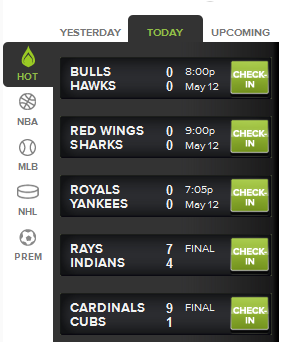

Image 1 / 2
Founding Story
Fanvibe was built by a team with unusually direct credentials for the problem they were solving. Vishwas Prabhakara had worked at ESPN and Digg before co-founding the company — a combination that gave him both sports-media domain knowledge and a firsthand understanding of how social content discovery worked at scale.[3] He holds a BS in Information Systems and Economics from Carnegie Mellon University and an MBA from Harvard Business School.[4] Art Chang and Joe Pestro both came from Yardbarker, an early sports social network that had been acquired by Fox Sports in 2010 — meaning two of the three founders had already built and sold a sports-focused digital product before starting Fanvibe.[5]
The founding insight was straightforward: sports fandom is inherently social, but the tools fans used to share the experience of watching live games were generic. Twitter and Facebook were not built around the rhythms of a fourth-quarter comeback or a walk-off home run. The founders wanted to build something purpose-built for the live-game moment — a product where checking in to a game was the primary action, and everything else (scores, news, trash talk) flowed from that anchor.
The company was incorporated as "We The Fan," a name that signaled the fan-first mission from the outset.[6] It launched in approximately November 2009 under the name FanPulse before rebranding to Fanvibe — the reasons for the name change are not documented in available sources, though the shift may reflect an early pivot in product positioning or a trademark issue.[7]
The team incubated at Dogpatch Labs in San Francisco before entering Y Combinator's Summer 2010 batch. As Chang later reflected: "The path through the early days at Dogpatch Labs, through the Y Combinator experience, and now being acquired has been quite the bumpy road. It wasn't all easy and success the whole time, in fact it has been quite the opposite."[8]
At YC Demo Day on August 24, 2010, Fanvibe was described as "a sports-focused site that gives you a way to interact with friends and like-minded fans online" — a description that undersold the live-game check-in mechanic that would become the product's defining feature.[9] The Demo Day appearance gave the company institutional validation and exposure to investors, though the follow-on funding it attracted beyond the standard YC seed check appears to have been limited.
Chang's framing of the company's philosophy was direct: "We learned early on that failure is the only way to success."[10] That ethos would be tested sooner than anyone anticipated.
Timeline
- 2009 — Fanvibe founded by Vishwas Prabhakara, Art Chang, and Joe Pestro under parent company "We The Fan"; headquartered in San Francisco.[11]
- November 2009 (approx.) — Company launches as FanPulse.[12]
- August 24, 2010 — Fanvibe (rebranded from FanPulse) presents at Y Combinator Summer 2010 Demo Day; described as a sports social site with stats, schedules, and friend interaction.[13]
- September 1, 2010 — Seed funding round closes with Y Combinator as sole institutional investor; CB Insights records $20K total raised.[14]
- December 11, 2010 — Fanvibe iPhone app reviewed with gamification features: points, trivia, leaderboards, prediction questions, and visual redesign noted.[15]
- June 27, 2011 — Fanvibe acquired by beRecruited; Prabhakara named CEO of beRecruited, Chang leads product and engineering, Pestro joins. Approximately 100,000 users at time of deal. Terms undisclosed.[16]
- June 28, 2011 — Co-founder Art Chang publishes blog post reflecting on Fanvibe's journey, citing NBA partnership and prediction engine as highlights.[17]
- July 18, 2011 — Fanvibe ceases operations. Prabhakara cites simultaneous NFL and NBA lockouts as having "effectively destroyed the point of the service." beRecruited makes the call to shut down.[18]
- August 13, 2011 — Post-mortem analysis published noting Fanvibe as a case study in external-factor failure despite meaningful user traction.[19]
- October 18, 2013 — beRecruited acquired by The Raine Group for $17–22 million; Prabhakara continues as CEO.[20]
What They Built
Fanvibe's core product was an iPhone app built around a single, elegant mechanic: checking in to a live sports game the way Foursquare users checked in to a restaurant. When a game was on, a fan opened Fanvibe, tapped the game they were watching, and was instantly connected to a social layer of friends and fellow fans doing the same thing. The check-in was the ignition point for everything else the app offered.
From that check-in, the product branched in several directions. The "Your Sports Pulse" feed aggregated real-time scores, breaking news, and friends' activity into a single personalized stream — a curated view of the sports world filtered through the teams and leagues a user cared about.[21] The personalized scoreboard delivered live game details and push alerts for score changes, so a fan who had checked in to a game would receive updates even after putting the phone down. A friend-finder tool pulled from Facebook, Twitter, and the user's address book to bootstrap the social graph — a critical feature for any social product trying to achieve critical mass.[22]
The product covered a broad multi-league footprint: NBA, NFL, MLB, NHL, college basketball, college football, and the English Premier League.[23] This breadth was both a strength and a strategic choice — it meant Fanvibe could serve fans across the full calendar year rather than being dependent on a single league's season.
By December 2010, the team had added a meaningful gamification layer. Users earned points for checking in to games, answering trivia questions, inviting friends, sharing on Twitter, and picking game winners. Leaderboards tracked top users for every team, creating a competitive social dynamic within fan communities.[24] A visual redesign accompanied these additions, along with "baseball card" user profiles and a prediction question engine that Chang later cited as one of the company's technical highlights.[25] The prediction engine automatically generated questions tied to live game events — a technically non-trivial feature that required real-time data integration and natural language generation.
The product's evolution followed a recognizable arc: it began as a focused check-in utility and expanded into a fuller social sports platform. Chang described the journey as starting with "a simple idea of checking in to live games and notifying friends via an iPhone app" before growing into "a full social network for sports fans."[26]
What distinguished Fanvibe from contemporaneous sports apps was the primacy of the live-game moment. Apps like theScore or ESPN's ScoreCenter were consumption tools — they delivered information to passive users. Fanvibe was a participation tool. The check-in mechanic transformed watching a game from a solitary act into a shared social event, even when fans were physically apart. The NBA partnership, whose scope and terms were not publicly disclosed, suggested the product had enough institutional credibility to attract league-level relationships — a significant signal for a seed-stage startup.[27]
No web product is documented in available sources; Fanvibe appears to have been iPhone-only throughout its operating life, which both focused the product and limited its addressable audience to iOS users.
Market Position
Target Customers
Fanvibe targeted the engaged sports fan — specifically, the fan who watched live games regularly and already used social media to discuss sports. The product was not built for casual viewers; it was built for the person who had strong team loyalties, watched multiple games per week, and wanted to share the experience with friends in real time. The multi-league coverage (NFL, NBA, MLB, NHL, college sports, EPL) suggests the team was targeting fans across the full sports calendar rather than a single-sport niche, which implied a user base of broadly engaged sports consumers rather than specialists.
The iPhone-only distribution further narrowed the initial target: in 2010–2011, iPhone users skewed younger, more urban, and more affluent than the general population — a demographic that overlapped well with the social-media-native sports fan the product was designed for.
Market Size
The U.S. sports media market was large and growing in 2010–2011. The NFL alone generated over $9 billion in revenue in 2010, and digital sports media was expanding rapidly as smartphone adoption accelerated. The addressable market for a mobile sports social app was not the total sports media market, however — it was the subset of fans who would change their behavior around watching games to incorporate a check-in mechanic. That behavioral shift was the real market-sizing question, and it was one Fanvibe never had the runway to fully answer.
Competition
Fanvibe's competitive position is best understood along two axes: distribution reach versus product depth, and content consumption versus social participation.
On the distribution-versus-depth axis, Fanvibe sat in a difficult middle position. Large incumbents like ESPN and Yahoo Sports had massive distribution — tens of millions of users, deep content libraries, and established brand trust — but their products were built for consumption, not participation. Fanvibe had deeper social mechanics but almost no distribution. The friend-finder tool (Facebook, Twitter, address book import) was an attempt to solve this cold-start problem, but bootstrapping a social graph from scratch against platforms that already owned the social layer was structurally disadvantageous.
On the consumption-versus-participation axis, Fanvibe's closest conceptual competitor was not Bleacher Report — which CB Insights lists as a competitor[28] but which was primarily a content platform, not a live-game social tool — but rather the emerging category of second-screen apps. GetGlue (later tvtag) was building a check-in mechanic for television broadly; IntoNow (acquired by Yahoo in April 2011 for a reported $30 million) was building audio-recognition-based TV check-ins. These products competed for the same behavioral moment — the fan reaching for their phone while watching — but with broader content coverage and, in IntoNow's case, significantly more capital.
The deeper structural problem was platform dependency. Fanvibe's social graph lived on top of Facebook and Twitter, which meant it was building on infrastructure it did not control. As Twitter and Facebook themselves added sports-specific features and real-time conversation tools, the differentiation of a dedicated sports social app narrowed. Twitter in particular was becoming the de facto second screen for live sports — not because it was better designed for sports fans, but because everyone was already there. Fanvibe was competing on product depth in a category where distribution and network effects were the decisive variables.
Business Model
Fanvibe never publicly disclosed revenue figures, and no monetization model is documented in available sources. The absence of revenue data is itself a signal: for a company that operated for approximately 20 months, raised only a seed round, and was acquired before any Series A, it is likely that Fanvibe was pre-revenue or in early monetization experiments at the time of acquisition.
The most plausible revenue paths for a product of this type in 2010–2011 were advertising (in-app display or sponsored content tied to team/league feeds), data licensing (selling engagement and fan behavior data to leagues or brands), and potential league or brand partnership fees — the NBA partnership being the most concrete example of the latter. None of these paths were confirmed or quantified in public statements.
On the cost side, the funding picture was extremely thin. CB Insights records $20K in total funding, consistent with the standard YC seed check of the era.[29] CB Insights also lists Dogpatch Labs and beRecruited as investors, though the nature of those relationships is ambiguous — Dogpatch Labs was a co-working space, not a traditional investor, and beRecruited's listing likely reflects the acquisition rather than a prior investment.[30] Additional angel investors are mentioned in press coverage but unnamed and unquantified.
Inference, not fact: With a three-person founding team, San Francisco operating costs, and roughly $20K in documented institutional funding, Fanvibe's runway was almost certainly measured in months rather than years. The company's survival through mid-2011 suggests either extremely lean operations, undisclosed angel capital, or both. The acquisition by beRecruited — described by Prabhakara as not the original plan — reads as a capital-constrained exit rather than a strategic one.
Traction
Fanvibe reached approximately 100,000 users by June 2011, roughly 20 months after launch.[31] For a seed-funded, iPhone-only sports app with no documented paid acquisition budget, this represented meaningful organic growth.
The NBA partnership — cited by Chang as one of the company's greatest highlights — suggests the product had achieved enough credibility and user engagement to attract institutional sports relationships.[32] League partnerships at this stage typically require demonstrated user engagement, data infrastructure, and brand alignment; Fanvibe's ability to secure one at the seed stage was a meaningful signal.
Prabhakara received external recognition during this period, including placement on Business Insider's Silicon Alley 100 and a "16 Entrepreneurs to Watch" list — indicators that the company had a public profile beyond its user base.[33]
No engagement metrics are available in public sources — DAU/MAU ratio, session length, check-in frequency, or retention curves are entirely undocumented. The 100,000 user figure is a registered or installed user count, not an active user count, and the distinction matters significantly for a product whose value was contingent on simultaneous live-game activity. A check-in app requires not just users, but users who are active at the same time, watching the same games — a coordination problem that makes raw user counts a particularly incomplete metric.
Post-Mortem
Primary Cause: The Lockout Kill Shot
The proximate cause of Fanvibe's shutdown was unambiguous, externally imposed, and catastrophic in its speed. In 2011, the NFL and NBA simultaneously entered labor disputes with their players' unions. The NFL lockout began March 11, 2011; the NBA lockout began July 1, 2011 — the day after Fanvibe's acquisition by beRecruited closed. Together, they threatened to eliminate the two most-watched sports leagues in the United States for the upcoming fall season.
Prabhakara's statement was direct: the lockouts "have effectively destroyed the point of the service."[34] This was not hyperbole. Fanvibe's entire value proposition — check in to live games, see what friends are watching, receive real-time score alerts — required live games to exist. Without games, there was nothing to check in to, no scores to push, and no shared moments to socialize around. The product did not degrade under lockout conditions; it became inert.
The decision to shut down was made by beRecruited, not the founding team. Prabhakara confirmed the acquisition "wasn't our plan," indicating the founders had intended to continue operating independently.[35] The sequence — acquisition announced June 27, shutdown announced July 18 — suggests beRecruited acquired the team believing the lockouts would resolve quickly, then concluded within three weeks that the threat of a full season without NFL and NBA games was too severe to sustain a product that had no off-season use case.
The NFL lockout ultimately resolved on July 25, 2011 — one week after Fanvibe shut down. The NBA lockout lasted until December 2011, canceling 16 games per team. In retrospect, Fanvibe shut down at the worst possible moment: days before the NFL dispute ended. Whether continued operation through the NFL resolution would have saved the company is unknowable, but the timing underscores how the shutdown decision was made under maximum uncertainty.
Secondary Cause: Structural Dependency on a Single External Variable
The lockout was the trigger, but the underlying vulnerability was structural. Fanvibe had built a product whose entire value was contingent on a single external variable — live sports being played — that the company had no ability to influence or hedge against.
This was not an unusual dependency for a sports product; every sports media company depends on games being played. But most sports media companies have content libraries, editorial operations, fantasy sports products, or other assets that retain value during off-seasons and labor disputes. Fanvibe had none of these. Its check-in mechanic, its score alerts, its social feed — all of these features had zero utility without live games. The product had no off-season mode, no content strategy, and no engagement mechanism that could sustain users between games.
The multi-league coverage (NFL, NBA, MLB, NHL, college sports, EPL) was intended to provide year-round relevance, and under normal conditions it would have. But the simultaneous lockout of the two highest-profile leagues — NFL and NBA — during the same calendar period was a scenario that compressed the product's value to near zero precisely when it needed to demonstrate growth to justify continued investment.
Tertiary Cause: Institutional Relationship Disruption
The lockouts did not just eliminate games — they disrupted the institutional relationships Fanvibe had built with the leagues themselves. Prabhakara noted that NFL digital staffers were laid off or departed during the lockout, observing: "They are now way behind on the digital stuff." His primary NFL contact left to become head of sports and entertainment marketing at JP Morgan Chase.[36]
This was a secondary but meaningful blow. The NBA partnership had been one of the company's most significant achievements, and the NFL relationship represented a potential path to the kind of official data and promotional support that could have differentiated Fanvibe from unofficial competitors. The lockouts effectively reset those relationships to zero, eliminating not just current value but future optionality.
Structural Context: The Second-Screen Category Was Winner-Take-All
Beyond the lockout, Fanvibe was operating in a category with structural dynamics that favored consolidation around a single dominant platform. Second-screen social engagement around live events is a network-effects business: the value of checking in to a game is proportional to how many of your friends are also checking in. This creates a winner-take-all dynamic where the platform with the largest social graph wins, regardless of product quality.
In 2011, that dynamic was resolving in favor of Twitter. Twitter had become the de facto real-time conversation layer for live sports — not because it was better designed for sports fans, but because it had already won the social graph. A dedicated sports check-in app faced the same challenge as any social network trying to compete with an incumbent that already owned the network: it needed to be dramatically better to overcome the coordination cost of getting users to switch. Fanvibe's gamification layer, NBA partnership, and purpose-built sports features were genuine differentiators, but they were competing against Twitter's distribution advantage, which was orders of magnitude larger.
IntoNow, a direct competitor in the second-screen check-in space, was acquired by Yahoo for a reported $30 million in April 2011 — two months before Fanvibe's acquisition — suggesting the category had attracted significant capital and strategic interest. But IntoNow's broader television focus gave it more surface area than a sports-only product, and even it was eventually shut down by Yahoo in 2013.
The Acqui-Hire Dynamic
The acquisition by beRecruited is best understood as an acqui-hire rather than a strategic product acquisition. beRecruited founder Ryan Spoon said of the Fanvibe team: "They are perfect fits as they all have strong backgrounds in sports, product and social web."[37] The framing was about people, not product. beRecruited was a sports recruiting platform — a structurally different business from a fan social network — and the Fanvibe product had no obvious integration path into beRecruited's core offering.
Prabhakara's post-shutdown statement confirmed the technology transfer framing: "We're going to put our focus on the growth of beRecruited for the near future, while leveraging some of the backend stuff we built for Fanvibe."[38] The "backend stuff" — likely the real-time data infrastructure, the prediction engine, and the social graph tooling — had residual value as engineering assets even after the consumer product was shuttered.
Key Lessons
-
A product whose core mechanic requires a specific external condition to function needs a contingency for when that condition disappears. Fanvibe's check-in mechanic was elegant and well-executed, but it had zero utility without live games. The company covered seven leagues specifically to avoid single-season dependency — but it had no hedge against a scenario where the two most-watched leagues simultaneously went dark. A content layer, a fantasy sports integration, or an off-season community feature would not have saved Fanvibe from the lockouts, but it would have given the product a reason to exist during the gap and given beRecruited a reason to keep it running.
-
In social products, distribution beats product depth. Fanvibe built a more purpose-designed sports social experience than Twitter, but Twitter already owned the social graph. By 2011, Twitter had become the default second screen for live sports — not because it was better for sports fans, but because everyone was already there. Fanvibe's NBA partnership and gamification layer were genuine differentiators, but they were insufficient to overcome the coordination cost of convincing users to maintain a separate social identity for sports. The lesson is specific: Fanvibe's failure was not a product failure, it was a distribution failure in a category where distribution was the only variable that mattered.
-
Acqui-hire timing is fragile. Fanvibe was acquired on June 27, 2011 — one day before the NBA lockout began — and shut down 21 days later. The founders had not planned to sell; the acquisition was a capital-constrained exit. Had the company raised a Series A in late 2010 or early 2011, it would have had the runway to survive the lockouts (the NFL dispute resolved July 25, one week after shutdown) and potentially emerge with its user base intact. The specific lesson: Fanvibe's thin funding — documented at $20K institutional capital — left it with no buffer against an external shock that a better-capitalized competitor could have waited out.
-
League partnerships are valuable but not durable under labor disruption. Fanvibe's NBA partnership was its most significant institutional achievement and a meaningful signal of product credibility. But the lockout dissolved the operational relationships that made that partnership actionable — NFL digital staff were laid off, key contacts departed, and the institutional infrastructure for digital partnerships went dormant. For any startup building on top of league relationships, the lesson from Fanvibe is that those relationships are contingent on the league itself being operationally stable, and labor disputes are a specific, historically recurring risk that should be modeled explicitly.
-
The 21-day gap between acquisition and shutdown reveals the real acqui-hire calculus. beRecruited acquired Fanvibe for the team, not the product. The speed of the shutdown — three weeks after closing — indicates that the product's viability under lockout conditions was assessed and rejected almost immediately after the deal closed. For founders considering acqui-hire exits, Fanvibe illustrates that the acquirer's commitment to continuing the product is often weaker than the acquisition announcement implies, particularly when the product's value is contingent on external conditions the acquirer cannot control.
Sources
- TechCrunch — Fanvibe Deadpool (July 18, 2011)
- TechCrunch — Fanvibe Acquired by beRecruited (June 27, 2011)
- TechCrunch — Y Combinator Demo Day 2 (August 24, 2010)
- Carnegie Mellon University — Vishwas Prabhakara Profile (February 2017)
- Art Chang Blog — Fanvibe Acquired by beRecruited (June 28, 2011)
- Crunchbase — FanPulse/Fanvibe Organization Page
- Failed Startups — Fanvibe Post-Mortem (August 13, 2011)
- Tracxn — Fanvibe Company Profile
- AppVita — Fanvibe for the Sports Obsessed (December 11, 2010)
- CB Insights — Fanvibe Company Profile
- TechCrunch — beRecruited Acquired by The Raine Group (October 18, 2013)
- YCDB — Fanvibe Company Listing
- Clarity.fm — Vishwas Prabhakara Profile