
FarmLogs
Winter 2012AcquiredSoftware that helps farmers operate more profitable businesses.
Pressure-test this opportunity
Explore the risks and possibilities with a prompt for ChatGPT, Claude, or your agent.
Software that helps farmers operate more profitable businesses.
Explore the risks and possibilities with a prompt for ChatGPT, Claude, or your agent.
FarmLogs was an Ann Arbor, Michigan-based agricultural software company founded in 2011 by Jesse Vollmar and Brad Koch. Operating from Y Combinator's Winter 2012 batch through its acquisition in June 2021, the company built a mobile-first farm management platform that helped row-crop farmers track field activity, monitor crop health via satellite imagery, and eventually market their grain. At its peak, FarmLogs had 110 million acres under management and served roughly one in five U.S. farms — a genuinely remarkable penetration rate for an agricultural software startup.
FarmLogs succeeded at the hardest part of agtech: convincing farmers to adopt software at scale. It failed at the second-hardest part: converting that adoption into a defensible revenue stream before a better-resourced incumbent commoditized the core offering. Climate FieldView, backed by Monsanto's balance sheet and existing farmer relationships through seed and chemical sales, could bundle software with physical product purchases in a way FarmLogs structurally could not match.
Bushel, an independently-owned agricultural software company based in Fargo, North Dakota, acquired FarmLogs on June 16, 2021 for an undisclosed price. All FarmLogs employees joined Bushel, and Vollmar became VP of Farm Strategy — a meaningful role, but a significant step down from founder-CEO. The FarmLogs brand was retired on March 1, 2023, when the product was rebranded as Bushel Farm. The outcome was a soft landing, not a catastrophic failure — but almost certainly a below-expectations exit given the $37.85 million raised, the user scale achieved, and the IPO Vollmar had publicly envisioned.
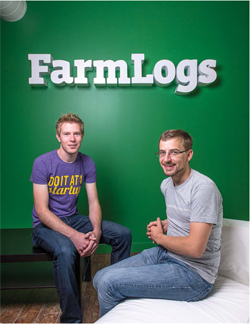

Image 1 / 2
Jesse Vollmar grew up on a fifth-generation family farm in Michigan's Thumb region, working the fields growing corn, wheat, and other row crops. He graduated from Saginaw Valley State University with a BS in Computer Information Systems — a degree that reflected a dual identity he would carry into entrepreneurship: farmer and technologist.[1] While still in high school, Vollmar had taught himself to build custom software, an unusual skill set for someone whose summers were spent in the fields.[2]
Brad Koch, also from a farm family in Michigan's Thumb region and a fellow Saginaw Valley State University alumnus, joined Vollmar as co-founder and CTO.[3][4] The founding insight was not abstract: both men had watched their families manage billion-dollar agricultural operations on paper ledgers and spreadsheets. The inefficiency was not a theoretical problem — it was a lived one.
FarmLogs was founded in 2011 and entered Y Combinator's Winter 2012 batch, receiving seed capital, technology mentorship, and three months of living quarters in Mountain View, California.[5] The YC experience provided legitimacy and a network, but Vollmar and Koch made a deliberate choice that distinguished them from most YC alumni: they moved back to Michigan. After the batch, the company relocated to Ann Arbor to stay close to their customer base and to recruit from the University of Michigan's computer science programs.[6] This was not a consolation prize — it was a strategic decision that gave FarmLogs authentic credibility with farmers who were deeply skeptical of Silicon Valley outsiders telling them how to run their operations.
Early fundraising was brutal. Vollmar recalled: "Early on when we were trying to raise our seed round, we just weren't having any success. We were fresh out of YC and agtech was not something VCs were interested in."[7] His characterization was blunter elsewhere: "Investors in Silicon Valley didn't want anything to do with AgTech at the time. In 2012, we were the ugly duckling."[8]
The founders' response to investor indifference was to grind. Vollmar later described the approach: "We decided to just hunker down, keep the burn rate low and keep grinding away making the product better. Eventually investors came knocking on our door because we were making something customers wanted and it started to show."[9] That discipline — building for farmers rather than for investor narratives — would define FarmLogs' early years and, ultimately, its limits.
Vollmar was named to Forbes Magazine's 30 Under 30 list in the energy and industry category, a recognition that arrived alongside the company's first institutional capital and signaled that the agricultural software category was beginning to attract mainstream attention.[10]
FarmLogs built a farm management platform designed to replace the paper ledgers, spiral notebooks, and spreadsheets that governed most American row-crop operations. The core insight was simple: farmers were making decisions worth hundreds of thousands of dollars per season with almost no structured data to guide them. FarmLogs aimed to be the digital operating system for the American farm.
Core Record-Keeping and Activity Tracking
The foundational product was a mobile app and web platform that let farmers log field activities — planting dates, fertilizer applications, pesticide treatments, harvest records — in a structured digital format.[26] The key technical differentiator was GPS-based automatic activity detection: the app used a farmer's phone location to identify which field they were working in and automatically correlated weather data to that field at that moment in time.[27] This reduced the manual data entry burden that had made previous farm software attempts fail — farmers didn't need to remember to log; the app logged for them.
Satellite Imagery and Crop Health Monitoring
FarmLogs' more technically sophisticated offering used satellite imagery from Planet Labs' RapidEye constellation to monitor crop health at the field level.[28] By building performance baselines from over five years of field-specific crop health data, the platform could flag anomalies — areas of a field underperforming relative to their historical baseline — that might indicate pest pressure, nutrient deficiency, or drainage problems. This was a meaningful capability: a farmer managing 2,000 acres cannot physically walk every row, and satellite imagery provided a bird's-eye diagnostic layer that ground-level observation could not.
The choice to use satellite imagery rather than ground sensors was deliberate and economically rational. Sensors require installation, maintenance, and capital expenditure per farm. Satellite imagery scales at near-zero marginal cost once the data pipeline is built.
Pricing Evolution
The product launched as entirely free — a deliberate land-grab strategy. Vollmar articulated the logic explicitly: "The starting place is getting some good software into every single farm in the country."[29] The Automatic Activity Recording package was priced at $300 per year as of 2015, while most of the platform remained free.[18] By October 2017, FarmLogs introduced a more structured tiered model: a free Standard package, FarmLogs Essentials at $49/month, and FarmLogs Premium which added in-season satellite imagery.[21]
The AutoHedge Pivot
Around 2018, FarmLogs executed what Vollmar called a "fairly bold pivot" away from yield maximization toward grain marketing and price optimization.[22] The flagship product of this pivot was AutoHedge, a grain marketing app for corn and soybean growers that recommended hedging strategies based on analysis of over 20 years of commodity price data.[30] The logic was sound: a farmer who grows 50,000 bushels of corn and sells at the wrong time can lose as much money as a poor harvest. But the pivot also signaled that the original data-science-driven yield optimization value proposition had not generated sufficient willingness-to-pay after years of free product adoption.
Vollmar framed the evolution charitably: "Our market evolved a lot since we started and we've been able to shift our focus while still staying true to our mission."[31] The more structural interpretation is that FarmLogs was searching for a monetizable wedge that the core farm management product had not delivered.
FarmLogs targeted U.S. row-crop farmers — primarily corn, soybean, and wheat growers — with a focus on operations of 100 acres or more. This was a deliberate segmentation: smaller farms lack the operational complexity that makes software valuable, while very large commercial operations often have dedicated agronomists and existing data infrastructure. The 100-acre-plus row-crop segment represented the commercial sweet spot: farms large enough to benefit from data-driven management but small enough to lack enterprise-grade tools.
The company's geographic focus was the American Midwest — the Corn Belt states of Iowa, Illinois, Indiana, Ohio, and Michigan — though the platform eventually reached farms in all 50 states and 130 countries.[32] The Ann Arbor headquarters and Des Moines satellite office placed the company physically inside its target market, a distribution advantage that Silicon Valley competitors could not easily replicate.
The U.S. row-crop farming sector manages approximately 250 million acres of cropland, with the corn and soybean belt alone representing hundreds of billions of dollars in annual commodity production. FarmLogs' own metrics — $20 billion in "crops under management" by mid-2015[17] and 110 million acres at acquisition[24] — suggest the addressable market was genuinely large. The challenge was not market size but monetization density: farmers are notoriously price-sensitive software buyers, and the willingness-to-pay for farm management software was empirically low relative to the value being created.
The grain marketing pivot reflected an attempt to access a different economic layer of the same market. Grain marketing decisions — when to sell, at what price, whether to hedge — directly affect farm income in ways that are immediately legible to farmers. A tool that demonstrably improves grain marketing outcomes has a clearer value proposition than one that improves yield by a percentage point or two.
FarmLogs competed primarily against Climate FieldView, owned by Monsanto (later Bayer following the 2018 merger).[33] The competitive asymmetry was structural, not merely financial.
Distribution advantage: Monsanto's existing relationships with farmers through seed and chemical sales gave Climate FieldView a bundling capability that FarmLogs could not match. A Monsanto sales representative visiting a farm to discuss seed purchases could simultaneously introduce FieldView — a zero-incremental-cost distribution channel. FarmLogs had to acquire every user through digital marketing, word of mouth, or direct outreach.
Data network effects: Both companies were building field-level crop performance databases. Monsanto's seed business gave it access to yield data from its own seed varieties planted across millions of acres — a proprietary data asset that FarmLogs could not replicate without the underlying seed business.
Financial staying power: Monsanto's $930 million acquisition of Climate Corp. in 2013 — the event Vollmar credited with "waking the VC world up" to agtech[12] — also signaled that the most well-capitalized player in agriculture had decided to own the data layer. A company with Monsanto's balance sheet could sustain a free or deeply discounted software product indefinitely as a customer retention tool for its seed and chemical business. FarmLogs, with $37.85 million in total funding, could not.
The independence differentiator: FarmLogs' explicit positioning as "unbiased" — not affiliated with any seed, chemical, or equipment company — was a genuine differentiator with farmers who were skeptical of Monsanto's motives for collecting their field data. But this positioning also foreclosed the most powerful distribution channel (agribusiness bundling) and the most obvious exit (acquisition by an agribusiness player). Vollmar's 2017 public vow to never sell to agribusiness[34] was a values statement that also constrained the company's strategic options.
Secondary competitors included John Deere's Operations Center (backed by equipment distribution), Trimble Agriculture, and a range of smaller agtech startups. The category was structurally tilted toward players with existing farmer touchpoints — equipment dealers, seed retailers, grain elevators — that could bundle software with physical product relationships.
FarmLogs pursued a freemium model: a free core product to maximize market penetration, with paid tiers for premium features. The Automatic Activity Recording package was priced at $300 per year as of 2015.[18] By 2017, the company introduced a more structured tiered model: FarmLogs Essentials at $49/month and FarmLogs Premium with satellite imagery at a higher price point.[21]
FarmLogs never disclosed revenue at any stage of its existence. The absence of revenue disclosure is itself a signal: companies that are generating meaningful ARR typically share that metric with press and investors as a credibility marker. The fact that FarmLogs consistently reported "crops under management" and user counts — rather than revenue — suggests the company was not generating numbers it was proud to publicize.
Inferential unit economics: With approximately 70 employees at the time of the Series C (January 2017)[20] and a Midwest cost structure, annual burn was likely in the range of $7–10 million (assuming fully-loaded employee costs of $100,000–$140,000 per employee, consistent with Ann Arbor market rates). The $22 million Series C would have provided roughly 2–3 years of runway at that burn rate — consistent with the four-year gap between the Series C (January 2017) and the acquisition (June 2021), though the PPP loan in 2020 suggests the runway was tighter than planned.[23] These are inferences, not disclosed figures.
If even 5% of the 100,000+ growers reported in late 2016 were paying $49/month, that would imply roughly $2.9 million in ARR — a thin revenue base relative to the company's burn rate and user scale. The 2018 pivot to grain marketing suggests the actual conversion rate was insufficient to sustain the business model.
FarmLogs' user growth trajectory was one of the most impressive in agtech history for its era:
Two observations complicate the headline numbers. First, the user count appears to have declined between 2016 (100,000+ growers) and 2021 (50,000 active farms) — a drop of roughly 50% in farm count, even as acreage grew from 78 million to 110 million. This suggests the platform retained larger farms while losing smaller ones, or that the definition of "active" tightened. Second, the "1-in-3 farmers" figure from 2016 and the "1-in-5 farms" figure from 2021 are not directly comparable — the former likely counts all growers while the latter specifies active farms — but the directional trend is consistent with user consolidation rather than growth.
FarmLogs was listed among YC's top companies by valuation as of October 2018,[35] suggesting investor confidence remained high at that point. No valuation figures were ever disclosed at any funding round.
The central failure of FarmLogs was not user acquisition — it was monetization. The company's deliberate choice to offer its core product for free was strategically rational in 2012: farmers were deeply skeptical of software, and a free product removed the adoption barrier. Vollmar articulated the logic clearly: "The starting place is getting some good software into every single farm in the country."[29]
The problem was that the free product became the product. As of February 2015 — three years after launch, with $12 billion in crops under management and 5%+ of U.S. row-crop farmers as users — FarmLogs had not yet generated revenue.[16] The company introduced paid tiers in 2015 ($300/year for Automatic Activity Recording) and restructured pricing in 2017 ($49/month Essentials, Premium with satellite imagery), but never disclosed the conversion rate from free to paid — a silence that speaks to the difficulty of the transition.
The attempted remedy was the 2017 pricing restructure and the 2018 AutoHedge pivot. Neither appears to have generated the revenue breakthrough the company needed. The four-year gap between the Series C (January 2017) and the acquisition (June 2021) with no disclosed institutional round strongly suggests FarmLogs could not raise a Series D at acceptable terms — either because revenue growth was insufficient to justify a higher valuation, or because investors had grown skeptical of the monetization timeline.
FarmLogs' primary competitor, Climate FieldView (Monsanto/Bayer), had a structural advantage that no amount of product excellence could overcome: the ability to bundle software with physical product sales. A Monsanto seed representative visiting a farm to discuss the upcoming planting season could introduce FieldView at zero marginal cost. FarmLogs had to acquire every user through digital channels, word of mouth, or direct outreach — a fundamentally more expensive and slower process.
Monsanto's $930 million acquisition of Climate Corp. in 2013 was the inflection point.[12] It validated the market and attracted VC capital to agtech — benefiting FarmLogs in the short term. But it also signaled that the most well-capitalized player in agriculture had decided to own the farm data layer as a strategic asset, not a profit center. Monsanto could offer FieldView for free or deeply discounted as a customer retention tool for its seed and chemical business. FarmLogs, with $37.85 million in total funding, was competing against a company that could sustain losses on software indefinitely.
The competitive dynamic was not primarily about product quality — FarmLogs' satellite imagery and field-level analytics were credible. It was about distribution reach versus product depth. On distribution reach, FarmLogs was structurally disadvantaged. On product depth, FarmLogs had an edge, but not one that translated into sufficient willingness-to-pay.
Vollmar's 2017 public vow to never sell to agribusiness — "I have always been very clear with my investors that the intention is not to sell to a large agribusiness"[34] — was both a genuine values statement and a strategic constraint. The "unbiased" positioning resonated with farmers who were skeptical of Monsanto's motives for collecting their field data. It was a real differentiator.
But it also foreclosed the most obvious exit (acquisition by Monsanto, Bayer, BASF, or another agribusiness player) and the most powerful distribution channel (bundling with seed or chemical sales). The companies most willing to pay a premium for FarmLogs' 110 million acres of field data and 50,000 active farms were precisely the companies Vollmar had publicly committed to never selling to.
The 2021 sale to Bushel — an independently-owned agricultural software company, not an agribusiness — honored the letter of Vollmar's commitment. But Bushel was not the IPO or the transformative exit that the commitment was meant to enable. The outcome suggests the independence positioning, while authentic, ultimately constrained the company's ability to capture the full value of what it had built.
The 2018 pivot to grain marketing and the AutoHedge product deserves specific attention as a diagnostic signal. FarmLogs had spent six years building a field-level data platform — GPS activity tracking, satellite imagery, crop health baselines, yield records. This was a genuine technical achievement. The pivot away from that platform toward grain price optimization was not a natural product extension; it was a search for a monetizable wedge.
Grain marketing has a clearer value proposition for farmers: a tool that helps a farmer sell 50,000 bushels of corn at $4.50 instead of $4.00 per bushel generates $25,000 in additional revenue — a number that is immediately legible and attributable. Yield optimization improvements are harder to attribute and slower to realize. The pivot suggests FarmLogs' data-science-driven yield optimization value proposition, while technically sound, was not generating sufficient willingness-to-pay after years of free product adoption.
No revenue or user data for AutoHedge was ever disclosed. The acquisition by Bushel — a grain elevator software company — suggests the grain marketing pivot may have been the strategic thread that made FarmLogs attractive to Bushel, even if it did not generate the revenue breakthrough FarmLogs needed independently.
FarmLogs received an SBA PPP loan of $150,000–$350,000 from Northstar Bank in 2020.[23] Many companies of all sizes took PPP loans during COVID-19, and this alone is not evidence of distress. But combined with the four-year gap without a new institutional round, the PPP loan is consistent with a company managing cash carefully in the final years before acquisition — not a company with the financial momentum to pursue an IPO.
FarmLogs demonstrated that farmers would adopt software at scale — but proved that adoption and monetization are separable problems in agricultural markets. By early 2015, FarmLogs had $12 billion in crops under management and had not yet generated revenue. The company spent three years building a user base before introducing paid tiers, and never disclosed conversion rates. The lesson is not generic ("charge for your product earlier") but specific: in markets where the buyer is deeply price-sensitive and the value proposition is diffuse (better yield data, not a specific dollar outcome), free product adoption does not automatically translate into paid conversion. FarmLogs would have benefited from testing willingness-to-pay at 5% market penetration rather than 25%.
Competing against an incumbent with bundling power requires a distribution strategy, not just a product strategy. FarmLogs built a technically credible product and achieved 1-in-3 farmer penetration through digital acquisition. Climate FieldView, backed by Monsanto's seed sales force, could reach the same farmers at near-zero marginal cost. FarmLogs never developed a comparable distribution channel — no equipment dealer partnerships, no grain elevator integrations, no seed company relationships — that could match FieldView's bundled reach. The company that eventually acquired FarmLogs, Bushel, was a grain elevator software company with exactly the distribution relationships FarmLogs lacked.
Public commitments to exit strategy constrain negotiating leverage in ways that compound over time. Vollmar's 2017 vow to never sell to agribusiness was authentic and resonated with farmers. It also eliminated the buyers most likely to pay a premium for FarmLogs' data assets — Monsanto, Bayer, BASF, and Corteva collectively had the most to gain from 110 million acres of field-level crop performance data. The 2021 sale to Bushel honored the commitment but at a price that was almost certainly below what an agribusiness acquirer would have paid. Founders with genuine values constraints should model the financial implications of those constraints before making them public.
The "crops under management" metric was a leading indicator that masked a lagging monetization problem. FarmLogs consistently reported acreage and farm counts rather than revenue — a choice that reflected both the genuine impressiveness of its user growth and the absence of revenue worth reporting. Investors and press accepted "crops under management" as a proxy for value creation. In retrospect, the metric measured the size of the free product's adoption, not the size of the business. A company with 110 million acres under management and 50,000 active farms that sells for an undisclosed price below its $37.85 million in funding is a company whose primary metric did not predict its financial outcome.
The 2018 AutoHedge pivot revealed that FarmLogs' core data platform had not generated sufficient willingness-to-pay after six years of free adoption. Rather than a natural product extension, the grain marketing pivot was a search for a monetizable wedge in the same farmer relationship. This is a specific pattern in B2B freemium businesses: when the free product achieves high penetration but low conversion, the temptation is to find an adjacent product with a clearer value proposition rather than to fix the conversion problem in the core product. FarmLogs chose the adjacent product. The acquisition by Bushel — a grain elevator software company — suggests the pivot identified the right strategic direction but not in time to build a standalone business around it.