
Fat Llama
Summer 2017AcquiredFat Llama is the first fully insured peer-to-peer rental marketplace.…
Pressure-test this opportunity
Explore the risks and possibilities with a prompt for ChatGPT, Claude, or your agent.
Fat Llama is the first fully insured peer-to-peer rental marketplace.…
Explore the risks and possibilities with a prompt for ChatGPT, Claude, or your agent.
Fat Llama was a London marketplace for renting cameras, tools, musical equipment, vehicles, and other idle goods from nearby owners. Founded in 2016 and accepted into Y Combinator's Summer 2017 batch, it built identity checks, item protection, messaging, booking, and payments around a simple promise: access the thing without buying it.[1]
This was an acquisition, not a collapse. Fat Llama proved demand and reached cash-flow positivity, but its broad marketplace imposed a tax on every new category: supply density, pricing, verification, fraud, claims, and local operations all had to work together. Hygglo bought the company in 2022 for a reported $41.5 million and valued its verification system and UK-US brand.[2] The Fat Llama name disappeared into Hygglo in November 2025, while the product, accounts, and team continued.[3]
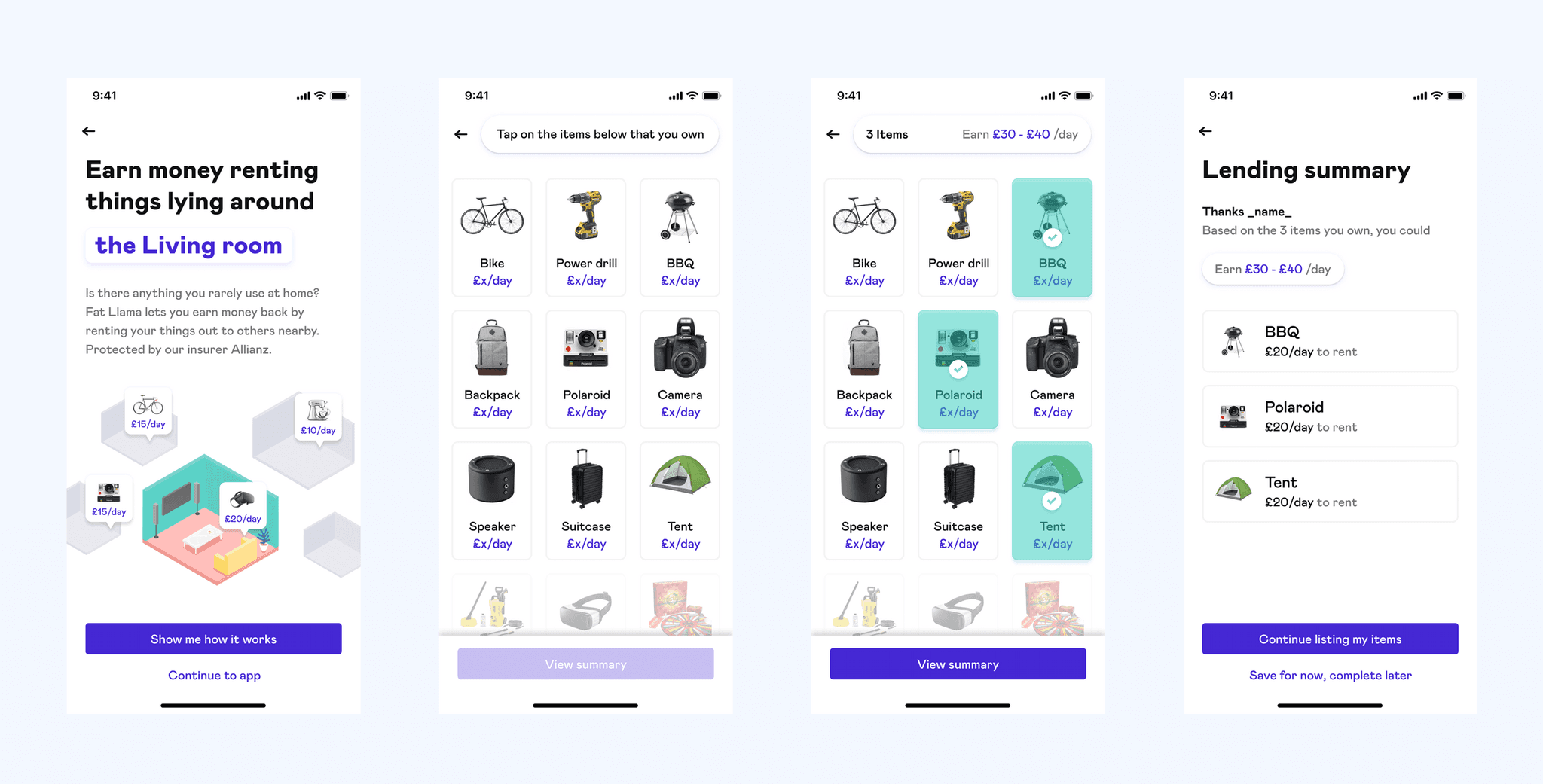
Image 1 / 2
Chaz Englander, Rosie Dallas, and Owen Turner-Major started Fat Llama in London. Englander and Dallas were old university friends; Turner-Major was the technical cofounder.[1] The spark came while the team was renovating a shared office in 2015. Ladders, drills, speakers, and other one-use purchases consumed almost a third of the renovation budget. Buying was easy, but finding the same items for short-term hire nearby was surprisingly difficult.[4]
They turned that irritation into a general rental marketplace. Owners would list idle goods, borrowers would book them for a day or weekend, and Fat Llama would handle discovery, payment, identity, and protection. It sounded implausible to early investors because the company asked strangers to hand over expensive possessions. Englander later described the first pitch in plain terms: “You’re going to lend out your items to people nearby.”[5]
Before YC, Englander funded the attempt through cold outreach. He messaged London finance professionals and pitched small checks, sometimes £1,000 or £2,000 at a time. Those direct checks mattered less than the introductions they produced. The company raised an initial £100,000 round and then roughly £1 million, although Englander said he could no longer recall the exact total.[5]
YC changed the team's credibility, but it did not solve the marketplace. Englander told The Product Market Fit Show, “Fat Llama took probably three years to find product market fit.”[5] The useful wedge emerged in film and photography, where gear was costly, short projects created frequent rental demand, and owners could earn meaningful money from idle inventory. From there, the founders tried to expand both categories and geography without losing the trust machinery that made high-value rentals possible.
Fat Llama made a local rental feel closer to an online purchase. A borrower searched by item and location, selected dates, sent a request, paid through the marketplace, and arranged collection with the owner. Owners set prices and availability, approved requests, and handed over the item. The platform carried the identity, reputation, payment, and protection layers that a classified listing lacked.
Trust was the real product. In 2017 the company said its verification flow collected 30 to 40 data points, automatically approved about 90% of applicants, and sent the remaining cases for extra checks.[6] Lender protection made a £5,000 camera rental imaginable, but the borrower still remained liable for loss. Fat Llama therefore had to prevent fraud before pickup and adjudicate evidence after something went wrong.
That evidence burden was substantial. A PetaPixel contributor documented a theft claim that required a police report, purchase records, and pre-rental proof of the equipment's condition. Fat Llama initially disputed the file, then replaced the stolen gear.[12] A separate London discussion described timestamped condition proof and a repairer's finding as prerequisites for some damage claims.[13] These are individual accounts, not company-wide loss data, but they show how much operational work sat behind the word “insured.”
The product expanded in two directions. First, Fat Llama added more consumer categories, from cameras and DJ decks to garden tools, bikes, party equipment, and vehicles. Second, it packaged rental infrastructure for retailers. John Lewis called its trial successful in 2020, and Fat Llama later named John Lewis and Sofology as enterprise partners.[9] That move acknowledged that the software, verification, and operations could be valuable even when a retailer already owned the inventory and customer relationship.
Fat Llama served two users who wanted opposite things. Borrowers wanted quick, affordable access to expensive equipment. Owners wanted income without accepting an open-ended risk of theft, damage, or liability. Creative professionals were the strongest early match because cameras, lenses, lighting, and audio gear have high purchase prices, short project cycles, and clear replacement values. By 2021, the Ellen MacArthur Foundation counted more than 50,000 active London users and identified creative equipment as the early wedge.[14]
Retailers became a second customer group. The enterprise product let brands test rental without building booking, verification, and logistics systems from scratch. Public sources name the pilots but do not disclose contract value, repeat rates, or how much enterprise revenue contributed.
No reliable public estimate isolates Fat Llama's true market: peer-to-peer rentals of general goods in dense cities. Broad “sharing economy” figures would overstate it by mixing homes, cars, labor, and resale. A better observed boundary is the company's own performance. Englander recalled just under $1 million per month in gross merchandise bookings near the sale.[5] That supported a cash-generating company, but not an obvious path to a giant stand-alone marketplace.
The addressable supply was vast in theory because households contain idle goods. The serviceable market was much narrower. An item needed enough value to justify search and handoff, enough local demand to rent repeatedly, and enough predictability to insure. A £20 shovel failed the convenience test; a £4,000 cinema lens passed it. This gap between theoretical inventory and economically rentable inventory constrained category expansion.
Fat Llama competed with specialist rental shops, classifieds, informal borrowing, and vertical marketplaces. Shops held inventory and controlled maintenance, which increased cost but reduced uncertainty. Classifieds offered reach but not bookings or protection. Vertical platforms could tune insurance, search, and workflows to one asset class. Fat Llama's advantage was a single consumer brand across categories, paired with sophisticated verification.
Its competitive challenge was not simply another app. Liquidity and risk were local and category-specific. A dense camera market in London did little for a borrower seeking a cement mixer in Manchester. Every expansion multiplied the combinations that had to clear the same bar: enough listings, enough renters, correct price, acceptable travel distance, low fraud, and manageable claims. Hygglo bought Fat Llama partly for its verification system and UK-US brand, then combined those assets with a broader European footprint.[2]
Fat Llama charged both sides of a rental. At the time of the Hygglo transition, the standard Fat Llama fee was 25% for the lender and 25% for the borrower. Hygglo later cut those standard rates to 20% and 10%, while retaining a higher borrower fee for some risky categories.[15] A nominal 50% combined fee funded payment processing, support, fraud checks, and item protection, but it also widened the price gap between direct and platform transactions.
The company raised about $13 million in total and had not raised again after its 2018 Series A, according to Sifted.[2] It shifted to profitability in 2019 and reached that target in March 2021. Public sources do not disclose net revenue, claims losses, customer acquisition cost, or city-level contribution margins, so any precise unit-economics model would be invented.
The enterprise product created a possible software and services revenue line with retailers. Its public scale is unknown. The consumer marketplace remained the proven engine, with Englander recalling just under $1 million monthly gross bookings around the sale.
Fat Llama had real use, not merely venture funding. It operated across the United Kingdom and entered the United States in early 2018.[7] It had more than 50,000 active users in London by 2021, and its creative-equipment wedge helped photographers and filmmakers access professional gear without buying it.[14]
The company also survived a shock that hit event and production demand. Sifted reported profitability in March 2021 after the pandemic, and Englander later said the marketplace was cash-flow positive near the acquisition.[2] Hygglo's 2025 transition material said the combined service had completed more than one million rentals across seven countries.[15] That figure covers both brands and should not be attributed to Fat Llama alone.
Fat Llama found a workable core after years of iteration. Englander said unit economics did not add up until about a year after the Series A, and the business later became cash-flow positive.[5] The next problem was expansion. Film and photography had the right combination of expensive assets, repeat renters, professional owners, and local density. Generalizing that success required the team to rebuild liquidity and risk knowledge for every category and city.
Management tried both axes. It entered the United States, widened consumer inventory, and sold rental infrastructure to retailers. Those moves produced a broader business, but public evidence does not show that any new geography, category, or enterprise account matched the original creative-gear economics. Englander summarized the ceiling directly: the business was “kicking out cash,” but it was harder to grow from there.[5]
The verification system separated Fat Llama from a classifieds board. It also created costs that did not vanish with scale. High-value rentals demanded identity checks, coverage rules, condition evidence, customer support, and claim judgment. The standard two-sided fees reached 50% of the lender's listed price before Hygglo lowered them.[15] That fee structure is evidence of an expensive transaction, not proof of poor management.
The structural mechanism was cross-subsidized trust. Good transactions had to pay for verification, support, and losses from bad ones, while users could bypass the platform after meeting. Higher fees funded protection but increased the incentive to transact directly. Looser checks improved conversion but exposed owners and the company to fraud. Fat Llama addressed the trade-off through data-driven verification and documentation-heavy claims; the user accounts show why neither side became frictionless.
Ruckify approached Fat Llama about a merger and Canadian public listing. Fat Llama investors would have owned 75% of the combined company, which planned to run on Fat Llama's platform.[16] The process consumed months and more than half a million in legal fees, according to Englander's later account. It fell apart shortly before completion as market conditions changed. Ruckify subsequently folded.[2]
Fat Llama then considered raising capital or finding another buyer. Hygglo called in January 2022, moved quickly, and bought the company that August. Englander rejected the idea that this was a rescue: “We’re profitable, we are not a business that was burning money and needed to exit.”[2] The acquisition gave Hygglo a verification system and transatlantic brand, kept the team, and preserved the service. One Norwegian report cautioned that the headline $41.5 million represented Fat Llama's valuation in the deal and that the detailed consideration was not public.[11]
Calling Fat Llama dead misses the durable part of the story. Hygglo kept its technology, users, and operations, then retired the brand only after three years of integration. In November 2025 the same accounts began working under one Hygglo name across seven countries.[3] The independent company ended because consolidation offered a better route to geographic density and lower fees, not because people stopped renting equipment.
Start with the items that can bear the transaction cost. Fat Llama's strongest wedge was professional creative gear, where saving hundreds of pounds justified search, travel, verification, and a handoff. Expanding to “almost anything” enlarged the catalog faster than it improved local economics.
Trust infrastructure is a product with a balance sheet. Verification and protection unlocked high-value supply, but every approved rental carried claims exposure and support work. The 25% fee on each side showed the price of making strangers comfortable enough to transact.
Profitability did not prove an unlimited growth path. After years of work, Fat Llama reached cash-flow positivity and meaningful bookings. Its harder question was whether the same economics could repeat across more cities and categories without recreating liquidity and risk from zero.
A failed deal can improve the next one. The Ruckify process collapsed after months of legal work. Fat Llama used that experience to move faster with Hygglo, protect continuity for the team, and sell from a position the founders described as profitable.
The acquisition preserved what the buyer could compound. Hygglo valued verification and UK-US brand reach, then joined them to its European density. Three years later it retired the duplicate name but kept the service, users, and operating system.