
Firebase
Summer 2011AcquiredBuild and grow iOS, Android, and Web apps.
Pressure-test this opportunity
Explore the risks and possibilities with a prompt for ChatGPT, Claude, or your agent.
Build and grow iOS, Android, and Web apps.
Explore the risks and possibilities with a prompt for ChatGPT, Claude, or your agent.
Firebase made an application’s data change everywhere without each developer building the synchronization servers. James Tamplin and Andrew Lee discovered that opportunity inside Envolve, their website chat service. Customers wanted its live data flow for games, collaboration and other applications. The YC Summer 2011 team launched Firebase publicly on April 12, 2012.[1][4]
Google acquired Firebase in October 2014. The product continued and became a much broader app-development platform. Its trajectory shows two connected choices: follow developers beyond the original use case, then remove more of the work between an idea and a deployed application. The later challenge is service-level continuity: a surviving platform can still change or retire individual capabilities.[10][23]

Image 1 / 2
Envolve provided real-time chat for websites. Its most interesting customers were using the underlying data for much more than messages. Firebase’s launch account named games, collaboration tools and analytics as examples. The founders generalized the useful primitive rather than keeping it tied to the chat interface.[1]
Tamplin’s anniversary account dates coding to fall 2011, initially under the codename Plankton. Vikrum was responsible for operations and naming. As 2012 began, the team refined its API and gathered developer feedback. About 250 people attended the rainy San Francisco launch on April 12. This sequence establishes product development and launch; it does not establish a separate legal incorporation date.[2]
TechCrunch reported a $1.1 million seed led by Flybridge, with $1.4 million raised cumulatively.[3] In June 2013, Union Square Ventures and Flybridge backed a $5.6 million Series A. Chip Hazard and Albert Wenger joined the board, bringing experience with developer-facing businesses.[5]
Hazard’s investment account emphasized four things: the founders, growing demand for real-time features, applications without server code, and grassroots developer adoption. He described hiring, delivery against the roadmap and customer advocacy as reasons to invest again. This is an investor’s assessment, rather than an independent measure of paid retention.[6]
Tamplin later wrote, “Developer feedback is the reason the Firebase API is so concise and powerful.”[7] That feedback loop ran through support requests, hackathons, examples and framework integrations, not just formal customer interviews.
The original product combined a JavaScript API with a hosted real-time data service. Clients could read and change shared application data and receive updates without running their own synchronization servers. Security rules and authentication controlled which clients could access it. SDKs extended the approach to iOS, OS X and Android.[1][7]
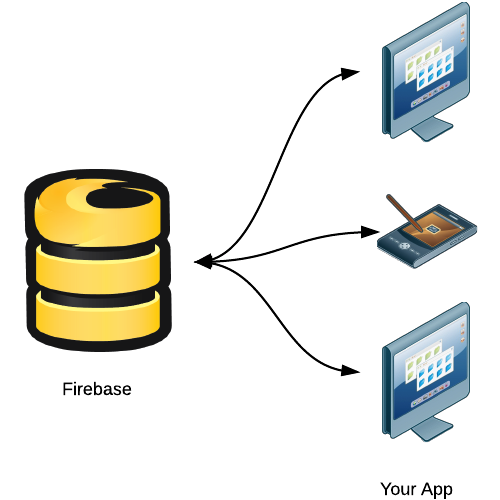
Removing synchronization servers did not remove every backend requirement. Firebase’s 2013 architecture guide distinguished client-only apps, apps with trusted server logic, and existing applications adding a live feature. External APIs, intensive computation and unusual authentication could still require servers. Twitch used Firebase alongside its own infrastructure; a customer could begin with a narrow notification feature instead of rewriting its entire platform.[17]
Firepad, launched in April 2013, made the primitive concrete. Its open-source collaborative editor provided shared cursors, presence, revision history and conflict resolution. Firebase built it after seeing many separate community implementations. CodeMirror supplied the editor, with ideas and code from ot.js. Examples and reusable components lowered the effort needed to reach a useful result.[27]
Hosting addressed another missing step. Its May 2014 release combined CDN delivery, automatic SSL, custom domains, one-command deployment and rollback. The launch linked its CDN to Fastly. More than 1,000 sites and apps had used Hosting during beta. Firebase could now serve both the application’s static assets and its changing data.[8]
The Google-era suite combined several lineages. The May 2016 expansion kept Realtime Database, Authentication and Hosting while adding analytics, storage, remote configuration, testing, messaging and growth tools. Google Cloud Messaging became FCM. Fabric brought Crashlytics, which the January 2017 agreement described as the expected primary crash-reporting offering.[11][12][13]
Firestore was a new document database, not a drop-in replacement for Realtime Database. Its October 2017 launch addressed data structure, querying and scaling limits while retaining live synchronization and offline access. Google explicitly continued both databases.[14] Data Connect later brought Cloud SQL PostgreSQL, GraphQL-defined operations and generated client SDKs. The April 2026 SQL Connect announcement retained that architecture while adding stronger SQL and real-time capabilities.[15][25]
Firebase served developers building new apps and teams adding real-time features to established products. The August 2013 company examples included CBS’s Big Brother social features, Twitch notifications, Atlassian Stash pair programming and Roll20. Those illustrate different jobs; they do not establish equal contract values or revenue contributions.[7]
Its distribution followed developer communities. Firebase supplied AngularJS and Backbone bindings, then supported Ember. At January 2014 ng-conf it offered a quickstart guide, starter examples, office hours, a talk and event sponsorship. Its year-end account also described sponsoring EmberConf. These were concrete paths from a framework community to working application code.[28][20]
YC’s Hacker News API became another visible use case. Firebase’s year-end account pointed to developers answering questions, sharing GitHub samples and helping one another. The community supplied examples and support that made the platform easier for the next developer to adopt.[20]
No reliable standalone addressable-market total is established here. Developer registrations, applications, sessions and network connections measure adoption or activity. None can be converted into paying customers, annual recurring revenue or market size without conversion and contract-value evidence.
Backend services were already a funded category: Kinvey raised a Series A in 2012.[18] Firebase’s distinctive proposition was live synchronization and a developer experience that omitted server operations. A feature could complement existing infrastructure rather than requiring an all-or-nothing platform choice.
As of October 2, 2026, Firebase still lists Realtime Database, Firestore, Authentication, Hosting, App Hosting, SQL Connect and Firebase AI Logic. Its SDK release notes document ongoing updates through September 2026.[23][31] Supabase currently offers PostgreSQL, authentication, storage, functions and real-time capabilities. Appwrite offers an open-source platform spanning similar application services and hosting. These are present-day alternatives, not explanations for the 2014 sale.[29][30]
Managed convenience leaves application teams responsible for security decisions, billing exposure and migration planning. Vendor documentation supplies service behavior; each application still needs to establish which versions and capabilities it actually depends on.
Firebase began charging when it left beta in August 2013. Its founder announcement described a large free tier, paid plans starting at $49 per month and enterprise pricing. Hosting entered existing plans without a price increase: the free Hacker plan served a Firebase subdomain, while paid Candle, Bonfire, Blaze and Inferno plans included custom domains. These are historical offers, not today’s terms.[7][8]
Current pricing separates the no-cost Spark plan from pay-as-you-go Blaze. Realtime Database, Firestore, Hosting, App Hosting and SQL Connect have distinct usage measures and dependencies; some services also incur Google Cloud charges. A single platform account does not imply one uniform billing unit.[24]
The disclosed early financing rounds total about $7 million. Standalone revenue, conversion, gross margin, cash burn, purchase price and shareholder returns are not established by the observed announcements. Neither the founder announcement nor contemporaneous acquisition coverage provides a transaction price.[10][19]
At launch, Firebase reported 35,000 unique visitors and 3,000 developer signups in the first 24 hours.[7] By July 2014, Lee reported more than 83,000 developers, 100,000 applications, 24 million daily sessions and traffic from 50 million unique IP addresses in the prior month. The million-connection milestone measured simultaneous use of Firebase-powered apps, not a million paying Firebase accounts.[9]
The July account named Google, Yahoo, Citrix, Instacart, Nitrous.io and InVision and reported a team of 24 plus an intern, up from seven a year earlier. These are company-reported adoption and staffing measures.[9] Tamplin cited 110,000 developers on acquisition day, more than 130,000 by the end of 2014, and over 450,000 in May 2016. Hosting exceeded 7,000 deployed sites by year-end 2014.[10][20][11]
That sequence supports expanding developer reach. It does not establish a comparable series of active paying customers or the economics of each cohort.
Firebase’s acquisition rationale was concrete. Tamplin pointed to Google’s infrastructure and engineering resources; Google Cloud users would gain Firebase’s rapid application-development capabilities. His promise was “Firebase is here to stay and grow.”[10] Continued core services and the 2016 expansion support that stated product direction.
The strategic interpretation is that developer adoption and infrastructure scale complemented each other. Firebase’s team had built an approachable way into a difficult technical job. Google could extend its reach and surround it with more services. The evidence supports this platform fit; it does not establish financial pressure, a failed independent business or a particular investor return.
The acquisition discussion preserved an important customer concern. Readers questioned whether continuity promises would survive changes in ownership and support priorities. Those were contemporary risks voiced by developers, rather than evidence that Google had already broken the service.[21]
Later products make the distinction testable. Firestore added a different database without retiring Realtime Database. App Hosting targeted full-stack applications while original Hosting remained available.[14][16] A new product name can represent a new architecture, a complementary service or an evolution of the same system.
Dynamic Links supplies the counterexample to blanket continuity. Google’s deprecation notice set August 25, 2025 as its sunset date and explained changes in mobile ecosystems. It described consequences for links and older mobile authentication flows, along with export and migration guidance. This is an observed service notice, not an independent test of every legacy link’s behavior.[26]
The useful lesson is to evaluate the service an application uses, not just whether the platform brand survives. Record affected versions, fallback, billing units, export paths and owner decisions. Product expansion can create opportunity and integration costs at the same time; neither should be assumed from acquisition alone.