
Fivestars
Winter 2011AcquiredCustomer loyalty and payments platform for small businesses.
Pressure-test this opportunity
Explore the risks and possibilities with a prompt for ChatGPT, Claude, or your agent.
Customer loyalty and payments platform for small businesses.
Explore the risks and possibilities with a prompt for ChatGPT, Claude, or your agent.
Fivestars gave independent shops a shared loyalty program: customers could identify themselves, collect rewards and receive return offers across participating businesses. Victor Ho and Matthew Doka founded it in 2010 and joined YC W11. The product later connected loyalty to payments.[5][2]
SumUp closed its acquisition on October 28, 2021, for $317 million in cash and stock. Fivestars contributed a US merchant network and customer-engagement technology. SumUp now markets loyalty, automated messaging and nearby-business discovery through SumUp Connect. This is an acquired product lineage with continuing operations, rather than a documented shutdown.[1][15][16]
Ho and Doka worked together at McKinsey, where they saw large companies use customer data to encourage repeat purchases. They wanted small businesses to have similar tools without needing their own analytics team.[2]
In a founder interview, Ho recalled withdrawing from job interviews during an airport delay, calling Doka and deciding to start a company. They moved to the Bay Area, learned to code and discarded two earlier ideas. The account describes an exploratory start, rather than a fully formed loyalty strategy.[4]
The first merchant relationships required direct work. Fivestars' own history says the founders recruited their first 100 customers through door-to-door sales. Its early product used one physical membership card across shops and integrated with existing checkout systems. A 2012 company release claimed compatibility with more than 90% of POS systems; that was a historical company claim, not universal compatibility.[3][5]
By 2018, the founders described their aim as a login for the offline world. They said the mission had remained consistent while the product expanded from rewards into personalized messages, promotions and payments.[2]
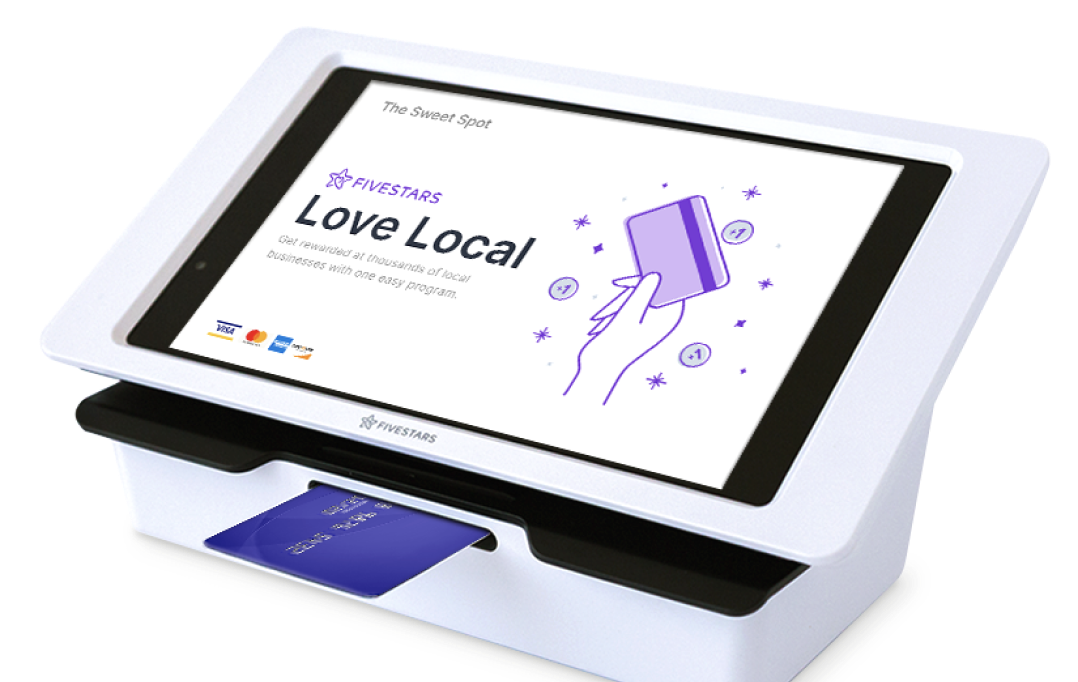
The early card connected purchases to a member record across participating shops. Later, customers could identify themselves by phone or a touchscreen. The mobile app helped them discover businesses and rewards. Merchants received customer records, visit information and messaging tools instead of managing a separate paper punch-card program.[5][10]
AutoPilot used customer activity to trigger return messages. The 2014 company release described 2.5 million monthly messages across text, push notifications and email. This is evidence of deployment scale, not proof that messages caused additional purchases.[6]
Fivestars Pay joined multi-tender payments to loyalty enrollment and offers. Infinicept supplied payment-facilitator infrastructure. Its later case study described payment processing as an additional revenue stream for Fivestars. Projected processing volumes in launch materials should not be treated as achieved volumes.[11][19]
VGS supplied tokenization to reduce the sensitive card data Fivestars handled and support processor flexibility. Its case study attributed nearly $1 million and at least six months of development savings to Fivestars' own calculation. These are partner-reported estimates, not independently audited savings or a guarantee about compliance obligations.[12]
Designer Mary Dyer's retrospective says the 2018 integrated terminal produced four times as many signups in its alpha test. Merchants still preferred the legacy device because checkout lines moved faster and rewards were easier to see. Signup growth and a useful checkout experience were different outcomes.[13]
The redesign let a customer check in while staff entered the order. It mirrored relevant reward information to the merchant and limited disruptive alerts to actions needing attention. Moderated and unmoderated tests informed the work. The practical lesson is specific: customer enrollment must fit the counter's timing, not compete with taking the order.[13]
Fivestars served repeat-visit local businesses, including cafés, restaurants and specialty retail. These merchants needed customer recognition and return offers without building a large marketing operation. The early card and existing-POS integration reduced the need for each shop to establish its own consumer app or database.[5][6]
A large count of small businesses is not an addressable market estimate. Relevant customers must have repeat visits, usable transaction identities, appropriate messaging permission and enough volume to measure an offer. Those conditions also constrain any rebuild.
Belly and LevelUp were named alternatives in the 2012 launch profile. Paper punch cards and a shop's own program were simpler substitutes.[5] Today, Square bundles loyalty and marketing with broader POS capabilities, while Toast offers restaurant loyalty.
SumUp Connect itself combines loyalty, AutoPilot and local discovery. Its launch release says it integrates with many third-party POS systems, although it works best with SumUp POS. Nearby-business promotion is therefore an existing capability, rather than an untouched market.[15][16]
A new independent layer needs a demonstrated workflow gap: supported connectivity, permission handling or credible experiment reporting for a particular merchant. Being independent of one POS brand does not establish that gap by itself.
Fivestars sold merchants a recurring software and service package. Ho described a typical full package at about $300 monthly in 2016.[7] That historical price does not establish current SumUp pricing or revenue per merchant.
Payments introduced another revenue path alongside customer-engagement software. Infinicept's case study describes that change, but public sources here do not establish standalone gross margins, acquisition costs, churn or profitability.[19] Multiplying merchant counts by one quoted package price would hide plan mix, discounts, dates and inactive locations.
The $317 million acquisition consideration and reported financing total answer different questions. Financing included equity and debt; acquisition consideration included cash and stock. Their ratio would not show investor returns, liquidation preferences or proceeds to individual shareholders.[1][8]
| Date | Reported network | Source and scope |
|---|---|---|
| September 2014 | 5,300 merchants; four million members | Company financing release. |
| October 2018 | 13,000 businesses; 40 million people | Founder interview published by YC. |
| October 2021 closing | More than 12,000 merchants; 65 million consumers | SumUp acquisition release. |
The 2015 company account defined members as people who had signed up at a participating business or in the app. Membership is therefore not the same as monthly active usage.[10] The acquisition release also cited $3 billion in annual sales and 100 million transactions. These figures describe reported network reach and activity, not Fivestars' revenue.[1]
The founder's acquisition announcement cited 70 million users, while SumUp's closing release cited 65 million consumers. The sources do not reconcile their definitions or measurement dates. They cannot establish a five-million-user decline. Similarly, merchant figures from different years do not prove a plateau or the reason for selling.[9][1]
Customer identification, return offers and checkout share a merchant's daily workflow. Fivestars' move into payments made that connection more direct and added a revenue mechanism. The sources support this product progression; they do not prove that loyalty economics made an acquisition inevitable.[2][11][19]
The founders' first 100 merchant visits show the effort behind early adoption. Dyer's checkout account then shows that a stronger signup metric could coexist with a worse staff experience. These are documented operating lessons. They do not quantify lifetime acquisition costs or prove that hardware caused the sale.[3][13]
Ho's account establishes a substantial 2016 team reduction. It does not provide the operating results or negotiations needed to connect that event to the 2021 transaction. The five-year gap matters when assessing a causal claim.[14]
SumUp described the acquisition as an expansion of its US presence, adding merchants and engagement technology. Those are management's stated reasons. Continuing SumUp Connect products support product continuity; they do not independently validate integration returns or Fivestars' earlier unit economics.[1][15][16]
Fivestars was acquired after building a substantial merchant network. Public evidence here does not establish a forced sale, a shutdown, or that independent operation was impossible. Assess the transaction as a change of ownership and product distribution, while leaving undisclosed financial outcomes unresolved.