
Hellosaurus
Summer 2020AcquiredInteractive video platform for kids
Pressure-test this opportunity
Explore the risks and possibilities with a prompt for ChatGPT, Claude, or your agent.
Interactive video platform for kids
Explore the risks and possibilities with a prompt for ChatGPT, Claude, or your agent.
Hellosaurus was a New York City-based interactive video platform for children ages 2–8, founded in late 2019 by James Ruben under the legal entity All Together Labs, Inc. [1] The company built a subscription iOS app where children participated in "playable video" — content that used the device camera, microphone, and touchscreen to make kids active participants rather than passive viewers. It also built a no-code Creator Studio that allowed kids media producers to create interactive content without engineering resources. [2] Hellosaurus was part of Y Combinator's Summer 2020 batch and raised $3.65M–$5M across three rounds. [3]
Hellosaurus built a genuinely innovative product and earned real recognition — App Store features, Kidscreen Awards, and a creator network with 200M+ combined YouTube subscribers — but could not convert that qualitative momentum into a subscription business with the unit economics required to raise a Series A and scale independently.
In December 2022, roughly two years after its public launch, Brilliant.org acquired Hellosaurus for an undisclosed price. The acquisition framing emphasized the Creator Studio technology and team rather than the consumer subscriber base — the hallmarks of an acqui-hire rather than a business acquisition. James Ruben subsequently returned to Stanford University, leaving the consumer app to continue in app stores under Brilliant's ownership. [4]

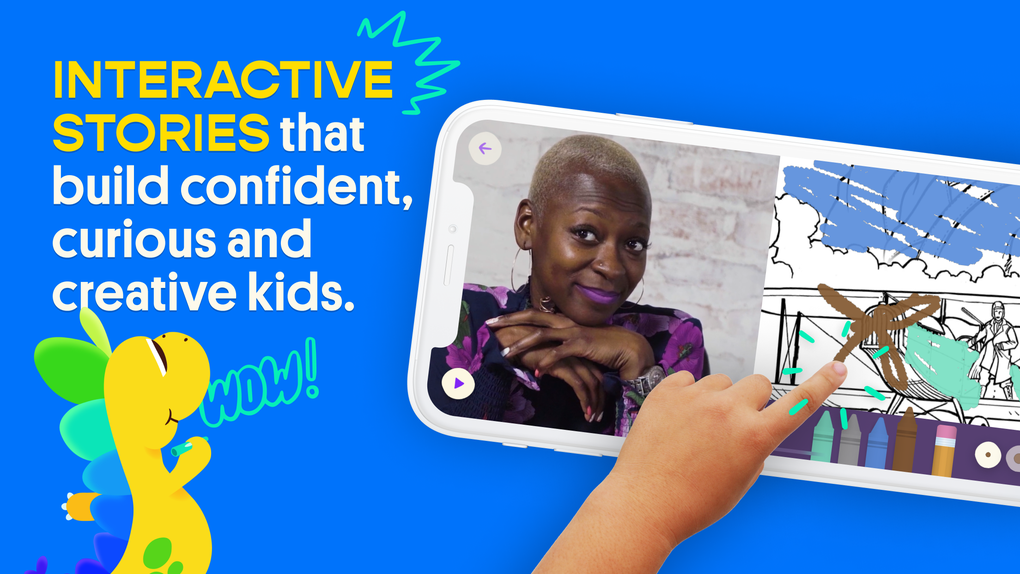
Image 1 / 2
James Ruben's path to Hellosaurus was unusually direct. He graduated from Harvard University with a degree in Economics and Computer Science, joined Google as a product manager, and then moved to HQ Trivia as Head of Product — a role that placed him at the center of one of the most culturally significant interactive media experiments of the late 2010s. [5] Forbes named him to its 30 Under 30 list for Consumer Technology. [6]
The founding insight came directly from HQ Trivia. As Ruben later described it, the best interactive content has no fourth wall — it makes the audience a participant, not a spectator. [7] At HQ Trivia, millions of adults would stop what they were doing twice a day to answer trivia questions in real time with a live host. Ruben saw that the engagement mechanism — the feeling of being in the content rather than watching it — was the product, not the trivia itself. The question he brought to Hellosaurus was whether that same mechanism could be applied to the 2–8 age bracket, where passive screen time had become both ubiquitous and a source of parental anxiety.
Two structural market dislocations sharpened the timing. COVID-19 lockdowns in early 2020 drove kids' mobile screen time up by over 150% — in some studies as high as 500% — creating both demand for kids content and parental guilt about its quality. [8] Simultaneously, YouTube's January 2020 FTC settlement caused a roughly 75% revenue collapse for kids content creators by restricting targeted advertising on children's content. [9] Creators who had built large audiences on YouTube suddenly had both the motivation and the urgency to find alternative platforms.
Ruben founded Hellosaurus in late 2019 as a solo founder — a structural choice that would later carry operational implications — and incorporated it as All Together Labs, Inc. in New York City. [10] Rather than recruit a co-founder, he assembled a team of industry veterans: people from Toca Boca, Nickelodeon, Sesame Street, Apple, and EA Games. [11] The first creative collaborator was Jens Peter de Pedro, a former Toca Boca executive, who co-created the company's debut product alongside producer Sara Berliner. The hiring signal was deliberate: Hellosaurus was positioning itself as a media-plus-technology hybrid from the start, not a pure tech startup that happened to make kids content.
Ruben framed the mission in terms of both child experience and parental trust: "We wanted to create something that a kid will love, but a parent will also feel great about handing over." [12] That dual constituency — the child as user, the parent as buyer — would define both the product design and the go-to-market challenge throughout the company's life.
Late 2019 — James Ruben founds Hellosaurus (All Together Labs, Inc.) in New York City. [13]
January 2020 — YouTube FTC settlement takes effect; kids content creators see ~75% revenue decline from restricted ad targeting, creating the creator monetization crisis Hellosaurus is built to address. [14]
May 2020 — "The Birthday Show" debuts as Hellosaurus's first product — an interactive virtual birthday party experience for kids during COVID-19 lockdowns, co-created with former Toca Boca exec Jens Peter de Pedro and hosted by Tim Kubart of Sunny Side Up. [15]
August 25, 2020 — Hellosaurus receives $150K YC investment as part of the S20 batch. [16]
November 23, 2020 — Hellosaurus launches public beta of its iOS app and announces a $3.5M seed round led by General Catalyst, with participation from GSV Ventures, BDMI, Shrug Capital, and angels including YouTube co-founder Chad Hurley and Vimeo co-founder Zach Klein. TechCrunch names it a favorite in the YC S20 batch. [17]
December 29, 2020 — Common Sense Media reviews Hellosaurus, documenting subscription pricing at $7.99/month, $17.99/quarter, or $49.99/year with a 14-day free trial. [18]
2021 — Hellosaurus wins the Kidscreen Award for Best Original App/Web Series. Apple features the app as "App of the Day" and a "Must-Have Kids App"; the app reaches #3 in the Kids category on the App Store. [19]
April 6, 2022 — Hellosaurus raises a third seed round led by 500 Global for an undisclosed amount — 17 months after the main seed, suggesting the company needed additional capital before reaching Series A metrics. [20]
June 13, 2022 — Hellosaurus partners with hoopla digital to offer library patrons 7-day BingePass access to the full app — the first children's content on hoopla's BingePass. [21]
2022 — Hellosaurus wins Best Kids-Only Streaming Service at Kidscreen 2022. Fast Company names it a "World Changing Idea." Forbes calls it "Mister Rogers for the iPhone Generation." [22]
December 6, 2022 — Brilliant.org acquires Hellosaurus for an undisclosed price. The Creator Studio is incorporated into Brilliant's products; the consumer app continues in app stores. James Ruben subsequently returns to Stanford University. [23]
Hellosaurus's core consumer product was an iOS app for children ages 2–8 built around a concept the company called "playable video." The premise was simple but technically non-trivial: rather than watching a show, a child would participate in it. The app used the device's camera, microphone, and touchscreen to create what Hellosaurus called "Do-It" moments — discrete interactive beats embedded within video content. These fell into categories like "Say It" (the child speaks a word or sound), "Find It" (the child touches an object on screen), and "Build It" (the child completes a physical or on-screen task). [24]
The user experience was designed to be operable by a two-year-old without parental assistance. A child would open the app, select a show, and be greeted by an on-screen host who spoke directly to them — not at them. The host would pause, ask a question, wait for a response, and react. The fourth wall was structurally absent. This was the HQ Trivia insight applied to preschool content: the engagement came from the feeling of being seen and responded to, not from the content itself.

The first product, "The Birthday Show," debuted in May 2020 as a COVID-era wedge. It was an interactive virtual birthday party experience — a clever product decision that solved a real, immediate problem (kids couldn't have birthday parties during lockdown) while demonstrating the platform's core mechanic. The show was co-created with former Toca Boca executive Jens Peter de Pedro and hosted by Tim Kubart, a known figure in kids media. [25] It served as both a proof of concept and a marketing vehicle.
By the November 2020 public beta launch, the platform featured content from creators including Mother Goose Club, Kidz Bop, Super Simple Songs, The Wiggles, Cosmic Kids Yoga, and Laurie Berkner — names with a combined 200M+ YouTube subscribers. [26] By the time of the acquisition in December 2022, the platform had accumulated 50+ hours of interactive content. [27]
The second major product — and arguably the more technically defensible asset — was the no-code Creator Studio. This toolkit allowed kids media creators to produce interactive video content without engineering resources, at a fraction of the time and cost previously required. [28] A creator could take existing video content and layer in interactive moments using a visual interface, then distribute it through the Hellosaurus platform. This was the supply-side solution to the two-sided marketplace problem: rather than requiring creators to build interactive content from scratch, Hellosaurus gave them a tool to retrofit existing content.
The platform was ad-free by design. Subscription revenue was shared directly with creators — a deliberate positioning against YouTube's ad-dependent model, which had just been structurally damaged by the FTC settlement. [29]
What distinguished Hellosaurus from alternatives was the combination of interactivity and production quality. YouTube Kids offered scale but passive consumption and ad exposure. Netflix Kids offered quality but no interactivity. Educational apps like Khan Academy Kids offered interactivity but not the video-native, entertainment-first experience. Hellosaurus occupied a genuine white space — but white spaces require category creation, which is expensive.
Hellosaurus had two distinct customer groups that needed to be acquired simultaneously.
The demand side was parents of children ages 2–8, specifically those who were already paying for kids content (Netflix, Disney+) and were motivated by concerns about passive screen time. The product was designed to appeal to parents who wanted their children to be active rather than sedentary during screen time — a concern that COVID lockdowns had amplified significantly. The $7.99/month price point positioned Hellosaurus as a premium add-on to existing streaming subscriptions, not a replacement. [30]
The supply side was kids content creators — particularly those who had been hurt by the YouTube FTC settlement and were looking for alternative monetization. Hellosaurus offered them a revenue-share model on a subscription platform, plus the Creator Studio to lower the cost of producing interactive content. The target creator was one with an existing YouTube audience (and thus content production capability) but diminished ad revenue.
The global kids' digital content market was large and growing. The children's e-learning market alone was projected to reach $30B+ by 2025, and the broader kids' streaming and app market represented billions in annual consumer spending. COVID accelerated both screen time and parental willingness to pay for quality content. The YouTube FTC settlement created an estimated $200M+ annual revenue gap for kids content creators — the addressable pool of motivated supply-side partners.
However, the addressable market for a premium, interactive-only, iOS-only subscription service was considerably smaller than the total kids content market. Hellosaurus was not competing for all kids screen time; it was competing for the subset of parents willing to pay a separate subscription for an interactive-specific experience on top of existing streaming services.
Hellosaurus's competitive position was structurally unusual: it was not competing head-to-head with any single incumbent on the same dimension, but it was competing with every incumbent for the same parent's wallet and child's attention.
On distribution, YouTube Kids had an insurmountable advantage. It was free, pre-installed on Android devices, and had effectively unlimited content. Hellosaurus's ad-free, subscription model was a genuine differentiator for parents, but it required parents to actively seek out and pay for an alternative — a high-friction ask.
On interactivity, the closest analog was the gaming category (apps like Toca Boca, Sago Mini) rather than video platforms. But gaming apps competed on open-ended play rather than video-native interaction. Hellosaurus's "playable video" format was genuinely novel, which meant it had no direct competitor but also no established category to slot into.
On content quality and brand, Netflix Kids and Disney+ had structural advantages in IP, production budgets, and subscriber bases. Neither had meaningfully invested in interactive kids content at launch — Netflix's "Bandersnatch"-style interactivity experiments were aimed at adults — but both had the capability to add interactive features to existing content if the category proved out.
The most important competitive dynamic was platform dependency. Hellosaurus was an iOS-first app that required Apple's App Store for distribution. Apple's 30% commission on subscriptions directly compressed the unit economics of a $7.99/month product. Apple also controlled featuring — the App Store "App of the Day" placement that drove Hellosaurus's #3 Kids ranking was a gift that could not be reliably repeated. Any platform that could build interactive video natively (YouTube, Netflix, or Apple itself) could absorb the category without building a separate subscription business.
Hellosaurus operated as a subscription video-on-demand (SVOD) service with three pricing tiers: $7.99/month, $17.99/quarter (effectively $6/month), or $49.99/year (effectively $4.17/month), with a 14-day free trial and one free episode available without a subscription. [31] Subscription revenue was shared directly with creators, though the specific revenue-share percentage was never disclosed publicly.
The company never disclosed revenue figures at any point in its public life. The absence of revenue data in all press materials — including the seed round announcement, award citations, and acquisition press release — is itself a signal that subscriber numbers were not strong enough to serve as proof points for investors or acquirers.
Inferring from available data: Hellosaurus had approximately 15 full-time employees at the time of acquisition. [32] At a conservative average fully-loaded cost of $150K–$200K per employee in New York City, annual burn was likely in the range of $2.25M–$3M, excluding content production costs and platform infrastructure. With total funding of $3.65M–$5M across three rounds, the company had limited runway at any point — likely 12–18 months per round at best. These are inferences from headcount and geography, not disclosed financials.
The hoopla digital partnership (June 2022) introduced a B2B2C distribution channel — library patrons could access the full app for 7 days via a BingePass. [33] This suggests Hellosaurus was exploring institutional distribution as a complement to direct consumer subscription, possibly in response to slower-than-expected direct subscriber growth. Whether hoopla paid a per-access fee or a flat licensing fee was not disclosed.
Hellosaurus accumulated substantial qualitative recognition but disclosed no quantitative subscriber, revenue, or engagement metrics at any point.
On the recognition side, the traction was genuine: Apple featured the app as "App of the Day" and a "Must-Have Kids App," and the app reached #3 in the Kids category on the App Store. [34] Hellosaurus won the 2021 Kidscreen Award for Best Original App/Web Series and the 2022 Kidscreen Award for Best Kids-Only Streaming Service. [35] Fast Company named it a "World Changing Idea." Forbes called it "Mister Rogers for the iPhone Generation." TechCrunch named it a favorite in the YC S20 batch. [36] GSV Cup named it one of the Top 10 Most Innovative Education Tech Companies. [37]
On the creator side, the platform had assembled a genuinely impressive supply network. By the seed round announcement in November 2020, creators including Mother Goose Club, Kidz Bop, Super Simple Songs, The Wiggles, Cosmic Kids Yoga, and Laurie Berkner had joined the platform — a combined 200M+ YouTube subscribers. [38] By acquisition, the platform had 50+ hours of interactive content. [39]
On the distribution side, the hoopla digital partnership (June 2022) opened a new institutional channel — the first children's content on hoopla's BingePass — suggesting Hellosaurus had sufficient brand credibility to open new channels. [40]
Critically, no subscriber count, MAU, revenue, or retention data was ever disclosed. App Store rankings are point-in-time metrics that can spike from a single Apple feature and then normalize. The 200M+ combined YouTube subscriber figure reflects creator audiences on a different platform, not Hellosaurus subscribers. The absence of any quantitative traction metric in two years of press materials — including a seed round announcement and an acquisition press release — is the most informative data point available.
Hellosaurus built a real product, earned real recognition, and assembled a real creator network. It was acquired, not shut down — a distinction that matters. But the acquisition price was undisclosed, occurred just eight months after the third seed round, and was framed around technology and team rather than business scale. The most accurate characterization is that Hellosaurus built something valuable that it could not scale into a standalone business. The reasons are structural, not merely executional.
The central failure mode was an inability to convert impressive qualitative signals into a subscription business with Series A-ready metrics. Every press mention, award, and App Store feature was real — but none of them translated into disclosed subscriber numbers, revenue figures, or retention data. In two years of public operation, Hellosaurus never cited a subscriber count in any press release, investor memo, or acquisition announcement. That silence is not accidental.
The specific mechanism is inferrable from the business model. At $7.99/month, Hellosaurus needed a large number of paying subscribers to cover a burn rate that was likely $2.25M–$3M annually (based on ~15 employees in New York City). Apple's 30% App Store commission reduced effective revenue to roughly $5.60 per subscriber per month. To cover burn at that rate, the company needed approximately 33,000–45,000 paying subscribers at full price — before accounting for content production costs, creator revenue share, or marketing spend. There is no evidence it reached that threshold. The third seed round in April 2022, coming 17 months after the main seed and led by a new investor (500 Global) rather than the existing lead (General Catalyst), suggests the company had not reached the metrics required for a Series A. [41]
Hellosaurus launched its public beta in November 2020 — at the peak of COVID-driven screen time demand. The founding thesis was partly built on two tailwinds: surging kids' screen time (up 150–500%) and the YouTube creator monetization crisis. [42] Both were real. Neither was permanent.
By mid-2021, COVID lockdowns had ended in most U.S. markets. Kids returned to school, playdates, and outdoor activities. Screen time normalized. The urgency that made parents willing to try a new subscription app — and willing to pay for it — diminished. Hellosaurus's product was designed for a world where kids were home and parents were desperate for quality content. That world existed for roughly 12–18 months of the company's operating life.
The YouTube creator monetization crisis was more structural, but it did not guarantee creator migration. Creators with 200M combined YouTube subscribers had built their audiences on YouTube's distribution. Moving those audiences to a new platform required subscribers to actively download a new app and pay for it — a conversion rate that is typically low even for well-known creators. The creator network was a supply-side asset; it did not automatically generate demand-side subscribers.
Hellosaurus was simultaneously building a consumer subscription product (requiring marketing, content production, and subscriber acquisition) and a B2B creator platform (requiring engineering, creator partnerships, and revenue-share economics). Both sides of the marketplace required investment. With total funding of $3.65M–$5M, the company was chronically undercapitalized relative to its ambitions. [43]
The strategic choice to build both sides simultaneously — rather than winning one side first — is a common failure mode for marketplace businesses. Hellosaurus needed creators to attract subscribers, and subscribers to attract creators. With limited capital, it could not invest heavily in either side. The Creator Studio was the more defensible technical asset (Brilliant acquired it specifically for this reason), but it was not the primary revenue driver. The consumer subscription was the revenue driver, but it required the creator network to have content worth subscribing for.
The deepest structural risk was that "interactive video for kids" was a feature that any major platform could add, not a standalone business category. Netflix demonstrated this with its interactive content experiments (including "You vs. Wild" for kids in 2019). YouTube could have added interactive overlays to kids content. Apple could have built interactivity into its TV app. None of these moves happened at scale during Hellosaurus's operating window — but the threat was always present.
The Creator Studio was the most defensible moat because it was a tool, not a content category. A no-code tool for producing interactive video is a platform-level capability that requires engineering investment to replicate. This is why Brilliant acquired it: not to run a kids subscription service, but to incorporate the tooling into its own product for 12M+ users. [44] The irony is that the B2B tooling — which was not the primary revenue driver — turned out to be the primary asset of value.
Ruben founded and ran Hellosaurus as a solo founder throughout its life. [45] Running a capital-intensive business that required simultaneous investment in consumer product, content production, creator relationships, platform engineering, and investor relations — with a team of ~15 people — is a significant execution challenge for any founding team. For a solo founder, the bandwidth constraints are structural. There is no evidence that the absence of a co-founder was the primary cause of failure, but it is a compounding factor in a business that required expertise across media, technology, and consumer marketing simultaneously.
The acquisition by Brilliant in December 2022 — eight months after the third seed round — was almost certainly not the outcome investors underwrote at the $3.5M seed. The undisclosed acquisition price, the technology-and-team framing, and Ruben's subsequent return to Stanford all point to an acqui-hire or near-acqui-hire rather than a business acquisition. [46] Whether investors received any return on their capital is unknown. What is clear is that the acquisition was the rational outcome given the alternatives: a third seed round that had not produced Series A metrics, a consumer subscription business that had not disclosed growth, and a market environment (rising interest rates, declining consumer tech valuations in 2022) that made raising a Series A on qualitative traction alone increasingly difficult.
The Creator Studio was the durable innovation, but Hellosaurus bet on the consumer subscription. The no-code tool for producing interactive video at low cost was a platform-level capability — the kind of infrastructure that Brilliant acquired specifically to incorporate into its own products for 12M+ users. The consumer subscription app was the revenue vehicle, but it required constant subscriber acquisition against a demographic (ages 2–8) that ages out quickly. Hellosaurus might have found a more durable business by licensing the Creator Studio to platforms rather than competing with them for subscribers.
The COVID tailwind created a launch window, not a business. Hellosaurus launched its public beta in November 2020, at the peak of lockdown-driven screen time demand. By mid-2021, that urgency had normalized. The company's subscriber acquisition challenge became structurally harder as the conditions that made parents most receptive to a new kids content subscription — desperation, guilt, and unlimited home time — faded. The third seed round in April 2022, 17 months after the main seed, suggests the post-COVID normalization hit the business before it had built durable retention.
A 200M-subscriber creator network does not equal 200M potential subscribers. Hellosaurus's supply-side traction — creators with massive YouTube audiences — was real, but it measured reach on a different platform. Converting a YouTube subscriber into a paying Hellosaurus subscriber required that person to discover the app, download it, start a free trial, and convert to paid. Each step in that funnel has friction. The creator network was a credibility signal and a content supply asset; it was not a distribution channel.
For kids subscription apps, the demographic churn problem is structural. A child who is 2 years old at signup is 4 years old two years later and may be aging out of the target demographic. Hellosaurus's 2–8 age range gave it roughly six years of potential subscriber lifetime per child — but in practice, content preferences shift rapidly within that range, and the platform needed to continuously acquire new families to replace those whose children had aged out. This creates a customer acquisition treadmill that requires either very low CAC or very high LTV, and there is no evidence Hellosaurus achieved either.
Qualitative traction is necessary but not sufficient for a consumer subscription business. Hellosaurus earned App Store features, Kidscreen Awards, Forbes coverage, and Fast Company recognition — all genuine signals of product quality. But none of these translated into disclosed subscriber numbers. The company's press strategy emphasized recognition over metrics, which is a rational choice when metrics are not strong enough to be proof points. Investors funding a Series A in 2022 needed subscriber counts, retention curves, and CAC/LTV ratios — not award citations.