
Heysan
Winter 2007AcquiredFree messaging on mobile phones
Pressure-test this opportunity
Explore the risks and possibilities with a prompt for ChatGPT, Claude, or your agent.
Free messaging on mobile phones
Explore the risks and possibilities with a prompt for ChatGPT, Claude, or your agent.
Heysan put existing instant-messaging conversations on a mobile phone. Founded in 2007 and backed by Y Combinator's Winter 2007 batch, it connected people across messaging services and later added a mobile community. Good Technology acquired the company in May 2009. Its investors included Khosla Ventures and Atomico. [1]
The strongest evidence of its difficulty comes from cofounder Gustaf Alstromer: the team struggled to grow the product. That supports a lesson about distribution. It does not establish that platforms blocked Heysan, that investors refused another round, or that its acquisition produced a poor return. [2]
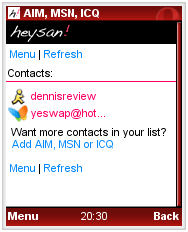
Image 1 / 1
Alstromer's account places the application process in a cold New York apartment with Marie Brattberg and Pär Lindhe, followed by Michael Ossareh. YC identifies the four founders and their roles: Alstromer led the company, Brattberg handled product, Lindhe handled product development and user experience, and Ossareh developed the software. [3] [1]
Their application proposed free interoperable mobile messaging. It addressed a practical problem: friends already used different desktop messaging networks, while a phone was becoming a place to maintain those conversations. An aggregator could provide value before anyone moved their social graph to a new service.
The founding account also contains a useful disagreement. In a comment on Alstromer's post, Lindhe recalled demonstrating a feature that sent a phone photo to a social profile. Paul Graham suggested it could become a company. Lindhe wrote: “I was not fully convinced but did not want to rock the boat”. This is a founder's retrospective recollection, rather than proof that Heysan passed up a predictable Instagram outcome. [3]
Alstromer later told a YC growth panel that Heysan was “a messaging product on mobile that we couldn’t grow”. He later led growth work at Voxer and Airbnb. [10] The relevant lesson is to investigate how customers discover and return to a product while building it. A good demonstration alone does not answer those questions. [2]
Heysan offered a mobile web interface for MSN, AIM, Yahoo, Google Talk, and Myspace IM. Users could bring existing contacts into a phone-based experience. SMS notifications, profiles, and community features extended the service beyond a contact list. Mobile Industry Review praised its interface and described rewards for notifying friends about the service. The virtual store included special emoticons. [4]
The surviving screenshot gives the product a concrete shape: recognizable network labels, contacts, refresh controls, and an invitation to add people. Heysan reduced the effort of reaching an existing network from a handset. The screen offers no evidence about its server architecture or encryption, so those details remain unknown.
The initial customer already had people to talk to on established messaging networks. Convenience on a phone was the immediate benefit. Heysan therefore depended on both useful mobile access and continued support for the networks holding those contacts.
The available evidence does not establish a reliable dollar value for Heysan's market. Total mobile subscribers would overstate its reachable audience. The narrower question was how many people wanted several existing messaging accounts on a phone, and how cheaply Heysan could reach them.
Contemporary reporting describes eBuddy, Nimbuzz, and Fring as mobile messaging alternatives. Aggregation already faced direct competition. [11]
Using the original network directly was an alternative to an aggregator. Platform-controlled access was a structural risk, because Heysan could not independently guarantee every network's behavior. The surviving sources do not show a particular access restriction causing the acquisition. Treating that risk as the proven cause would outrun the evidence.
The service was free to users. CB Insights reports total funding of $1.02 million and says the acquisition valuation and other terms were undisclosed. The amount is a database estimate, not a retrieved investment announcement. No audited revenue, advertising yield, payroll, or cash-burn figures were found. [5]
Free access could encourage adoption. It also leaves the business needing a way to pay for serving those users. Without revenue and cost records, we cannot calculate a break-even audience or conclude that the company ran out of money. The presence of prominent seed investors does not establish their later financing decisions.
Mobile Industry Review reported 600,000 users, 100 million monthly pageviews, and average use exceeding five hours a month in November 2008. It identified the UK and US as the largest markets. Those were reported figures without a disclosed measurement method. They are not interchangeable with monthly active users, messages, or retention cohorts. [4]
YC's profile reports more than one million users and tens of millions of monthly messages, without dating that observation. The numbers indicate substantial use, but do not reveal acquisition cost or the shape of growth. Engagement averages also cannot rule out churn. [1]
Alstromer's recollection is direct evidence of a growth problem. It does not specify whether acquisition, activation, retention, or monetization constrained Heysan most. An aggregator can work for one person without persuading their friends to join. That helps adoption, but can weaken an invitation loop: the friends remain reachable on the original network. This is a product-design inference, not a measured diagnosis of Heysan's funnel.
Good Technology's acquisition ended Heysan's independent trajectory. Public sources do not disclose the buyer's rationale, return to investors, or what happened to every product feature afterward. A team acquisition is possible, but claiming it as established fact would require stronger evidence. Acquisition also does not, by itself, establish failure.
The EU's messaging-interoperability rules create a narrower opportunity than a universal inbox. The European Commission excluded iMessage from gatekeeper designation in February 2024. Meta's November 2025 announcement described optional WhatsApp third-party chats for Europe, initially with BirdyChat and Haiket. Provider participation, eligibility, and user consent remain material. Neither source supports automatic access to Telegram, Signal, and iMessage through one universal mandate. [6] [7]
Heysan demonstrates that useful aggregation and difficult distribution can coexist. Measure the customer journey rather than inferring it from large cumulative totals. Put explicit permission around invitations and message routing. Treat each external channel as a dependency with its own availability and consent conditions.
A rebuild also needs a specific reason to win. Beeper currently documents a unified inbox and on-device connections. Its continued operation contradicts a claim that modern aggregators have all failed. A new entrant must establish a narrower workflow benefit, such as reliably completing client follow-ups, and verify that benefit with paying users. [8]