
Insight
Winter 2019AcquiredThe first extensible browser for iOS
Pressure-test this opportunity
Explore the risks and possibilities with a prompt for ChatGPT, Claude, or your agent.
The first extensible browser for iOS
Explore the risks and possibilities with a prompt for ChatGPT, Claude, or your agent.
Insight Browser was a Y Combinator Winter 2019 company that built what it claimed to be "the first extensible browser for iOS." Founded by Abhinav Sharma and Archa Jain, the product let iPhone users create browser extensions using simple if-then rules or JavaScript — bringing a desktop-class extension ecosystem to mobile for the first time. The company launched publicly in February 2021 to positive press coverage and a warm Hacker News reception, then pivoted to a Safari extension called Hyperweb before being quietly acqui-hired by Scale AI around 2022.[1][7]
The core thesis of Insight's failure is structural: the company built a genuinely useful product, but its central value proposition — extensibility on iOS — was absorbed by Apple when Safari added native extension support in iOS 15, announced just four months after Insight's launch. A standalone browser could not compete with Safari's deep OS integration, and the team's pivot to Hyperweb, while recognized by Apple as a "must-have" extension, was ultimately a smaller opportunity that ended in an acqui-hire rather than a standalone business.[13][15]
By January 2024, both Insight and Hyperweb were abandonware: websites returning 404 errors, apps unupdated for over a year, and Tracxn listing the company as "deadpooled."[15][24]

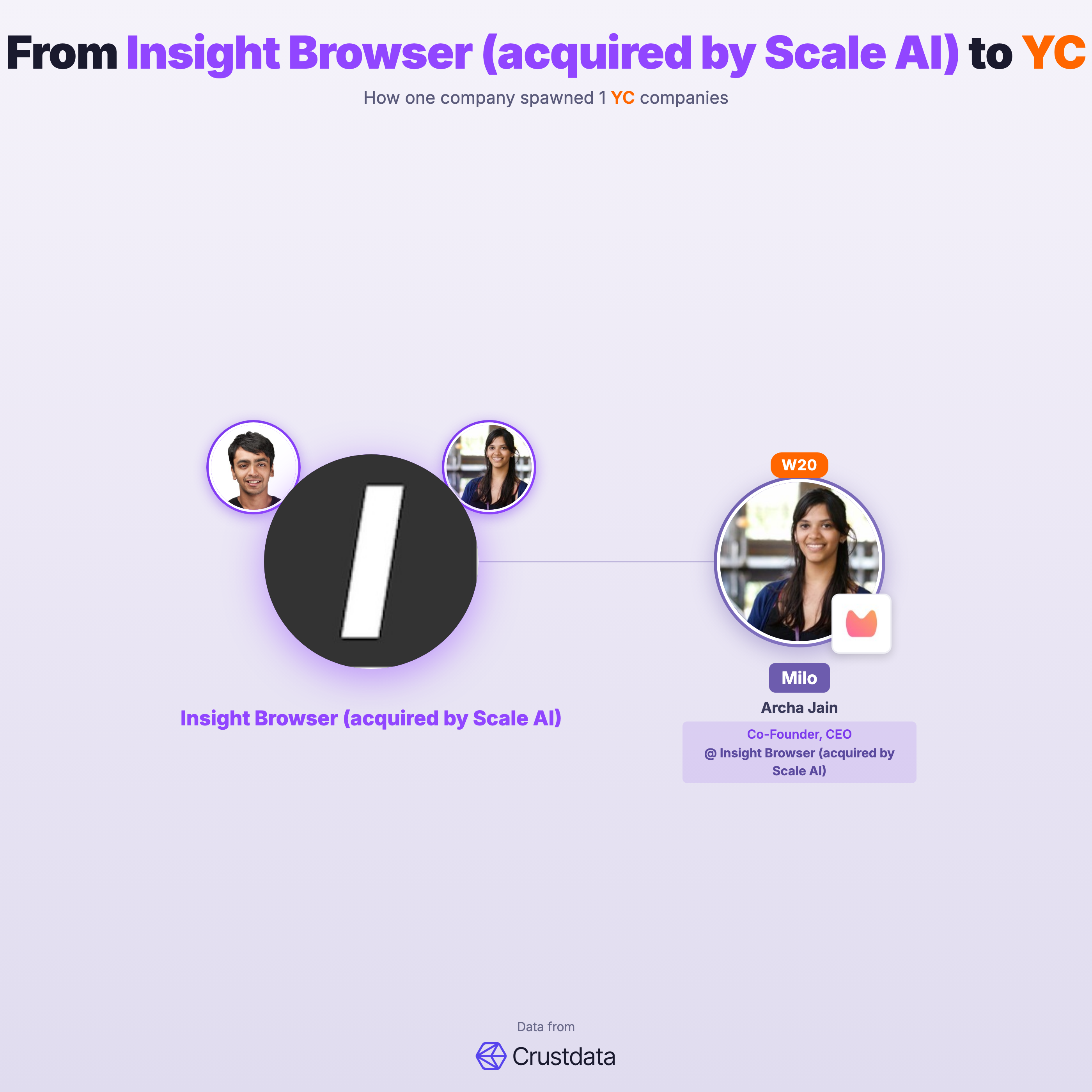
Image 1 / 2
Abhinav Sharma came to Insight with an unusually strong pedigree. He was a Product Lead at Quora, where he started the AMA and Communities features; an ML Engineer and Data Scientist at Facebook; and the first engineer at Duolingo — before the company was even called Duolingo. He studied Computer Science at Carnegie Mellon University.[17] His co-founder, Archa Jain, listed herself as Co-Founder and CEO of Insight from December 2018 on LinkedIn, and would later co-found Milo (YC W20) as CTO and join Goodfire as Member of Technical Staff.[10][19]
The company was legally Laso Technologies Inc., was women-founded per Crunchbase (which lists Jain and Shubhi Nigam as founders), and had a team of just three people.[2][3][27] How the founders met is not publicly documented, and the third team member is unnamed in any source.
The founding insight came from a survey of the Chrome extension store. As Jain explained in the Launch HN post: "We surveyed existing extensions on the Chrome extensions store and realized that most of them fit one of two patterns — augment pages with content or remove content from pages... Inspired by that and frustrated by missing what we had on desktop, we built Insight, where 90% of extensions can be built on the phone with if-then conditions."[6]
Sharma echoed this in a September 2021 interview: "We felt that the web deserved to be every bit as customisable and powerful on mobile as it is on desktop. However, because mobile usage is short on-the-go sessions, we wanted to make it even easier to create extensions (via the GUI) as well as auto-suggest extensions that are useful for a page."[22]
The company went through YC's Winter 2019 batch, then spent nearly two years building before its public launch in February 2021.[0]
Insight was a standalone iOS browser built on top of Firefox for iOS, which itself wraps Apple's WKWebView. The product's defining feature was its extension system: users could create extensions using simple if-then conditions through a graphical interface, or write JavaScript for more advanced functionality. This was a genuine innovation — no other iOS browser at the time offered user-created extensions.[5]
The launch extensions demonstrated the range of what was possible: blocking ads on Google, Amazon, and social media; detecting fake Amazon reviews via ReviewMeta and Fakespot; setting price alerts through CamelCamelCamel; enabling dark mode on sites that lacked it; checking media bias via Media Bias Fact Check; and enabling picture-in-picture video on YouTube.[26] At launch, the platform had around one hundred extensions, with tools allowing anyone — even non-developers — to create their own.[7]
The user experience was designed for short, on-the-go mobile sessions. Rather than requiring users to browse a directory and install extensions manually, Insight auto-suggested extensions that were useful for the page being viewed. The if-then rule system was the core abstraction: "if you're on Amazon, then show fake review detection" — a pattern that covered the vast majority of what desktop extensions did.[6]
The team used the Bing API to power some search features.[21] The business model was a paid subscription at $3.99/month or $39.99/year, with a stated commitment to no data exploitation.[16][23]
The product had a hard technical ceiling imposed by Apple: because it ran in a regular WKWebView, it could not support Apple Pay — a feature reserved for Safari and SFSafariViewController. This was a recurring theme: the standalone browser was always a second-class citizen on iOS, unable to match Safari's OS-level integration.[24]
Insight targeted power mobile users who wanted desktop-class browser customization on iOS — people frustrated by ads, fake reviews, and the lack of extension support on their phones. The product's positioning as "the first extensible browser for iOS" was aimed at a technically literate early-adopter audience, which the Launch HN reception (81 points, 48 comments) reflected.[20]
The iOS browser market is enormous but structurally concentrated. Safari holds the dominant share of iOS browsing by default, with Chrome and Firefox as the main alternatives. The addressable market for a third-party browser with extensions was a subset of power users willing to install a new default browser — a meaningful but niche segment. Sharma claimed "millions of users" and "1M+ active daily users" across Insight and Hyperweb combined, though this claim is medium-confidence and unverifiable from public data.[14]
The competitive landscape shifted decisively during Insight's lifetime, and the shift was not caused by a rival browser — it was caused by the platform itself. When Insight launched in February 2021, it had a genuine differentiation: no other iOS browser offered user-created extensions. But Apple announced Safari extension support for iOS 15 in June 2021, just four months later. This was not a competitor out-executing Insight; it was the platform owner absorbing the product's core value proposition into the default browser.[13]
The structural problem was that Insight competed on a dimension — deep OS integration — where Safari had an unassailable advantage. As Sharma himself acknowledged, users "have to go back to Safari because of some deep OS integration."[13] A standalone browser on iOS is always a layer above Safari, subject to WKWebView's limitations (no Apple Pay, no password autofill integration, no Handoff). When Safari gained extensions, the standalone browser's only remaining advantage — extensibility — evaporated.
The competitive axes that mattered were distribution reach versus product depth. Safari had distribution (it is the default browser on every iPhone) and, after iOS 15, product depth (native extensions). Insight had product depth but no distribution advantage, and its depth was a subset of what Safari could now offer. This is a classic platform-absorption pattern: a third-party product that extends a platform's capabilities is vulnerable to the platform owner adding those capabilities natively.
Insight's business model was a paid subscription: $3.99/month or $39.99/year for the browser.[16] The company was explicit about its approach. As Jain said in the Launch HN discussion: "We want to be as transparent as possible because our business plan is going to work around a paid tier and we have no intention of data exploitation."[23]
The company raised a Seed round led by Y Combinator with five investors, including Heartcore Capital and AltaIR Capital, though the total amount was never publicly disclosed.[8] With a team of three and roughly two years between YC and launch, the burn was likely modest — perhaps $500K-$1M annually, an inference based on typical YC seed-stage salaries and the small team size. No revenue figures were ever disclosed.
The absence of revenue data is itself a signal. A company claiming "millions of users" and "1M+ active daily users" that never disclosed revenue, and whose apps were last updated in October 2022, suggests the subscription model did not generate enough revenue to sustain the standalone browser as a business.[14][15]
Public traction data is thin but suggestive. The Launch HN post received 81 points and 48 comments — a moderate reception that indicates interest but not overwhelming enthusiasm.[20] TechCrunch covered the launch positively, highlighting the extension ecosystem.[7]
Sharma's intro.co profile claims "millions of users" for Insight and "1M+ active daily users" across Insight and Hyperweb combined.[14] This claim is medium-confidence — it comes from the founder's own promotional profile and cannot be independently verified. The fact that the company pivoted away from the standalone browser despite this claimed traction suggests either the numbers were inflated, or the users were not converting to paying subscribers at a sustainable rate.
The most important failure mechanism is platform absorption. Insight's entire reason for existing was that iOS lacked browser extensions. The company spent roughly two years building the first extensible iOS browser, launched in February 2021, and Apple announced Safari extension support in June 2021 — four months later. The standalone browser's differentiating feature became a native Safari capability within a single iOS release cycle.[13]
Sharma's own words on Product Hunt make the causal chain explicit: "We've seen great usage and retention with Insight but the #1 piece of feedback from our users has always been that they have to go back to Safari because of some deep OS integration. So when Apple announced support for extensions in Safari earlier this year, it was quite clear what the next step would be for us."[13]
This is a structural mechanism, not a company-specific failure. Any third-party iOS browser that competes on extensibility faces the same risk: Apple controls the platform, the WebKit rendering engine, and the OS-level features that make a browser feel native. Insight was not out-executed by a rival; it was made redundant by the platform owner. The company's attempt to address this — pivoting to Hyperweb, a Safari extension that could ride Apple's new extension infrastructure — was the logical response, but it transformed Insight from a platform into a feature, with a correspondingly smaller market.
Even before Apple's extension announcement, Insight operated under structural disadvantages that no amount of product quality could overcome. Because it ran in a regular WKWebView, it could not support Apple Pay — a feature reserved for Safari and SFSafariViewController.[24] This was one instance of a broader pattern: deep OS integration — password autofill, Handoff, iCloud Keychain, Apple Pay — was simply unavailable to third-party browsers. Users noticed, and the #1 piece of feedback was that they had to return to Safari for these features.[13]
The attempted remedy was Hyperweb, which turned Insight's extension-building capability into a Safari extension. This was a smart adaptation: instead of fighting Safari, the team would augment it. Apple recognized Hyperweb as a "must-have Safari extension."[13] But the pivot also meant the company was now competing in a much smaller market — Safari extensions, not browsers — and was entirely dependent on Apple's continued support and promotion.
The subscription model — $3.99/month or $39.99/year — was a reasonable choice for a privacy-focused browser, but it faced a fundamental challenge: convincing users to pay for a browser when Safari is free, pre-installed, and increasingly capable. The claimed "1M+ active daily users" never translated into disclosed revenue, and the apps were last updated in October 2022 — roughly a year after the pivot to Hyperweb.[14][15] The absence of any revenue disclosure, combined with the quiet acqui-hire by Scale AI, suggests the standalone browser was not a sustainable business on its own.
The strongest counter-explanation is that Insight never achieved product-market fit as a standalone browser, and the Apple announcement was a convenient excuse rather than the true cause. The Launch HN reception was moderate (81 points), not explosive. The company spent two years building before launch, which is long for a YC startup. And the claimed traction figures come from the founder's own promotional profile, not from any independent source.
This counter-argument has some force, but it does not fully explain the outcome. The pivot to Hyperweb and its recognition by Apple as a "must-have" extension suggests the team's extension-building capability was genuinely valuable — the problem was the vehicle, not the underlying technology. The acqui-hire by Scale AI, a company focused on AI data infrastructure, further suggests the team's talent was the primary asset being acquired, not the product or its user base.[9]
The more precise framing is that Insight had product-market fit for a feature (extensible browsing on iOS) but not for a product (a standalone browser). When Apple made that feature native, the standalone browser's raison d'être disappeared. The team adapted intelligently, but the market for Safari extensions is structurally smaller than the market for browsers, and the acqui-hire was the natural endpoint.
Insight's story is a case study in platform dependency risk. The company built its entire value proposition on a gap in Apple's platform — the absence of browser extensions on iOS. This is a dangerous position because the platform owner can close the gap at any time, and when it does, the third-party product loses its reason to exist. The company's specific decisions — building on Firefox for iOS, focusing on no-code extensions, pivoting to Hyperweb — were all reasonable. The failure was structural: Insight was a feature waiting to be absorbed, and Apple absorbed it.
The acqui-hire by Scale AI, with Sharma becoming Director of Product and later Head of Product Design, is the final data point.[9][18] The team was talented enough to land at a well-funded AI company, but the product they built could not survive contact with the platform it depended on.
Platform dependency is existential risk. Insight built its entire value proposition on a gap in Apple's iOS platform — the absence of browser extensions. When Apple closed that gap in iOS 15, announced just four months after Insight's launch, the standalone browser lost its reason to exist. Any startup whose core value depends on a platform's missing feature should assume the platform owner will eventually add it, and build a moat that survives that event.
A feature with product-market fit is not a product with product-market fit. Insight's extension-building capability was genuinely useful — Apple recognized Hyperweb as a "must-have" extension. But a feature that works well inside a platform is not the same as a standalone product that can sustain a business. The team's pivot from browser to Safari extension was logical, but it also meant competing in a much smaller market with no distribution advantage.
On iOS, third-party browsers are second-class citizens by design. Insight could not support Apple Pay because Apple reserves that for Safari and SFSafariViewController. This was one instance of a broader pattern: deep OS integration is simply unavailable to third-party browsers. The #1 piece of user feedback was that people had to return to Safari for these features. Building a browser on iOS means accepting structural disadvantages that no amount of product quality can overcome.
The acqui-hire is a legitimate outcome, not a failure. Insight was quietly acquired by Scale AI, with Sharma becoming Director of Product and later Head of Product Design.[9][18] The team's talent was valuable even when the product wasn't. For a three-person YC startup facing platform absorption, an acqui-hire that places founders in strong positions at a well-funded company is a reasonable outcome — and one that the lack of public post-mortem suggests the team accepted pragmatically.