
Overview
Instant made application state feel local while keeping it shared. Its database combined relationships, live updates, permissions, and offline behavior behind a frontend SDK. That reduced work developers otherwise repeated in every application. The team later reported that agents had become most users' route into the product. In August 2026 it announced a move to OpenAI and a scheduled closure of Instant Cloud. Open source remained the continuity path.[1][2]

Image 1 / 1
A database problem inside the interface
Joe Averbukh and Stepan Parunashvili met in San Francisco in 2014 and worked at Facebook and Airbnb. Their seed announcement describes engineers frustrated with repeating the same client-server plumbing. Each feature could require a database change, an endpoint, client state, and another cache. Fast interfaces added optimistic changes, synchronization, and recovery when a write failed.[3]
Parunashvili's 2022 architecture essay treated these as connected problems. Instant stored information as entity-attribute-value triples and exposed relational queries through a JavaScript-shaped query language. The client could update its local view before the server replied. The important trade-off was moving complexity into shared infrastructure, so application developers could reuse it.[4]
This was a specific product bet. A developer building a shared task list should not need to separately invent local state, reconnect handling, relationship queries, and permission checks. The architecture promised those pieces together; its value depended on their behavior agreeing under failures as well as in a short demo.
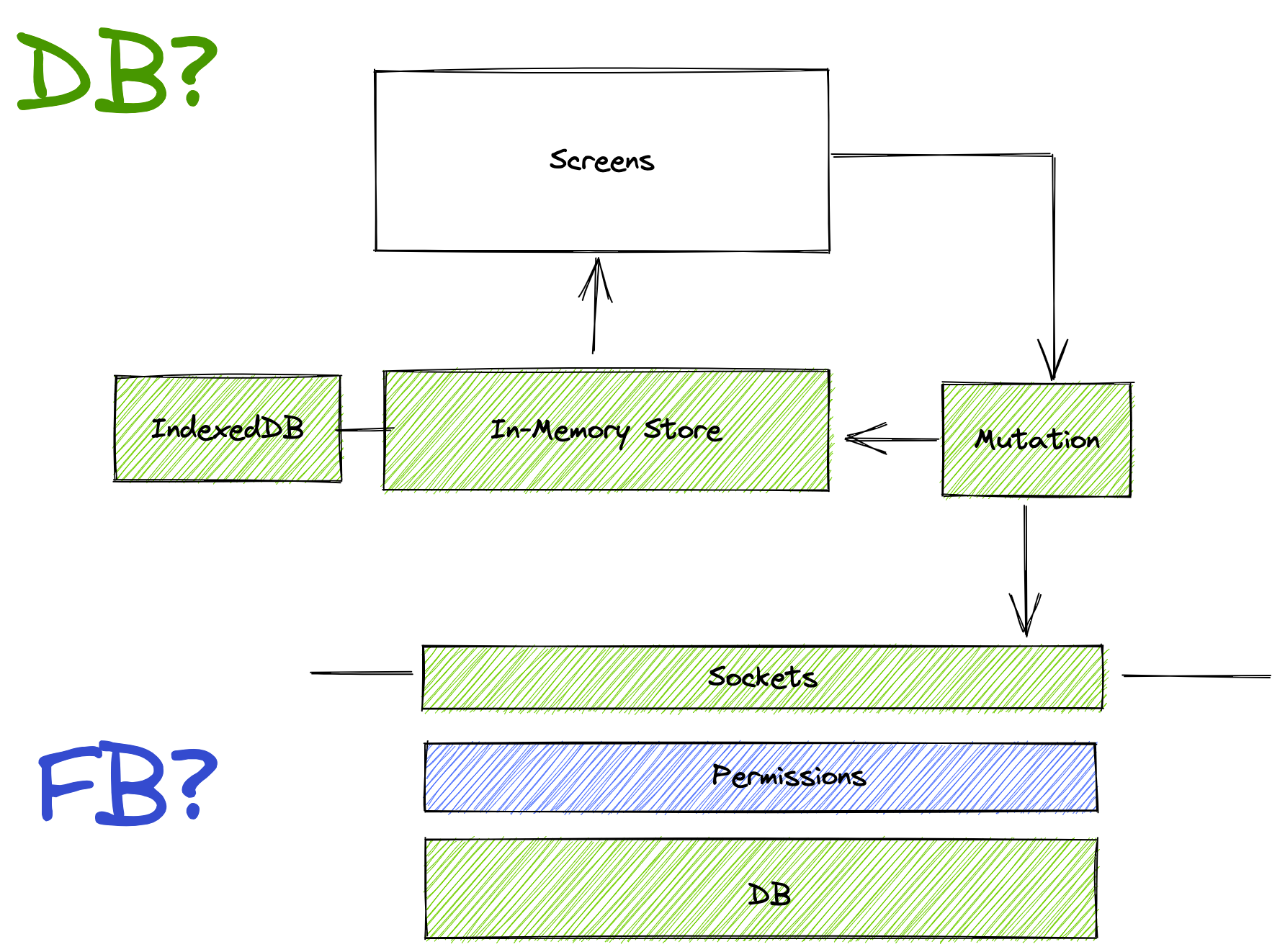
Source: Stepan Parunashvili / Instant
Essays became distribution
The company traces its public origin to a 2021 browser-database essay, followed by the graph-based design in 2022. It open-sourced Instant in August 2024. By 2025, its product combined database, authentication, permissions, and storage; later scaffolding tools made starting a project easier.[5]
The Hacker News launch made the product concrete with a small chat application. Its authors explained how queries subscribed to browser data, writes applied optimistically, and PostgreSQL changes reached connected clients. Firebase cofounder James Tamplin joined the discussion and described the appeal of combining relationships with real-time, offline, and open-source behavior. These were useful public endorsements and technical feedback, not proof of paid conversion.[6]
Instant announced a $3.4 million seed round after its open-source launch. Named backers included YC, SV Angel, Tamplin, Paul Graham, Greg Brockman, and Jeff Dean. The founders emphasized a shared backend that could create many small applications without provisioning a separate database for each. That supported a low-friction developer entry point, though public material does not establish hosting margins or annual recurring revenue.[3]
More applications did not mean more customers
At the team transition, Instant reported more than 17,000 users, 400,000 created apps, and about 2.5 billion processed transactions. Those are company-reported cumulative figures. They describe different units: a person can create many apps, and an app can generate many transactions. None is a paid-customer count.[1]
The product documentation shows why agent-built applications could fit the same approach. A scaffolding command creates a project; schema and permissions live beside application code; a client subscribes to queries and submits changes. A reusable backend can reduce the amount of infrastructure an agent must generate. That is an architectural interpretation, rather than evidence that agent use improved retention or economics.[2]
Outcome and continuity
Instant's announcement closed new Cloud signups and directed existing users to migrate. Cloud apps are scheduled to stop on August 31, 2027, with backups available until August 31, 2028. Certain recent subscriptions qualify for refunds. The announcement confirms a team move; it does not disclose the purchase price or establish financial distress.[1]
Self-hosting is documented rather than hypothetical. Instant publishes separate VPS and AWS guides, with indicative infrastructure costs starting around $30 monthly for side projects and at least $600 monthly for business setups. Those are the vendor's estimates, before any new operator's support fee. A service around migration must beat the cost and risk of following those guides directly.[7]
Convex continues to sell a reactive backend with a free entry point and a Professional plan priced per developer. A new company therefore needs a narrower reason to exist than providing another reactive database. A migration-and-operations service for existing Instant applications is one testable option; its demand and willingness to pay remain unverified.[8]
Timeline
- 2021: Published the browser-database thesis.[5]
- 2022: Published the graph-based architecture and joined YC's Summer batch.[4][9]
- August 2024: Open-source launch.[6]
- 2026: Announced the team move to OpenAI.[1]
- August 31, 2027: Scheduled Instant Cloud shutdown.[1]