Overview
Iris Automation was a drone safety software company founded in 2015 by Alexander Harmsen and James Howard in Vancouver, Canada. The company built Casia, a computer vision-based detect-and-avoid (DAA) system that allowed drones to sense and evade non-cooperative aircraft — the critical missing piece for commercial beyond visual line of sight (BVLOS) drone operations. Backed by Bessemer Venture Partners, Sony Innovation Fund, Verizon Ventures, and Y Combinator, Iris raised between $23M and $35M across five rounds and achieved regulatory approvals in nine countries before being acquired by uAvionix in October 2023.[1]
The company built genuinely superior technology and accumulated more regulatory credibility than almost any peer in the drone safety space. It failed not because the product didn't work, but because the FAA's BVLOS rulemaking process moved far slower than the market required — keeping the addressable commercial market artificially small for the entirety of Iris Automation's independent life. When the 2023 venture capital contraction closed off the Series C runway, the company had no path to profitability at its constrained scale.
The October 2023 acquisition by uAvionix — at an undisclosed price, following a ~46% headcount reduction — was a strategic soft landing rather than a venture-scale exit.[2] CEO Jon Damush became CEO of the combined entity, and Casia's non-cooperative detection capability was absorbed into uAvionix's broader airspace safety stack — validating the technology while confirming it was worth more as a feature than as a standalone company.


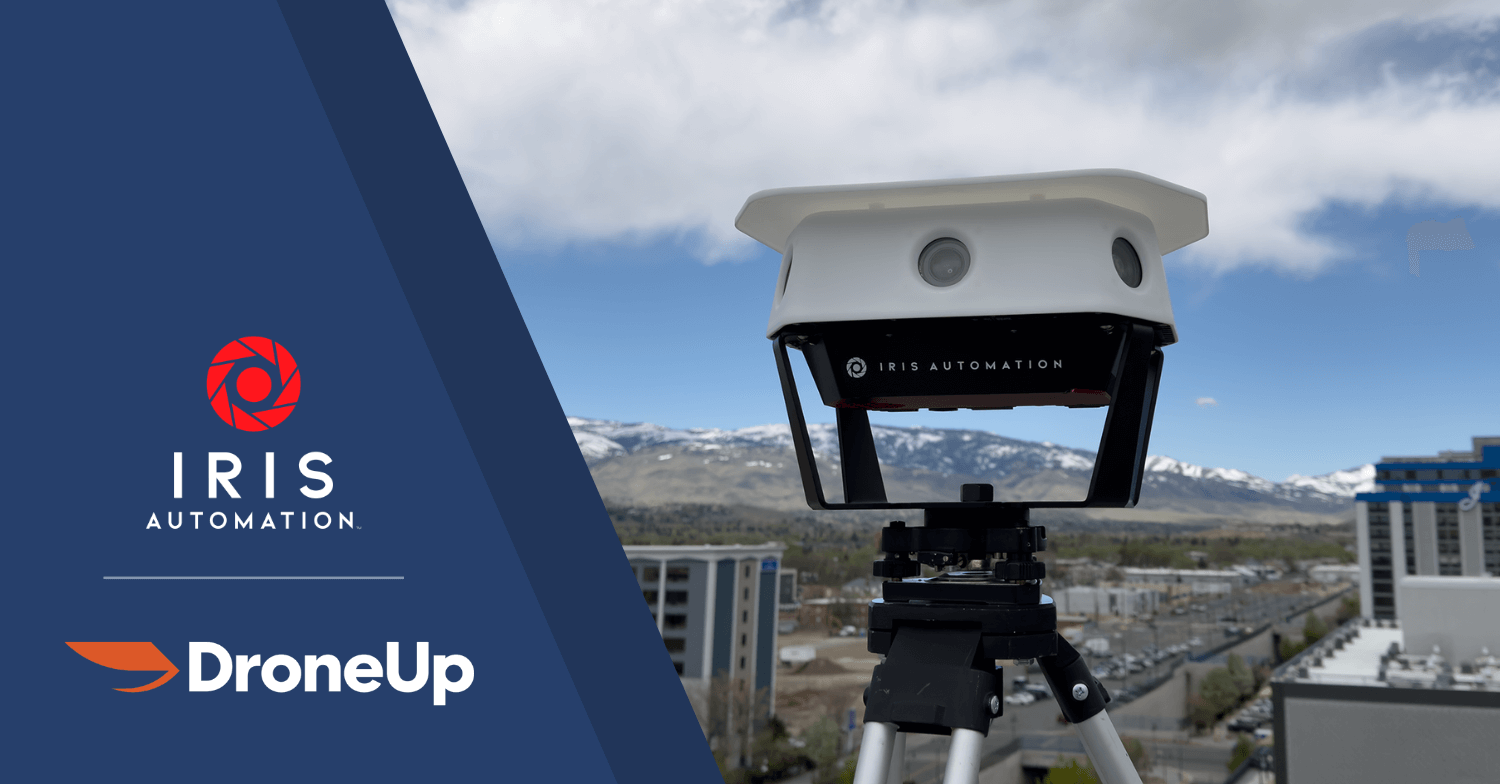
Image 1 / 3
Founding Story
Alexander Harmsen and James Howard founded Iris Automation in Vancouver, Canada in 2015, bringing an unusually credentialed technical pedigree to what was then a nascent commercial drone market.[3] Both founders had worked on computer vision and drone-related projects at institutions that sit at the intersection of aerospace and machine learning: NASA's Jet Propulsion Laboratory, Boeing R&D, Matternet (the drone delivery pioneer), and Spire Global (the satellite data company).[3] This background gave them direct exposure to both the technical complexity of autonomous flight and the regulatory machinery that governs it — a combination rare among early-stage founders.
The problem they identified was specific and commercially consequential. Drone operators could fly within visual line of sight (VLOS) under existing FAA rules, but the high-value commercial applications — infrastructure inspection, precision agriculture, package delivery at scale — all required BVLOS operations. The legal barrier to BVLOS was not primarily technical; it was safety certification. Regulators required proof that drones could detect and avoid other aircraft, including small general aviation planes and helicopters that do not broadcast ADS-B transponder signals. No commercially available system solved this for non-cooperative aircraft. As co-founder James Howard put it: "This is the biggest problem facing the industrial drone market today, we're solving that with cutting edge computer vision technology."[4]
The founders' answer was to apply computer vision and machine learning — the same techniques advancing autonomous cars — to airborne collision avoidance. Rather than relying on radio signals from other aircraft, Casia would use cameras and 3D environmental reconstruction to detect any moving object in the flight path, regardless of whether it was broadcasting anything.
Early capital came from Bee Partners, Chris Nelson, and Panda Angel Partners, with Y Combinator providing the institutional validation that accelerated the company's move from Vancouver to San Francisco for the S16 batch in mid-2016.[5] The company eventually settled its headquarters in Reno, Nevada — a location that placed it in proximity to FAA test corridors and the Nevada UAS Test Site, one of seven FAA-designated drone testing facilities in the country.
At the time of YC, Harmsen expressed confidence in the regulatory timeline: "The American and European regulatory environment is really going to change over the next few years."[6] That prediction, made in June 2016, would prove optimistic by nearly a decade — and the gap between that forecast and reality became the defining constraint of the company's commercial life.
Timeline
- 2015 — Iris Automation founded in Vancouver, Canada by Alexander Harmsen and James Howard, both with backgrounds at NASA JPL, Boeing R&D, Matternet, and Spire Global.[7]
- November 2015 — Company Twitter/X account (@Iris_Automation) created, indicating early public presence.[8]
- March 2016 — Raised $500K seed round from Bee Partners and Y Combinator.[9]
- June 2016 — Participated in Y Combinator S16 batch; Harmsen publicly predicts regulatory change "over the next few years."[5]
- January 2017 — Raised $1.5M seed extension round.[10]
- January 2018 — Raised $8M Series A led by Bessemer Venture Partners; David Cowan and Tess Hatch join board.[11]
- April 2019 — Launched Casia commercially — described as the first commercially available computer vision DAA solution for BVLOS — following 7,000+ real-world test flights and 30+ beta customers across five countries.[12]
- October 2020 — Won AUVSI XCELLENCE Award for Technology & Innovation (first place).[13]
- October 2020 — Co-founder Alexander Harmsen replaced as CEO by aerospace veteran Jon Damush; Harmsen moves to Chairman of the Board.[14]
- December 2020 — Closed $13M Series B with Sony Innovation Fund, Verizon Ventures, Bessemer, Bee Partners, and OCA Ventures.[15]
- June 2021 — Selected by FAA to participate in the BVLOS Aviation Rulemaking Committee (ARC) — confirming regulatory credibility, but also confirming that scalable BVLOS rules still did not exist six years after founding.[16]
- April 2022 — Launched Casia G, a ground-based 360° airspace detection and alert system — a product line expansion into adjacent regulatory use cases.[17]
- October 24, 2023 — Acquired by uAvionix Corporation at an undisclosed price; Jon Damush becomes CEO of the combined entity.[2]
- November 3, 2023 — Damush publicly cites "ugly" capital-raising environment and strategic complementarity as acquisition rationale.[18]
What They Built
Iris Automation's core product, Casia, was an onboard computer vision system that gave drones the ability to see and avoid other aircraft without relying on radio signals. The distinction matters: most aviation safety systems depend on ADS-B transponders, which broadcast an aircraft's GPS position to other aircraft and ground stations. But a large portion of the general aviation fleet — small planes, helicopters, ultralights, gliders — either does not carry ADS-B equipment or carries it inconsistently. A drone flying BVLOS that could only detect ADS-B-broadcasting aircraft would be blind to a significant fraction of the real-world traffic it might encounter. Casia solved this by treating every moving object as a potential threat, regardless of what electronics it carried.[19]
The system used cameras and machine learning to perform 3D environmental reconstruction in real time, identifying moving objects in the drone's flight path and classifying them as threats requiring avoidance maneuvers. The underlying architecture drew on computer vision techniques developed for autonomous ground vehicles, adapted for the specific challenges of airborne operation: variable lighting, high relative speeds, and the need for extremely low false-positive rates (a drone that maneuvers unnecessarily is itself a safety hazard).[19]
Casia launched commercially in April 2019 following an extensive validation program: more than 7,000 real-world test flights, over 40,000 simulated encounter scenarios, and a beta program with more than 30 customers across five countries.[12] The system was designed to be platform-agnostic, with over 16 validated integrations across multirotor, fixed-wing, and VTOL aircraft configurations — a deliberate choice to maximize the addressable customer base rather than tying the product to a single airframe.[20]
In April 2022, Iris Automation launched Casia G, a ground-based variant of the detection technology.[17] Rather than mounting on the drone itself, Casia G provided 360° airspace monitoring from a fixed ground station, alerting drone operators to approaching aircraft before launch or during operations. This product addressed a different regulatory use case — ground-based detect-and-avoid for drone corridors and vertiports — and represented the company's attempt to expand its addressable market beyond onboard systems. It also reflected a pragmatic recognition that some operators preferred ground-based monitoring over the cost and weight penalty of onboard hardware.
The product evolution from Casia to Casia G illustrates a broader strategic tension the company navigated throughout its life: the onboard system was technically superior and more scalable, but ground-based monitoring was easier to deploy without waiting for individual aircraft certifications. Neither product line generated disclosed revenue at a scale sufficient to sustain the company independently.
What made Casia genuinely differentiated was the non-cooperative detection capability. Competitors in the DAA space — including Daedalean, PIXEVIA, and Neurala — were working on similar computer vision approaches, but Iris Automation was first to commercial availability and accumulated the most extensive real-world validation dataset.[21] That validation record was ultimately what made the company attractive to uAvionix — not as a standalone business, but as a technology and regulatory asset.
Market Position
Target Customers
Iris Automation's primary customers were commercial drone operators seeking regulatory approval for BVLOS operations — specifically, enterprises in industries where BVLOS unlocks meaningful economic value: utility and pipeline inspection, precision agriculture, public safety, and package delivery. Secondary customers included drone manufacturers seeking to integrate DAA capability into their platforms, and regulators and test programs that needed validated safety technology to develop BVLOS frameworks.
The customer profile was inherently enterprise: organizations large enough to navigate the FAA waiver process, absorb the cost of safety hardware, and operate at a scale where BVLOS efficiency gains justified the investment. Consumer drone operators were not the target. This enterprise focus was appropriate given the regulatory context, but it also meant the sales cycle was long, the customer count was structurally limited, and revenue was dependent on customers' own regulatory approvals — a dependency that compounded the FAA timing risk.
Market Size
The commercial drone services market was projected to reach tens of billions of dollars globally by the mid-2020s, with BVLOS operations representing the highest-value segment. McKinsey estimated the drone delivery market alone at $13B by 2030, contingent on scalable BVLOS rules.[22] AUVSI estimated that routine BVLOS operations could generate $34.4B in economic impact and create 100,000 jobs in the U.S. over the decade following rule publication.
The critical qualifier in every market size estimate was "contingent on regulatory approval." Iris Automation's addressable market was not the full commercial drone market — it was the subset of operators who had obtained or were actively pursuing BVLOS waivers. That subset remained small throughout the company's life. The FAA issued BVLOS waivers on a case-by-case basis, each requiring extensive safety documentation and typically taking 12–24 months to process. The result was a market that was large in theory and tiny in practice, with no clear timeline for the transition.
Competition
Iris Automation competed along two primary axes: technical approach (computer vision vs. radio-based detection) and regulatory positioning (which approvals and test programs a system had validated against).
On the technical axis, the company's non-cooperative detection capability was a genuine differentiator. ADS-B-based systems from companies like uAvionix itself could only detect aircraft broadcasting transponder signals — a meaningful limitation given the composition of the general aviation fleet. Iris Automation's camera-based approach detected any moving object, making it the more complete safety solution for mixed-traffic airspace. Competitors including Daedalean (Swiss, well-funded, focused on piloted aircraft autonomy), PIXEVIA, and Neurala were developing similar computer vision approaches, but none had matched Iris Automation's real-world validation depth by the time of the acquisition.[21]
On the regulatory axis, Iris Automation's position was structurally strong but strategically insufficient. The company's participation in 14 BVLOS test programs, approvals in nine countries, and FAA ARC membership gave it unmatched institutional credibility.[23] But regulatory credibility is not the same as regulatory market access. The FAA's BVLOS rulemaking process — which Iris Automation was actively participating in — was the same process that was keeping its customers from scaling. The company was simultaneously embedded in the solution and trapped by the problem.
The most important competitive dynamic was not between Iris Automation and its direct DAA competitors, but between Iris Automation as a standalone company and the structural reality that its technology was a component of a larger airspace safety stack. uAvionix provided cooperative detection (ADS-B); Iris Automation provided non-cooperative detection (computer vision). Together, they covered the full threat picture. Separately, each was incomplete. The acquisition was the market's verdict on whether the non-cooperative detection layer was worth more as an independent company or as a feature within a combined platform. The answer was the latter.
Business Model
Iris Automation's revenue model combined hardware sales (the Casia onboard unit and Casia G ground station) with software licensing and regulatory support services. The company never disclosed revenue figures at any stage of its life — the absence of public revenue data is itself a signal about the scale of commercial traction relative to the capital raised.
Based on available data, directional unit economics can be inferred, though these are estimates rather than facts. Total funding of $23M–$35M across roughly seven years of operation implies an average annual burn rate of approximately $3.3M–$5M, assuming relatively even spending.[24] The Series B close in December 2020 at $13M, followed by no disclosed Series C, suggests the company operated on that capital for approximately three years before the acquisition — implying a burn rate in the $4M–$5M annual range during the post-Series B period, consistent with a team of 30–60 people in a high-cost technical domain.
Hardware-software hybrid models in regulated aviation markets typically carry high gross margins on software (70%+) and lower margins on hardware (20–40%), with the hardware serving primarily as a platform for recurring software and data revenue. Whether Iris Automation achieved meaningful recurring revenue from software subscriptions or remained primarily transactional is unknown. The lack of a disclosed revenue figure at acquisition — combined with the "ugly" capital environment cited by the CEO — suggests the company had not reached a revenue level that would support a standalone Series C valuation in the 2023 market.[18]
Traction
Iris Automation accumulated substantial technical and regulatory validation, even if commercial revenue remained undisclosed.
By the April 2019 commercial launch of Casia, the company had completed more than 7,000 real-world test flights, run over 40,000 simulated encounter scenarios, and enrolled more than 30 beta customers across five countries.[12] These numbers represented a serious engineering validation effort — the kind of real-world flight data that regulators require before certifying safety-critical systems.
Regulatory traction was the company's most distinctive achievement. Iris Automation received BVLOS operational approvals in nine countries, including the U.S., Canada, U.K., India, and South Africa.[23] It participated in 14 completed BVLOS test programs worldwide and was embedded in the FAA's most important drone integration initiatives: the UAS Integration Pilot Program (IPP), the BEYOND program, the ASSURE research consortium, and NASA's Unmanned Traffic Management (UTM) program.[25] In Canada, the company sat on the Board of Directors of Unmanned Systems Canada and worked directly with Transport Canada on regulatory development.[5]
In June 2021, the FAA selected Iris Automation as one of the participants in the BVLOS Aviation Rulemaking Committee — a body convened to develop the actual regulatory framework for scalable BVLOS operations.[16] ARC membership confirmed that the FAA viewed Iris Automation as a credible technical voice. It also confirmed, six years after founding, that the rules the company's entire business depended on had still not been written.
The company won AUVSI's top Technology & Innovation award in 2020, and co-founder Harmsen described the company as having "achieved ground-breaking regulatory approvals in the U.S. and internationally" at the time of the CEO transition.[14] Post-acquisition, the former CEO noted the company had "achieved sales globally" and "received regulatory approvals in 9 countries" — but no specific revenue or customer count figures were ever disclosed.[26]
Post-Mortem
Primary Cause: The FAA's BVLOS Rulemaking Delay Kept the Market Too Small
The single most important factor in Iris Automation's failure to achieve independent scale was structural: the FAA did not publish scalable BVLOS rules during the company's entire operational life.
When Harmsen predicted in June 2016 that the regulatory environment would "really change over the next few years," he was not being reckless.[6] The FAA had been under congressional pressure to integrate drones into the national airspace since the FAA Modernization and Reform Act of 2012. Part 107, the basic commercial drone rule, had just been finalized. The UAS Integration Pilot Program was being designed. The trajectory looked like it was pointing toward scalable BVLOS rules within a 3–5 year window.
That window did not open. The FAA's BVLOS rulemaking process — which Iris Automation was actively participating in through the ARC — moved through years of committee work, public comment periods, and internal review without producing a final rule during the company's independent life.[22] BVLOS operations remained available only through individual waivers, each requiring extensive safety documentation and months-to-years of FAA review. The result was a market that could not scale.
The mechanism of harm was direct: Iris Automation's customers needed BVLOS regulatory approval to deploy Casia at commercial scale. Without that approval, they could not justify the purchase. The company could sell into test programs and pilot deployments — and it did — but test programs do not generate the recurring revenue needed to sustain a venture-backed company through a Series C. Every year the FAA delayed was a year Iris Automation's commercial market remained artificially constrained.
The company's response was to embed itself as deeply as possible in the regulatory process — FAA ARC membership, Transport Canada board participation, 14 test programs across five countries.[16] This was the correct strategic response, but it did not accelerate the FAA's timeline. Regulatory participation is a necessary condition for credibility in this market; it is not a sufficient condition for market creation.
Secondary Cause: The Technology Was a Feature, Not a Standalone Product
Iris Automation built the non-cooperative detection layer of a complete airspace safety stack. uAvionix built the cooperative detection layer (ADS-B). Together, these two capabilities cover the full threat picture for BVLOS operations. Separately, each is incomplete.
This "feature vs. product" dynamic was visible in the acquisition rationale. CEO Damush described the strategic logic explicitly: Iris Automation solved the non-cooperative aircraft problem that uAvionix could not, and uAvionix provided the cooperative detection and transponder infrastructure that Iris Automation lacked.[18] The combined entity offers a more complete solution than either company could independently.
The implication is that Iris Automation's technology was always more valuable as a component of a larger platform than as a standalone product. A drone operator buying Casia still needed ADS-B integration for cooperative traffic. A drone manufacturer integrating Casia still needed to address the full airspace safety certification stack. Iris Automation's platform-agnostic design and 16+ validated integrations were strengths, but they also meant the company was selling a critical component into a market where customers needed the whole system — and no single vendor provided it.
The company attempted to address this by expanding into Casia G (ground-based monitoring) in April 2022, broadening its product surface and addressing adjacent regulatory use cases.[17] But ground-based monitoring is a different product for a different buyer, and the expansion did not resolve the fundamental question of whether Casia-as-onboard-system could generate standalone company-scale revenue.
Tertiary Cause: The 2023 Capital Market Closed the Exit Ramp
Even if the regulatory timeline had been more favorable, Iris Automation faced a capital market in 2023 that was structurally hostile to deep tech companies with long regulatory timelines and no clear path to near-term profitability.
Damush was direct about this: "The current economic environment for raising capital is ugly, and both companies were looking to expand beyond their capabilities at the time, so an acquisition made sense."[18] The Series B closed in December 2020 at $13M. No Series C was announced in the following three years. The employee count declined approximately 46% in the period leading up to the acquisition — whether through layoffs or attrition, the signal is the same: the company was managing costs against a runway that was running out.[27]
The 2023 venture contraction hit drone and aerospace companies particularly hard. The category had attracted significant capital in 2020–2021 on the thesis that BVLOS rules were imminent; by 2023, that thesis had been repeatedly deferred, and investors were unwilling to fund another cycle of regulatory waiting. Companies like Iris Automation — technically credible, regulatorily embedded, but pre-profitability — found themselves in a gap between the capital they needed to reach the market and the market that would justify the capital.
Structural Factor: Regulated-Market Deep Tech and the Venture Model Mismatch
Iris Automation's story illustrates a broader structural tension between venture capital's return requirements and the timelines of regulated-market deep tech. Venture funds typically require exits within 7–10 years of investment. Iris Automation was founded in 2015 and acquired in 2023 — eight years — without achieving the revenue scale that would justify a standalone IPO or strategic acquisition at a premium to capital raised.
The company did everything a regulated-market startup is supposed to do: it built technically superior technology, embedded itself in the regulatory process, secured institutional investors with relevant domain expertise (Bessemer's Tess Hatch was a drone specialist), and installed enterprise-credentialed leadership for the commercial phase. None of these moves were wrong. But they could not compensate for a regulatory timeline that was outside the company's control and a capital market that ran out of patience before the market opened.
Bessemer's Tess Hatch captured the investor thesis at the Series B: "One day drones will ubiquitously operate in our airspace making our lives safer, easier, and better, and Iris Automation is the key to unlocking the full potential of commercial operations."[28] The thesis was directionally correct. The timing was not.
Key Lessons
-
Regulatory dependency is an existential risk that cannot be managed away by regulatory participation. Iris Automation was embedded in more FAA and Transport Canada programs than any comparable company — FAA ARC membership, 14 test programs, five-country approval portfolio — and none of it accelerated the BVLOS rulemaking timeline. The lesson is not that regulatory engagement is wrong; it is that a business model whose revenue is gated by a third party's rulemaking schedule is structurally fragile regardless of how well the company executes its regulatory strategy. Iris Automation needed the FAA to move; the FAA moved on the FAA's timeline.
-
"First commercially available" in a market that doesn't yet legally exist is a validation milestone, not a revenue milestone. Casia launched in April 2019 as the first commercially available computer vision DAA solution for BVLOS. Four years later, the company was acquired at an undisclosed price. The gap between technical readiness and market readiness — caused entirely by the FAA's rulemaking pace — meant that being first to market provided competitive positioning but not commercial scale. The market rewarded the technology's existence as an acquisition asset, not as a standalone revenue engine.
-
The CEO transition from founder to operator in a regulated market signals investor recognition of a specific problem: enterprise sales credibility. When Iris Automation replaced Harmsen with Damush in October 2020 — two months before closing the Series B — investors were signaling that the next phase required Boeing-pedigreed leadership for FAA relationship management and enterprise sales cycles. Damush's background at Boeing NeXT and Insitu was directly relevant. The transition was appropriate for the market context, but it also reflected a bet that the regulatory window was about to open and enterprise sales would follow. That bet did not pay off on the expected timeline.
-
A technically superior component in a larger system stack is worth more as an acquisition than as a standalone company. Casia's non-cooperative detection capability was genuinely differentiated — no competitor had matched its real-world validation depth. But it was one layer of a complete airspace safety stack, and customers needed the whole stack. The uAvionix acquisition resolved this by combining cooperative and non-cooperative detection under one roof. Iris Automation's technology survived; the company did not. Founders building safety-critical components in regulated markets should model the "feature acquisition" outcome explicitly alongside the standalone company path.
-
The 2023 venture contraction disproportionately punished deep tech companies whose market thesis required regulatory catalysts. Iris Automation raised its Series B in December 2020, near the peak of drone sector enthusiasm. By 2023, the BVLOS rules that would have justified a Series C had not materialized, and the capital market had repriced the category. Companies in this position — technically validated, regulatorily credentialed, but pre-profitability — had no good options: they could not raise at acceptable terms, could not reach profitability at their constrained market size, and could not wait for the regulatory window to open without more capital. The acquisition was the only viable path.
Sources
- Iris Automation Series B Press Release — PR Newswire, December 2020
- uAvionix Acquires Iris Automation — uAvionix Press Release, October 2023
- Iris Automation — Y Combinator Blog
- Congratulations Iris Automation — BC Tech
- Iris Automation — The Macro (YC), June 2016
- Iris Automation Twitter/X account
- Iris Automation funding — Tracxn
- Iris Automation Series A — BrainStation, January 2018
- Iris Automation Series A — UAS Vision, January 2018
- Iris Automation Launches Casia — AUVSI, April 2019
- Iris Automation AUVSI XCELLENCE Award 2020
- Iris Automation Appoints Jon Damush as CEO — PR Newswire, October 2020
- FAA Selects Iris Automation for BVLOS ARC — Iris Automation, June 2021
- Casia G Launch — Growjo, April 2022
- uAvionix Acquires Iris Automation — Commercial UAV News Interview with Damush, November 2023
- Casia platform integrations — Iris Automation website
- Iris Automation competitors — Tracxn
- AUVSI BVLOS NPRM Analysis
- Iris Automation regulatory approvals — Iris Automation website
- Iris Automation Crunchbase profile
- Iris Automation — YC Company Directory
- uAvionix acquisition coverage — DroneDJ, October 2023
- Iris Automation YCDB profile