
Localyze
Summer 2019AcquiredGlobal mobility platform for companies and employees
Pressure-test this opportunity
Explore the risks and possibilities with a prompt for ChatGPT, Claude, or your agent.
Global mobility platform for companies and employees
Explore the risks and possibilities with a prompt for ChatGPT, Claude, or your agent.
Localyze built a case-management and service platform for companies moving employees across borders. Founded in Hamburg in 2018, it gave HR teams one place to assess visa eligibility, collect documents, track immigration and relocation tasks, and coordinate in-country experts. It raised roughly $49 million and expanded from Europe into North America.[1]
COVID-19 briefly stopped relocation, then distributed work created new types of movement. Geography became the harder constraint: every new market required current legal knowledge, government access, service partners, and case operations. Customers wanted one global provider, while Localyze had built its strongest coverage in Europe.
Boundless Immigration acquired Localyze on October 1, 2025, joining its Americas operation with Localyze's European footprint. The price and investor return were not disclosed. The Localyze team and product continue inside Boundless Global.[2]
Hanna Asmussen had lived abroad for much of her life. In a long-form interview, she recalled: “When I was 15, I moved to Argentina. And since then, I've pretty much moved around the globe.” She began considering a consumer relocation product around 2011, then concluded that customer acquisition and monetization would be stronger in B2B.[3]
The co-founding team supplied three different forms of knowledge. Asmussen had studied engineering, worked in consulting, and experienced immigration personally. Lisa Dahlke had built the internal relocation and global-mobility function at a gaming company and had moved more than 300 employees. Dr. Franzi Löw brought technical and industrial-economics experience.[1] Asmussen knew Dahlke and Löw from university. She brought them into the company in 2018.
Their early process was manual by design. Asmussen later said, “A large part of our work consisted of automating Lisa's knowledge.” The founders handled cases themselves, found recurring steps, and built software around them. “We did a lot of manual work in the beginning and built the product around it,” Asmussen explained.[4]
Localyze launched in early 2019 and joined YC's Summer 2019 batch.[5] The product sold to HR while serving the employee directly. HR received a common workflow across cases; the employee received step-by-step instructions, document collection, messages, and local help.
That dual user model mattered. Immigration cases carry deadlines and legal consequences, but the person completing most tasks is already changing jobs, homes, banks, schools, and countries. Localyze treated service delivery and employee experience as part of the product rather than leaving them to a law firm email chain.
Localyze combined workflow software with immigration and relocation service. An HR user opened a case for a new hire, employee transfer, workation, business trip, visa renewal, or departure. The platform showed the employee, office, process, status, and next task. HR could search across talent, delegate tasks, upload documents, read updates, and inspect closed cases.
The employee saw a guided process rather than a generic checklist. Each case specified what to submit, when to book an appointment, and what happened next. Case managers answered questions and coordinated country-specific work. The product also covered destination services such as registration, housing support, banking, insurance, and family relocation, depending on the case and country.[10]
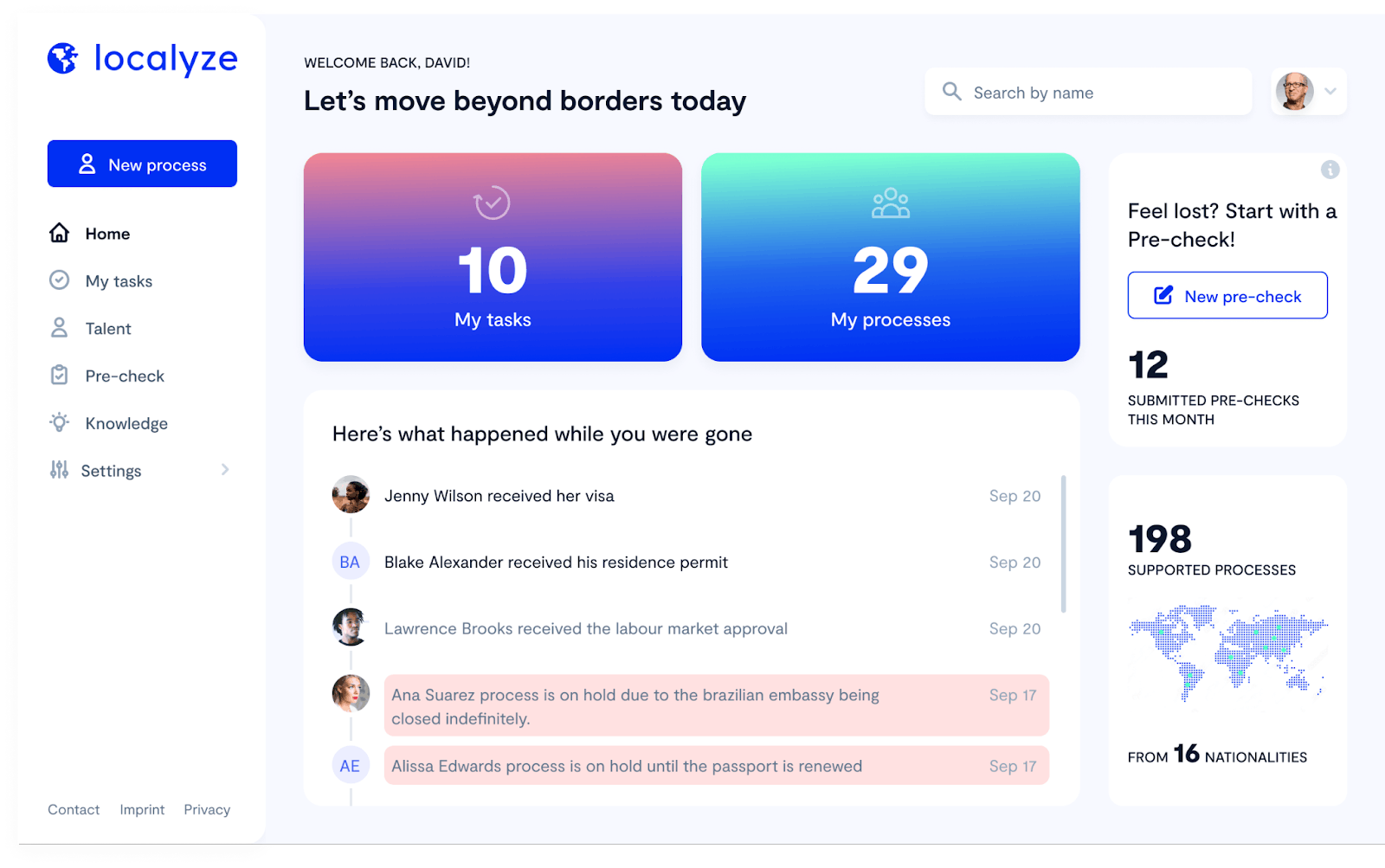
Localyze 2.0 made the case queue visible. Its dashboard surfaced “My Tasks,” active processes, recent events, and pre-check volume. A talent profile connected personal data, messages, documents, tasks, and the case timeline. The pre-check let HR ask whether a candidate appeared eligible and how long the route might take; a case manager responded within 24 hours. The knowledge center collected waiting times, country FAQs, forms, and templates.[8]
Local institutions remained part of delivery. A 2020 integration with Berlin's Business Immigration Service let Localyze submit checked applications through a preferred channel. Localyze said appointments could fall from waits exceeding three months to as little as two days.[6] The advantage came from software plus institutional access.
The product later added HRIS document sync, permit-expiry notifications, allowances, reporting, workations, and US immigration services. After the acquisition, Boundless described a combined platform spanning the Americas, Europe, and APAC, backed by legal experts and automation for document review, petition assembly, and risk analysis.[2]
Localyze first served European technology companies hiring internationally, then pursued larger multinationals. Its disclosed customers included Free Now, Trade Republic, Babbel, Thoughtworks, Tier, DeepL, Forto, Personio, Delivery Hero, and Roland Berger.[7] The buyer was an HR or global-mobility leader; the employee and family were the daily service recipients.
No observed source gives a neutral market-size estimate that maps cleanly to Localyze's revenue. The operational footprint is more useful. Before acquisition, Localyze reported more than 500 customers, over 10,000 relocations, and a 4.75 average customer-satisfaction score.[11] Those counts establish demand without revealing annual recurring revenue, repeat-case frequency, or margin.
International mobility expanded from executive assignments to employee-driven moves, temporary workations, and distributed hiring. Asmussen said 95% of relocations in Localyze's data were initiated by employees rather than employers.[4] That widened the case pool while increasing variation in trip length, destination, tax exposure, and visa route.
Localyze sat between immigration law firms and broad employment platforms. Traditional providers such as Fragomen and Vialto sold expert services. Jobbatical paired an immigration platform with in-country specialists and now claims 55-plus supported countries and 17,000 relocations.[12] Deel and Remote bundled visas with employer-of-record, payroll, and contractor management. Boundless had US consumer and business immigration software plus attorneys.
Two axes determined position: local legal depth and global account coverage. Localyze developed strong European case operations and government relationships. Broader HR platforms could cross-sell immigration from payroll, while law firms owned complex legal judgment. Localyze had to match both without letting service work overwhelm software economics.
The Boundless deal joined complementary territory. CEO Xiao Wang said the companies had worked together since 2024, referring customers between their US and European operations. Boundless said customers had been forced to manage multiple regional vendors; the acquisition replaced that patchwork with one partner.[13] Geographic complementarity was the deal logic.
Localyze was described as B2B SaaS, but its public price list shows a service-heavy transaction model. Assisted European cases ranged from €149 for a workation to €1,299 for many full relocations, with higher prices in some countries; UK and US matters carried separate legal and service fees.[10] The platform, document storage, consultations, and case support were bundled or contracted around those workflows.
This model aligned revenue with case volume and complexity. It also tied cost to people. Country specialists, case managers, partner firms, and licensed lawyers still had to review work and handle exceptions. No observed source discloses software subscription revenue, gross margin, customer retention, acquisition cost, or profitability.
Localyze raised $2 million at seed, $12 million at Series A, and $35 million at Series B.[1] The last round funded a US launch, product development, and an ambition to cover 50 markets by 2025. The acquisition price was not disclosed, so the financial outcome for investors cannot be assessed.
Localyze reported a 300% revenue increase in the first quarter of 2021, after relocation had briefly stopped during COVID-19.[7] By late 2022 it employed about 100 people across Europe and the US and had begun selling ahead of its formal US launch.[3]
The press page later reported more than 500 customers and 10,000 completed relocations.[11] Boundless's acquisition announcement did not disclose Localyze revenue, growth, or headcount. Its current FAQ says the Localyze team remains and that existing customers can now access US immigration expertise through the combined service.[14]
Closed borders were the obvious threat. Asmussen described COVID as “pretty much the worst thing that can happen to our business.”[3] Relocation stopped for roughly two months, and advisers urged Localyze to pivot. The team held its thesis, then added workations and other forms of cross-border work as employees moved without offices.
The recovery undermines a simple failure story. Localyze reported 300% first-quarter revenue growth in 2021, raised two large rounds, and reached hundreds of customers. Remote work did not eliminate borders; it created more cases in which employers needed to know whether an employee could legally work, pay tax, or access benefits elsewhere.
The deeper constraint was that immigration knowledge does not become universal after the first country. A new market brings new visa routes, forms, appointment systems, regulators, partners, languages, and licensed-practice rules. Software can reuse task engines and document flows, but the underlying content and service network must be rebuilt locally.
Localyze's Berlin integration shows the mechanism. Faster appointments came from being selected by a government service, checking applications, and maintaining a direct channel. That advantage could not be copied into another country by translating the interface.[6]
The team tried to scale in three ways. It codified case-manager knowledge, acquired TruePlan talent to improve the product, and raised $35 million to enter North America and reach 50 markets. Those moves increased product capacity and geographic ambition. Local expertise remained necessary.
Large employers wanted one accountable provider across many destinations. Regional specialists offered depth; payroll and employer-of-record platforms offered a global contract. Localyze's plan to cover 50 markets acknowledged that procurement pressure.
Boundless supplied a faster path. It already had the US legal operation, attorney network, software, and customer base that Localyze planned to build. Localyze supplied European workflows and teams. Asmussen summarized the decision: “Joining Boundless is the fastest way to achieve that mission on a global scale.”[2]
Category structure explains the acquisition better than documented collapse. Evidence of distress, profitability, or investor returns is unavailable. The sources establish a completed transaction, continued operations, and explicit demand for a single global vendor.
Localyze won by turning expert work into repeatable workflow while keeping humans in the loop. Each complex case tests that balance. Too much automation creates legal and employee risk; too much manual work limits margin and geographic speed.
Boundless now describes AI document verification, risk analysis, and petition compilation alongside attorneys and in-country experts. The combined company can spread those systems across a larger case base. It still cannot treat immigration advice as ordinary workflow automation. Policy changes, individual facts, and licensed legal judgment keep the human service layer central.