Overview
Maple sold an entire delivery experience: a short menu, food made for transport, and a predictable arrival window. It controlled ingredients, kitchens, software, and couriers. The company therefore paid for each step between buying ingredients and reaching a customer’s door.[1]
The New York meal operation closed on May 8, 2017. Its technology and some staff moved to Deliveroo. This was the end of Maple’s original food service, rather than evidence that every part of its work had become worthless. The buyer described uses for the software and kitchen expertise in Deliveroo Editions.[2]
The useful question is how a better delivery experience becomes a sustainable restaurant business. Maple had to earn enough from meals to support food, preparation, paid delivery time, and the central team. Software could improve those costs. It could not remove them.
Founding Story
Caleb Merkl met Akshay Navle through Primary Venture Partners in early 2014. They began working that June and launched publicly in April 2015. Merkl explained the operating choice plainly: “We own every single step in the process.”[1]
Will Gaybrick of Thrive helped shape the concept and technology; contemporary coverage calls him a co-founder. David Chang was an investor and chief culinary officer. WIRED also calls Chang a co-founder; other accounts emphasize his culinary role.[3][4]
Chang recruited Soa Davies, formerly of Le Bernardin, and culinary advisers including Mark Ladner, Brooks Headley, and Dan Kluger. The culinary team developed meals for delivery.[1]

Timeline
- 2014: Merkl and Navle began developing Maple. An initial $4 million funding round preceded the public service.[1][5]
- April 28, 2015: Maple launched in downtown Manhattan. Contemporary launch coverage reported a $22 million Series A after the seed round.[5]
- March 2016: Merkl described feedback from roughly 700 recipes and an ongoing effort to improve menu selection and forecasting.[6]
- December 2016: A firsthand service review described a broader Manhattan delivery area and an added surcharge. Separate reporting described heavy earlier losses.[7][8]
- May 8, 2017: Maple announced closure and a transfer of technology and selected staff to Deliveroo.[2]
What They Built
Customers chose among a small set of prepared meals. Launch prices were $12 for lunch and $15 for dinner, including tax, delivery, and tip. The menu changed, but the service aimed to reduce the work of browsing many restaurants. Kitchen preparation and delivery were designed together.[5]
The software coordinated incoming orders, preparation, grouping, and courier routes. It measured travel and handoff times, including differences between buildings. Neighborhood kitchens kept delivery areas tight. Routing therefore depended on both software decisions and the physical density of orders.[4]
Dan Cowgill built five connected staff apps for cooking, checking completed orders, packing delivery bundles, courier instructions, and kitchen oversight. Before launch, the team rehearsed with real meals and simulated orders to nearby buildings. Tests exposed physical problems, including changed oven performance and inconsistent portions. The system therefore depended on kitchen procedures as well as routing.[9]
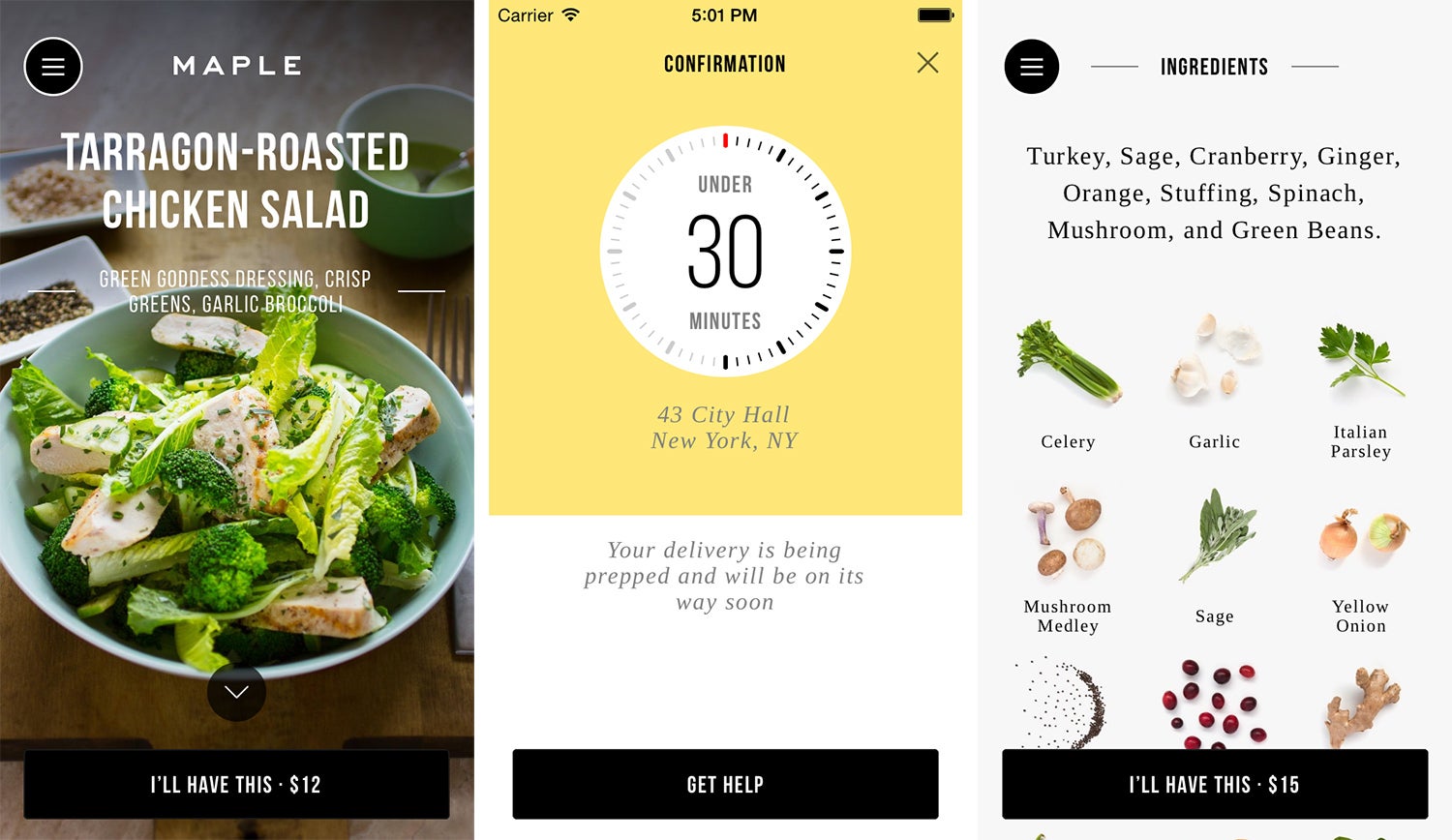
Menu data affected operations too. Customers rated meals from one to five. Merkl described learning about preferences across weekdays, ingredients, and meal types. He said the team was still “nailing the mix” and forecasting. Some menu combinations remained difficult to predict despite repeated positive ratings. This mattered because a recipe’s popularity did not directly establish how much to cook on a particular day.[6]
Market Position
Target Customers
Maple targeted people who wanted a convenient prepared meal without selecting a restaurant and navigating a long menu. Its initial Financial District area combined offices and homes. A small delivery zone reduced distance while letting the company test a complete service.[1]
Market Size
Food was a large category, but Maple’s useful market was narrower: people inside a kitchen’s service area who accepted its menu, price, and delivery windows. A citywide appetite for lunch could not establish demand at each kitchen during each service period. No independently audited local market or customer count is available in the checked material.
Competition
Seamless and Grubhub offered restaurant selection. Other startups prepared their own meals. Maple’s narrower choice and integrated operations were deliberate differences, but customers could still compare its total price with many alternatives. By late 2016, one reviewer received a vegetarian meal within the selected window, showing that the experience could work for an individual order.[7]
Business Model
Revenue came from meals. Unlike an ordering marketplace, Maple carried production and delivery costs directly. Contemporary launch reporting described substantial kitchens, equipment, delivery preparation, and investment before a wide operating footprint existed. The team compared its ambition with a restaurant chain while planning around a delivery-only format.[9]
Funding accounts vary. Launch reporting gives $4 million in seed financing followed by a $22 million Series A, or $26 million across those two reported rounds. Other coverage uses approximately $25 million or more. Those figures should not be combined into a different exact total. The transfer price and investor proceeds are not established here.[5][9]
Outcome and evolution
Fast Company summarized leaked documents reporting a $9 million operating loss on $2.7 million revenue in 2015. Inc. reported a forecast of $16 million operating loss on $40 million revenue for 2016. The second pair describes a projection, not a verified full-year result. Neither account provides audited final company accounts.[8][2]
The founders’ closure message, reproduced in contemporary reporting, said the business still faced challenges and sought a partner with greater scale. Deliveroo said Maple’s technology and kitchen expertise would support Editions, its restaurant kitchen platform. That statement establishes the intended use at the time; it does not prove a particular later financial return.[2]
Maple’s history therefore supports a bounded conclusion. A distinctive product and useful operating software coexisted with an unsustainable original service. The checked record does not isolate one cause, establish final margins by kitchen, or show that lower worker compensation would have made the company viable.
Key Lessons
- Measure a complete service period. Food cost per meal excludes idle preparation and delivery time. Include those costs before adding another kitchen.
- Forecasts need their own label. Planned revenue cannot explain an observed loss as if both figures came from completed operations.
- Limit operational experiments. A new menu, service area, and delivery promise each change costs. Change them separately when learning which one works.
- Preserve useful work during closure. The transfer shows that operational knowledge can retain value even when the original customer service ends.
Sources
- Restaurant Girl — Q&A with Caleb Merkl, August 21, 2015
- Inc. — Closure and Deliveroo transfer, May 2017
- Restaurant Business — Maple’s operating model, 2015
- WIRED — Launch, routing, and founder roles, April 28, 2015
- Food Republic — Launch interview and funding
- Fast Company — Menu data and forecasting, March 22, 2016
- TIME — Firsthand service review, December 22, 2016
- Fast Company — Shutdown and reported 2015 accounts, May 8, 2017
- Fast Company — Behind the scenes at launch, April 28, 2015