Overview
Mashable grew from Pete Cashmore's technology blog into a publisher, video producer, and software licensor. Its 2017 sale shows the risk of expanding production commitments while audience growth and business value move at different speeds. Cashmore could point to growing distributed video views and a profitable Snapchat operation. Those gains did not establish that every new format or the whole company could support its costs. [1]
Ziff Davis bought Mashable in late 2017. Contemporary reporting put the price near $50 million, below a reported $250 million valuation in 2016. The buyer's announcement confirms completion but does not disclose individual terms. Mashable continues as a Ziff Davis brand, so this is a history of a disappointing independent-company exit and subsequent operation. [2][3][4]
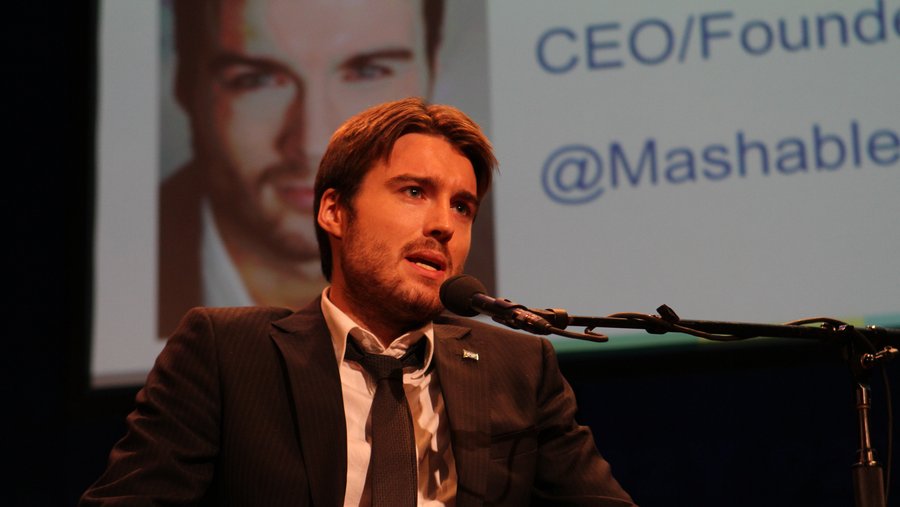
Image 1 / 1
Founding Story
Cashmore started Mashable in 2005 at 19, living with his parents in Banchory, Scotland. In a 2012 Inc. interview, he explained how reading technology blogs became an education while he recovered from illness. He then wrote for an American news cycle from Scotland, describing long nights and limited sleep. An early audience could be reached without a newsroom's traditional location or infrastructure. [5]
Cashmore told Inc., “I would look at the stats everyday”. He also recalled not meeting a reader until a 2008 San Francisco event, despite seeing a large audience in his analytics. Traffic gave a solitary founder feedback, but a rising number did not explain every reader's relationship with the publication. [5]
In a separate Entrepreneur interview, Cashmore said, “I wasn’t in [Silicon] Valley.” The company began with the practical job of explaining technology to a mainstream audience. Its later expansion into broader culture and entertainment extended that audience logic while introducing different production and sales requirements. [6]
Timeline
- 2005: Cashmore founded Mashable in Scotland. [5]
- October 2014: Mashable announced a year-long Velocity licensing agreement with media agency MEC. [7]
- September 2015: Comcast included Mashable among Watchable's launch partners. [8]
- March 2016: Mashable announced a $15 million Series C led by Turner and a strategic collaboration. [9]
- 2017: The company pursued premium video, then sold to Ziff Davis and reduced parts of its production operation. [1][10]
- October 2026 review: Ziff Davis continues to list Mashable as an operating global media brand. [4]
What They Built
Mashable's central product was editorial coverage of technology and digital culture. Distribution extended beyond its website into social platforms and video channels. This gave readers different ways to encounter the brand, while requiring content that fit each destination.
The company also built Velocity, a tool for identifying stories gaining attention online. Its 2014 MEC announcement describes collecting engagement data and forecasting which content might spread. A year-long license gave an external agency access to technology developed for the newsroom. That was a separate commercial product, with different customers from readers and advertisers. [7]
Mashable Studios broadened the offering again. The 2016 financing announcement describes serialized programming and branded entertainment for websites, social networks, television partners, and streaming services. Turner proposed joint programming, distribution, and advertising sales. Its investment therefore brought capital and a potential buyer or distributor into the same relationship. [9]
Comcast's Watchable launch confirms a further distribution channel. It included Mashable among roughly 30 digital partners, with viewing through mobile, web, and television. Such arrangements could add reach without giving Mashable control over the platform's economics. [8]
Market Position
Target Customers
Readers wanted explanations and entertainment around digital life. Advertisers wanted access to that audience. Agencies could buy analytics, while broadcasters and platforms could buy shows. These groups offered several revenue paths, but demand from one did not establish demand from the others.
Market Size
No independently reconciled addressable-market estimate was established. Audience counts, views, and commissioned shows describe different markets and units. Adding them would produce a larger number without a useful business denominator.
Competition
Mashable competed with other publishers for attention and with production companies for commissions. Social platforms could distribute its content while setting the terms of discovery and monetization. In March 2017, Cashmore told Digiday that platform owners were building their own businesses, whose needs might or might not coincide with Mashable's. That qualification matters more than assuming distribution partnerships always improve publisher economics. [1]
The company also faced a scope problem. A short editorial article, an agency software license, a daily Snapchat channel, and a longer video series require different work. Shared brand recognition can help sell them; it does not make their costs interchangeable.
Business Model
Mashable pursued advertising, branded content, commissioned programming, and software licensing. The 2016 release reported branded-content revenue growth of 69% year over year and named Golin, MEC, and Wunderman as Velocity licensees. These were company claims about particular revenue lines, with no absolute profit figures supplied. [9]
The reported acquisition price and prior funding valuation should remain separate measures. Their difference does not establish a particular investor's realized loss. The reviewed sources do not reveal the preference terms, debt, full purchase consideration, or distribution to each security holder.
Traction
Mashable's 2016 financing announcement claimed 45 million monthly unique visitors and 28 million social followers. In March 2017, Cashmore reported two billion monthly video views across distributed platforms. He described Snapchat as profitable. These claims support genuine distribution and some successful commercial activity, while leaving the whole-company result unresolved. [9][1]
The current parent brand page reports 18 million global monthly average unique visitors using FY2025 measurement sources. Its scope and method differ from earlier company claims. The figures cannot support a clean percentage decline calculation. [4]
Outcome and evolution
The strongest supported explanation is uneven economics across an expanding set of products. In March 2017, Cashmore said, “display [advertising] is iffy”. The company sought more valuable audiences and premium programming. Those were deliberate attempts to improve its business, rather than proof that management ignored monetization. [1]
After the sale, Digiday reported 13 cuts within a nearly 50-person Studios division, including its Los Angeles creative-development team. It also reported that Snapchat and YouTube operations would continue. The buyer's response was selective. It reduced some production ambitions while preserving formats and editorial work it valued. This weighs against explaining the outcome as a failure of all video. [10]
The interpretation has limits. No audited standalone series of production margins or partner contract values was established. Platform dependence and scope explain possible fragility, but the evidence cannot assign each cost a share of the sale-price change.
Mashable continues under Ziff Davis. A 2026 StackCommerce case study describes commerce work involving Mashable and PCMag. It is vendor marketing, not an audited Mashable profit statement. Still, it documents that the sequel includes commerce partnerships, rather than an absent publication waiting to be recreated. [11]
Key Lessons
- Cashmore used a narrow editorial interest to reach readers from outside the usual media centers. The company later faced different economics as its formats expanded.
- Velocity created a licensing path from an internal tool. Its existence did not establish that software licensing could fund the wider publisher.
- Turner's investment joined financing, distribution, and production ambitions. Each needed its own commercial test.
- Snapchat's reported profit and later preservation challenge a blanket video-failure story. Teams should measure each format's contribution before expanding overhead.
- An acquisition can preserve a publication while disappointing earlier valuation expectations. Current operations and original investor outcomes need separate evidence.
Sources
- Cashmore's March 2017 Digiday interview
- Reported completed sale and valuation
- Buyer's acquisition-completion announcement
- Current Ziff Davis Mashable brand page
- Inc. founder interview transcript
- Entrepreneur founder interview
- MEC Velocity licensing announcement
- Comcast Watchable launch
- Turner investment and partnership announcement
- Selective production cuts after the sale
- 2026 StackCommerce case study