Overview
Mithril Medicine used Claude to help one founder coordinate a biotech research program. Paid specialists and outside laboratories supplied the scientific expertise and experiments. Anthropic acquired the company in July 2026 and disclosed the purchase on October 27. Its research programs continue inside Anthropic.[1]
The useful lesson is about organizational design. Reducing the work between experiments can let a small team pursue more research. Whether that produces better medicines remains an open question.
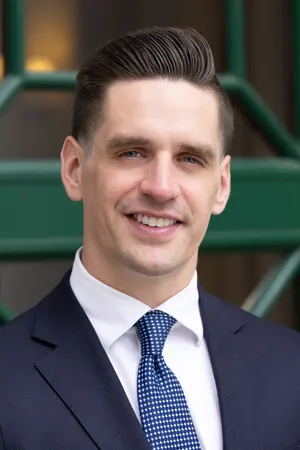
Image 1 / 1
A founder with an existing biotech network
Harvard identified Cody Tranbarger as Mithril's founder and acting CEO in July 2025. He had completed its joint MS/MBA program and was an entrepreneur-in-residence at Atlas Venture. Earlier roles at Prime Medicine and Casdin Capital gave him experience across biotech operations and investing. Harvard also identified him as co-founder of Revision Bio, a separate company developing gene-writing technology.[2]
Mithril's operating model began with a founder who could draw on specialist knowledge and professional relationships. Its small headcount does not establish that an inexperienced operator could reproduce the work.
Tranbarger's published account credits Atlas Venture with a small seed investment. The amount was not disclosed. Acquisition reporting also leaves the purchase price undisclosed, so neither investor returns nor the cost of reaching the mouse results can be calculated.[3]
The product was an experimental medicine
Mithril developed antibody therapies for LAMA2-related congenital muscular dystrophy and alpha-dystroglycanopathy. These are rare genetic muscle diseases. Its first published technical report examines antibodies designed to reconnect muscle cells with surrounding support tissue.[4]
An antibody that binds two different targets can form a molecular bridge. Mithril tested that approach in cells and mice. This was a drug-development program; the public record does not establish a commercial software product, paying customers, or product revenue.
One treated mouse group showed roughly twice the grip strength and peak triceps force of controls. The experiment was small, treatment was assigned by litter without randomization, and treated animals were tested months after controls. The authors call for concurrent, blinded replication. The October 26 technical report is not peer reviewed.[4]
What the small team still needed
R&D World reports that Tranbarger directed eight paid consultants and advisers and worked with 11 outside laboratories. Those laboratories produced antibodies and performed measurements, cell assays, and animal studies. The full-time employee count leaves out much of the labor required to carry out the research.[5]
Claude helped read program records, calculate material requirements, and draft correspondence. In the technical report's selected example week, people reviewed and sent the emails; Claude sent none. The team also recorded errors that survived editing and reached outside labs.[4]
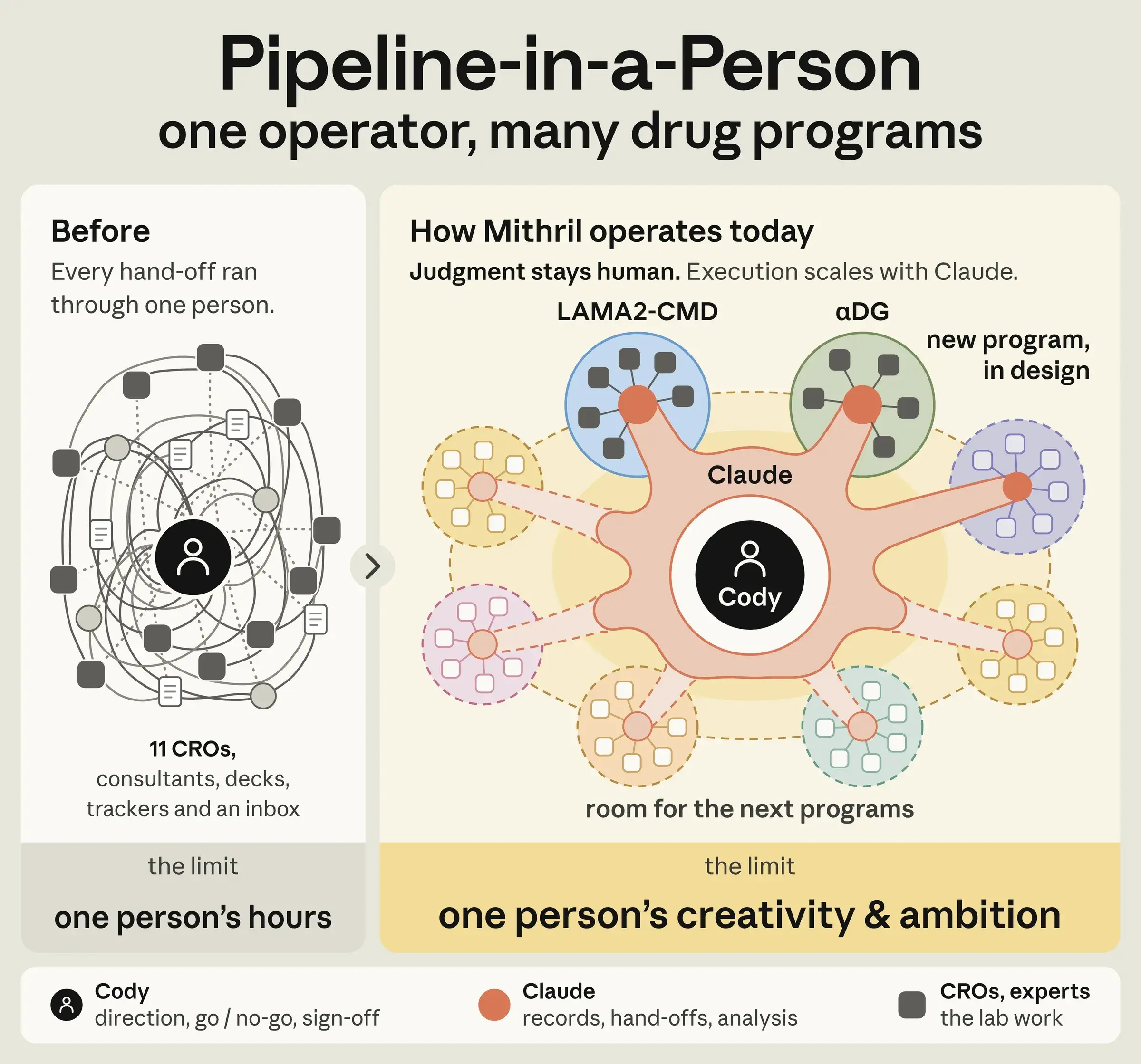
The likely advantage was less effort spent reconciling handoffs and documents. The remaining constraint was whether a human could detect incorrect premises across those documents. Reviewing an email's conclusion does not guarantee that its quantities, assumptions, and experimental instructions are correct.
Outcome and evolution
Mithril's two research programs became Anthropic's first internal drug-development programs. Tranbarger continued the work after joining the acquirer. Global Genes describes the acquisition as a test of whether one scientist working with AI can direct multiple programs.[6]
Anthropic targets drug-candidate selection in 2027 and possible human trials from late 2028 for LAMA2-CMD and 2029 for alpha-dystroglycanopathy. These are conditional research targets, not demonstrated clinical outcomes. Anthropic also sells Claude, so its account of the operating model carries a commercial interest.[1]
Claude Science already offers a general research workbench. A proposed software business around this workflow would need to establish what customers require beyond that existing product.[7] There is not enough public evidence here to recommend a differentiated rebuild or estimate its economics.
Timeline
- July 2025: Harvard names Tranbarger as Mithril's founder and acting CEO.[2]
- July 2026: Anthropic acquires Mithril.[4]
- October 26, 2026: The technical report is dated.[4]
- October 27, 2026: Anthropic publicly describes the acquisition and continuing programs.[1]