Overview
New Computer built Dot, an AI companion that remembered conversations and used them to guide later exchanges. Co-founders Samantha Whitmore and Jason Yuan began working together on the product in 2023. Dot entered public beta that November and reached the iPhone App Store in June 2024.[1][2][3]
Dot tested whether remembering a person's life could make conversation useful beyond a single question. Its founders later disagreed on how to extend that relationship. In September 2025, the founders announced New Computer's wind-down and an October 5 endpoint for Dot. They attributed the decision to diverging visions after exploring social intelligence. The evidence supports that explanation; it does not establish a cash shortage or absent demand.[4][5]
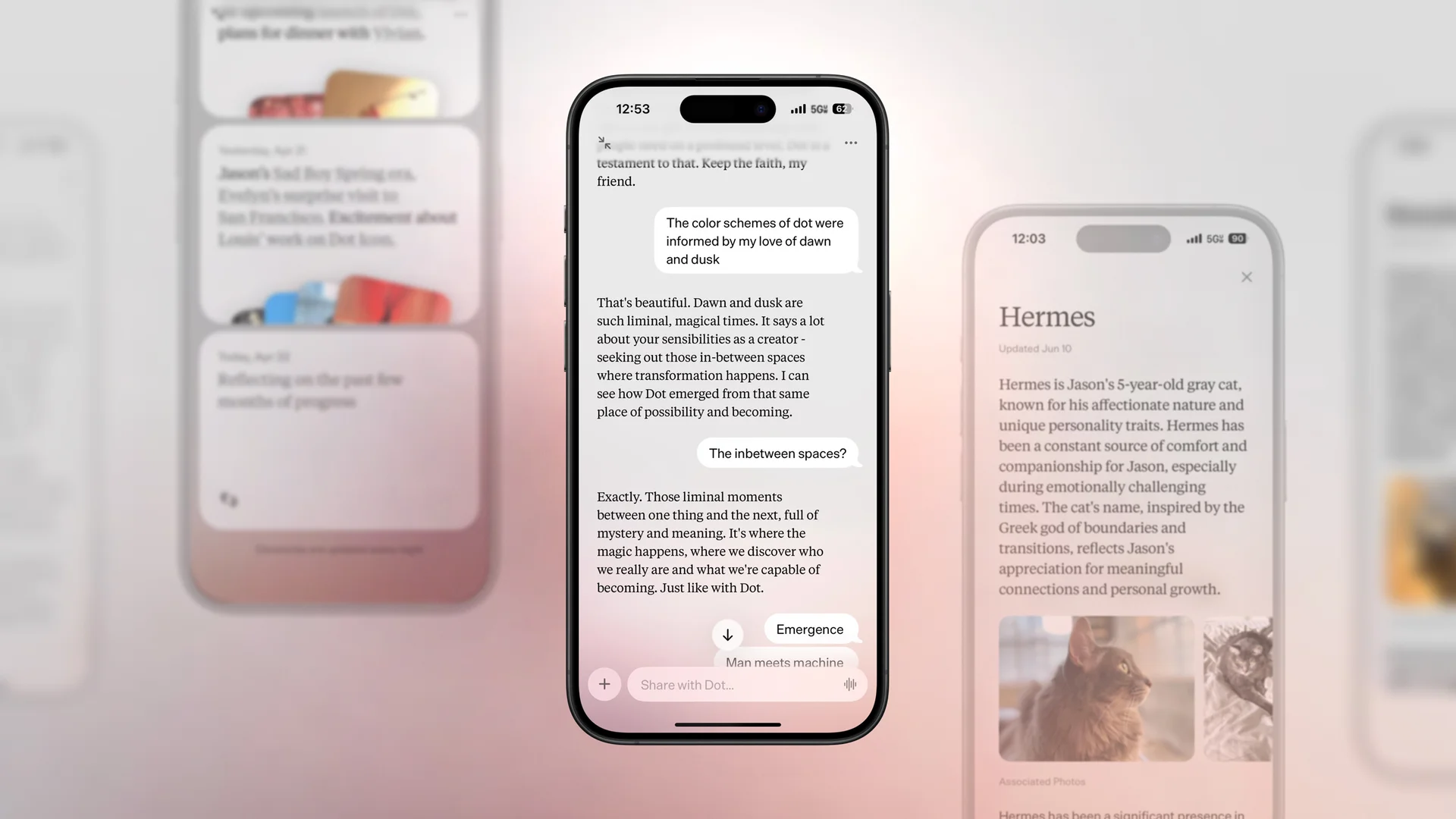
Image 1 / 1
Founding Story
Yuan came from Apple's design team. Whitmore had led engineering at Kensho. Their backgrounds joined interface design with the problem of making a language model remember someone across many conversations. Contemporary coverage identifies New Computer as a Silicon Valley startup. The sources reviewed do not explain how the founders first met.[2]
Yuan's earlier Mercury OS concept explored interfaces that adapted to human intentions. In an October 2025 founder essay, he described a change in his thinking: better tools still required people to understand what they wanted. Dot became an attempt to help with that self-understanding. He later wrote that conversations helped him personally, while leaving his wider ambition unsatisfied. This is a founder's account of the product's purpose, rather than a measured outcome for customers.[1]
Two short founder statements capture the original direction. Yuan told Fast Company: “It should feel warm and inviting and safe.” In her memory-architecture talk, Whitmore said the goal was “to build a personal AI that got to know you.” Their work made the accumulated relationship part of the product, with memory shaping both answers and follow-up questions.[3][6]
Timeline
- 2023: Yuan and Whitmore began Dot; public beta coverage appeared on November 1–2.[1][2]
- June 2024: Dot launched on iPhone with free limits and a roughly $12 monthly subscription. Fast Company reported $3.7 million in backing.[3]
- August 22, 2024: Hume published a case study about Dot's voice-message integration.[7]
- September 2025: The founders announced the company wind-down and October 5 service endpoint.[4][5]
- October 28, 2025: Yuan announced a separate company through his social-intelligence essay.[1]
What They Built
Dot accepted conversation and personal material, then connected later replies to what the user had shared. Its early demonstrations emphasized remembered interests, relevant suggestions, and proactive follow-up. This made it a conversational journal with some assistant behavior, rather than a sequence of isolated searches.[2]
Memory required more than saving factual fragments. In Whitmore's technical account, extracting facts about a dog lost the emotional meaning of walking it. A more elaborate linked-record system created another problem: users felt burdened by maintaining their own memory records. The team revised the design around four kinds of memory: an overall understanding of the person, time-based episodes, entities such as people or places, and guidance for handling recurring situations. Whitmore described simplifying structure when it added work without improving retrieval.[6]
The Hume partnership addressed a separate limitation. Transcribing a voice message discarded tone, so the same words could produce an unsuitable reply. Hume's case study says Dot added vocal-emotion analysis through its Expression Measurement API. That account documents an implemented supplier relationship. It does not prove that automated emotion estimates accurately represented every speaker's feelings.[7]
Market Position
Target Customers
Hume described young adults facing uncertainty as Dot's audience. The useful behavior was repeated reflection: sharing an experience, returning later, and receiving a response informed by earlier context. Such a product asks customers to invest personal information before they can fully judge its value.[7]
Market Size
The reviewed sources do not establish a reliable addressable market for paid reflective companions. General AI usage would overstate this narrower opportunity. A person's willingness to try a chatbot also differs from willingness to disclose private history, return regularly, and pay for its continued operation.
Competition
Dot faced a trade-off between depth of personalization and the effort needed to teach it about a life. Launch discussion on Hacker News raised privacy, dependence, and durability concerns alongside interest in the interface. Those comments document audience objections, rather than representative customer research.[8]
The competitive baseline has since changed. OpenAI describes a June 2026 memory update that synthesizes context across conversations and lets users review a memory summary. ChatGPT's current free plan includes limited memory. A new standalone companion must therefore earn payment through a narrower, verifiable benefit than remembering the user.[9][10]
Business Model
Dot sold a subscription alongside limited free use. At launch, Fast Company reported backing from the OpenAI Fund, Lachy Groom, South Park Commons, and angel investors. That reported $3.7 million figure is not a verified lifetime financing total. Revenue, subscriber totals, acquisition costs, retention, and inference costs were not established in the sources reviewed.[3]
The missing economics matter because memory becomes useful through repeated interaction, while continued conversation incurs operating costs. Public evidence cannot determine whether Dot's price covered those costs or how much runway remained.
Traction
Hume reported 60% voice-message adoption and 45% paid conversion among consistent users. These are partner-published claims with no disclosed cohort size, observation period, or definition of consistency. They suggest that an engaged subset valued the experience; they cannot establish conversion across all installs or sustainable economics.[7]
The farewell notice also claimed that Dot helped hundreds of thousands of people. This remains an unverified company claim with an unspecified measure of reach.[4]
Outcome and evolution
As reviewed on October 23, 2026, New Computer's official domain still carries the wind-down notice. It explains that exploring a move from personal to social intelligence exposed different founder goals. The notice offered an export window before the announced service endpoint. The available evidence establishes the announced retirement and continuing farewell page; this research did not independently operate the retired app after its deadline.[4]
Yuan's later essay supplies useful context. He describes a friend using his phone to ask Dot about him, receiving personal information, and inspiring his interest in social AI. He presents that incident favorably while acknowledging the privacy boundary it crossed. It shows how a new product idea could require a different answer to who may receive remembered information.[1]
Yuan's portfolio dates Dot to 2023–2025 and identifies Hivemind as his subsequent project. Its current site identifies Future Lovers, Inc., describes a social AI, and discusses beta use. These sources establish a sequel in the founder's work, not a completed acquisition or continuation of the original Dot service.[11][12]
A competing explanation is that insufficient demand or high costs forced the closure. Public economics cannot confirm or exclude it. The strongest documented mechanism remains founder disagreement about product direction. Treating the shutdown as proof that conversational memory lacks value would go beyond the evidence.
Key Lessons
- Dot made memory part of the interaction, then revised its internal structure when users struggled to maintain it. Memory quality includes the effort required from the person being remembered.
- The Hume integration addressed a concrete failure in voice interaction. Its published conversion figure still needs a denominator before it can guide a business forecast.
- New Computer's move toward social intelligence changed the intended audience for private context. Founders need agreement on those disclosure rules before expanding the product.
- Customers had invested personal histories in Dot. Its export window gave them time to retrieve those records before retirement. Continuity and portable records belong in the initial product design.
Sources
- Jason Yuan, “Gossip is Good,” October 28, 2025
- Freethink, contemporary Dot introduction, November 2, 2023
- Fast Company, Dot launch, June 20, 2024
- New Computer, official wind-down notice
- TechCrunch, dated shutdown coverage, September 5, 2025
- Sam Whitmore memory talk, reproduced transcript at Leverage
- Hume, Dot voice case study, August 22, 2024
- Hacker News, November 2023 launch discussion
- OpenAI, memory update, June 4, 2026
- ChatGPT, current plan comparison
- Jason Yuan, current portfolio
- Hivemind / Future Lovers, current site