Overview
Pear Therapeutics developed software prescribed to treat specific conditions. Its products included reSET for certain substance-use patients, reSET-O for use alongside outpatient opioid-use treatment, and Somryst for chronic insomnia. Each had a defined regulatory pathway and intended use. They were not interchangeable wellness apps. FDA reSET review, reSET-O record, Somryst record
The company’s June 2021 investor presentation reported more than $250 million raised before its proposed public-market transaction. In April 2023, Pear and its US subsidiary filed Chapter 11. A subsequent auction split assets among several buyers. Some treatments continued under new owners, while the original independent business ended. Investor presentation, Bankruptcy filing, Auction report
Founding Story
Founder Corey McCann trained as a physician-scientist, worked in healthcare consulting, and then invested in life sciences. In a 2021 interview, he said the operating company incorporated in 2013. He saw an opportunity to develop therapeutic software using a regulated product model. Founder interview
McCann described the category as “software to treat human disease.” His ambition included an organization that could discover, develop, and commercialize multiple products. He also recognized a commercial dependency, saying “we need a federal benefit type for prescription digital therapeutics.” Both quotations predate the bankruptcy and describe what he was trying to build. Original transcript
The legal structure changed when the operating company combined with Thimble Point in December 2021. The public parent took the Pear name, while the legacy operating company survived as its subsidiary. The 2013 founding date describes that operating history. Annual filing
Timeline
- 2013: The operating company incorporated, according to McCann. Founder interview
- September 2017: FDA granted reSET’s De Novo request, establishing its device classification. FDA record
- December 2018: FDA cleared reSET-O through the 510(k) pathway. FDA database
- March 2020: FDA cleared Somryst. FDA database
- December 2021: Pear completed its public-company business combination. Annual filing
- April 2023: Pear filed Chapter 11 and sharply reduced its workforce. SEC filing
- May 2023: Asset-auction results identified four buyers. Auction report
- December 2023: PursueCare announced its acquisition of reSET and reSET-O. Buyer announcement
- October 2024: PursueCare announced the treatments’ rollout within its care offering. Relaunch release
What They Built
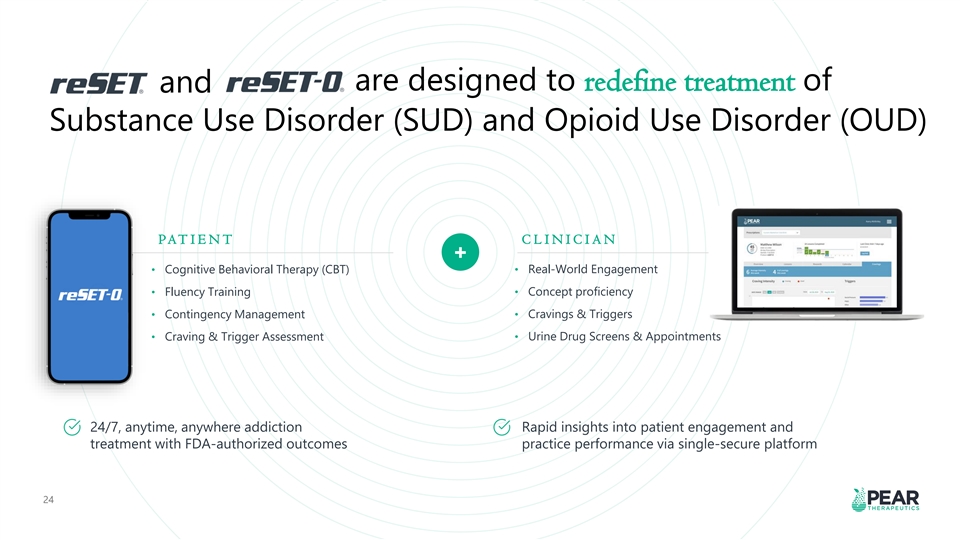
reSET provided cognitive behavioral therapy alongside clinician-supervised outpatient treatment and contingency management. Its authorization had specific population limits. reSET-O addressed retention in opioid-use treatment alongside buprenorphine and contingency management. The prescription and clinician relationship were part of the product’s intended use. FDA reSET summary, Current product indications
Somryst targeted a different condition: chronic insomnia. FDA’s database records its March 23, 2020 clearance as a computerized behavioral therapy device for insomnia. Its clinical documentation describes a structured software treatment, rather than a general sleep tracker. The date on a later clearance-letter copy should not replace the database’s original decision date. FDA database, FDA summary
McCann described a path from clinician encounter to prescription, access support, and dispensing. Each handoff could affect whether treatment reached the patient. Founder interview
Market Position
Target Customers
The user, prescriber, and payer were different participants. Patients used treatment software; clinicians decided whether it fit their care; insurers or contracting organizations determined payment. A useful commercial proposition had to work across that chain. Current PursueCare materials still start with a consultation and describe the products within a broader treatment service. Current treatment pathway
Market Size
Pear’s presentation described a large potential market and a broad product pipeline. Those estimates were investor projections. A population with a condition did not automatically become an eligible, prescribed, fulfilled, and paid treatment course. The company’s later operating measures show why those stages needed separate attention. 2021 presentation
Competition
The practical alternatives included clinician-delivered behavioral treatment and other care pathways. Digital products also had to fit a clinic’s existing workflow. The successor model illustrates one response: PursueCare now combines the acquired applications with its virtual addiction-care offering and access support. That is a different commercial setting from selling a standalone treatment platform. Buyer release, Provider support
Business Model
Pear sought payment for prescription software and broader access arrangements. Its 2022 filing describes agreements with providers, payers, and governments, including discounts and some value-based rebates. Large agreements could make quarterly revenue uneven. Regulatory authorization established a product’s permitted use, while contracting and payment remained separate commercial jobs. Annual filing
The same filing reported $12.694 million in 2022 total revenue and $136.044 million in total costs and operating expenses. These are accounting measures for that year, not a measure of investor losses or cash burn. The business needed more financing or a strategic transaction. Financial statements
Traction
Pear reported more than 45,000 Total Prescriptions in 2022, a 53% fulfillment rate, and a 41% payment rate. Total Prescriptions combined revenue-imputed prescriptions under Access Agreements with other written prescriptions. Fulfillment counted either therapy commencement or a contractual payment obligation with recognized revenue. Payment rate used fulfilled prescriptions as its denominator. These definitions prevent reading the figures as individually written prescriptions, completed treatment courses, or a single conversion rate. Defined operating metrics
Outcome and evolution
Pear’s April 2023 filing records voluntary Chapter 11 cases for the public company and Pear Therapeutics (US). It also records the termination of approximately 170 employees, leaving a small transition team. The planned path was a competitive sale of the business or assets. SEC bankruptcy filing
The auction produced reported winning bids totaling $6.05 million across four buyers. Nox’s $3.9 million bid covered Somryst-related assets. Harvest BIO’s package included reSET, reSET-O, and other assets, while Click and Welt bought other packages. These were asset bids, not the enterprise value of a continuing Pear business or a complete shareholder-recovery calculation. Auction account
Nox confirmed its completed Somryst acquisition. PursueCare later announced reSET and reSET-O acquisitions and their relaunch. Its current site offers clinician-led access, while Nox maintains Somryst documentation and a privacy notice updated in January 2026. Continued product stewardship does not establish that every former patient retained uninterrupted access. Nox announcement, PursueCare rollout, Nox notice
Payment policy also evolved. CMS’s January 2026 material describes codes for digital mental-health devices and related management, with defined conditions. The existence of a code does not establish coverage for a particular patient, product, or claim. CMS guidance
Key Lessons
- Validate every access step. A prescription, fulfillment, and payment were separate milestones with different denominators.
- Budget for commercialization. Authorized software still required clinician adoption, contracting, support, and reliable payment.
- Keep intended use specific. Evidence and authorization for one condition did not establish suitability for another.
- Plan continuity at product level. Different buyers continued individual treatments after the original business failed.
Sources
The record prioritizes FDA decisions, SEC filings, original buyer announcements, and a named-founder transcript. Auction bids remain attributed to reporting because the linked court filing was inaccessible. It leaves individual recoveries and uninterrupted patient access unresolved.