
PlanGrid
Winter 2012AcquiredMobile applications for the construction industry.
Pressure-test this opportunity
Explore the risks and possibilities with a prompt for ChatGPT, Claude, or your agent.
Mobile applications for the construction industry.
Explore the risks and possibilities with a prompt for ChatGPT, Claude, or your agent.
PlanGrid made construction drawings usable where buildings were being built. Founded in 2011 and accepted into Y Combinator's Winter 2012 batch, it replaced cumbersome paper sets with a mobile workflow for finding drawings, distributing revisions and recording field work. Autodesk acquired the company in December 2018 for an announced $875 million net of cash.[1][2]
Its outcome was a strategic acquisition followed by product integration. The field workflow continued shipping and became part of Autodesk Build. As of October 2026, Autodesk directs new PlanGrid buyers to Forma Build, while providing legacy login and support. The lesson is how a precise field problem became a larger workflow business, and why integration can preserve that capability while changing its commercial identity.
Tracy Young and Ryan Sutton-Gee studied construction management at Sacramento State and worked as construction engineers. They understood a costly coordination problem: a drawing could look authoritative while being obsolete. Young identified the danger of “accidentally building off outdated drawings” in a 2014 founder interview.[3]
Their software cofounders were Ralph Gootee, Antoine Hersen and Kenneth Stone. Gootee was a rendering engineer at Pixar; Hersen worked in high-frequency trading and recruited Stone. Hersen died of cancer in January 2012, after the team's acceptance into YC. This was a company built by friends combining construction knowledge with software engineering, under difficult personal circumstances.

The iPad supplied a new interface, but handling drawings still required engineering. Young later recalled that their large blueprint images exhausted a first-generation iPad's memory. Her construction contacts and university network supplied the first 20 users, whom she called for feedback. The team tested the product with people doing the work before building a sales organization.[4]
The first product made a construction drawing set portable and easier to update. Crews could view drawings, add notes and amendments, and share changes through the cloud. In April 2012, Macworld reported DPR Construction testing PlanGrid on four projects, with iPads distributed to supervisors and foremen. Young described the paper expense bluntly: “We were outraged at how much blueprints cost.” The cited $3,500 per $1 million of construction was her estimate, not a measured saving guaranteed by the software.
This product addressed the handoff between office information and field action. It reduced the work of distributing physical revisions, but still depended on people publishing the right information and keeping devices current. That distinction matters: easier access to a drawing does not certify its correctness.
PlanGrid expanded into specifications, photos, requests for information, field reports, punch lists and tasks. A punch list records work that still needs correction or completion. The May 2020 release shows continued development after acquisition: report contributors could edit in parallel, RFIs could be created from the sheet viewer, and published interfaces connected RFI and submittal data to other applications. Its Smartsheet example synchronized submittal updates, illustrating how the drawing workflow grew into coordinated records.

Autodesk Build's 2021 launch extended the combined field workflow into project management, quality, safety, cost and closeout. The later Forma name should not obscure that earlier sequence. Autodesk's current PlanGrid page still provides web login and support, and directs mobile users to the Autodesk Forma app.

Current transition documentation describes an import stage followed by transition into an active project. It includes summary reports, history, item counts and exceptions, including a partially imported status. It is therefore more than a file-copy button. Separately, Autodesk's Bridge documentation provides a PlanGrid as-built import route.[14][15]
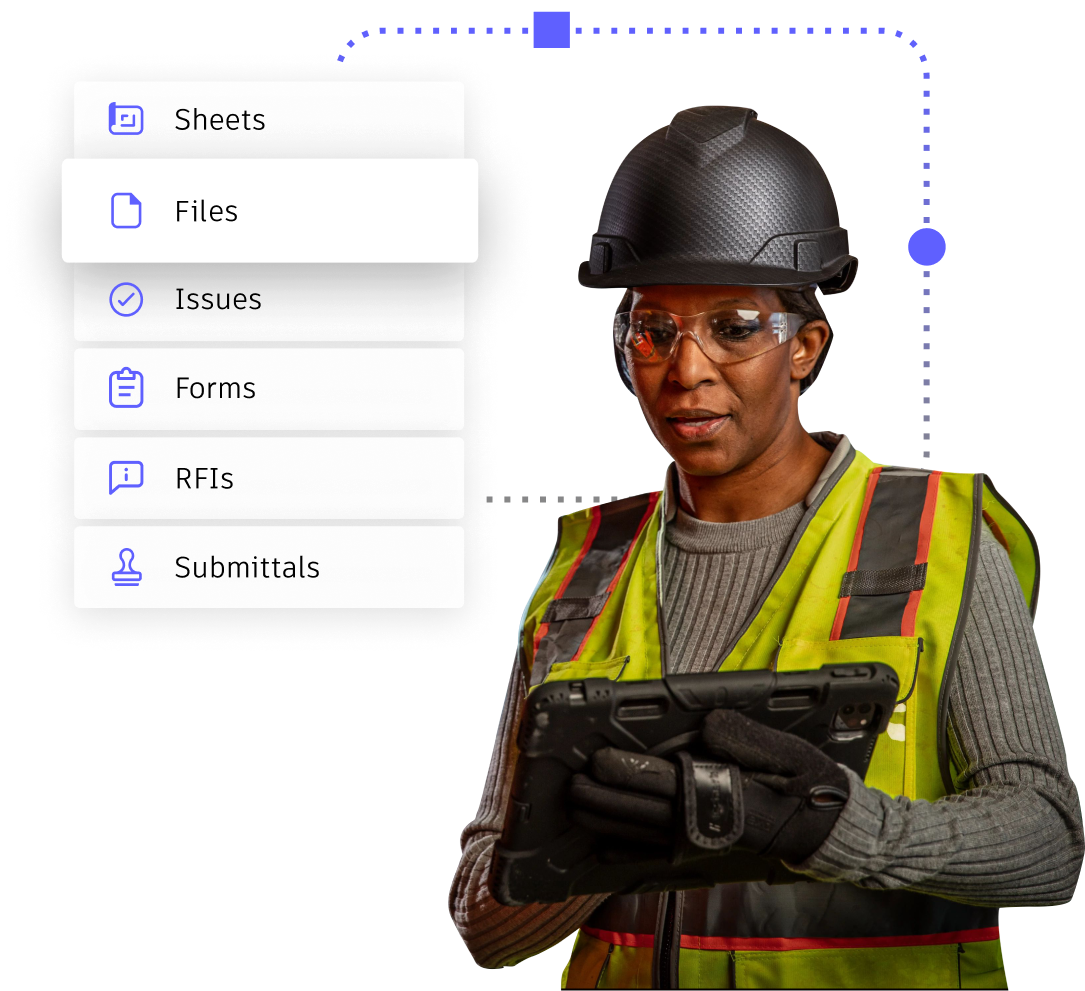
PlanGrid's early advantage was field usability informed by construction experience. It did not invent construction software or remove the need for office systems. It gave the people executing work a more useful interface to project information.
The present category is well served. Procore's drawing product manages revisions and offers mobile access, including offline use. Bluebeam's current offering includes PDF markup, document workflows and collaboration across desktop, web and mobile. Forma Build spans a broader construction-management workflow. Their overlap leaves a new entrant needing a specific job that the existing products serve poorly.
Autodesk's acquisition announcement specified integration with Revit and BIM 360. This supplies the strategic mechanism: PlanGrid brought a field-facing workflow to a buyer already connecting design and construction. Axios reported that PlanGrid was considering another funding round when Autodesk approached.[16] That account supports a strategic-sale interpretation, without establishing what a further independent round would have achieved.
PlanGrid sold subscriptions to construction organizations and individual users. Current legacy support documentation still distinguishes invited and existing users, who may buy individual plans after being invited by an established customer. Its published prices are $39, $59 and $119 per month when billed annually for Nailgun, Dozer and Crane, versus $49, $69 and $139 with monthly billing. Sheet capacities are 550, 5,000 and unlimited. These are eligible legacy-user prices, not a net-new PlanGrid offer or Forma Build pricing.[17]
The 2015 company releases establish $18 million and $40 million rounds. YC's company profile reports more than $69 million total funding. No complete cap table, margin, burn, churn or comparable paid-seat history was established.
Two acquisition measures deserve separate labels:
| Measure | Amount | Meaning |
|---|---|---|
| Announced transaction value | $875 million net of cash | Autodesk's purchase announcement |
| Acquisition-date fair value of consideration | $777.6 million | Accounting measure in Autodesk's annual report |
Autodesk's fiscal-2020 annual report describes the accounting consideration as $772.4 million cash plus $5.2 million of assumed equity awards for pre-combination services. Its purchase-price allocation also records a later measurement-period adjustment. These figures should not be added to the headline or treated as a simple contradiction.[18]
The acquisition-close release forecast approximately $100 million of fiscal-2020 ARR contribution. This was a forward-looking annual recurring revenue measure, not realized annual revenue or disclosed standalone profit.
The May 2015 company release reported more than 10,000 customers, 200,000 projects and 20 million blueprints, including customers such as Structure Tone and Sutter Health. The November release reported 300,000 projects and 30 million construction documents. By the acquisition close, Autodesk reported more than one million projects in 90 countries. YC's profile retains an 84-country figure and more than 100 million blueprints; those undated profile totals should not replace the dated acquisition account.
These are reported scale measures, not active-user counts or audited product economics. They demonstrate reach across projects, while leaving retention, current usage and rework savings unresolved. The causal value of the customer evidence is narrower: field teams had reason to use tablets for current drawings, and the product could expand into adjacent records they already handled.
The acquisition rewarded a workflow that had grown from a specific field problem. Autodesk's stated plan connected PlanGrid to design and construction systems; subsequent releases and the 2021 Build launch show that integration actually continued. The standalone product stopped taking net-new buyers, but its core work survived within a larger offering.
The current sequel is Forma Build. Autodesk's March 2026 release history records the rebrand; its September release notes, updated October 1, describe further transition and handover capabilities.[19] A later brand change is not evidence of an acquisition-day shutdown. No sourced deadline for final PlanGrid support or mandatory migration was established.
Young said that she and Gootee left Autodesk in March 2020, then served as visiting YC partners and built TigerEye. In her subsequent YC interview, she described cultural and decision-making friction inside the larger company.[20] Her account shows the organizational cost of integration alongside the product’s continuing development.
A neutral handoff-receipt registry remains a possible smaller business to test. Existing Autodesk tools already report transfer outcomes and exceptions. An additional registry would need to prove that cross-vendor evidence, owner attestations and revision-bound cutover decisions improve on those tools and ordinary consulting checklists. Migration activity alone does not establish demand for a separate product.