Overview
Pocket solved a timing problem. People found useful material while doing something else, then needed to return to it on another device. Its save button connected those moments. Browser and app integrations made that behavior available where readers already found links. The later recommendation business served a related job: helping people discover material to read.[1][2]
Mozilla acquired Read It Later, Inc., the company behind Pocket, in 2017. It closed the standalone service on July 8, 2025. Firefox's editorial recommendations continued. The history therefore contains a useful product, an acquisition, and a later decision to stop maintaining one part of the business. The reviewed evidence does not establish that the original problem disappeared or disclose Pocket's standalone profitability.[3][4][5]
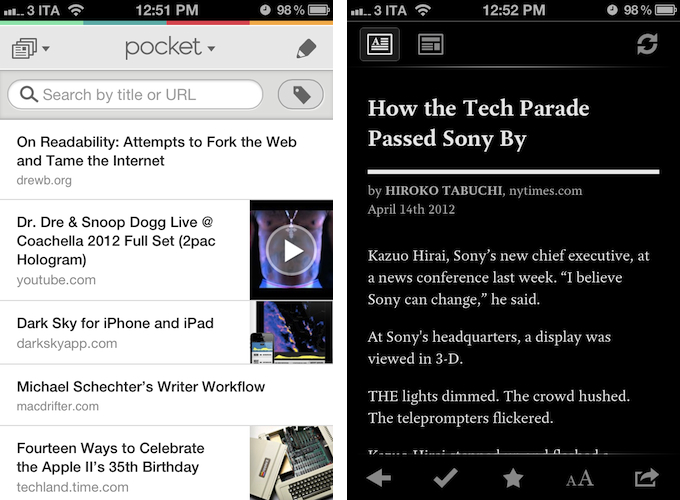
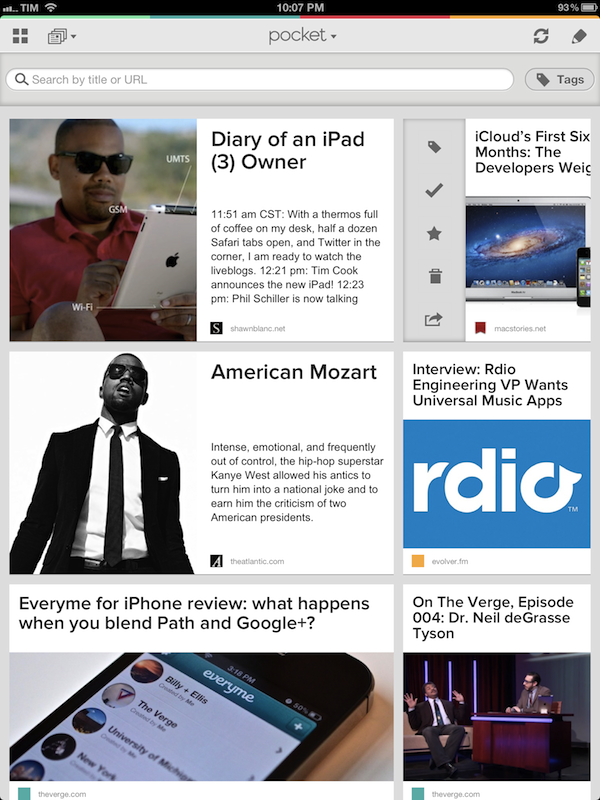
Image 1 / 2
A personal tool became a cross-device service
Nate Weiner began Read It Later in 2007 while working in web design. He was emailing himself links to programming tutorials and losing them in his inbox. In his investor's later interview, he described building a small Firefox extension and sharing it with friends. Wider attention followed a Lifehacker mention.[6]
Syncing and article-view capabilities followed, along with an iPhone app. The move from a local extension to a service required more than interface design. Weiner credited Matt Koidin with taking over server operations and improving redundancy after joining the team. They had previously worked together at Team Rankings, where Koidin handled back-end work.[1]
Read It Later became Pocket in April 2012 and made the main app free. The new presentation accommodated articles, videos, and other saved pages. The contemporary review described a product with 4.5 million users; that was a user-count claim, rather than a monthly-active measure.[7]
The rename reflected a broader job. A title focused on reading did not describe saving a video very well. The important continuity was the action: capture something that deserves attention, then make it easy to find when time becomes available.
Saving was useful because it crossed boundaries
Pocket separated the source of discovery from the place of consumption. People could save from a browser or another app, then read through a consistent interface. Weiner's 2012 interview put browser saves at about half the total and third-party apps at about 40%. Those were his contemporary estimates, not a measured attribution study.[1]
This distribution pattern made integrations part of the product. A save command inside another app reduced the work required to keep a reading list. Removing that connection would affect the habit even if the reading screen stayed identical.
Firefox added an integrated Pocket save feature in June 2015, before Mozilla bought the company. Weiner's accompanying essay argued that a reading list should work across publishers, operating systems, and devices. He reported that 70% of Pocket users saving from iOS also used non-Apple devices or browsers. This was a specific defense against browser-only reading lists, rather than proof that every user needed a separate service.[8][9]
A large save count still would not establish that people finished what they saved. The relevant mechanism was dependable return access. The reviewed sources do not provide a cohort-level link between integration use, reading completion, and subscription conversion.
The business model expanded beyond saving
Pocket introduced Premium in May 2014. Contemporary coverage priced it at roughly US$5 monthly or US$45 annually. Permanent copies, fuller search, and suggested tags made a growing library more useful. The free product remained available.[10]
This packaging charged for preserving and retrieving a collection. It also introduced a long-lived expectation: material saved today would remain available later. That expectation would become important when the service closed.
Weiner acknowledged a separate operating mistake in his acquisition-era interview. He had concentrated on building a product people loved and had not done enough to make the business sustainable. His account supports the lesson that product enthusiasm and business development need attention together. It does not establish the financial cause of a shutdown eight years later.[6]
By 2017, Pocket had raised US$14.5 million, according to TechCrunch.[11] Mozilla's subsequent sponsored-content work shows another commercial direction. In April 2018, Weiner described expanding sponsored stories in Firefox New Tab recommendations. Mozilla said personalization happened on the device and users could disable sponsored content.[2]
The two businesses depended on different behavior. Premium rewarded users who wanted a durable personal library. Recommendations and sponsored stories depended on attention to suggested material. They could share infrastructure and editorial judgment without having identical customers or measures of success.
Mozilla acquired capabilities and distribution
Mozilla's February 2017 announcement emphasized discovery, mobile reach, and access to high-quality web content. It described Pocket as a wholly owned subsidiary and linked the team to its broader Context Graph initiative. This was a strategic rationale stated by the buyer.[3]
The audited 2017 financial statements date the acquisition to February 24 and record US$25 million cash plus US$5 million in deferred payments. Their preliminary allocation shows a US$29.824 million purchase price. These accounting details should remain distinct from the public announcement on February 27.[12]
Weiner said Mozilla met his test for a partner that could help solve the problem at greater scale. That was an expectation at the time, not a guarantee that every Pocket product would survive indefinitely.[6]
In 2019, Mozilla moved Weiner into a broader New Markets leadership role. Koidin became Pocket's VP and general manager. The acquisition therefore had an operating sequel with continuing leadership and product work.[13]
The personal library closed; recommendations remained
Mozilla announced the closure in May 2025. It said browsing habits had changed and it would concentrate resources on Firefox. This supports an owner-priority explanation. It does not supply Pocket-level revenue, costs, or retention data that would prove an independent economics explanation.[4]
Kevin Rose publicly offered to take over Pocket.[14] The published offer does not establish a negotiated sale. Pocket's own current site confirms that the standalone product closed.[5]
The shutdown timetable distinguished the app from its remaining data access. The service ended on July 8, 2025; exports and API access ended on October 8. Mozilla said data would then be permanently deleted. Those deadlines have passed. A new product cannot promise recovery of server-held libraries that users failed to export.[4]
Mozilla retained the editorial recommendation capability in Firefox. The current farewell page describes a combination of machine selection and human editorial oversight. Ten Tabs also has a current Mozilla subscription page for curated articles. These continue discovery without restoring the old personal save-and-sync service.[5][15]
Public client code is another surviving artifact. The original Pocket organization's iOS repository remains available. Source availability does not restore the hosted account system, content library, or expired export window.[16]
The current market still serves the reading job
As checked on November 5, 2026, several alternatives address Pocket's original work. This is an established market with free and paid options.
| Product | Verified price | Relevant capabilities |
|---|---|---|
| Readwise Reader | US$7.99/month billed yearly for Reader only; US$9.99/month billed yearly for the full bundle | Articles, PDFs, EPUBs, feeds, newsletters, search, text-to-speech, and AI tools |
| Instapaper | Free basic plan; Premium US$5.99/month or US$59.99/year | Saved articles, permanent archive, fuller search, PDFs, and reading tools |
| Raindrop.io | Free basic plan; paid Pro available | Bookmarks, collections, sharing, export; Pro adds full-text search and web archives |
| wallabag | Open-source software; hosted wallabag.it costs €11/year | Full saved article text, offline reading, annotations, imports, and exports |
The prices and feature boundaries come from the current official pages. Reader's newer single-app plan matters: older descriptions that require buying the full Readwise bundle no longer describe its cheapest reader plan.[17][18][19][20][21]
Another general reader with summaries would face these existing features immediately. A narrower test is publisher-owned offline editions: a small magazine selects its own public articles and issues a checked EPUB that readers can keep. EpubPress and calibre already convert web material into ebooks, so conversion alone offers little distinction. The paid hypothesis concerns repeatable editorial preparation and delivery under the publisher's control.[22][23]
Timeline
- 2007: Weiner starts Read It Later as a Firefox extension.[6]
- 2012: Pocket replaces the Read It Later brand and makes the main app free.[7]
- 2014: Premium adds permanent copies and enhanced library tools.[10]
- 2015: Firefox integrates Pocket before the acquisition.[8]
- 2017: Mozilla acquires Read It Later, Inc.[12]
- 2018–2019: Sponsored recommendations expand; Pocket leadership changes.[2][13]
- 2025: The app closes in July; exports and API access end in October.[4]
Sources
- MacStories interview with Nate Weiner
- Weiner on sponsored Firefox content
- Mozilla's acquisition announcement
- Mozilla's closure announcement
- Pocket's current farewell page
- Foundation Capital interview with Weiner
- MacStories' April 2012 Pocket review
- Firefox's June 2015 integration announcement
- Weiner's save-button essay
- Contemporary Premium coverage
- TechCrunch's original acquisition report
- Mozilla's audited 2017 financial statements
- Mozilla's 2019 leadership announcement
- TechCrunch on Kevin Rose's public offer
- Mozilla's Ten Tabs page
- Original Pocket iOS repository
- Readwise's current pricing
- Instapaper's current plans
- Raindrop.io's current plans
- Hosted wallabag.it pricing
- wallabag source and project description
- EpubPress features and free model
- calibre's current manual