Overview
Quixey wanted people to find software by describing what they needed to do. Its later ambition went further: search inside apps and send users directly to a useful action. The problem was real, but indexing content did not guarantee access, distribution, or a profitable contract.[1][2]
The Mountain View company’s shutdown process became public in March 2017. Co-founder Liron Shapira later confirmed that the venture closed after years of financing and a difficult commercial relationship with Alibaba.[3][4]
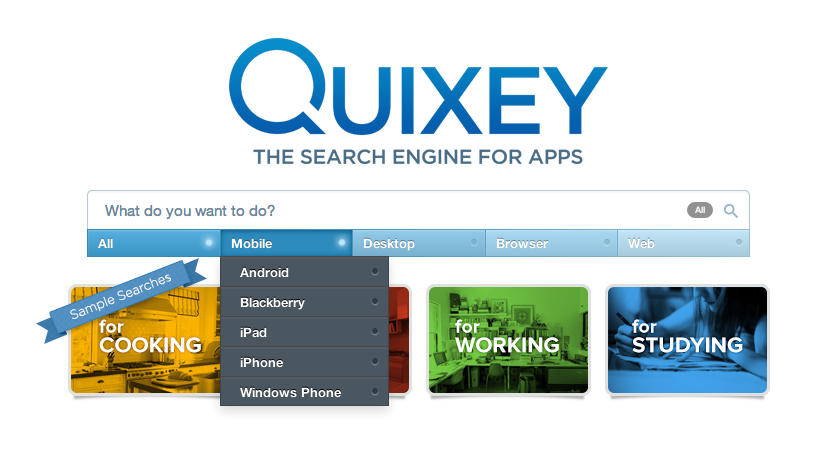
Image 1 / 1
Founding Story
Tomer Kagan and Liron Shapira founded Quixey in 2009, near the beginning of the smartphone app economy. Shapira’s retrospective describes their thesis as building search technology suited to finding the right app. The product had to connect a person’s need with software they might not already know by name.[3][4]
Shapira studied computer science and worked at Slide before Quixey.[4] The checked sources do not establish how the two founders first met.
The company called this “Functional Search.” Its 2013 announcement described partnerships with app stores, manufacturers, carriers, search engines, and web platforms. Distribution through other companies was part of the plan, alongside consumer discovery.[1]
Kagan described the technical burden candidly in a 2014 interview: “we did not anticipate the complexity.” A service spanning many independently built apps had to cope with structures and access paths it did not control.[2]
Timeline
- 2009: Quixey began developing its app-search business.[4]
- 2013: An Alibaba-led $50 million Series C brought announced cumulative financing to $74.2 million.[1]
- 2014–2015: Contemporary interviews described efforts to connect search results with content and actions inside apps.[2][7]
- 2016: Reporting described an Alibaba contract dispute and a $30 million borrowing announcement.[6]
- March 2017: Most staff had been laid off while strategic options were explored.[3]
- 2020: Shapira published a first-person account confirming closure and criticizing the venture’s economics.[4]
What They Built
Quixey extended discovery to actions inside apps. A deep link opens a specific in-app screen, such as a restaurant reservation.[7]
The 2014 product coverage described an Android app that combined discovery with broader phone search. It also described developer tools and partner relationships intended to make app content accessible. Availability varied with the apps and platforms involved.[2]
A search company could produce an attractive result while still depending on another developer to maintain its destination. That dependency made useful coverage harder to sustain than a demonstration of one successful query.
Market Position
Target Customers
Consumers wanted to complete tasks without knowing which app to open. Distribution partners wanted useful search within their stores or devices. Developers wanted discovery, and advertisers could pay for visibility through Quixey’s Sponsored Apps offering.[1]
Market Size
The number of smartphones or apps did not establish a paying market for an independent search layer. The relevant opportunity depended on reachable app content, partner distribution, and repeatable commercial terms. No verified market size or audited customer economics is established here.
Competition
WIRED placed Quixey alongside Google, Facebook, Twitter, and other startups. Coverage depended on developers making app content reachable.[7]
The underlying category continued. Branch now offers commercial linking products and a validator for expected link behavior. Android supplies native domain-verification tools. These existing options make a broad linking-platform rebuild a crowded starting point.[12][13][11]
Business Model
Alibaba was both a strategic investor and a customer. A Washington Post report, reproduced by NDTV in August 2016, described custom work for Alibaba’s YunOS and disagreement over delivery and payment. It attributed private contract details to people familiar with the matter; the account does not establish a court finding of breach.[6]
Shapira later asked, “what’s the revenue model?” and described the custom work for Alibaba. Concentrating funding and revenue in one partner made the company harder to redirect.[4]
Traction
Contemporary reporting confirmed a $60 million round in 2015.[9] The 2017 Business Journal introduction cited roughly $133 million in venture funding. Shapira’s later account gives a broader $170 million raised over seven years. The record also includes borrowing, so those figures should not be silently treated as equivalent equity totals.[3][4][6]
Outcome and evolution
Alibaba told Axios that Quixey’s board decided to end the business.[5] No exact legal dissolution date, final asset-sale proceeds, or verified current operating successor is established here.
Shapira subsequently built Relationship Hero. YC’s S17 interview discusses his Quixey recruiting experience, but the later company’s YC affiliation belongs to that separate venture.[8]
Link services also face continuing platform changes. Google’s current Firebase FAQ records an August 25, 2025 Dynamic Links sunset date and warns that affected links stop working. That is a specific product retirement, not the end of native app linking.[10]
Key Lessons
- Check access before promising coverage. An app-search service needs reliable destinations and maintained developer cooperation.
- Separate partner roles. Funding, customer revenue, and control rights can become concentrated in the same relationship.
- Prove repeatable economics. Financing and custom contracts can support activity before a durable product model exists.
- Test the destination. A successful redirect or search result does not establish that the intended in-app task works.
Sources
- Quixey: Original 2013 financing and product announcement
- Fast Company: Product report and Kagan interview, November 2014
- Silicon Valley Business Journal: Public shutdown introduction and founder caption
- Liron Shapira: First-person retrospective transcript, December 2020
- Axios: Alibaba’s closure statement, March 2017
- Washington Post via NDTV: Contract dispute reporting, August 2016
- WIRED: App actions and coverage limits, April 2015
- Y Combinator: Shapira’s separate S17 company interview
- TechCrunch: Confirmed 2015 round
- Firebase: Current Dynamic Links deprecation FAQ
- Android Developers: Current App Links verification guide
- Branch: Current Intro pricing and limits
- Branch: Link Validator scope and workflow