Overview
Red Hat built a business around making shared software dependable enough for enterprise use. Its founders combined a Linux distribution with catalog marketing, then developed subscriptions, support and partner certification. IBM completed its acquisition in July 2019. Red Hat continues to sell Red Hat Enterprise Linux (RHEL), application platforms and AI infrastructure in November 2026. [9] [20] [21] [22]
The useful founder lesson concerns what customers repeatedly paid to avoid. Downloading source code did not remove integration work, security maintenance or uncertainty over application support. Red Hat organized those recurring jobs into a product. Its later source-access changes also show the tension between funding that work and preserving community trust. [6] [12] [14]
Two founders joined product and distribution
Bob Young's account starts with ACC, a computer-products catalog business he formed in March 1993. He used Linux mailing lists to reach buyers but wanted a recognizable product brand that retailers could stock. When customers recommended Marc Ewing's distribution, Young ordered 300 copies. Ewing understood that as the entire initial run; Young thought it was roughly a three-month supply. They joined in January 1995. The 1993 founding date follows ACC's lineage; 1995 marks the combined Red Hat business. [1] [2]
Ewing also made fresh releases easier to download through FTP, avoiding the wait for new CDs. Direct delivery and retailer distribution could coexist. [1]
Red Hat distributed and contributed to software developed across many upstream projects. Packaging Linux did not give it ownership of that whole body of code. Young later emphasized the customer's control over software. In a 2005 interview, he described his next company, Lulu, choosing paid RHEL rather than Fedora because it reduced administration work. Even a founder committed to free software could value maintained releases more than avoiding a subscription. [3]
Enterprise promises changed the product
The March 2002 Advanced Server announcement named Oracle, VERITAS and twenty independent software vendors supporting its enterprise direction. Those commitments mattered because an operating system buyer also needed databases and applications to remain supported. A broader catalog of software increased the usefulness of a stable platform, while that platform gave vendors a target they could test. These were announced partner commitments, rather than proof that every application was already certified. [4]
The company separated release purposes. Fedora Core 1 debuted in November 2003 as a community release. RHEL served the longer enterprise maintenance cycle. That division allowed faster experimentation upstream without requiring every enterprise customer to accept the same pace of change. It also required Red Hat to maintain older versions and carry fixes forward. [5] [6]
Acquisitions and platform development expanded the supported stack. Red Hat completed the JBoss acquisition in June 2006, bringing enterprise middleware into its support and distribution operation. OpenShift Enterprise 3 arrived in June 2015 with Docker-format containers, Kubernetes, RHEL 7 and JBoss runtimes. Red Hat packaged components into an application platform while their upstream communities retained their own governance and development. [7] [8]
The distribution system included direct sales, equipment manufacturers, software vendors, distributors, integrators, resellers and cloud providers. These channels helped reach buyers already procuring hardware or applications elsewhere. They also reduced Red Hat's direct contact with some end customers. Its FY2019 filing identifies that tradeoff. [6]
Subscriptions funded work that copying could not finish
For the year ended February 28, 2019, Red Hat reported US$3,362.069 million in revenue. Subscription revenue was US$2,949.059 million, about 87.7% of the total. These are standalone annual figures before IBM's acquisition. Subscriptions included maintenance, security fixes, upgrades and access to a tested ecosystem, with revenue generally recognized over the service period. The model required continuing delivery after the initial software download. [6]
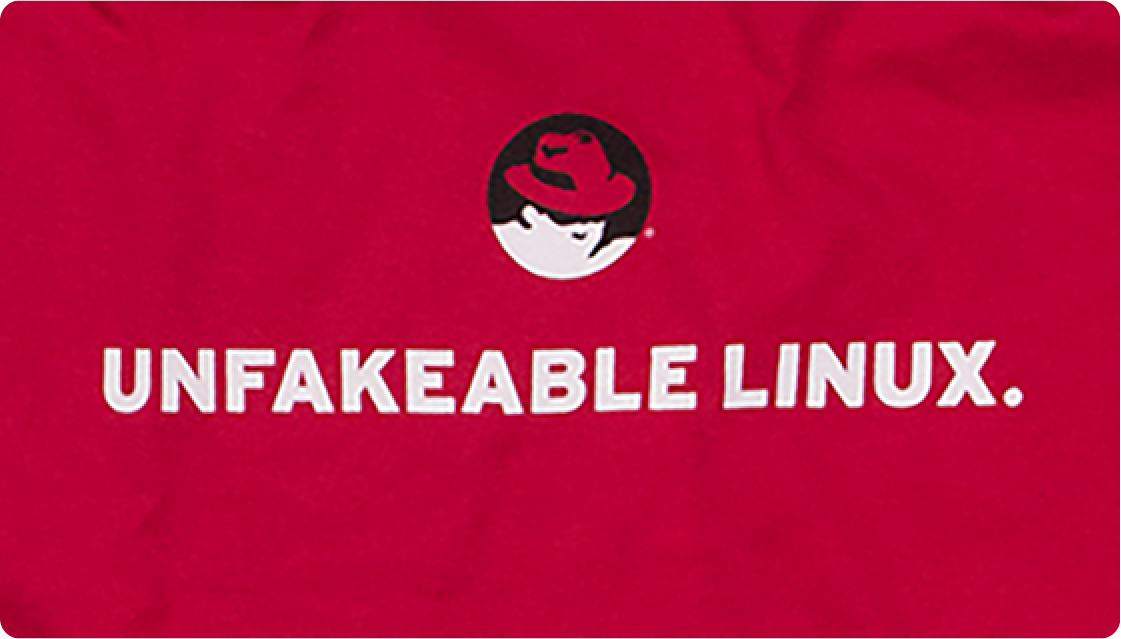
Competition could copy much of the software more easily than the support organization or partner relationships. Red Hat's own brand history records its 2006 response to Oracle's competing Linux offer: shirts reading “Unfakeable Linux.” The campaign asserted a difference between reproducing code and reproducing Red Hat's work and reputation. It documents the positioning, rather than establishing a measured customer preference. [2]
IBM closed the acquisition on July 9, 2019, paying US$190 per share in cash. The announcement put the equity value at approximately US$34 billion. IBM promised a distinct Red Hat unit and continued neutrality toward existing partners. This was a completed sale of an operating business with substantial subscription revenue. The price alone says nothing about the return IBM subsequently earned. [9]
Source access exposed a difficult boundary
In December 2020, Red Hat shifted the CentOS project's focus toward CentOS Stream, positioned upstream of RHEL, rather than the downstream CentOS Linux rebuild. CentOS Linux 8 ended updates on December 31, 2021. CentOS Linux 7 reached its end in June 2024. A user seeking a free downstream release therefore faced a different migration decision from someone wanting to participate in the next RHEL release. [10] [11]
In June 2023, Red Hat made CentOS Stream the sole public repository for RHEL-related source releases. Customers and partners could still obtain RHEL source through the Customer Portal. Red Hat argued that sustained upstream contributions and years of backported fixes needed commercial support. These changes concern access to its maintained release sources and subscription relationships; describing all of Linux as becoming proprietary would misstate them. [12] [13]
Software Freedom Conservancy's Bradley Kuhn criticized the interaction between subscription contracts and redistribution rights under the GNU General Public License. His argument was that a customer could retain license rights while risking the commercial relationship. That is an attributed legal analysis, not a court ruling. Charging for maintenance can support investment while contractual limits create distrust among users who value redistribution. [14]
The alternatives also changed. AlmaLinux now targets application binary interface compatibility with RHEL, rather than its former one-to-one rebuild goal. That means preserving interfaces used by compiled applications; it does not automatically reproduce every certification or support commitment. Rocky Linux describes its goal as bug-for-bug compatibility. Those are distinct project commitments, not interchangeable guarantees for every workload. [15] [16]
The current business and a bounded opportunity
Current RHEL product material identifies versions 10.2 and 9.8. OpenShift remains available in self-managed and managed cloud forms. Red Hat announced AI Enterprise in February 2026, combining RHEL and OpenShift with inference, tuning and agent workloads. Its July subscription guide distinguishes layered OpenShift AI licensing from AI Enterprise's accelerator inclusion rules. Buyers must compare deployment and subscription scope, rather than infer a complete platform cost from one capacity rate. [20] [21] [22] [23]
IBM's quarter ended September 30, 2026 shows US$2,086 million for its Hybrid Cloud line, described as Red Hat, within US$7,804 million of Software segment revenue. Hybrid Cloud grew 10.6% as reported and 11.1% after currency adjustment. These are IBM's quarterly reporting categories. They are not a fresh standalone Red Hat annual filing, and the whole Software segment must not be assigned to Red Hat. [24]
As checked on November 5, RHEL Server Standard's US store listing showed US$878.90 for one year with business-hours support. Ubuntu Pro listed US$500 per server annually with unlimited virtual machines; support tiers cost extra. AlmaLinux and Rocky offer free community distributions. SUSE Multi-Linux Support sells support for existing enterprise Linux estates, with a quote based on systems and support level. These offers differ in operating system, entitlements and support scope, so their prices are not equivalent service comparisons. [19] [17] [15] [16] [18]
OpenShift also competes with cloud-managed Kubernetes and other supported management platforms. Amazon EKS lists US$0.10 per cluster-hour for standard-version support, with worker resources charged separately. SUSE Rancher Prime adds supply-chain controls, longer support lifecycles and enterprise support to Rancher. Their scope differs from OpenShift’s integrated platform, so the EKS control-plane fee cannot be compared with a complete OpenShift deployment. [32] [33]
A new general Linux support supplier would need sustained maintenance capacity and credible compatibility relationships. A smaller experiment could serve independent backup or observability vendors that ship host-installed software. The proposed Install Bench would rerun installation, upgrade, reboot and removal checks on vendor-authorized RHEL and AlmaLinux virtual machines, then produce a reproducible release evidence bundle. This is an inference from the maintenance and certification workflow, not observed paid demand.
Existing products set a high bar. Red Hat already documents application certification, partner onboarding and lifecycle requirements. AlmaLinux offers free certification using vendor evidence and review. Testing Farm and tmt cover test execution and environments. Rocky announced Testrarc on November 4, 2026 to track distribution release validation. Install Bench would need to save repeated work for a particular software vendor beyond those tools. It could not confer official certification or redistribute customers' subscription images. A paid pilot should establish that distinction before a larger build. [25] [26] [27] [28] [29]
Timeline
- 1993: Young forms ACC, the commercial lineage used for Red Hat's founding date. [1]
- 1995: Young and Ewing combine distribution and engineering into Red Hat Software. [1] [2]
- 2002–2003: Advanced Server launches; Fedora Core 1 follows as a community release. [4] [5]
- 2006: Red Hat completes the JBoss purchase and responds to Oracle with its Unfakeable Linux campaign. [7] [2]
- 2015: OpenShift Enterprise 3 packages Kubernetes and container technology into an enterprise platform. [8]
- July 9, 2019: IBM completes the approximately US$34 billion equity-value acquisition. [9]
- 2020–2023: CentOS strategy and public RHEL source access change. [10] [12]
- 2026: Red Hat expands its AI platform; IBM continues reporting a growing Hybrid Cloud line. [22] [24]
Sources
- Bob Young on Red Hat origins
- Red Hat brand history
- Bob Young after Red Hat
- Advanced Server enterprise launch
- Fedora ten-year history
- Red Hat FY2019 annual filing
- JBoss acquisition completed
- OpenShift Enterprise3 launch
- IBM completed Red Hat acquisition
- CentOS Stream strategy
- CentOS Linux end of life
- 2023 source-access change
- Red Hat source-policy response
- Software Freedom Conservancy analysis
- AlmaLinux current FAQ
- Rocky Linux current offering
- Ubuntu Pro current pricing
- SUSE Multi-Linux Support FAQ
- RHEL Server store
- Current RHEL product
- Current OpenShift pricing and options
- Red Hat AI Enterprise launch
- Red Hat AI subscription guide
- IBM Q3 2026 filing
- 2026 Red Hat software certification
- AlmaLinux certification
- Testing Farm documentation
- tmt test-management guide
- Rocky Testrarc announcement
- GitHub Actions runner pricing
- Campaign intake TechCrunch
- Amazon EKS current scope and pricing
- SUSE Rancher Prime current scope