Overview
Rethink Robotics tried to make factory robots easier to teach and safer to work around. Its Baxter and Sawyer machines put that ambition into recognizable hardware. Yet a factory buys dependable output from a complete installation. The company’s closure shows how an appealing design can fall short when precision, accessories, support, and sales execution do not fit the buyer’s job. [1]
The original Boston business shut in October 2018. HAHN Group subsequently bought technology, patents, name rights, and software. Later products carried the brand, but an asset purchase does not establish uninterrupted ownership of the original legal entity. [3]
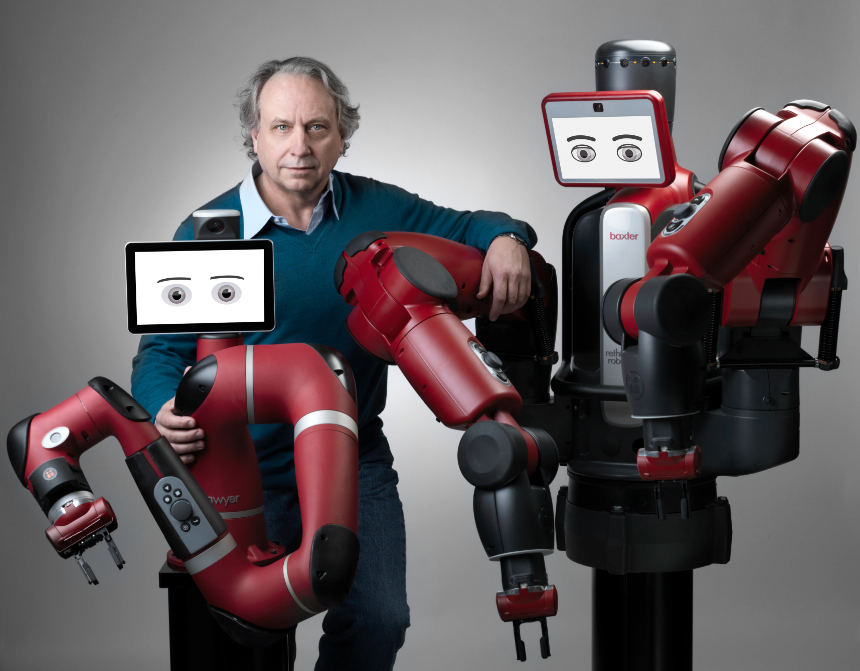
Image 1 / 1
Founding Story
Rodney Brooks and Ann Whittaker founded the company in 2008. Brooks brought experience from MIT and iRobot. The reviewed sources do not establish how the cofounders met or a complete account of Whittaker’s early operating role. Brooks’s public account does not establish Whittaker’s full contribution. [1]
Brooks linked his motivation to manufacturing labor shortages and the difficulty of adapting conventional robots. In a 2017 essay, he wrote, “Naturally I thought about whether robots could make up the shortfall.” His proposed response reduced separation between machines and workers and made teaching a task part of the interface. [5]
In a later account of programming languages, Brooks explained that Intera represented a robot’s program as a behavior tree. A person could demonstrate actions rather than write every instruction. He summarized the hardware’s commercial reach: “We built and shipped many thousands of robot arms to be used in factories.” That is a founder’s retrospective claim, without a verified annual shipment series. [4]
Rethink reduced programming effort, but a buyer still needed an economically useful installation. A successful demonstration of safe teaching could not establish that the robot would meet a particular production tolerance all shift.
Timeline
- 2008: The original company began, initially using the Heartland name. [5]
- 2012: Baxter introduced the two-arm approach; Sawyer followed in 2015. [6]
- July 2018: Rethink announced ten new distribution partners. [2]
- October 2018: The Boston company closed; HAHN announced its asset purchase on October 26. [6] [3]
- September 2024: Later brand-owner releases introduced Reacher arms and a Riser mobile-manipulator offering. [7] [8]
What They Built
Baxter used two arms and a screen face; Sawyer used a smaller, single-arm arrangement. A worker could move an arm to teach positions. Intera converted interactions into an executable task structure. The interface tried to make a robot more like an adaptable factory tool and less like a specialized programming project. [4]
Rethink also sold the surrounding system. Its 2018 release promoted Intera software and ClickSmart grippers and targeted plastics, packaging, metal fabrication, electronics, and automotive suppliers. These details matter because a bare arm cannot complete those jobs. It needs an end effector, work presentation, sensing, safe operating conditions, and service. [2]
ASME’s customer reporting identified specific friction. Rapid-Line described trouble with precision and troubleshooting. Cox Container needed a locally fabricated gripper and encountered a software-support problem, while still expressing satisfaction with Sawyer’s work. Those accounts resist a simple verdict that every installation failed. They instead show how application fit and support shaped the realized return. [1]
Market Position
Target Customers
Rethink addressed manufacturers that wanted flexible automation without a large programming burden. Its global distributor network was intended to provide local implementation support. New partners included Centro, Power Motion, Europneumaq, and Tongchan Machinery. The announcement establishes named relationships, but not orders fulfilled or revenue collected. [2]
Market Size
This research did not establish a reliable contemporary market estimate for Rethink’s reachable applications. Counting all industrial robots would blur the precision, speed, and payload constraints that determined where these machines could work.
Competition
Universal Robots offered a competing approach to collaborative factory work. IEEE reported that some distributors moved toward it and that Rethink’s sales fell short of goals. Competition therefore involved channel confidence and production suitability as well as an easy teaching interface. [6]
One counterargument is that Rethink anticipated a real market before buyers were ready. Research use and later brand activity show enduring technical interest. The customer accounts still document deployment problems that timing alone cannot explain.
A current buyer also faces a more developed alternative. Universal Robots introduced UR15 in May 2025. The historical product URL now redirects to its UR17g-1300 page, which lists specifications and asks buyers to request pricing. This does not supply an installed-cell price or remove the need for task-specific acceptance tests.[11][12]
Business Model
Rethink sold physical robots through a partner network, with software and accessories forming part of the offering. Public reporting puts total funding near $150 million. The reviewed record does not provide audited revenue, product gross margin, warranty costs, or distributor inventory exposure. No burn estimate is justified from the financing total alone. [6]
A plausible economic mechanism is that installation and support effort reduced the advantage of an accessible purchase price. That remains an inference. The available customer accounts explain why deployment labor matters but do not supply enough figures to calculate the company’s margins or each customer’s payback.
Outcome and evolution
Contemporaneous reporting describes missed sales goals and a planned sale that fell through before closure. HAHN’s later release identifies acquired patents, name rights, and INTERA5. It said it planned further development, support, and possible licensing. Those stated intentions do not prove the later execution of each plan. [6] [3]
ASME attributed the failed planned sale to investor John Maeder, who said a Chinese buyer feared potential US investment-review objections. That is his explanation, not evidence of a formal government prohibition.[1]
The 2024 releases document another commercial use of the brand: seven Reacher models and a Riser configuration combining an arm with a mobile base. These successor offerings should not be backdated into the original startup. A September 2025 robotics newsletter links a report of a further closure, but the original Robot Report article was inaccessible. This report preserves that later outcome as reported, with its exact corporate and asset disposition unresolved. [7] [8] [9]
As reviewed October 23, 2026, the historical domain could not be retrieved through this research tool. Its current ownership and support obligations were not established. Current parts availability, licenses, and support require separate checks before a buyer relies on an installed robot. [10]
Key Lessons
- Rethink’s teaching interface addressed real setup work, but the customer bought repeatable production. Validate the complete task before treating ease of demonstration as value.
- Rethink expanded named distributors shortly before closing. Partner announcements measure reach; cash collection and successful installations measure a different part of the business.
- HAHN preserved technology through an asset deal. Buyers still needed clarity about service, software rights, and parts after the original company stopped operating.
- Rethink’s successor product announcements show why a brand history needs separate entity records. The same name can span different products, owners, and outcomes.