Overview
Sendoid was a browser-based, peer-to-peer file transfer service built by Caffeinated Mind Inc., a San Francisco startup that emerged from Y Combinator's Winter 2011 batch. Founded by engineers John Egan and Zac Morris, the product routed encrypted data directly between sender and receiver machines — no central server — achieving transfer speeds roughly 50x faster than contemporary alternatives. By January 2012, the company had abandoned the consumer product and pivoted to Expresso, an enterprise-grade UDP-accelerated data transfer server targeting CAD firms, genome research labs, and big data analytics teams.
The company never validated a sustainable business model. The consumer product attracted only thousands of users after a year of operation, and Expresso never left private beta before the team was acqui-hired.
On February 29, 2012 — approximately one year after YC Demo Day — Facebook acquired the three-person team for an undisclosed sum, explicitly not acquiring the technology. Both Sendoid and Expresso were shut down within two weeks. The outcome was a talent exit: the founders went on to meaningful careers at Facebook and Uber, but investors received no disclosed return, and users lost access to a product they had come to rely on.

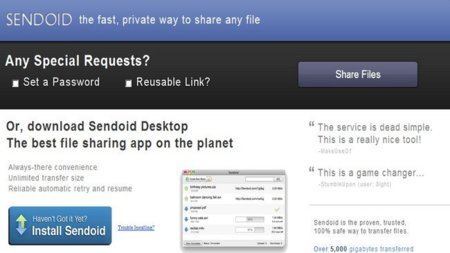
Image 1 / 2
Founding Story
John Egan and Zac Morris started building Sendoid in 2010, roughly a year before their YC Demo Day appearance in March 2011.[1] Both were engineers. Morris had previously worked at Apple, giving the team credibility in systems-level software development.[2]
The founding motivation was direct and personal. Egan and Morris were working on projects together while living on opposite coasts, and they needed to regularly move large, sensitive files — often exceeding 500MB — between each other.[3] The existing options were slow, required uploading to a third-party server (introducing privacy risk), or imposed file size caps that made them impractical for the team's actual workloads. The founders built the tool they needed, then asked whether others needed it too.
The company was incorporated as Caffeinated Mind Inc. and accepted into Y Combinator's Winter 2011 cohort — one of 43 companies in the batch.[4] YC provided early validation, network access, and the standard seed terms of the era. The team was small and engineering-heavy: three people total, with no identified business or sales co-founder.[5] The identity of the third team member has not been publicly disclosed.
At launch, the founding vision was explicitly consumer-first: a fast, private, browser-based file transfer tool that anyone could use without creating an account. The enterprise angle — film studios, pharmaceutical companies — was framed as a monetization layer on top of the free consumer product, not a separate product line.[6]
That framing would not survive the year. By January 2012, the team had concluded that the consumer product was not generating a viable path to revenue and pivoted entirely to Expresso, an enterprise big data transfer server. The pivot was a significant strategic reorientation — from a consumer tool with no login requirement to a B2B infrastructure product requiring enterprise sales cycles. Caffeinated Mind's own shutdown statement framed the journey as a coherent evolution: "When CMI first started, we wanted to change the way files moved online. That vision has evolved over the last year through our experience at YCombinator, where since launching Sendoid we've moved countless files for our users and then later went on to tackle big data transfer problems for enterprises with Expresso."[7]
Whether the pivot was a strategic insight or a response to failing consumer traction is not definitively answerable from the public record. The fact that the company was simultaneously seeking a new funding round for Expresso at the time of the pivot announcement suggests runway was a constraint.[8]
Timeline
-
2010 — John Egan and Zac Morris begin building Sendoid, motivated by their own need to transfer large files between opposite coasts.[1]
-
January 2011 — Caffeinated Mind Inc. is accepted into Y Combinator's Winter 2011 batch, one of 43 companies in the cohort.[4]
-
March 2011 — Caffeinated Mind launches Sendoid publicly. TechCrunch covers the launch, highlighting the 35-second 100MB transfer speed and the planned freemium enterprise business model.[6] The company is actively raising its first angel round and developing iOS and Android apps.
-
March 22, 2011 — YC W11 Demo Day. VentureBeat highlights Sendoid as one of five standout companies in the cohort, describing it as "Fast, private, massive file transfer via peer-to-peer in-browser and on the desktop."[9]
-
2011 (post-Demo Day) — Sendoid raises a seed round. Salesforce Ventures is listed as an investor. Amount undisclosed.[10]
-
January 20, 2012 — Caffeinated Mind pivots to Expresso, an enterprise UDP-accelerated data transfer server. Expresso launches in private beta, free of charge. The company states it is seeking a new funding round.[8]
-
February 29, 2012 — Facebook acqui-hires the three-person Caffeinated Mind team for an undisclosed amount. Facebook does not acquire the technology.[11]
-
March 1, 2012 — Caffeinated Mind publishes its shutdown statement, noting it has purged all user transfer history logs.[12]
-
March 7, 2012 — Sendoid web application shuts down.[13]
-
March 14, 2012 — Sendoid desktop application stops working. Expresso corporate pilot also shuttered.[13]
-
2016 — John Egan co-founds Workplace by Facebook, an enterprise collaboration suite.[14]
-
2019 — John Egan co-founds Kintaba, an incident management platform, after leaving Facebook.[15]
-
February 10, 2020 — TechCrunch covers Kintaba's $2.25M seed round led by FirstMark Capital.[15]
-
July 4, 2022 — YC W11 batchmate Michael Ma publishes a Medium retrospective describing Sendoid as "designed for large file transfers in the enterprise world" and noting it was "ultimately sold to Facebook."[16]
What They Built
The Core Product: Sendoid
Sendoid's technical premise was simple to explain and hard to replicate in 2011: when a user initiated a file transfer, the service opened a 128-bit AES encrypted pipe directly between the sender's machine and the recipient's machine.[17] No file ever touched a Caffeinated Mind server. This had two meaningful consequences: transfers were dramatically faster, and the privacy profile was fundamentally different from server-based competitors.
The speed advantage was not marginal. According to co-founder John Egan, Sendoid transferred a 100MB file in approximately 35 seconds — compared to 25 to 30 minutes on a server-based service.[18] That is roughly a 50x improvement, and it was demonstrable in a live demo — which likely explains why VentureBeat singled Sendoid out as one of five standout companies at YC W11 Demo Day.[9] A W11 batchmate later recalled: "the demo was great."[16]
The user experience was intentionally frictionless. No account creation was required. A sender visited the Sendoid website, selected a file, and received a link. The recipient opened the link, and the transfer began — directly, browser to browser.
There was one meaningful friction point in the browser experience: file size was capped at roughly 600MB to 1GB, depending on the user's system resources.[19] Files larger than that required downloading a desktop application, which had no size limit. For a product whose core use case was large file transfer, this was a significant UX break — the users most likely to need Sendoid were also the users most likely to hit the browser ceiling.
The technical implementation of the browser-based P2P pipe is not fully documented in the public record. WebRTC — the now-standard browser API for peer-to-peer communication — was not yet standardized in 2011, suggesting Sendoid likely relied on Flash or Java applets to establish the direct connection. This would have introduced its own compatibility and friction issues.
The Pivot: Expresso
By January 2012, Caffeinated Mind had abandoned the consumer product and launched Expresso in private beta.[8] Expresso was architecturally distinct from Sendoid: rather than a browser-based consumer tool, it was a server-side product that enterprises deployed themselves — in the cloud, on a server, or on a local workstation — using a single command.
The underlying transport mechanism shifted from TCP (standard internet protocol) to accelerated UDP (User Datagram Protocol). UDP sacrifices some reliability guarantees in exchange for speed, and Expresso's implementation was designed to saturate available bandwidth for large data transfers. Egan described the problem the product solved with characteristic directness: "The standard way to move a 100 GB file is to wrap it up in a box on a hard drive and put in overnight FedEx."[20]
Target verticals included engineering and architecture firms moving large CAD files, genome sequencing research institutions, and businesses running analytics on massive datasets.[21] Expresso leveraged open-source academic projects rather than inventing novel transport protocols from scratch.[22]
Expresso never left private beta. No paying customers were publicly disclosed before the Facebook acquisition ended the experiment.
Market Position
Target Customers
Sendoid's initial target was a broad consumer audience: anyone who needed to move large files quickly and privately. The product had particular appeal for creative professionals (video editors, photographers, architects) and technical users who understood the privacy implications of server-based alternatives. The planned enterprise upsell targeted film studios and pharmaceutical companies — verticals where file size and confidentiality both mattered.[6]
After the pivot, Expresso's target customer was explicitly enterprise: CAD and engineering firms, genome research institutions, and big data analytics teams.[21] These were organizations moving terabytes of data regularly, for whom the FedEx-a-hard-drive workaround was a genuine operational cost.
Market Size
The large file transfer market in 2011 was real but fragmented. Consumer file sharing was dominated by services like Dropbox (founded 2007), YouSendIt (founded 2004), and WeTransfer (founded 2009). The enterprise end of the market — high-speed transfer of multi-gigabyte and terabyte-scale files — was served by specialized tools like Aspera (founded 2004), which IBM would acquire in 2014 for a reported $1.4 billion. The existence of that acquisition validates the market Expresso was targeting, but it also illustrates the competitive challenge: Aspera had a seven-year head start and deep enterprise relationships by the time Expresso launched.
Competition
The competitive landscape Sendoid faced was structurally unfavorable on two dimensions: distribution and platform dependency.
Consumer file transfer: a feature, not a product. In the consumer segment, Sendoid competed against Dropbox, Google Drive (launched April 2012), and a range of file-sharing utilities. The core problem — moving large files between two people — was a feature that cloud storage incumbents could absorb natively. Dropbox's shared folder feature and Google Drive's file sharing addressed the same use case with the added benefit of persistent storage and an existing user base. Sendoid's P2P speed advantage was real, but it required both sender and recipient to be simultaneously online and using Sendoid — a coordination cost that server-based alternatives eliminated. The product was competing on a dimension (raw transfer speed) where most users were willing to accept a slower alternative in exchange for the convenience of asynchronous transfer.
Browser-based P2P: a platform timing problem. Sendoid's browser-based P2P architecture was technically ahead of the browser infrastructure available in 2011. Without WebRTC — which Google began developing in 2011 and which was not standardized until 2017 — browser-to-browser direct connections required plugins (Flash, Java) that introduced friction, security warnings, and compatibility issues. The product's core technical advantage was partially undermined by the platform it ran on.
Enterprise transfer: entrenched specialists with enterprise sales. In the enterprise segment, Expresso competed against Aspera, FileCatalyst, and other high-speed transfer tools that had years of enterprise relationships, compliance certifications, and dedicated sales organizations. A three-person team with a product in private beta and no disclosed revenue was not positioned to displace them. The enterprise sales cycle — procurement, security review, IT integration — was incompatible with Caffeinated Mind's runway and headcount.
The structural dynamic. Sendoid sat in an uncomfortable middle position: too niche to achieve the consumer scale that would justify a freemium model, and too early-stage to compete in enterprise sales. The pivot to Expresso was a recognition of this, but it moved the company into a market where the barriers to entry were higher, not lower.
Business Model
Sendoid's planned revenue model was freemium: free unlimited transfers for all users, with premium tiers offering additional security controls and auditing features for enterprise customers.[6] The company never disclosed revenue figures for either Sendoid or Expresso — the absence of any revenue disclosure is itself a signal that meaningful revenue was never generated.
Expresso was offered free during its private beta, meaning Caffeinated Mind had not begun charging for any product at the time of the Facebook acquisition.[8]
Inferred unit economics (labeled as estimates): Caffeinated Mind raised an undisclosed seed round from Salesforce Ventures.[10] For a three-person engineering team in San Francisco in 2011–2012, a reasonable inference is that total compensation and infrastructure costs ran $400,000–$600,000 per year. YC's standard seed investment at the time was $150,000 for 7% equity; any additional seed capital from Salesforce Ventures would have extended runway. The company operated for approximately 14 months between public launch (March 2011) and acquisition (February 2012), suggesting total cash deployed was likely in the $500,000–$800,000 range — consistent with a modest seed round. These are inferences, not disclosed figures.
The decision to seek a new funding round for Expresso in January 2012 — just six weeks before the Facebook acquisition — suggests the existing seed capital was nearly exhausted and the Expresso pivot required fresh capital to pursue enterprise sales. Whether that fundraise was failing (making the acqui-hire a preferred outcome) or simply in progress (making it an opportunistic exit) is not determinable from the public record.
Traction
Sendoid had "thousands of users" as of early 2012, per VentureBeat reporting at the time of the Expresso pivot announcement.[23] No more precise figure was disclosed. For a consumer product that had been publicly available for approximately ten months, "thousands" is a modest number — it suggests the product had genuine users but had not achieved the viral growth that would characterize a successful consumer file-sharing tool.
No traction data was disclosed for Expresso. The product launched in private beta in January 2012 and was shut down six weeks later. No paying customers, signed LOIs, or pilot metrics were made public.
The iOS and Android apps that were in development at the time of the March 2011 launch were never publicly confirmed as shipped. Their absence from the public record suggests they may not have been completed before the pivot or acquisition.
Post-Mortem
Primary Cause: A Consumer Product Without a Consumer Business Model
Sendoid's core failure was structural: the product solved a real problem for a narrow audience, but the freemium model required scale that the product's coordination requirements made difficult to achieve.
The fundamental constraint was simultaneity. Unlike Dropbox or WeTransfer — where a sender could upload a file and a recipient could download it hours later — Sendoid required both parties to be online at the same time for the P2P pipe to function. This was not a bug; it was an architectural consequence of the product's core privacy feature (no server intermediary). But it meant that Sendoid's user experience was meaningfully worse than server-based alternatives for the most common file-sharing scenario: "I'll send it now, you grab it when you have a chance."
The team's response was to develop a desktop app that could handle larger files and presumably manage the connection more robustly. But the desktop app introduced its own friction — a download step that interrupted the otherwise seamless browser experience. By January 2012, with "thousands" of users after ten months of operation, the team concluded the consumer model was not working and pivoted to Expresso.[23]
The attempted remedy — the Expresso pivot — addressed the monetization problem by targeting enterprise customers willing to pay for high-speed data transfer. But it did not address the team's structural disadvantage in enterprise sales.
Secondary Cause: Platform Timing and Browser Limitations
Sendoid's browser-based P2P architecture was technically impressive for 2011, but it was built on a browser platform that could not fully support it. WebRTC — the API that now enables browser-to-browser direct connections natively — was announced by Google in May 2011 and did not reach standardization until 2017.[16] In 2011, browser-based P2P required plugins (Flash or Java applets) that introduced security warnings, compatibility issues, and a degraded user experience — particularly for non-technical users.
The practical consequence was the 600MB–1GB browser ceiling: users who needed to transfer files larger than that were prompted to download a desktop app.[19] For a product whose core use case was large file transfer, this was a significant friction point at exactly the moment of highest user need. The team did not have a remedy for this that didn't require waiting for browser infrastructure to catch up — which it eventually did, but not in time to help Sendoid.
Tertiary Cause: The Enterprise Pivot Arrived Too Late and Without Sales Infrastructure
The Expresso pivot identified a genuinely large problem. As Egan described it: "The standard way to move a 100 GB file is to wrap it up in a box on a hard drive and put in overnight FedEx."[20] That problem was real, and the market that eventually solved it was substantial — IBM's 2014 acquisition of Aspera for a reported $1.4 billion validated the enterprise high-speed transfer category.
But Expresso launched in private beta in January 2012 with no disclosed customers, no sales team, and a stated need for a new funding round.[8] The enterprise sales cycle for infrastructure software — procurement review, security certification, IT integration, contract negotiation — typically runs three to twelve months. A three-person engineering team with six weeks of runway before an acqui-hire was not positioned to close enterprise deals.
The attempted remedy was to raise a new round to fund the Expresso go-to-market. That fundraise was either failing or had not yet closed when Facebook made its offer in late February 2012. Whether the acqui-hire was a preferred outcome or a fallback is not determinable from the public record — Egan's public statement framed it positively, but the timing (six weeks after announcing a fundraise) is consistent with a team that needed capital and found a different path.
Structural Factor: The Acqui-Hire as a Category Outcome
The Facebook acqui-hire was not an anomaly — it was a predictable outcome for a small, engineering-heavy team with a technically impressive but commercially unproven product in 2012. Facebook was scaling rapidly ahead of its May 2012 IPO and was actively acquiring engineering talent. The Caffeinated Mind team's expertise in P2P networking, encryption, and high-speed data transfer was directly applicable to Facebook's internal infrastructure needs.
The acqui-hire structure — people acquired, technology not — is the tell. Facebook did not want Sendoid's user base (thousands of users was not meaningful at Facebook scale) or Expresso's enterprise pipeline (which was empty). Facebook wanted the engineers. The team was assigned to build internal file-sharing tools for Facebook employees,[24] not a consumer or enterprise product — confirming that the acquisition was a talent transaction.
This outcome is structurally common for small YC companies with strong engineering talent and weak commercial traction. The acqui-hire market in 2011–2012 was active, and the price for a three-person engineering team was typically in the $1M–$3M range — enough to return capital to investors at a modest multiple on a small seed round, but not a venture-scale outcome.
What the Founders Did Next — and What It Implies
John Egan's post-Facebook career is instructive. He co-founded Workplace by Facebook in 2016 — an enterprise collaboration suite — and later co-founded Kintaba, an incident management platform that raised $2.25M from FirstMark Capital in 2020.[15] Both products are in the enterprise software category that Expresso was pointing toward. This trajectory suggests the Expresso pivot was directionally correct — the founders had genuine insight into enterprise infrastructure problems — but the company ran out of time and capital before it could be validated.
Zac Morris moved to Uber as a mobile security lead,[25] applying his engineering background in a different domain. The divergence in post-Facebook paths — one founder staying in enterprise software, one moving to security — is consistent with a team that was united by engineering skill but may not have had a shared long-term vision for the company.
Key Lessons
-
A technically superior product that requires simultaneous presence from both parties faces a structural adoption ceiling that speed alone cannot overcome. Sendoid's P2P architecture was genuinely faster than server-based alternatives, but it required sender and recipient to be online at the same time — a coordination cost that most users were unwilling to pay for a speed improvement they rarely needed. The product's privacy advantage (no server intermediary) was real but not valued enough by mainstream users to offset the convenience loss. Sendoid's "thousands of users" after ten months reflects this ceiling precisely.
-
Pivoting from consumer to enterprise requires more than a new product — it requires a new organizational capability. Caffeinated Mind's Expresso pivot identified a real enterprise problem (terabyte-scale data transfer) and built a technically credible solution. But the company had no sales team, no enterprise relationships, and no time to build them. Aspera — which IBM acquired for a reported $1.4 billion in 2014 — had been selling into the same verticals since 2004. The pivot was correct in direction but arrived without the go-to-market infrastructure that enterprise sales requires.
-
Announcing a fundraise and accepting an acqui-hire six weeks later is a signal about fundraise momentum. Caffeinated Mind publicly stated in January 2012 that it was seeking a new round for Expresso. The Facebook acquisition closed February 29, 2012 — six weeks later. The public record does not confirm whether the fundraise was failing, but the timeline is consistent with a team that found the acqui-hire more certain than the fundraise. Startups that announce fundraises and then exit quickly are often signaling that the fundraise was not going as planned.
-
Engineering-heavy founding teams without a commercial co-founder are structurally disadvantaged in freemium consumer markets. Sendoid's three-person team was entirely engineering-focused — no identified business development, sales, or growth co-founder. The freemium model requires active user acquisition, conversion optimization, and enterprise sales development. These are not engineering problems. The team's talent was ultimately more valuable to a platform incumbent (Facebook) than to the commercial development of their own product.
-
The acqui-hire outcome for Sendoid validated the team's talent but not the product thesis. Facebook acquired the people and shut down the technology — the clearest possible signal that the value was in the engineers, not the product. John Egan's subsequent co-founding of Workplace by Facebook and Kintaba suggests the Expresso insight (enterprise data infrastructure) was directionally correct. The lesson is not that the idea was wrong, but that a three-person team with a modest seed round and no enterprise sales infrastructure was not the right vehicle to pursue it.
Sources
- TechCrunch: "Sendoid: Finally, Sharing Big Files Isn't A Huge Pain" (March 21, 2011)
- YCombinator Company Directory: Sendoid
- VentureBeat: "Facebook acquires Caffeinated Mind, maker of Sendoid" (February 29, 2012)
- VentureBeat: "Expresso: Caffeinated Mind's enterprise pivot" (January 20, 2012)
- VentureBeat: "Y Combinator Winter 2011 Demo Day" (March 22, 2011)
- Crunchbase: Sendoid / Caffeinated Mind
- WebProNews: "File Sharing Company Caffeinated Mind Acquired By Facebook" (March 1, 2012)
- Computerworld: "Facebook acquires staff behind file transfer startup" (March 1, 2012)
- TechCrunch: "Kintaba raises $2.25M for incident management" (February 10, 2020)
- Medium: "Whatever happened to the class of W11 YC?" — Michael Ma (July 4, 2022)
- Crunchbase: John Egan
- YCDB: Sendoid
- PitchBook: Caffeinated Mind
- Slashdot: "Facebook Workplace Co-Founder Launches Downtime Fire Alarm Kintaba" (February 10, 2020)