Overview
Shyp removed several chores from sending a parcel. A customer photographed an unpackaged item, requested collection, and left packing and carrier selection to the service. The original San Francisco venture began in 2013 and ended operations on March 27, 2018. Its chief executive, Kevin Gibbon, said an eventual focus on business customers arrived too late.[1][2]
The case turns on purchase frequency. A service can produce an excellent occasional experience while requiring a much steadier flow of work to support its staff and facilities. Shyp expanded before resolving that mismatch.
Founding Story
Kevin Gibbon, Joshua Scott, and Jack Smith founded Shyp. An early investor, Tim Ferriss, identified the three in his September 2013 investment announcement. Contemporary reporting also names Smith as a co-founder. Gibbon's experience selling on eBay supplied the original problem: sending sold goods involved too many separate tasks.[2][7][4]
The starting proposition made those tasks nearly disappear for the customer. Ferriss described an iPhone application, a driver collecting unpackaged items, and selection among national carriers. He argued that frequent use and carrier discounts could support the model. Those were investment expectations, which his own disclaimer identified as speculative.[2]
There is a dating distinction. Public investor and service evidence exists in 2013, while Gibbon's closure essay calls 2014 the launch year. The record supports a 2013 company beginning without assigning an exact incorporation date or treating every early trial as the broad public launch.[1][2]
Timeline
- September 2013: Investors publicly described the team and collection-and-packing service.[2]
- April 2015: Shyp confirmed a $50 million Series B led by Kleiner Perkins.[6]
- 2015: Homebrew described service in San Francisco, New York, and Miami, with Los Angeles expansion planned.[3]
- 2016: eBay expanded its Shyp integration to Los Angeles after pilots in three other cities.[4]
- Summer 2017: Shyp restricted operations to San Francisco and business customers.[1]
- March 27, 2018: The original company stopped operating immediately.[1]
- 2019: A third party bought Shyp's brand and domain; Gibbon said he was unaffiliated.[8]
What They Built
The customer interface concealed a substantial physical operation. Couriers collected goods, warehouse employees packed them, and established carriers performed delivery. Shyp developed logistics software and used equipment that cut boxes to fit items. Fast Company's reporter, who had used the service, praised its packaging and customer experience.[5]
The business version added shipment management and commerce integrations. eBay's announcement describes a feed of sold items, pickup requests, carrier comparison, buyer notifications, and tracking. Its pilot claimed a 53 percent repeat-use rate and a customer recommendation score of 94. The announcement gives no cohort duration or full cost record, so these measures establish reported customer response rather than durable profitability.[4]
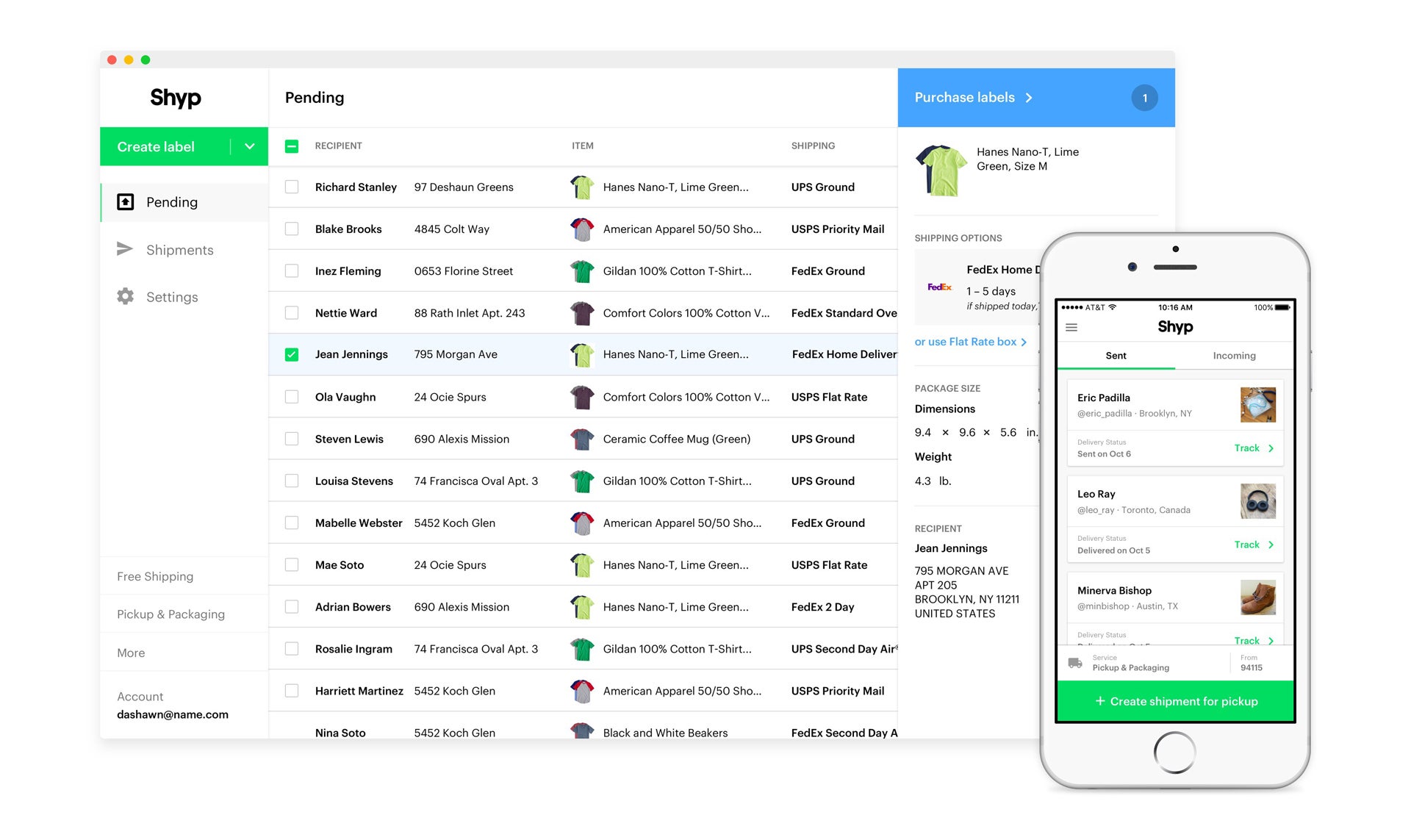
Image 1 / 1
Market Position
Target Customers
The initial service addressed people who disliked occasional shipping chores. Online sellers offered a more repeated task. Those groups could both appreciate convenience while generating very different work patterns and revenue. A customer who sends one gift cannot support the same operating schedule as a seller preparing orders each weekday.
Market Size
The reviewed evidence does not establish a reliable addressable market for Shyp's exact service. National parcel volume would include shipments that needed no pickup or packing help. The relevant opportunity depended on customers willing to pay for those tasks inside an economical collection area.
Competition
Customers could pack goods themselves, use carrier counters, or purchase help from existing packing shops. Business sellers also had software alternatives. Fast Company identified Shippo and ShipBob among companies serving the broader business-shipping need.[5]
Homebrew's expansion announcement shows why Shyp attracted attention: one request replaced preparation and a trip to a shipping counter. That benefit was easy to demonstrate. Its economic value still varied with item complexity, travel, and repeat frequency.[3]
Business Model
Early promotional material offered retail-level shipping prices plus a $5 collection fee for a single item, with that fee waived for multiple items. The investor thesis relied on purchasing carrier services below the price charged to customers. This spread had to cover collection and packing as well as central overhead.[2]
Shyp later separated packaging charges and adjusted its business offering. Fast Company reports that packaging could range from $3 to $75, depending on the item. A flat pickup fee could conceal very different handling costs for shoes and a large fragile object.[5]
Employment also affected the service design. Gibbon told Time that using employees allowed more control over accepting jobs and service quality. That account describes an operating trade-off; it does not prove that employee classification caused the closure.[11]
Outcome and evolution
Gibbon's explanation centers on delayed focus. Reflecting on warnings about consumer frequency, he wrote, “I didn’t listen.” He said earlier mistakes left “too little runway and insufficient resources” after the business shift. He claimed approximate San Francisco break-even by December 2017. These are founder claims, without audited accounts in this review.[1]
A stronger business segment does not by itself establish a viable standalone company. It must cover all continuing costs and attract enough recurring demand. The alternative explanation—that more financing could have completed the transition—remains possible. The evidence does not establish how much additional money or time would have made that outcome likely.
The later brand transaction concerns separate ownership. This review did not verify a current operating service on the historical domain, which timed out. It also did not establish the original company's final legal dissolution or investor recovery. The original March 2018 shutdown remains distinct from later use of the name.
Key Lessons
- Measure repeat demand before extending the operating network.
- Price collection, packaging, and postage with their different costs visible.
- End an unprofitable activity when changing focus; small residual teams still consume resources.
- Treat founder-reported improvement as a lead for verification, rather than a complete financial record.
Sources
- Founder shutdown account
- Investor Tim Ferriss original investment thesis
- Homebrew financing and expansion account
- eBay partnership and pilot results
- Fast Company founder interview and product examination
- Confirmed Series B announcement
- Contemporary founder and seed report
- Later brand and domain transaction
- Courier employment and quality-control account